I’ve been wanting to watch the opening scenes of Spielberg’s War of the Worlds (2005) again, and last night I finally did, intending to watch till the end of the scene where the first tripod emerges from the earth.
And watched the entire movie again.
Here are a few errant thoughts on the movie, which I apparently never got to reviewing here. There are some spoilers, in case you haven’t seen the movie, read the book or heard anything about the story that is now over 125 years old:
The scene mentioned above, where the first tripod emerges through the blacktop of an intersection of Cruise’s character’s neighbourhood, is classic Spielberg, but infused with a kind of jumpy camera that underscores the chaos and uncertainty of what’s happening. Everything is revealed in bits, through snatches of dialog to the initially small hole forming cracks that become fissures, ultimately leading to a hole that swallows cars. The camera assumes a low perspective when the top of the tripod emerges, disguising its ultimate size. People back away, but only a little, snapping photos with pocket cameras (I suspect the one change today would be copious shots of people shooting video on smartphones, which were nascent in 2005).
The sound design of the tripods is great. The horns cry out like something almost alive, while the weapons operate almost silently, vaporizing people and knocking vehicles aside in ways that show just how much force the beams impart.
The entire film has a desaturated look, right from the beginning. Everything looks grimy, earthy. Nothing is beautiful, before or after the invasion.
This is definitely a horror film, not a science fiction one. Spielberg layers on both set pieces and startling imagery to illustrate the devastation, everything from clothing of vaporized people falling from the sky like snow, to a passenger train blasting through a road crossing, all of its windows belching flames.
Tom Cruise is very good at playing a lousy father.
On the rewatch, I didn’t find Dakota Fanning’s character as annoying. There are several times when her character loses it and starts screaming, and it just feels so horribly real. Spielberg’s always been great working with kids.
Some of the CGI–notably the gulls flying away near the start of the ferry scene–is distractingly bad. Kind of weird. Most everything else looks great, though, and there’s a grounded sense of physicality to most of the effects work.
When Cruise’s character encounters a news team, the reporter quaintly loads VHS tapes to show him what’s been happening.
Tim Robbins is very creepy.
Justin Chatwin portrays teen son Robbie and conveys his rage and contempt for his father through these devastating, wordless looks. I love it. Also, the actor was 22 at the time and was born in Nanaimo.
Do people come together or break into factions when things get really bad? Spielberg’s answer seems to be, “Yes!”
The bait and switch on Robbie’s fate is still very ham-handed. There’s a gigantic, expanding explosion and fireball meant to tell you in no uncertain terms that ROBBIE IS DEAD. Except he’s not, he’s fine.
Overall, it’s hard to call the movie “fun” but it is an exhilarating experience that offers its own take on a classic story. Spielberg is great at generating and maintaining tension and it works, at times brilliantly, here.
The premise of this novel is simple: The parents of a squabbling adult sister and brother die in a car accident, and the sister, Louise, flies out to their parents’ town, to meet with her obnoxious younger brother, Mark, in order to inspect and prepare their parents’ house for sale.
The house turns out to be full of creepy-ass puppets made by their mother throughout her life. And is also haunted, possibly by all of those puppets…or something else.
The Goyner family has skeletons not only in the closet, but also every other room in the house, not to mention the attic, which Louise and Mark find has been boarded shut for reasons that become horrifyingly clear later
Grady Hendrix applies his usual combo of wit, horror and gory action here as he puts the characters through the dual wringers of dealing with a dark and unresolved past, and a bunch of seemingly murderous puppets, particularly one named Pupkin, who has a very possessive effect on anyone who chooses to don said puppet on their hand.
Hendrix lays on the puppet abuse pretty thick at times, almost but not quite taking me to the point of, “Oh, come on” but in the end, this is a rollicking adventure that makes puppets seem even creepier than dolls. Don’t worry, there are creepy dolls, too.
Recommended for old school horror fans, especially those who like a bit of droll wit to leaven the carnage (even if the carnage is mostly puppets being shredded and ripped apart. Mostly.)
This is the latest in the ongoing series of books Strieber started (in)famously with Communion in 1987 and it is, perhaps, the strangest.
The book is divided into two halves, the first is largely based on a series of posts on reddit describing the physiology of the visitors based on an alleged eyewitness report. Strieber expands on these entries with his own experience to extrapolate on various aspects of the visitor’s anatomy, abilities and so on. The entire set of reddit posts is also included in an appendix.
Drawing on what he and others have seen, Strieber speculates on how the visitors can perform seemingly impossible things, like levitation, telepathy and ignoring physics and gravity. He further goes on to explain the visitors may be “out of time” and that they are here to both observe and perhaps join with us, because we are still trapped in a mode where time is linear. A major part of the thesis Strieber elaborates on is how the visitors have evolved to a point where they exist outside conventional time in such a way that they essentially know everything that has happened or will happen–basically, a life where there are no surprises.
If that sounds like a bit of a bummer, Strieber agrees. He seems to feel the visitors are perhaps even envious of us and our more primitive minds and bodies, where life happens and we don’t always know what’s coming.
Strieber also brings up two ongoing threats to humanity–the crisis of climate change, and the still-possible risk of nuclear war, and edges closer to thinking the visitors will intervene in some way if things get too dire for us (this seems especially timely for 2025, given what a dumpster fire the year is already becoming for the world).
The second half of the book is full of weird speculation about…us! Specifically, Strieber tries to draw examples from both ancient and more recent history to put forward the idea that humans had many of the same abilities of the visitors, like levitation and telepathy, but lost the abilities thanks to global cataclysms thousands of years ago (ice ages, along with other calamities, like fires that consumed large swathes of North America, and more) that forced people to prioritize survival over establishing cities and civilization. This shift to basic survival led to a kind of mass amnesia where these abilities were forgotten. He suggests it is possible for us to re-learn these abilities, and may indeed need to if we are to integrate the visitors into our lives without feeling inferior to them (to help with that, Strieber also suggests they are not necessarily all that much more intelligent than we are, which feels a bit like a burn on them).
The evidence presented throughout is circumstantial, though to his credit, Strieber does provide numerous examples of megalithic structures built to a scale and level of precision that would challenge us even with modern technology. For example, Ggantija on the island of Malta, has stones up to 5 meters high and weighing up to 50 tonnes–with no obvious means of how they would have been transported to the site. Strieber suggests it was, quite literally, levitation, which would have been a common ability of people at the time.
I’ve always approached Strieber’s books as being sincere–I don’t think he’s pulling some long con on readers–and that he truly believes everything he writes about. His tone in The Fourth Mind remains calm and sober as he discusses things that are pretty wacky, really. In trying to piece together a “grand vision” for both the visitors and humanity, it feels like he is making greater leaps than before. It’s all certainly food for thought if you have an open mind, and Strieber’s smooth, articulate writing makes reading such speculation effortless.
If you’ve enjoyed his other books, you will likely find this shorter entry worthy of your time as well. If you are disinclined to believe any of this stuff, there’s nothing in this book that will win you over.
I’m going to keep this brief, and I didn’t rate the book on Goodreads because I don’t want to harsh the author’s mellow there. I am going to harsh it here, though.
It took me a long time to finish this book because a lot of it is dull. Nothing much happens, and while I’m perfectly fine with a story trundling along on mood and atmosphere, here it just never amounts to much.
Reggie Valentine is a gay and apparently sex-crazed 19-year-old Black guy who, messing around with an old stone gate with a friend, suddenly finds himself thrust back in time to 1959. There he meets Daniel Parker, a straight-laced young man deep in the closet, as was the style at the time. They fall in love, have the requisite explicit sex that is mandatory in any romance novel, and the story just putters along, with the realities of 1959 kind of pushed off to the side. About three-quarters into the story, there is finally An Incident™ in the form of a police raid on a secret dance club for queer folk. Reggie gets roughed up and spends a week in jail. Daniel, being the son of a well-connected white doctor, escapes unscathed. This is enough to convince Reggie to try the gate again, with the plan being for him and Daniel to both return to the present (2022, in this case).
NOTE: The “science fiction” part of the story is completely nonsensical, and don’t even try to figure out the time travel/possible timeline stuff.
The story seems to end tragically (spoilers ahead) when Reggie makes it through, but Daniel doesn’t. Reggie reunites with the now 80-something Daniel and the story ends with him somehow convincing Daniel to rekindle their relationship, despite being literally four decades apart in age. We are spared further explicit sex scenes between a 20 and 80-year-old man. I found this kind of gross, especially since Reggie comes across throughout as kind of a creep obsessed with sex. He even tries to convince Old Daniel to get it on by pointing out he won’t be around much longer, anyway. I know it’s supposed to be “true love” but it comes across completely differently to me. Reggie feels more like a Character in a Novel than a believable person, and he’s often unlikeable, despite the author clearly not trying to make him this way.
I kind of regret slogging through this story just to get a weird, gross ending. But I think it cured me of seeking out further gay romance stories, at least ones involving time travel, so there is that.
Yes, I know, an actual review of an actual book I read. I started reading it on January 19, so it took almost a year to complete (according to my Kobo it was 6.8 hours of reading).
It took me a long time to get through this relatively short novel, but that was entirely on me. My attention span has been depleted this year–and I don’t even go to TikTok!
That said, this is a weird story that combines alien hive minds with an alternate history version of 20th century and early 21st century Earth, in which a hypercolony of aliens in orbit have been intercepting and subtly modifying communications to prevent wide-scale conflict, so there is no World War II, relative peace has lasted a hundred years and people’s lives are relatively safe and secure, even if some technologies, like satellites and the internet have never been developed.
But with humanity’s worst impulses suppressed, a secret group called the Correspondence Society has been investigating and identifying what is really going on. From there, the story launches into following an extended family as they get involved in a gambit to break humanity free of the hivemind, regardless of the possible fallout. Wilson intermingles science fiction and horror here, with a strong “Invasion of the Body Snatchers” vibe (a good thing). The characters are complex and not always what they seem–a recurring motif.
That said, there is something so weird about the plot that it was ultimately hard for me to embrace–and I don’t necessarily see that as a negative. Wilson paints an alternate history that is peaceful, but filled with subtle repression, and seems to ask if that’s good enough for most people.
If you like Wilson’s work, you’ll likely enjoy Burning Paradise. Readers new to him may want to be prepared for a story that is at turns bloody, philosophical, and just generally a downer.
I reviewed the book (published in 2015) this movie is based on back in 2018, which feels like another lifetime ago. I found the characters smart, likeable, and far more quippy and quick-witted than I could ever manage, and the story an entertaining slice of teen life, with complications.
All of this holds true for the movie version, which came out the same year as the book. I caught it on Disney+ and have watched it three times now, most recently just yesterday, because watching this movie is like hugging the world’s softest, friendliest puppy.
I never reviewed it, because I am very lazy when it comes to movie reviews.
But I’m reviewing it now, because it’s fresh in my mind, and it is very faithful to the book, right down to the characters all being adorable, yet believable.
The only significant change from the book that I noticed (it’s been six years, there are probably more) is the musical in the story they perform at Creekside High is Cabaret instead of Oliver!, perhaps because Cabaret better known and offers more sizzle for the rehearsal scenes.
Seeing, rather than reading, about Simon’s teen life, underscores how on the surface everything is great–his family is well-off, they all love and support each other and Simon even admits his family would likely be fine with him announcing he’s gay. So unlike coming out stories from three or four decades ago, this one is less about being accepted as gay (although there is a smidgen of that) and more about keeping secrets, finding your identity, first love, and the value of friendship. All things that are perfect grist for the teen angst mill. Yes, that’s what I said: the teen angst mill.
The movie never wanders far off from its lighter touch, but when the bottom falls out on everything for Simon before the final act, you can’t help but feel bad for the guy and the foolish decisions he’s made.
Another thing I like is the cringy way they show teens acting. I remember high school. I was a cringy teen. The music is different now, but those vibes are eternal.
One of my favourite bits (and spoiled in previews) is very early on, where Simon is sitting in his car in the driveway and watches a very hunky gardener across the street with a weed whacker. He calls out to him about how he likes his boots, then instantly realizes how dumb that sounds. It’s delightful.
The whole film is delightful. I’ll probably watch it again someday. Yes, it’s aimed at high school teens, but it’s just so warm and fuzzy–and witty–that I can’t help but be drawn in. Maybe part of it is nostalgia. For all the changes in the last 40 years, this movie still captures the high school experience in ways that I can recall vividly.
Highly recommended, especially if you just want to watch good people go through some ups and downs, then triumph in the end.
Random trivia: Strange as it may seem, this was the first major studio film to feature a gay teen romance. 2018!
When I buy breakfast cereal, I have a few criteria:
Is it on sale?
Is it yummy?
Is it too yummy?
I tend to alternate between low and not-quite-as-low in sugar cereals. I never go for totally gross cereals that have “sugar” in the actual name. Surprisingly (or maybe not), a lot of supposedly adult cereals have as much, if not more, sugar than the crap we ate as kids (if you are currently a kid, please change this to the present tense). These usually have “crunch” or “oats” in the name.
Some low sugar cereals I like:
Original Cheerios
Crispix
Grape Nuts (sadly, no longer on sale in Canada)
Some quite-not-as-low:
Multigrain Cheerios
Corn Squares
Reese Puffs
Today, I noticed a new variety of Cheerios–and on sale! I should note that “a new variety of Cheerios” is utterly unremarkable, because General Mills seems to be experimenting with weird new flavours on a nearly-daily basis.
Today, I beheld this:
My first thought–as yours might be–was: I’m pretty sure neither apples nor strawberries are vegetables. But then the smaller print explains “naturally flavoured with sweet potato, carrot and spinach.” OK, that makes more sense1But not entire sense. Shouldn’t they be flavoured with apple and strawberry?.
When I got home, my manly hands applied too much brute force to the bag and tore a huge rip in the side, so I immediately had to transfer the contents to an airtight container. But as I did, I noticed that this was possibly the most aromatic cereal my nose has ever encountered. It smelled pretty! Would it also taste pretty?
Well, kind of. Despite being not super-high in sugar (11 grams), it tasted quite sweet. I found it a bit too sweet, really, and I say this as someone who will scarf an entire box of chocolate chip cookies if given the opportunity. It wasn’t terrible or anything, just a bit too much for my preference. I’ll finish the box (er, airtight container), then note that is an interesting taste experiment. If I want sweeter Cheerios, I’ll probably stick to my occasional indulgence of Chocolate Cheerios.
It also struck me later that this is basically an adult version of Froot Loops.
Next up: Revisiting Cap’n Crunch. Just kidding, I respect my mouth more than that.
Billy Joel is 74 years old as I write this, and still actively touring and playing shows. His last album, River of Dreams, came out in 1993.
Since then, he has written two singles, the last one 17 years ago1These were both oddballs, as they weren’t “classic” Joel songs he would have put onto one of his albums, so you could make the argument they don’t officially count. Earlier this month, he released a new single and, unlike the other two, this one could easily be slotted in with the tracks from either of his last two albums. It’s called “Turn the Lights Back On.”
Part 1: The Official Music Video and Single
A lyric version of the video was initially released, but now there’s another official version. It depicts a younger Joel performing the song in an empty venue before coming back and closing with Joel as he is today. The visual effects are decent, but not entirely convincing, so I found it vaguely creepy.
Alternate universe Billy Joel sings Billy Joel.
As for the actual song, it’s…fine? It reminds me of “Two Thousand Years” from River of Dreams, in tone, style and structure. I’d rank it is a solid effort, short of his classics, but far above his worst stuff. Pretty decent for someone who hasn’t exactly been cranking out new tunes for the last 30 years.
Part 2: The Live Version at the 2024 Grammys
The song was debuted at the 2024 Grammy Awards, with Joel accompanied by a full orchestra.
This universe’s Billy Joel playing the song at the Grammys.
Before seeing this, I’d read some wag online describing the performance as “lacking energy”, an assessment I don’t agree with.
First, it’s a slow, ballad-style song. He’s not going to be dancing on top of the piano.
Second, listen to his voice. He knows where to put the emphasis on the words, he knows how to draw out the emotion. This is a very Billy Joel song, and Billy Joel knows how to sing Billy Joel songs better than anyone.
His reaction at the end is cute, too. He takes off the cool shades and looks around, as if he just played his first audition at the age of 18. The crowd approved.
Keep in mind what I said above regarding emotion.
Part 3: The State of Pop Music Today and How Billy Joel is not Immune
We conclude with a third video from the Wings of Pegasus YouTube channel. This video is nearly 30 minutes long, so I don’t expect you to watch the whole thing (though that near-30 minutes went by fairly quickly for me).
I can’t decide if waking up with Fil’s hair would be the ultimate dream or nightmare.
This is an analysis of the two versions of the song. Fil often looks at the modern-day scourge of pitch correction software, and how it’s used to weld a singer’s voice to a specific upper range. The result inevitably scrubs a lot of tone and emotion from the voice. Remember above how I said Billy Joel really brings out the emotion of the song in the Grammy version?
The analysis video reveals that the official single uses pitch correction to essentially steamroll out everything that makes Joel’s voice and singing style uniquely his. It’s breathtaking, in a way, how something so simple–modulating the voice just a bit–can have such a profound effect on how a song hits you.
I wonder if Joel knows the single is pitch-controlled? The live version sounds great–yes, he sounds older, but you’re allowed to sound older when you’re 74–and as Fil points out, Joel recorded the song at 74–there’s no need to make him sound “younger” here, because he’s not trying to hit the high notes of a song he recorded 40 years ago. The result is just weird and a bit robotic. For a guy who wrote “All About Soul”, I can’t imagine he’d be happy with this. It’ll be interesting to see how it all shakes out in the end.
I recently watched the original Star Wars trilogy again and while I’ve seen all three movies multiple times before, I’ve never watched them back-to-back. How do they hold up to the grumpy, world-weary version of me in 2024 vs. the kid who marvelled to Star Wars in 1977? Let’s find out!
NOTE: I watched on Disney+, so these are the special editions. I’ll have more on that aspect of the movies in each review.
First, here’s how I rank the movies, in order and on a scale of 1 to 5 Ewoks shouting “Yub yub!”:
The Empire Strikes Back (4.5 Ewoks)
A New Hope (4 Ewoks)
Return of the Jedi (3.75 Ewoks)
And in chronological order:
Episode IV: A New Hope (1977)
This is a bit of a weird movie, because it feels like Lucas was still deciding how the characters should behave, so Luke starts out super whiny, then seems to settle down. Leia has a British accent that slowly goes away, maybe after Lucas decided all the bad guys should be British. Also, the light saber duel between Kenobi and Vader (spoiler!) is stiff and perfunctory. A light saber duel should never be perfunctory. This is corrected in all other Star Wars movies.
Still, there’s so much to like here. John Williams’ score, right from the opening fanfare, lifts so much of the movie beyond what Lucas shot. There’s a moment where Luke walks out to watch the twin suns of Tatooine setting. He stands with a hand propped on one knee, a gentle breeze riffling his hair, the glow of the suns washing over his face and the score swells, then fades, perfectly capturing Luke contemplating his life and if there’s anything more for him (hint: there is).
The lived-in look of everything here–the homes, bars, the ships, grounds the more fantastic elements. And those fantastic elements are at turns creepy (sand people), delightful (the jawas) and just weird (the cantina scene). There’s humour, derring-do, plenty of action and the good guys win. Really, what more could you want?
I am raising my own hand here. I know, I know! What you could want is a remastered version of the original print, because almost everything Lucas added or changed for the special edition is unnecessary or actively terrible. The worst list:
Greedo shooting first. The fact they that have tweaked this multiple times since shows how dumb a change it was.
Adding back the Jabba the Hutt scene with a crappy-looking CGI Jabba. Because the scene was cut, some of its dialogue was moved to the scene between Han and Greedo. So you end up with literal dialogue duplication. So bad.
Every bit of business added in the Mos Eisley street scenes, most of which seem to be designed to delight five-year-olds and annoy anyone else.
Adding the scene between Biggs and Luke was a nice touch, but I’d still have nixed it if it meant getting rid of all the other junk Lucas put in.
Overall, though, this is a terrific popcorn movie, elevated by effects that hold up surprisingly well, a rousing score and an appealing cast.
Episode V: The Empire Strikes Back (1980)
This is a better film than Star Wars for a couple of reasons:
The script is smarter.
The actors are more comfortable in their roles.
The story is pretty good–being the middle part, there’s lots of drama as the rebels get pushed back by the Empire.
The effects and action scenes are well-executed and mostly still hold up.
Taun tauns!
Imperial walkers are cool. Don’t think about them logically. They are COOL.
Irvin Kershner is a better director than Lucas.
The light saber duel between Luke and Vader (spoilers!) is great and far more dynamic than the “wave sticks around while standing still” battle in the first movie.
Also notable is the special edition of Empire only tweaks a few things, the most notable being an additional shot of the snow beast eating before it decides to go chow down on Luke, suspended upside-down in its ice lair. I can see the argument that showing more of the monster lessens its menace and agree, but overall I am neutral to the addition. Kershner died in 2010 at the age of 87, so unlike Richard Marquand (director of Return of the Jedi), he was still very much alive when the special editions came out. I suspect Lucas used a lighter touch in deference to him.
While the nature of Empire is such that you can’t really recommend it for “if you’re only going to watch just one Star Wars movie”, it is definitely a great choice if you get the urge to revisit any of the original trilogy.
Return of the Jedi (1983)
Luke’s hair is shorter and neater, as befits a Jedi.
This is often placed third in rankings of the original trilogy and it’s easy to see why. But it’s still a good movie!
First, let me say this up front: The Ewoks are fine. Yes, they are cute, but they’re also weird, with their creepy big eyes and desire to eat our heroes when they first meet them. And yes, it’s hokey that they use literal sticks and stones against Imperial troops, but watch the battle scenes, and it’s made clear that a lot of their tactics are ineffective, while some work really well. They’re fine.
In retrospect, it’s a bit odd, perhaps, that they devoted the first act entirely to the rescue of Han Solo. It’s kind of a prologue for the rest of the movie. I don’t think this is a bad thing, as it gives the writers a chance to show off the characters in a different kind of action–all stealthy and sneaky. It’s also the kind of thing none of the new movies would have ever done. Characters over action? Never!
And while the third act is largely devoted to a retread of the original–take out the Death Star–it makes sense that the Empire would build another one, this time with better defenses. So I’m good with that. And having it be a) under construction makes for neat scenes inside its superstructure and b) allows for the surprise twist of “Oh yeah, we totes have the cannon ready to go, rebels!”
The speeder bike scenes on Endor remain highly entertaining.
The scenes between Vader, the Emperor and Luke are great. The duels between Vader and Luke (spoiler!) nicely demonstrate the growth of Luke into a full Jedi.
My biggest nitpick, apart from the special edition changes (see below), is that Han Solo’s character is just…off. Ford gives a weird, hammy performance, and I’m not sure if it’s him, the director, the script (which is not as sharp as Empire’s) or some combination of the three. He’s not terrible, but he was far better in Empire. A strange regression.
Overall, it’s a fun and satisfying conclusion to the trilogy. The good guys win. Again!
But those special edition changes…
The reworked number in Jabba’s palace is terrible. The song is worse, the new character is a stupid-looking Muppet-like1I’m not dissing on Muppets. I love Muppets, but this one literally looked like it belonged on The Muppet Show, not in a Star Wars movie. thing that looks totally out of place and mugs, bafflingly, to the camera. Absolute garbage. Again, it seems like Lucas was aiming this directly at pre-school children for some reason.
Having Vader shout “No!” (twice!) while watching the Emperor zap Luke actually takes away from the moment, making it ham-fisted in typical Lucas style. We can see what’s happening. Vader literally turns his head back and forth between Luke and the Emperor before deciding to toss Ol’ Wrinkly Face down the tube. It doesn’t need to be further telegraphed. Unless you’re George Lucas.
The infamous “Yub yub” Ewok number at the end is also changed to something more prim and proper, and scenes of people celebrating on Naboo, Coruscant and Bespin are added (if you haven’t seen the prequel trilogy, these shots will be somewhat baffling as Naboo and Coruscant are not seen or mentioned in the original trilogy). Also, the old song had a choir that reached a crescendo just as the camera focuses on the gang posing for a group photo, leading directly into the credits, and it just kind of gives you goose bumps. The new song doesn’t really do this.
Lucas’ meddling can’t ruin the film, though, so it remains a somewhat flawed but still satisfying conclusion to the original saga.
I rewatched Star Trek: The Motion Picture for the first time in a while, catching it on Paramount+ (as an aside, my experience with Paramount+ has been pretty bad–videos crashing out, resetting your progress, no “Continue watching” which is either baffling or just open contempt for the viewer [or both], and movies or shows not showing up on the site but appearing if you do a search, which in this case specifically applies to this movie).
There are a few things most people remember about the first Star Trek movie:
It is deliberately paced (ie. slow)
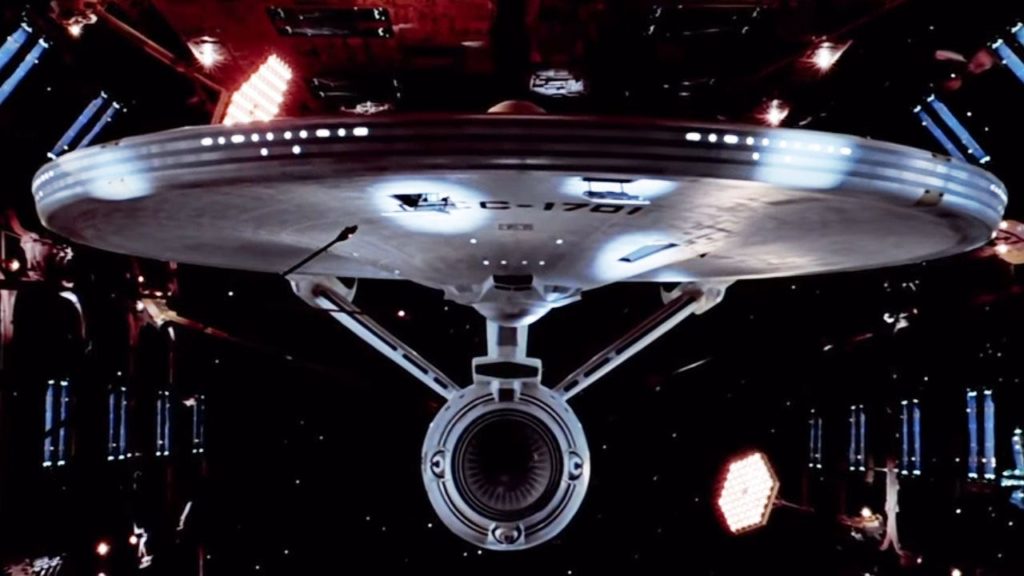
The scene where the retrofitted Enterprise is revealed goes on for about five hours
Space pajama uniforms
Illia coming back as the galaxy’s sexiest alien probe
Now that it’s 44 (!) years later, how does it hold up? It’s…OK.
The problem isn’t that the pacing is slow (and it is slow), it’s that there’s a lot of padding where nothing much happens. You get the feeling that director Robert Wise was trying to really set the mood of travelling into an unknown and alien realm (boldly going), but you could probably lop off 10 minutes of the footage of the Enterprise moving deeper inside V’ger without it hurting the continuity at all.
And that initial pass of the Enterprise is silly. My reaction, even knowing full-well what to expect was still:
The new Enterprise. It looks nice!
Going around the ship, still looks nice!
Still going around the ship. Shouldn’t they have docked by now?
Why is this scene still happening?
I am going to the bathroom. Will the scene still be going when I return?
The scene still runs after returning from the bathroom for another minute before Kirk and Scotty’s shuttle finally docks with the Enterprise.
You could cut another five minutes from this sequence, and it would still be long, but it would end just as you started to get squirmy.
The effects are fine for a movie of this age–they should be, as they cost a fortune and made Paramount go cheap on every Trek film to make sure it didn’t happen again. The space pajama costumes are very 70s, and while I appreciate what they were trying, subsequent TV series (and movies) did a much better job of looking like uniforms, while retaining the colour and style of the originals.
The main issue with the movie, though, isn’t the looks or the pacing, or the effects–it’s the story, or more specifically, the execution of it. You basically have:
Unknown entity of unimaginable power is heading for Earth
It vaporizes every bit of technology it encounters
Only the Enterprise is in range to intercept before something probably really bad happens to Earth
This is a fine premise.
The problem is the way it’s presented, where the Enterprise crew gets pulled into the mystery box of V’ger, then just hangs around on the bridge while V’ger does stuff and they react to it, trying to figure out what to do next. Mostly they can’t do anything.
What this means is there’s a lot of nothing much happens. The cast sit and stand and talk about V’ger and that’s most of the movie. It’s just not very interesting, let alone exciting. There’s one scene where MCcoy comes onto the bridge–this is specifically shown. Everyone watches V’ger on the viewscreen. McCoy hangs around for a bit, never says, a word, then leaves the bridge. Why? Who knows!
Still, I admire the film for not having a typical villain or space shootouts and other stuff people usually expect to see in a sci-fi movie1These are not bad things, but they became super common after the success of Star Wars, which came out only two years earlier.. They tried going for “big idea” and while it doesn’t make for riveting viewing, it’s not bad, either. Some of the interior design of V’ger is downright funky. It was neat watching Kirk and others step off the saucer of the Enterprise to meet V’ger, giving a great sense of scale of the ship. There are a few funny lines here and there. The cast does what it can with a script that demands they mostly react to things they can’t see.
In the end, this was not really the way the Star Trek crew should have returned, but it did make Star Trek II: The Wrath of Khan look even better in comparison.
“Here comes that great writer they told us about. Oh…his ship just blew up.”
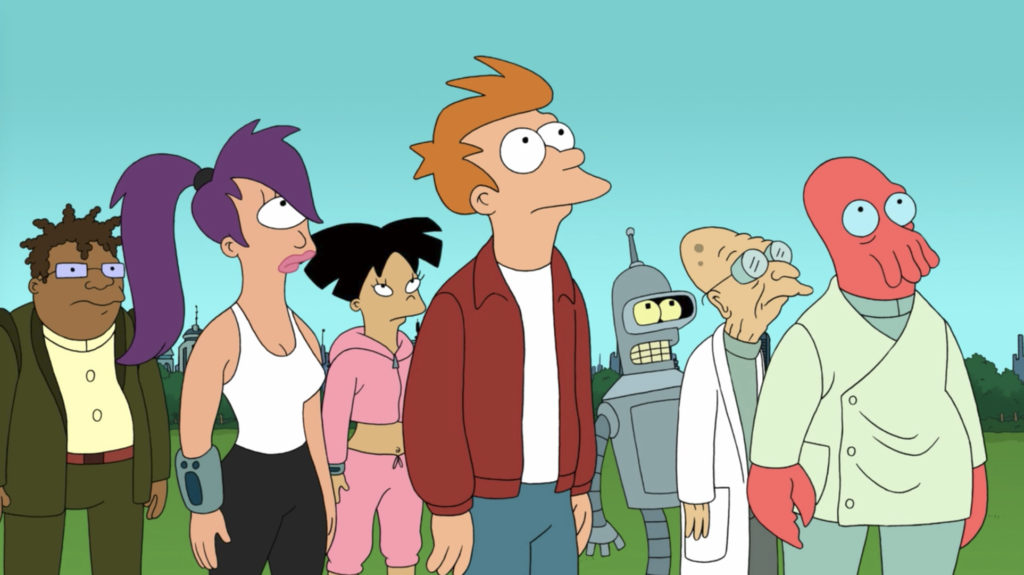
At last, we have the answer to the question, “What happens when a beloved animated series gets cancelled (again) and is revived 10 years later?” And the answer, in the case of Futurama, whose last new episodes aired during the Obama presidency, is you get 10 episodes that feel like Futurama, look like Futurama, but mostly lack the spark the show originally had.
And I can’t help but wonder why it turned out this way. While 10 years is a long hiatus, it’s also plenty of time to work on new and clever stories, with solid writing and jokes. Instead, most of the new episodes were mildly amusing, often just weird and didn’t leave me yearning for more.
First, the good news (everyone):
All the voice actors are back. I felt Billy West (Fry, Farnsworth and Zoidberg) and Katey Sagal (Leela) sounded a bit off in the first episode, but were mostly fine after that. For West, it seemed more like he just wasn’t used to doing the voices again (admittedly, none of the cast members are exactly young anymore), where with Sagal it felt more like she was sometimes struggling to recapture the character, something compounded by generally weak or uninspired writing and possibly direction that may have deferred to the actors, giving them freer reign (I have not read anything about the production, so I could be way off base here).
The episode introducing Kif and Amy’s kids was probably the best of the season and, tellingly, character-focused. It expanded the show’s storytelling while keeping the full Slurmy flavor of Futurama.
Continuity remains excellent. The show has picked up without missing a beat three times now. The first episode of Season 11 literally starts right after the end of the last episode of Season 10.
The Momazon episode was pretty decent.
The not good news:
The writing was generally limp. A lot of the episodes just weren’t that funny. It seemed like the writers in particular didn’t know how to treat Leela. A lot of it just fell back to old stuff, while adding nothing new.
I think they may have done their worst episode yet: Episode 9, where the characters are shown as toys, was weird, unfunny, and the framing story was kind of dumb.
The final episode, written by co-developer David Cohen, held promise with a high concept: the gang question whether they might be in a vast computer simulation. But it then gets bogged down in a lot of technobabble and mostly forgets to be funny.
The attempts to riff on contemporary topics, which the show has done successfully before, almost universally fizzled. The pandemic episode was something that could have been clever, but it went nowhere. People coughed and acted violent. None of it was especially funny, or even interesting. Except for the Momazon episode mentioned above, all of these attempts really didn’t click.
I am a bit baffled that the episodes were so mediocre. Maybe 10 years off is too long. I read that three more seasons (presumably 30 episodes) have been ordered, and I think they can still turn the (Planet Express) ship around, but only if they examine what they failed to achieve in an unremarkable Season 11. Or, you know, just hire better writers.
I’ve been on a science fiction movie nostalgia trek (ho ho) for a while now, and here’s a couple of mini review of two recent rewatches, both of them direct sequels to their first film.
Star Trek II: The Wrath of Khan (1982). At the time this was pitched as the movie that “saved” Star Trek after the slow and, some would say, ponderous first film, which focused on a Big Idea. The sequel ditched the space jammy uniforms and brought back a classic villain from the original TV series, and swapped out the mystery of V’ger with a cat and mouse chase between Khan and Kirk.
The movie holds up remarkably well 41 years later. Some of the effects work is dated, but the scenes of the Enterprise and Reliant flying blind in the nebula and nearly colliding, are still thrilling to watch (just ignore the fact that no one actually looked out a real window to see where they were going). Kirk struggling with mortality and getting older is a great emotional frame for the film, and Shatner doesn’t ham it up under the hand of director Nicholas Meyer.
Ricardo Montalban clearly relished playing Khan, and Meyer allows him to ham it up–but never to the point of making the character appear a fool. He also gets the most quotable lines. “Revenge is a dish best served cold. And it is very cold in space.”
Still recommended after all these years, and probably still the best of the original cast movies.
Aliens (1986). What an odd movie series this is. The first two films are great, the second two are pretty bad, and they all have weirdly long gaps between them, defying Hollywood convention to crank out sequels. The gap between the first and fourth Alien movie is 18 years!
But here we have the first sequel, coming in seven years after the original and in terms of the timeline, 57 years after the events of Alien, when Ripley’s pod is found, and she is brought out of hypersleep.
For some reason, Disney+ (where I watched it) does not offer the Special Edition, which is both good and bad. You miss the early scene of the colonists going about their business before the alien infestation, which helps to give context to what comes later (though you can also argue it also kills the mystery when the marines first arrive at the settlement to find no one there). Likewise, there’s a terrific sequence with automated turrets missing from the original cut, where you see their ammo get depleted…and the aliens keep coming. AND you also don’t get the scene where Burke confirms to Ripley that her daughter had died two years earlier, which really helps provide motivation to her character for the rest of the film.
All that said, everything else that makes this a great sequel is still there. Effects-wise, it mostly holds up, though some of the models are clearly models (in the same way that today’s CGI is often very clearly CGI) and any shot of the dropship where it is not shot against the starry expanse of space looks shockingly bad, to the point of distraction. Everything else, crucially including the aliens themselves, still looks great.
I’d forgotten what a complete spaz Bill Paxton’s character was. Several others in the movie repeatedly tell him to shut up and calm down. It’s great. This film is definitely a James Cameron joint, as he loves his military hardware and foul-mouthed grunts. There are scenes where weaponry is lovingly explained. There’s testosterone spilling all over the place. And it is all neatly undercut when the characters realize what they are up against.
Sigourney Weaver gets a lot more to do here, and this is clearly her character’s film and story. She makes it work with a terrific performance, aided by a solid supporting cast. Paul Reiser, better known as the lovable, quippy husband on Mad About Her, is perfectly slimy as the human villain, cold and calculating until his inevitable and appropriate end.
I could quibble about a few plot contrivances and conveniences, but they ultimately don’t detract from a story that expands on Alien, while providing its own terror-filled ride. Still very much recommended, although watch the Special Edition if you can, the added scenes really do flesh the story out more.