
Book review: A Darker Shade of Magic

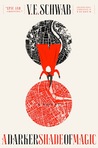
A Darker Shade of Magic (Shades of Magic, #1)A Darker Shade of Magic by V.E. Schwab
My rating: 4 of 5 stars

I don’t read a lot of fantasy. Sure, I read The Hobbit and The Lord of the Rings. That’s about 95% of it right there, the remainder being short stories or books I’m not recalling at the moment. I’ve seen more fantasy movies–they’re quicker to consume–but generally while I am aware of most of the cliches, stereotypes, tropes and such of fantasy, I am not well-read on the genre.

This is my way of saying my opinion of A Darker Shade of Magic may come across as naive, or uninformed or kind of dumb. Because when it comes to fantasy I am kind of dumb.

Still, I’ll start by saying my strongest criticism of the book was its occasional lapse into twee language, passages where the author’s voice intrudes by phrasing something in a way that draws attention to the narrator. This can work if the entire novel is presented as a story being told by an unseen narrator (Mr. Norell and Jonathan Strange comes to mind in this regard–and hey, that’s another fantasy novel I read) but here it pops up only a few times, so it draws unnecessary attention. This is a very minor criticism, though.

Another mild criticism is how it feels like some of the character development happens very slowly, perhaps because this is the first book of a series, so by the end of the book it only feels like some parts of the story are getting started. The character of Lila is the best example of this, a cutpurse with grand plans for adventure and little care for anyone else who only just starts to show a more human side by the end of the story.

The story itself presents a plot with far-reaching implications–the fates of three parallel versions of Victorian-era London are at stake–but feels intimate because it focuses on a small number of characters, primarily the two Antari (powerful wielders of magic), the good-but-somewhat-naughty Kell of Red London, and Holland, the bad and beholden servant to the throne of the amoral White London, along with the aforementioned Lila Bard and assorted kings, queens and a royal brother.

The world building is likely to draw in a lot of readers, as Schwab does a fine job of laying out the different versions of London and how they and the magic within each, operates. Into this comes Kell, whose habit of trading trinkets from the different Londons, using blood magic that allow him as an Antari, to slip between the worlds while few if any others can, ends up with him coming into possession of something Very Bad from Black London. Black London, as you might guess, is also Very Bad and is sealed off from the other Londons to prevent its corrupt magic from spreading and possibly destroying the other three versions of the city.

There is a lot of vicious magic, swinging of swords and the occasional report of gunfire at play as things speed toward an increasingly bloody conclusion. While the story does achieve a certain level of closure, it’s still obvious by the end that there is more to come.

Why do I keep swearing off series and then find myself reading them? I’m not yet sure if I will read the follow-up to A Darker Shade of Magic, but I’m reasonably certain that anyone not entirely tired of stories set in Victorian London will find the story here a brisk and entertaining read. While there are few surprises, there are many small pleasures to be had, whether it be the exchanges between characters who won’t dare admit they like each other, to the showy displays of mages fighting, using wits and, sometimes, anything they can get their hands on.

Recommended.

View all my reviews

Book review: Shattered Glass

Shattered Glass (Shattered Glass, #1)Shattered Glass by Dani Alexander
My rating: 3 of 5 stars

This is one of my “what the heck, it’s on sale” impulse purchases.

Shattered Glass could also go by the alternate title Biting Lips because the characters bite their lips enough for it to be an obsession (of the characters and/or author). The main character, 26 year old police detective Austin Glass, frequently points out these biting lips, particularly those of a 20 year old hustler, the red-headed Peter, a volatile young man who has a shady past, a shady present and perhaps a shady future (in the ground) if he’s not careful.

Part police procedural and part coming out story, Shattered Glass begins with the Glass, a rich trust fund baby, preparing for his upcoming wedding. The story is narrated by him and he quickly demonstrates then confirms and re-confirms that he is a cheating, self-serving, smart-mouthed jerk. He also has daddy issues. And mommy issues. And then gay issues as he thinks back to all the signs that he was repressing who he really was when growing up. The planned wedding goes up in smoke. He begins a vision quest. Well, he gets drunk.

It comes to a head (and lips start getting bitten) when he and his grizzled veteran partner (yes, who woulda thunk it?) investigate a scheme that leads to a murder, arson and other fun stiff, all centered around the inscrutable yet angry yet distant yet tender but always smouldering hot Peter. Within a week Glass has fallen hard for the guy, despite constantly referring to him–usually to his face–as a whore. That could be the other alternate title for the story: Whore. You see the word a lot. Maybe Whores Biting Lips would be the best alternate title, although it perhaps suggests a different type of story than police procedural.

The two constantly fight, occasionally fool around a bit (the sex scenes are brief and would probably get an R rating if translated to screen, depending on how creative the camera angles were) then go back to fighting as the investigation gets increasingly complicated and dangerous.

The character of Glass reels off a constant sarcastic patter and I loves me some sarcasm, but it does wear after awhile. The story as a whole feels padded out, too, and yet still comes up short on dealing with the various relationships as the police procedural and “figuring out the gay” constantly vie for attention. Strangely, even though Glass ultimately come to terms with being gay, he doesn’t seem to experience any real growth as a person. He starts out an argumentative jerk (you know, one of those people who has to say something smart, no matter how ill-advised) and basically ends the same way, except in an allegedly committed relationship. It left me feeling like there were parts missing from the story, despite the aforementioned length of the novel.

Overall, though, this is a decent effort and though it wobbles a bit when trying to juggle the competing plot lines, I remained invested enough to stay with it to the end.

I’ve just discovered this is the first book in a series of Glass novels, though lamentably, the author elected not to give subsequent books awful glass-based puns for titles. Perhaps Glass experiences more growth in these additional books. Given the abrasive nature of the character I’m not sure I’d want to find out. But…maybe.

View all my reviews

Book review: The Chronoliths

The ChronolithsThe Chronoliths by Robert Charles Wilson
My rating: 4 of 5 stars

Minor spoilers below.

The Chronoliths takes the same broad theme of Wilson’s later novel Spin (mysterious giant objects appear around the globe) and uses it to frame a bleak look at a near-future where environmental and economic collapse have left the world vulnerable to military conquest on a level not seen since World War II. The twist is that the conquest is set to happen twenty years in the future and is foretold by the arrival of chronoliths, giant towers of indestructible stone and ice that commemorate the victories of someone or something only identified as Kuin.

With chronoliths spreading from Asia to South America and beyond, and pro and anti-Kuin forces forming, the story follows software developer Scott Warden as he witnesses the arrival of the first chronolith in Thailand and then becomes entangled in what Warden’s former teacher and scientist Sue Chopra calls “tau turbulence” in the quest to stop both the chronoliths and Kuin.

Written in 2001 and predating the 9/11 attacks, The Chronoliths is informed by a present that didn’t anticipate the arrival of the smartphone (it predates the launch of the iPhone by six years) and as such, even though it depicts a mid-21st century where video phones and terminals are commonplace, it feels ever-so-slightly out of date. This is not a real criticism, just a reflection on the likelihood of science fiction that chronicles near-future events not quite hitting the mark. Predicting the future is tricky business, which is ironically (and as Chopra would point out, not coincidentally) what the story is about. Reading the novel when it was published in 2001, these incongruities are non-existent. In 2016 you just have to keep the story in context of when it was written.

That said, the story moves along briskly and Wilson quickly ensnares Morgan, his friends and family into the future of the chronoliths, making Morgan’s actions and decisions both momentous and personal. He may not necessarily want to save the world, taking a rather jaundiced view of it, but he does want to save the people he loves. As more chronoliths appear and Kuin’s victory seems more and more inevitable, the tone becomes increasingly one of despair and hopelessness. Told from the first person perspective, the character of Scott Morgan deliberately feeds into this, framing the tale as one in which many terrible things happen. And they do!

I won’t spoil the ending but Wilson does kind of pull a rabbit out of a hat and it works. As with most stories that have a time travel element it’s best if you don’t try to pull the logic apart. In the case of The Chronoliths, Wilson makes that easy with a style that effortlessly moves the plot along.

Recommended.

View all my reviews

Book review: The World Beyond Your Head

The World Beyond Your Head: On Becoming an Individual in an Age of DistractionThe World Beyond Your Head: On Becoming an Individual in an Age of Distraction by Matthew B. Crawford
My rating: 4 of 5 stars

Crawford draws on theories and ideas from Kant to Freud to Nietzsche and more, both favorably and negatively, as he makes his case for how we in the western world are suffering from distractions both insidious and incidental, all of which collectively diminish what we can achieve by working to make us conform, to comply, to passively listen and not question. Crawford isn’t talking about the people walking down the sidewalk with their eyes glued to their smartphones–though he touches on such digital distractions–but rather bigger and more encompassing things that work to grab our attention, usually because some corporate or other vested interest has deemed our eyeballs and ears too valuable to leave alone. We are fed muzak in public spaces with no option to turn it off. A children’s TV show (Mickey Mouse Clubhouse) presents life as a no-risk endeavor where every potential hazard can be overcome with miraculous devices and conflict is smoothed over quickly, if it ever happens (he contrasts this with the earliest episodes of Sesame Street where characters regularly fight and yell at each other). Slot machines (machine gambling) are carefully engineered with newer technology to maximize their addictive quality, at the expense of those that fall victim to the addiction. We are pushed to know a little of everything and away from specialization.

He laments that classrooms are largely comprised of students sitting at desks passively listening to a teacher presenting information that may or may not be relevant to them, and counters with examples of people engaged in occupations that make use of skills that are learned from other craftspeople/masters as well as drawn from the lessons of those who came before them in the same field, putting together a picture of how we can become more individualistic not by rebelling or isolating ourselves from others, but instead acknowledging and working with the people around us and our society.

He turns to examples ranging from efficiently multi-tasking short order cooks and, in greater detail, an organ shop that restores and builds church organs, to illustrate how focused craft and skills can produce more productive and engaged citizens, while criticizing the trend toward general, non-specific (shallow) knowledge. The loving detail to these examples and his own affection for building and working with tools is alluring. You may not want to assemble a motorcycle or build a church organ when you’re done reading, but you’ll probably want to make something with your hands.

The writing itself may be challenging for some, falling (sometimes awkwardly) between casual and academic. The footnotes alone are more than 40 pages. This is not a self-help book or one with quick fixes or bullet point lists of easy solutions. Instead it is a meditative exercise on where we can (or should) go as a society and the dangers of continuing along our present course. There is a lot to chew on here and I suspect I will return to this book from time to time to re-read key passages, while carrying the central message that the individual, crafting and building, is a wonderful thing.

View all my reviews

Book review: Trigger Warning

Trigger Warning: Short Fictions and DisturbancesTrigger Warning: Short Fictions and Disturbances by Neil Gaiman
My rating: 4 of 5 stars

If you ever talk to someone who’s read The Lord of the Rings books, it’s inevitable that you get to that question: Did you read the songs?

For me the answer was not a straightforward “no” because I did read some of them, then I read fewer as I worked my way through the story, then I just plain stopped. But I still had a great time reading The Lord of the Rings.

The same can be said of Neil Gaiman’s latest collection, Trigger Warning, which intersperses a few poems–the equivalent to Tolkien’s songs–in among the short stories. In his second collection, Fragile Things, he describes the poems as “bonuses for the kind of people who do not need to worry about sneaky and occasional poems lurking inside their short-story collections.”

I read some of the poems, then read fewer of them, the just plain stopped. But I still had a great time reading Trigger Warning.

This is a hodgepodge of stories, covering everything from modern horror to high fantasy, all of it presented with Gaiman’s usual dry wit and depiction of the world as a place both dark and beautiful.

I enjoyed all of the stories but being who I am, the ones I enjoyed most were the Twilight Zone-esque “The Thing About Cassandra” in which imagined loves are perhaps not so imaginary, “Orange,” which uses a question and answer format to show the transformation of a young, tanning-obsessed woman into something rather more cosmic and “The Man Who Forgot Ray Bradbury,” which paints a chilling portrait of a man who forgets words, with more impact than one might expect. Stories based on Dr. Who and Sherlock Holmes are well-executed and the final and original piece, “Black Dog” features Shadow from American Gods, in a story about murder, ghosts and the power of the mind to both protect and destroy.

This is an easy recommendation for anyone who enjoys Gaiman’s writing, but I feel there is enough variety here to entice those unfamiliar with his work.

View all my reviews

Book review: Brother Odd

Brother Odd (Odd Thomas, #3)Brother Odd by Dean Koontz
My rating: 3 of 5 stars

Brother Odd is #3 in the Odd Thomas series and finds the titular character hanging out at an abbey in the California Sierras. When a few bodachs appear (smoky entities that only Odd can see that are harbingers of death) Odd knows trouble is a-coming and he works to protect the mentally and physically handicapped children under the care of the abbey’s monks and nuns.

While Odd remains a wonderfully self-deprecating character that Koontz could probably write in his sleep, the story this time is more out there, dealing with the quest to scientifically prove the existence of God and what happens when you start messing around with life on a quantum level (bad things, as it turns out). This may sound a bit odd (ahem) given the setting of the book, but it’s explained early when one of the monks in residence is revealed to be a former physicist who has bequeathed a fortune to the abbey and secretly continued his work while praying and meditating with his fellow monks.

As the number of bodachs grows, a blizzard sweeps over the mountain, effectively trapping everyone as the potential hour of doom nears. While it serves to increase tension, I was left with a feeling that the story has holes in it you could probably drive a monk-filled SUV outfitted with a snowplow through. Ultimately this only minimally detracts as Brother Odd is, despite its subject matter, not the kind of story you will ponder deeply afterward. It’s an entertaining popcorn read, exactly as I expected.

View all my reviews

Book review: Carrie

CarrieCarrie by Stephen King
My rating: 4 of 5 stars

Some spoilers ahead, in as much as you can spoil a novel published in 1974.

King’s first published novel is in a way the ultimate teenage tale of revenge. Dowdy, introverted Carrie White, a 16 year old girl raised by an extreme Christian fundamentalist mother, is taunted and bullied through high school and does her best to ignore it all while bearing the incessant, borderline insane ravings of her mother. Things seem to be turning around when good boy Tommy Ross invites her to the prom but if you’ve seen the movie, you know how that turns out.

Carrie uses her telekinetic powers to take revenge on those who have humiliated and teased her, eventually spreading her wrath to the entire small town of Chamberlain. Basically, everyone dies.

King writes the story as an epistolary, inserting interviews, book excerpts, commission reports and newspaper stories between the more conventional narrative scenes. Two things I found interesting were how King tips his hand early–less than halfway through you learn that a lot of people are going to die, often which specific people. The story, bracketed by the interviews and reports, becomes less about what will happen and more about what did happen. There is still a slow-burning dread that builds as prom night approaches, a kind of Doom That Came To Chamberlain, if you will.

King also approaches telekinesis as something worthy of scientific study, showing experts speculating on its likely genetic origin and whether more “taunt me and watch me destroy the world” Carries might be out there. Perhaps this was meant as a way of making Carrie seem more sympathetic, a victim of both a brutal upbringing, and a terrible, albeit, natural ability she could not control (or could control all too well, perhaps).

Unlike many of King’s later novels, Carrie is fairly brief and some of the characters feel a bit thinly drawn as a result. There’s just enough meat on the bones here but only just. One of King’s affectations is in full force, though. This is where he’ll break a paragraph abruptly

(and put something in parentheses to emphasize a specific mood or line of thought)

and then continue on with the narrative only to

(switch back to the parenthetical interjection, often making liberal use of exclamation points! italics and word repetition word repetition o the words o the interjections over and over)

While it can certainly emphasize a particular mood or thought pattern, it looks a bit hamfisted now.

Still, any fan of King’s work would be remiss to not read Carrie. King’s skills are still being refined here and not every character or turn feels true (Carrie’s mother especially seems way over the top, something Piper Laurie took to heart in the 1976 film adaptation), but even at this early stage he shows an effortless ability to get a narrative rolling and keep it moving.

View all my reviews

Book review: Wastelands 2

Wastelands 2 - More Stories of the ApocalypseWastelands 2 – More Stories of the Apocalypse by John Joseph Adams
My rating: 3 of 5 stars

A second volume in a themed horror collection might seem like a good candidate for more experimental work that may not be entirely successful and such is the case with Wastelands 2, although I enjoyed the majority of the stories.

Post-apocalypse tales are one of the enduring favorites in horror fiction. Some of the classic boogeymen like nuclear war have faded as threats to all humanity while others like global warming have risen–Wastelands 2 delivers on both of these, along with biological terrors, Lovecraftian beasts from the sea, really mean flowers and, of course, Kevin Costner. Sort of.

While the stories are bound by the theme of apocalypse, style and tone is all over the place. There is little in the way of humor (as one might expect), though Keffy R. M. Kehrli’s “Advertising at the End of the World” with its androids-as-literal-walking-advertisements still searching for buyers after a super-virus decimates humanity, is quietly absurd. Most are dark or darker and the majority betray little hope regarding humankind’s ability to come back from the brink of extinction. You’ll also put down the book thinking most people are jerks.

This is not exactly feel-good material is what I’m saying.

A few standouts for me include Jack McDevitt’s “Ellie,” which presents a nice twist on a story about caretakers keeping things running at a massive particle collider in the hope of staving off further disaster. The aforementioned “Advertising at the End of the World” is a relatively original take on post-apocalypse, with the sensible protagonist Marie trying to deal with an army of annoying androids as humanely as possible. George R. R. Martin’s hippie-fest “…For a Single Yesterday” reminded me a bit of the novel Station Eleven, with entertainers providing a focal point in surviving communities, with a bit of time-travelly drugs tossed in.

“Monstro” is a deliciously weird story about a virus inducing strange and dangerous groupthink among the infected quarantined in Haiti. Author Junot Díaz steeps the story in local culture while slowly unwinding an ever-widening apocalypse that may or may not be contained on the island state.

Jake Kerr’s “Biological Fragments of the Life of Julian Prince” is an epistemological accounting of how an author survives, writes about and in a way is consumed by a meteor impact that devastates North America in the first half of the 21st century. I feel this format–excerpts from Wikipedia, interviews, news reports and so on–is trickier to pull off than it looks but Kerr handles it expertly, lending an authentic feel to these glimpses of Prince’s life and the apocalyptic event that sits at its core.

On the negative side, I found David Brin’s “The Postman” (a novella version of the novel) was fine but oddly undercuts the whole enterprise on the very last page with the protagonist turning weirdly flippant and derisive. I have no idea if the book (or the Costner movie) are the same, but I found it jarring.

But while “The Postman” was still a pleasant enough read overall, I only managed a few pages of Maria Dahvana Headley’s “The Traditional.” The story features an unlikable and uninteresting protagonist and is written in the second person: “You’ve always been the kind of liar who leans back and lets boys fall into you while you see if you can make them fall all the way out the other side. You want them to feel like they’ve hit Narnia. You traffic in interdimensional fucking, during which they transcend space and time, and you go nowhere.” I’ve always been the kind of person who finds the second person point of view a very tough sell. I was not sold. I didn’t even rent.

There are more than enough stories in Wastelands 2, however, to recommend it to anyone looking for some post-apocalyptic fun.

View all my reviews

Book review: The Super Natural

The Super Natural: A New Vision of the UnexplainedThe Super Natural: A New Vision of the Unexplained by Whitley Strieber
My rating: 3 of 5 stars

This one is kind of bonkers if you think the world and the universe around it are pretty much known things. If you’re less certain (just what is dark matter, anyway, and why is there so much of it?) then the you may find the ideas presented to be intriguing, even as the authors make no absolute claims on any of the evidence they bring forward.

The premise of The Super Natural is that the various unknown phenomena reported around the world–everything from UFOs to alien abductions, apparitions, implants, strange lights and more–are real and explainable, and point to a larger reality that most people lack the perception and skill to interact with in a meaningful way, or even at all. Further, they suggest the possibility of parallel universes that may intersect with ours at times. On top of that, there’s a lot of theory on what happens after you die and whether or not the soul exists. Finally, there is a common belief between the authors that some kind of intelligent plasma energy may be behind most of this.

Pretty bonkers, right?

Whitley Strieber is well-known for his books about what he calls the visitors, starting with Communion. His experiences have been largely ignored by mainstream media or openly mocked (he expresses regret for coming up with the phrase “rectal probe”, two words that have launched a thousand jokes over the past thirty years). His chapters largely consist of him recalling and expanding on experiences he has previously described, as well as bringing in some new ones. He offers theories but is very careful to commit to none of them, keeping his mind open to other possibilities. He doesn’t think the visitors are aliens from another planet, a common misconception people have with his experiences.

Jeff Kripal is a historian of religions and his chapters focus more specifically on the theories behind what may be going on, with different techniques offered as part of a “toolbox” for examining and cataloguing the unknown.

In a few instances the authors disagree on specifics but overall they present a united front in believing the likeliest explanations of all this weird stuff lies in intelligent plasma energy that exists perhaps in a dimension outside of ours and may be trying to teach those who are receptive what lies beyond our physical form and physical dimension. There are suggestions that these other beings live outside of normal space and time and to them we seem pretty primitive with our living and dying and not being able to fly around as spooky balls of energy. But the good news is they consider us teachable.

There are no good explanations on why these more advanced forms of life want to teach us or why they are being relatively coy about it (I say relatively because there are thousands of UFO sightings, for example, and even well-documented cases rarely get reported by conventional media, so while these various phenomena may be unknown, they are not exactly rare). Perhaps we’re just really slow learners. Maybe our nukes scare them. They still kind of scare me.

Kripal in particular also goes into detail about what is real versus fictional or imagined and how we may essentially make our own reality. One example he recounts is about an academic colleague who was making blueberry muffins (mmm). He finished mixing the wet ingredients then rinsed out and set the empty honey jar on the sink counter to dry. He went to get a tin of flour off a shelf and, surprised by how unusually heavy it felt, dropped it on the floor. He sifted through the spilled flour and found the honey jar, caked in the flour. He looked at the counter. The jar was no longer there. It had moved on its own. Neat! And weird.

Kripal explains:

Apparently, that is what the human mind-brain does when it is participating in a dimension of reality that is quite beyond our primitive “mental” and “material” categories of thinking (and our primitive science, which assumes the same division to work at all). It tells itself a story that involves otherwise impossible things and then acts out that story with physical objects. If those objects are available in the immediate environment, it uses them as props, like Dan’s honey jar. If they are not, it creates them “out of nowhere.”

He goes on to say these odd events happen to “mess with us” (that is a direct quote), to shake up our view of the world as one in which the mental and physical are separate things. It’s all very trippy, like trying to count to infinity.

In the end a skeptic is unlikely to be convinced by the evidence presented by Strieber and Kripal, but their ideas are interesting and entertainingly presented. The way they both hold back from making absolute claims seems less a dodge and more a genuine admission that they–and us–really don’t know for sure what it happening out there. But something certainly seems to be.

Meanwhile, I can’t even get the TV remote to teleport into my hand. If the mental and physical are really one, I wouldn’t mind at least a few perks before evolving into a super-intelligent ball of light.

View all my reviews

Book review: The Ballad of Black Tom

The Ballad of Black TomThe Ballad of Black Tom by Victor LaValle
My rating: 4 of 5 stars

Victor LaValle takes one of H.P. Lovecraft’s most clumsily racist stories, “The Horror at Red Hook” and expands it into a novella that both builds on the original while dealing head-on with Lovecraft’s ill-informed and offensive take on race. The author does this by dividing the story into two parts, one from the perspective of police detective Malone, as in the original, and the other from the viewpoint of the titular Black Tom, also known as Charles “Tommy” Tester, a 20 year old living with his father in Harlem of 1924.

Tommy is both hero and villain, an agent of despair and a victim of senseless violence and racism. He and Malone cross paths when both encounter the enigmatic Robert Suydam, a man trying to unleash Lovecraft’s Great Old Ones on the world so that the oppressors may be wiped away while the oppressed are justly rewarded for awakening these elder gods.

The world LaValle depicts is one of easy cruelty and racial division, where hope is tamped down and then crushed, and songs play not to soothe souls but to help speed them along to a certain hell. He does this while effortlessly weaving in Lovecraft’s original characters and story and it is there that The Ballad of Black Tom is perhaps at its weakest, as the original material was rather thin to begin with.

Still, LaValle elevates the original far beyond what Lovecraft had achieved, creating a tragic tale that trades melodrama for something more human, even as the world is threatened by cosmic horrors.

If you enjoy Lovecraft’s work you’ll almost certainly enjoy this. LaValle’s prose is concise, sometimes wry and always on point. His expansion of the original simply works in every way you would expect. If you enjoy Lovecraft but have always been troubled by the racism weaved throughout so many of his stories, The Ballad of Black Tom comes even more highly recommended. LaValle has managed the difficult trick of both paying respect to and being scornful of a very flawed author.

View all my reviews

Book review: Day Four

Day Four (The Three #2)Day Four by Sarah Lotz
My rating: 4 of 5 stars

Note: some minor spoilers ahead.

While not a direct sequel to Lotz’s previous novel The Three, Day Four does take place in the same timeline, one where the mysterious crash of four airliners on the same day and the decidedly weird doings of the three (or was it four?) child survivors leads to talk of the Apocalypse being on its way and the election of a deeply religious President in the U.S., one who oversees an extremely conservative federal government that seems to be doomsday preppers writ large. And official.

Day Four references the plane crashes, survivors and spookier stuff while sidestepping talk of the political landscape. The main story is largely self-contained, though, so reading The Three is not a prerequisite.

One might glibly describe Day Four as The Love Boat from Hell–and you would actually not be far off. As the story begins, the first three days of a cruise on The Beautiful Dreamer, of the fictitious Foveros Cruise Line, encounters nothing out of the ordinary after leaving Miami. On the fourth day it runs into mechanical problems. Then virus problems, rapist/murder problems, why-isn’t-anyone-coming-to-help problems and finally, possible ghost and maybe worse-than-that problems.

Lotz does an excellent job of ramping up the tension as conditions on the ship deteriorate, switching between a large cast of characters with the same ease she demonstrated in The Three. The crew of the ship is split into cabals and cliques, divided along lines of rank as well as ethnicity, each group typically speaking in their native tongue to better exclude others from the conversation. Even with the cruise running optimally it’s clear a lot of the people on board are never going to get along. And there are enough skeletons to fill a walk-in closet.

The passengers are a quirky mix of gossip bloggers, psychics, tourists and suicides-in-waiting. As things go sideways (literally, as the days without rescue go on) clashes among the passengers and crew increase. The power goes out. Toilets stop working. Ghosts start working.

To say more would be to enter into major spoiler territory but suffice to say the ending seems very much to set up another book, though whether it will follow the characters of Day Four or not is unclear (though I lean toward no). What is clear is that the people that inhabit this alternate present-day timeline are likely in for a bumpy few years.

If you approach Day Four on its own, the references to The Three may feel a bit oblique and the ending may be less satisfying but I still feel it works well on its own. As a companion to The Three, Lotz has crafted a nightmare cruise that neatly sets up even worse things to come. Recommended.

View all my reviews

Book review: 11/22/63

11/22/6311/22/63 by Stephen King
My rating: 4 of 5 stars

11/22/63 is very by-the-numbers.

Sorry, had to get the inevitable and terrible pun out of the way.

11/22/63 is one of King’s best post-accident (post-1999) works, a long and adventurous novel that jumps feet-first into the time travel paradox. As expected, giving much thought to the logistics of time travel only reveals the gaps and flaws common to this particular sub-genre of science fiction. King knows this, too, and steers clear of trying to provide plausible scientific reasoning, leaving it up to the butterfly effect and what the main character of school teacher Jake Epping calls “harmonics.”

Saving Kennedy is a favorite time-travel trope, probably the most popular after killing Hitler, and King neatly lays out the scenario where Epping goes back to September 1958 and adapts to living for five years in an era before he was born, all the while tracking his prey, Lee Harvey Oswald. Along the way Epping falls in love with both the past and another school teacher, the tough if clumsy Sadie Dunhill.

Typically, King does a terrific job in fleshing out the many characters, while the sounds and sights of late 50s and early 60s America feel authentic. The story sprawls but never drags as Epping faces obstacle after obstacle while moving closer to his target. As the repeated refrain goes, the past is obdurate and doesn’t want to be changed.

To say more would venture into spoiler territory and although the book has what amounts to two endings, both are fine. There are no giant spiders here. 😛

Unlike King’s horror fare, 11/22/63 has broader appeal, to fans of time travel stories, to those who enjoy the whole “fish out of water” thing and finally, to anyone who enjoys watching characters whose actions and complexities drive the action, rather than the other way around.

View all my reviews