One of the nice things about ebooks is how they allow you to easily analyze aspects of a book that would have been much more tedious or time-consuming to analyze back in the days of books made through the sacrifice of trees.
For instance, in just a few moments I was able to find out Slaughterhouse Five repeats the phrase “so it goes” 106 times. Amazon lists the paperback edition as being 224 pages long.
The repetition of the phrase is a device used for varying effects and at first I accepted it as such a device and nothing more. Toward the end of the book, though, it finally became grating. Maybe that was the point all along.
So it goes.
Slaughterhouse Five is irreverent and droll and makes important statements about the purpose and meaning of life, contrasting its absurd characters and banal suburban life against the horror of World War II and specifically the firebombing of Dresden, something Vonnegut experienced directly as a POW. Vonnegut’s time as a journalist undoubtedly influenced his writing style, which is as concise and straightforward as his subject matter is sardonic. The contrast between grim reality and the absurd is constant and lends the novel a surrealistic feel, as if one is not really reading a narrative but instead catching glimpses of a life or lives that are dull and depressing, filled with few moments of genuine joy.
For as light as the writing style is, Slaughterhouse Five is a glum thing. I can’t say I enjoyed reading it, but I admire Vonnegut’s technique and the ease with which he draws out scenes with simple phrases–the buttons of a man’s spine, the tearing of a coat too small, the grit and grime in window sills. In many ways it’s a fascinating book but not one I’d particularly want to revisit.
Lisey’s Story is, at its heart, about a woman, Lisey Landon, coming to terms with the death of her husband, two years dead as the novel begins.
It is also about family and the sacrifices made to keep them together–or to merely survive them.
Along the way are ruminations and reflection on the life of a famous author, being the wife of a famous author, the attendant unhinged and occasionally violent fans, flashbacks to exceedingly ugly childhoods, and a bond that reaches from the past and through an extraordinary place out of time that helps bring closure on a life and love over too soon.
There’s also a creepy monster in some spooky woods and the deranged fans (two, one via flashback, the other a more immediate concern) keep things from getting too maudlin. This is still a King story, after all.
A lot of interesting ideas and themes are at play here and for the most part King juggles them as ably as you would expect. At one point you may even believe the deceased author Scott Landon is not entirely dead–and you may be right, in a way–but in the end Lisey’s story is one in which doors to the past are quietly closed.
The weakest part of the story may be in the overall structure. It’s a sprawling and at times rambling work, sometimes feeling like a lazy ride down a river in summer that suddenly and briefly changes to a plunge into unexpected rapids before easing back into that slow drift again. This is to say the pace is often languid but at times uneven. Some may mistakenly think the deranged fan is the central plot when he actually just serves as another piece to the puzzle in getting Lisey to where she can put the past behind her.
King plays with several of his familiar elements here, and while I roll with them without blinking, others may find the unique phrases the characters use, like “bad-gunky” and “smucking” a bit twee.
Despite its girth, Lisey’s Story has an intimate feel. There is no big bad evil here, no world-destroying plagues or zombie apocalypses. There are supernatural elements, but the most horrifying parts are contained in the depiction of Scott Landon’s childhood at the hands of a deranged and violent father.
Lisey’s Story ultimately succeeds because Lisey’s journey feels authentic and earned. Strip away the creepy “long boy” and the demented fans, the land of the Boo’ya Moon where the dead gather, the flashbacks to childhood terrors, and you are left with a story that simply tells of how one person deals with the grief of a lost love. And that story is told well.
And you may look twice the next time you see someone hefting a spade.
Perhaps the most interesting aspect of All Out is that Kevin and Alex Newman wrote their own chapters independent of each other, allowing the reader to directly compare the father’s and son’s take on events and more importantly, how the two saw each other, which forms the heart of the book.
And they often saw each other very differently, creating a tension that existed between the two men until they were both adults.
In a journey that starts with the senior Newman co-hosting CBC’s Miidday, moves onto his brief (and disastrous) stint as co-host of Good Morning America, and ends with him back in Canada as part of CTV’s W5, Kevin Newman provides insights and observations about the TV news business, ranging from the long hours that necessitated so much time away from his family, the sometimes farcical demands of producers and handlers (on Good Morning America he was asked to dye his eyelashes to make them darker and presumably more masculine) and ultimately how for decades his work defined so much of his existence–at the expense of family and life outside work.
Alex’s journey begins as a young boy, sensitive and creative, bullied in school and seemingly failing at living up to the masculine ideals of his father, showing little interest in sports or other “guy” pursuits.
It comes to a head when at age 17 Alex realizes he is gay and comes out to his family. Or rather, he tries to come out but his father actually cuts him off at the pass, so to speak, by asking his son (who had called a family meeting), “Is this about your sexuality?” From that awkward beginning, the two start a process of testing and challenging each to accept each other as they are, not as they wish they were.
For Kevin he finally realizes that work is just work and family matters more. He lets go of his own hangups regarding what he sees as the masculine ideal and confronts his discomfort with homosexuality. In the process he achieves a breakthrough in his relationship with his son and with his own father as well.
Alex’s struggle with being gay stems not so much from being afraid of how others would see him–virtually everyone he knows was accepting–but in how it defined him in a way that he didn’t like. Being gay meant he could never be that ideal son that Kevin wanted and tried so much to shape through the years. At his darkest moments he contemplates suicide, as many gay youth do, but a network of friends and acquaintances keeps him from going too far into the abyss.
The writing by both men is fine if not extraordinary, though Alex ably captures the voice and mentality of his younger self. Kevin’s behind-the-scenes look at TV news is in some ways quietly horrifying and in other ways warmly affirming–it turns out Peter Jennings really was a warm, wonderful person. But it is the intertwined story of the two men that speaks strongest here, and it is difficult to not be moved by the self-realizations that allowed Kevin to fully embrace his son for who he is–and to finally let go of the mental baggage he had carried for decades, allowing him to finally, truly be content.
And not have to worry about dying his eyelashes ever again.
(Note: Slade House features references to characters and settings from Mitchell’s other stories, but is completely standalone even if you’ve never read anything else of Mitchell’s.)
Answering the question, “Should you ever try entering a strange black iron gate embedded in the imposingly tall brick wall of a long, twisting alley to see what’s on the other side?” (the answer is no, you probably shouldn’t), Slade House begins in the 70s and moves to the present in nine year jumps, recounting the visits of various people invited/lured to the titular house, one that turns out to be both real and unreal.
Starting with a young boy addled on his mother’s Valium and ending with someone a wee bit more together, Mitchell lays out what is essentially a collection of short stories recounting the people drawn to the house and their typically horrifying experiences there, each story further revealing the mystery of what Slade House is. The stories are told from the first person POV and Mitchell grandly cheats on this, so much so that you’re likely to just accept it or, if you’re feeling cranky, perhaps put the book down.
Trading more on the bizarre and funny and less on outright horror, I found the main strength of the book comes in the variety of the assorted protagonists, ranging from hapless kids to hapless would-be paranormal investigators. Mitchell’s glee at tormenting them is almost palpable.
To say much more would spoil the story. While the revelations are likely to be worked out by those steeped in the genre, I still enjoyed the ride. Or visit, if you will.
I decided to pick this up because it recently got re-released as an ebook.
This is a collection of letters received by Anne and Whitley Strieber after the publication of the latter’s book Communion, and some its subsequent follow-ups. (The book came out originally in 1997.)
I’ve always enjoyed Strieber’s Communion books because a) he’s a novelist, so he knows how to tell a story b) the stories he recounts are by turns freaky and fascinating and c) they satisfy a part of me that is intrigued by the possibility that the reality we see and the reality that might be could be vastly different things. There is some scientific evidence to suggest the possibility of parallel dimensions, for example. Imagine if we had definitive proof–it would shatter our current conception of the universe. The mere thought that multiple Adam Sandlers could exist is almost too much for the human mind to comprehend.
But I digress.
The Communion Letters is loosely themed into chapters focusing on specific types of encounters with beings that may be aliens or have some connection to the dead or could be super-evolved humans come back from the future to keep us from screwing up the planet. Each chapter has a short introduction from Whitley (Anne’s task was to read through the staggering 200,000 letters they received) but the bulk of the book are the letters themselves.
They range from odd incidents that may or may not be explainable through conventional means, to stuff that would fit right in with the wackiest theories floated on Ancient Aliens. The quality of the writing is just as varied, with some letters being somewhat disorganized as the authors backtrack on their thoughts or interject in the middle of a recollection with something else, while others have that “just cracked open a thesaurus” feel to them. More than a few are not just well-written, the stories they tell are riveting, filled with details of small town life interrupted by strange, sometimes wondrous and often terrifying events.
In the end no definitive conclusion is drawn by Strieber, other than a wish that science would study the people reporting these experiences, to help demonstrate that their stories are not just the products of over-active imaginations or even mental illness (Strieber says he read over many writings from people suffering mental illnesses and found a clear distinction between their work and the stories recounted in the letters they received).
At times creepy and at times so out there that I had to fight the urge to roll my eyes, The Communion Letters is an interesting showcase for ordinary people to sound off on their experiences with the “visitors.” If the subject matter intrigues you, this is worth a read, even if the selection of letters could have been a bit stronger overall.
The Songs of Distant Earth uses “terabyte” as if it’s a near-impossibly huge amount of storage space, but other than being a bit dated tech-wise (it was published in 1986 and the genesis of the story began as a piece originally written in 1958), this short, brisk novel details events surrounding the improbable chance of two separate colony ships sent hundreds of years apart encountering each other light years away from Earth.
To be more precise, the first colony ship has already landed on the water world of Thalassa, its crew having settled there hundreds of years earlier, populating the three islands that form the entirety of land on the planet. One of the last ships to leave the doomed Earth centuries later stops by on its way to its own destination, the hostile but tameable world of Sagan Two. Choosing Thalassa in order to use its water to reconstitute a massive ice shield on the bow of their colony ship, the crew of the Magellan is surprised to find the planet inhabited (after losing contact due to a broken antenna on Thalassa, it was assumed its colony ship had never completed its journey), thus beginning a clash of cultures, ideas and philosophy, pitting the laidback Thalassans and their seeming Utopia against the crew of the Magellan, who still face a massive amount of work to make their chosen planet livable (an edict passed in the dying days of Earth forbids colony ships from colonizing worlds with any notable life, sort of a variant on Star Trek’s Prime Directive).
There is a lot of debate about what makes life worth living, with a fairly heavy hand directed against the alleged scourge of religion–the Thalassans are non-religious and live in a democratic society where procrastination and non-monogamous relationships are the norm. Clarke has characters from both the planet and the Magellan intermingle–on projects in and out of bed–to help illustrate the risk of “contamination” between the two groups. Complicating things further, the paradise-like nature of Thalassa leads a small number of Magellan’s crew to attempt mutiny.
The tension Clarke creates as these two peoples work and play together for the months it takes to rebuild the Magellan’s ice shield is low and never really threatens to boil over, but the discussions the characters have are filled with insights, dry humor and observations about humanity that feel authentic, if somewhat studied.
The Songs of Distant Earth sometimes feels a bit thin compared to denser works of science fiction, but Clarke does not so much skimp on detail as focus precisely on what he feels is most important to the story. In the end, the novel offers hope that humanity will mature and flourish among the stars, albeit not without some bumps along the way.
I first read this book back in 1984 when the Cold War was still a legitimate threat–just before Gorbachev started the policy of Glasnost and Reagan was still joking about bombing the Russians. It left an indelible impression of how even a limited nuclear attack could have devastating, world-changing consequences that could stretch on for decades. Reading it now there is a certain sense of distance with the old U.S./USSR rivalry long dead, Putin’s efforts to turn back the clock notwithstanding, but the reality is most of these nuclear missiles still exist, with more than enough firepower to ruin your day and then some.
The book is written as a first person account of the effects of a limited nuclear war five years after the bombs fell. The authors, Whitley Strieber and James Kunetka, place themselves into this fictional scenario set in the year 1993, starting a journey across America that takes them to both coasts before heading back to their adopted hometown of Dallas, where they work as reporters.
The story opens in October 1988 with Strieber’s recollection of being on a bus in downtown New York when the bombs fall. New York is one of three cities targeted in the first volley (the other volleys do not follow due to U.S. retaliation disabling the Soviets’ ability to counter-attack), the other two being Washington and San Antonio. He survives because the bombs miss New York proper, landing over Brooklyn and off the coast. He still gets dosed with enough radiation that he is later classified under the triage system as not treatable, as the radiation is expected to kill him within years and those with better survivability are given priority.
Bombs exploded in the upper atmosphere create an EMP effect that blankets the country, disabling nearly all electronics, ranging from computers to vehicle ignitions and most forms of communication. The final blow comes in the form of volleys aimed at missile silos in the Dakotas and other states. Winds sweep the radiation from these blasts across the bread basket of the U.S., devastating crops and leading to widespread famine.
Against this grim backdrop–the book suggest 7 million die on the day the bombs fall and up to 60 million die from the effect in the following five years–the authors find that some places have prospered, others have become uninhabitable, and assistance has been offered from other nations, albeit with a price.
The bulk of the story captures Strieber’s and Kunetka’s journey from state to state–mostly by rail, as air travel is still rare five years after the attack–conducting interviews with government officials and ordinary folks, supplementing these accounts with official documentation of the effects of the war. The level of detail in these mock documents is impressive and help paint a picture of a country that has been split apart, where deflation has reduced most items to cents, gold is the favored currency and the federal government, now in L.A., is a stunted shadow of its former self.
The narrative works because it presents its fiction so plainly, even when specific scenarios seem absurd when taken out of context. At one point the authors are escaping authorities in California–which was spared attack but has emerged as a near police-state, locking down its borders–dressed as priests. They make a daring escape from a prison bus to continue their journey through the devastated heartland before heading to New York and then back to Texas. It sounds ridiculous and yet the details that are drawn of California, at once prosperous, yet cold, allow these occasional dramatic embellishments to at least seem plausible.
The bulk of the story is in the interviews, where survivors talk about living through famine and flu, abandoning cities and entire regions killed by radiation, some drifting, others settling, with a general sense that the people are banding together and helping each other where they can. International aid comes from the British and Japanese primarily, but both seem willing to only do so much, with a strong suggestion that the other nations of the world are not exactly eager to see the U.S. re-assert itself as a global power again.
One especially chilling interview is with a British naval officer who works as part of a crew of sub poppers, so-called because their job is to find nuclear-armed submarines that are still at sea–and thus presenting a threat–and disabling or destroying them. He recounts taking out subs with enough firepower on board to cause devastation many times greater than what happened on Warday itself, a grim reminder of how terrible and terribly effective nuclear weapons are.
Although the specific scenario of Warday is no longer plausible–the Soviets launch a first strike due to the U.S. being on the verge of putting together a seemingly indestructible space-based defense system (how Reagan would have approved!)–the story remains as powerful now as it was over 30 years ago, simply because nothing at all has changed regarding the almost incomprehensible effects of nuclear bombs, and as mentioned, there are still an awful lot of them sitting silent in their silos, one launch code away from unleashing their destruction.
I don’t read a lot of fantasy. Sure, I read The Hobbit and The Lord of the Rings. That’s about 95% of it right there, the remainder being short stories or books I’m not recalling at the moment. I’ve seen more fantasy movies–they’re quicker to consume–but generally while I am aware of most of the cliches, stereotypes, tropes and such of fantasy, I am not well-read on the genre.
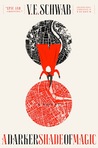
This is my way of saying my opinion of A Darker Shade of Magic may come across as naive, or uninformed or kind of dumb. Because when it comes to fantasy I am kind of dumb.
Still, I’ll start by saying my strongest criticism of the book was its occasional lapse into twee language, passages where the author’s voice intrudes by phrasing something in a way that draws attention to the narrator. This can work if the entire novel is presented as a story being told by an unseen narrator (Mr. Norell and Jonathan Strange comes to mind in this regard–and hey, that’s another fantasy novel I read) but here it pops up only a few times, so it draws unnecessary attention. This is a very minor criticism, though.
Another mild criticism is how it feels like some of the character development happens very slowly, perhaps because this is the first book of a series, so by the end of the book it only feels like some parts of the story are getting started. The character of Lila is the best example of this, a cutpurse with grand plans for adventure and little care for anyone else who only just starts to show a more human side by the end of the story.
The story itself presents a plot with far-reaching implications–the fates of three parallel versions of Victorian-era London are at stake–but feels intimate because it focuses on a small number of characters, primarily the two Antari (powerful wielders of magic), the good-but-somewhat-naughty Kell of Red London, and Holland, the bad and beholden servant to the throne of the amoral White London, along with the aforementioned Lila Bard and assorted kings, queens and a royal brother.
The world building is likely to draw in a lot of readers, as Schwab does a fine job of laying out the different versions of London and how they and the magic within each, operates. Into this comes Kell, whose habit of trading trinkets from the different Londons, using blood magic that allow him as an Antari, to slip between the worlds while few if any others can, ends up with him coming into possession of something Very Bad from Black London. Black London, as you might guess, is also Very Bad and is sealed off from the other Londons to prevent its corrupt magic from spreading and possibly destroying the other three versions of the city.
There is a lot of vicious magic, swinging of swords and the occasional report of gunfire at play as things speed toward an increasingly bloody conclusion. While the story does achieve a certain level of closure, it’s still obvious by the end that there is more to come.
Why do I keep swearing off series and then find myself reading them? I’m not yet sure if I will read the follow-up to A Darker Shade of Magic, but I’m reasonably certain that anyone not entirely tired of stories set in Victorian London will find the story here a brisk and entertaining read. While there are few surprises, there are many small pleasures to be had, whether it be the exchanges between characters who won’t dare admit they like each other, to the showy displays of mages fighting, using wits and, sometimes, anything they can get their hands on.
This is one of my “what the heck, it’s on sale” impulse purchases.
Shattered Glass could also go by the alternate title Biting Lips because the characters bite their lips enough for it to be an obsession (of the characters and/or author). The main character, 26 year old police detective Austin Glass, frequently points out these biting lips, particularly those of a 20 year old hustler, the red-headed Peter, a volatile young man who has a shady past, a shady present and perhaps a shady future (in the ground) if he’s not careful.
Part police procedural and part coming out story, Shattered Glass begins with the Glass, a rich trust fund baby, preparing for his upcoming wedding. The story is narrated by him and he quickly demonstrates then confirms and re-confirms that he is a cheating, self-serving, smart-mouthed jerk. He also has daddy issues. And mommy issues. And then gay issues as he thinks back to all the signs that he was repressing who he really was when growing up. The planned wedding goes up in smoke. He begins a vision quest. Well, he gets drunk.
It comes to a head (and lips start getting bitten) when he and his grizzled veteran partner (yes, who woulda thunk it?) investigate a scheme that leads to a murder, arson and other fun stiff, all centered around the inscrutable yet angry yet distant yet tender but always smouldering hot Peter. Within a week Glass has fallen hard for the guy, despite constantly referring to him–usually to his face–as a whore. That could be the other alternate title for the story: Whore. You see the word a lot. Maybe Whores Biting Lips would be the best alternate title, although it perhaps suggests a different type of story than police procedural.
The two constantly fight, occasionally fool around a bit (the sex scenes are brief and would probably get an R rating if translated to screen, depending on how creative the camera angles were) then go back to fighting as the investigation gets increasingly complicated and dangerous.
The character of Glass reels off a constant sarcastic patter and I loves me some sarcasm, but it does wear after awhile. The story as a whole feels padded out, too, and yet still comes up short on dealing with the various relationships as the police procedural and “figuring out the gay” constantly vie for attention. Strangely, even though Glass ultimately come to terms with being gay, he doesn’t seem to experience any real growth as a person. He starts out an argumentative jerk (you know, one of those people who has to say something smart, no matter how ill-advised) and basically ends the same way, except in an allegedly committed relationship. It left me feeling like there were parts missing from the story, despite the aforementioned length of the novel.
Overall, though, this is a decent effort and though it wobbles a bit when trying to juggle the competing plot lines, I remained invested enough to stay with it to the end.
I’ve just discovered this is the first book in a series of Glass novels, though lamentably, the author elected not to give subsequent books awful glass-based puns for titles. Perhaps Glass experiences more growth in these additional books. Given the abrasive nature of the character I’m not sure I’d want to find out. But…maybe.
The Chronoliths takes the same broad theme of Wilson’s later novel Spin (mysterious giant objects appear around the globe) and uses it to frame a bleak look at a near-future where environmental and economic collapse have left the world vulnerable to military conquest on a level not seen since World War II. The twist is that the conquest is set to happen twenty years in the future and is foretold by the arrival of chronoliths, giant towers of indestructible stone and ice that commemorate the victories of someone or something only identified as Kuin.
With chronoliths spreading from Asia to South America and beyond, and pro and anti-Kuin forces forming, the story follows software developer Scott Warden as he witnesses the arrival of the first chronolith in Thailand and then becomes entangled in what Warden’s former teacher and scientist Sue Chopra calls “tau turbulence” in the quest to stop both the chronoliths and Kuin.
Written in 2001 and predating the 9/11 attacks, The Chronoliths is informed by a present that didn’t anticipate the arrival of the smartphone (it predates the launch of the iPhone by six years) and as such, even though it depicts a mid-21st century where video phones and terminals are commonplace, it feels ever-so-slightly out of date. This is not a real criticism, just a reflection on the likelihood of science fiction that chronicles near-future events not quite hitting the mark. Predicting the future is tricky business, which is ironically (and as Chopra would point out, not coincidentally) what the story is about. Reading the novel when it was published in 2001, these incongruities are non-existent. In 2016 you just have to keep the story in context of when it was written.
That said, the story moves along briskly and Wilson quickly ensnares Morgan, his friends and family into the future of the chronoliths, making Morgan’s actions and decisions both momentous and personal. He may not necessarily want to save the world, taking a rather jaundiced view of it, but he does want to save the people he loves. As more chronoliths appear and Kuin’s victory seems more and more inevitable, the tone becomes increasingly one of despair and hopelessness. Told from the first person perspective, the character of Scott Morgan deliberately feeds into this, framing the tale as one in which many terrible things happen. And they do!
I won’t spoil the ending but Wilson does kind of pull a rabbit out of a hat and it works. As with most stories that have a time travel element it’s best if you don’t try to pull the logic apart. In the case of The Chronoliths, Wilson makes that easy with a style that effortlessly moves the plot along.
Crawford draws on theories and ideas from Kant to Freud to Nietzsche and more, both favorably and negatively, as he makes his case for how we in the western world are suffering from distractions both insidious and incidental, all of which collectively diminish what we can achieve by working to make us conform, to comply, to passively listen and not question. Crawford isn’t talking about the people walking down the sidewalk with their eyes glued to their smartphones–though he touches on such digital distractions–but rather bigger and more encompassing things that work to grab our attention, usually because some corporate or other vested interest has deemed our eyeballs and ears too valuable to leave alone. We are fed muzak in public spaces with no option to turn it off. A children’s TV show (Mickey Mouse Clubhouse) presents life as a no-risk endeavor where every potential hazard can be overcome with miraculous devices and conflict is smoothed over quickly, if it ever happens (he contrasts this with the earliest episodes of Sesame Street where characters regularly fight and yell at each other). Slot machines (machine gambling) are carefully engineered with newer technology to maximize their addictive quality, at the expense of those that fall victim to the addiction. We are pushed to know a little of everything and away from specialization.
He laments that classrooms are largely comprised of students sitting at desks passively listening to a teacher presenting information that may or may not be relevant to them, and counters with examples of people engaged in occupations that make use of skills that are learned from other craftspeople/masters as well as drawn from the lessons of those who came before them in the same field, putting together a picture of how we can become more individualistic not by rebelling or isolating ourselves from others, but instead acknowledging and working with the people around us and our society.
He turns to examples ranging from efficiently multi-tasking short order cooks and, in greater detail, an organ shop that restores and builds church organs, to illustrate how focused craft and skills can produce more productive and engaged citizens, while criticizing the trend toward general, non-specific (shallow) knowledge. The loving detail to these examples and his own affection for building and working with tools is alluring. You may not want to assemble a motorcycle or build a church organ when you’re done reading, but you’ll probably want to make something with your hands.
The writing itself may be challenging for some, falling (sometimes awkwardly) between casual and academic. The footnotes alone are more than 40 pages. This is not a self-help book or one with quick fixes or bullet point lists of easy solutions. Instead it is a meditative exercise on where we can (or should) go as a society and the dangers of continuing along our present course. There is a lot to chew on here and I suspect I will return to this book from time to time to re-read key passages, while carrying the central message that the individual, crafting and building, is a wonderful thing.
If you ever talk to someone who’s read The Lord of the Rings books, it’s inevitable that you get to that question: Did you read the songs?
For me the answer was not a straightforward “no” because I did read some of them, then I read fewer as I worked my way through the story, then I just plain stopped. But I still had a great time reading The Lord of the Rings.
The same can be said of Neil Gaiman’s latest collection, Trigger Warning, which intersperses a few poems–the equivalent to Tolkien’s songs–in among the short stories. In his second collection, Fragile Things, he describes the poems as “bonuses for the kind of people who do not need to worry about sneaky and occasional poems lurking inside their short-story collections.”
I read some of the poems, then read fewer of them, the just plain stopped. But I still had a great time reading Trigger Warning.
This is a hodgepodge of stories, covering everything from modern horror to high fantasy, all of it presented with Gaiman’s usual dry wit and depiction of the world as a place both dark and beautiful.
I enjoyed all of the stories but being who I am, the ones I enjoyed most were the Twilight Zone-esque “The Thing About Cassandra” in which imagined loves are perhaps not so imaginary, “Orange,” which uses a question and answer format to show the transformation of a young, tanning-obsessed woman into something rather more cosmic and “The Man Who Forgot Ray Bradbury,” which paints a chilling portrait of a man who forgets words, with more impact than one might expect. Stories based on Dr. Who and Sherlock Holmes are well-executed and the final and original piece, “Black Dog” features Shadow from American Gods, in a story about murder, ghosts and the power of the mind to both protect and destroy.
This is an easy recommendation for anyone who enjoys Gaiman’s writing, but I feel there is enough variety here to entice those unfamiliar with his work.

 Slaughterhouse-Five by Kurt Vonnegut