Son of Rosemary is the sequel to Rosemary’s Baby, and is set in 1999, 33 years after the original (and was written in 1997).
The book retains Levin’s glib, breezy dialogue, coupled with terse description that keeps the action rolling along. In the story Rosemary falls into a coma in 1971 and only wakes up after the last member of the Bramford coven is killed in a car accident. During her decades-long nap her son has grown up and claims to have resisted his darker tendencies (being the son of Satan and all), has started a religious charitable organization and orchestrated its crowning event, a global lighting of candles to usher in the year 2000 and a new era of peace, love and all that jazz.
Rosemary has her doubts and Andy’s occasionally nutty behavior underscores them. Without going into spoilers, the story gets increasingly dark, the ends with a twist at the end that will delight or infuriate, depending on how you felt about the story up to that point.
I was left nonplussed.
Tonally this is, despite the potential for worldwide domination by big letter Evil, not to mention Armageddon, a lighter read than Rosemary’s Baby. There’s never much connection to the shallow characters, and those who are more fleshed out waver back and forth like pendulums in their thoughts and actions, making it hard to empathize. The twist ending almost feels like Levin saying, “You wanted a sequel? Here ya go, suckers!” Or maybe it’s too subtly clever for me to properly appreciate.
In the end the book is carried on the strength of Levin’s skill as a writer. If you enjoyed Rosemary’s Baby and think you might be interested in a goofy “What if?” scenario on events following that book, give Son of Rosemary a shot. There are otherwise better horror novels out there.
This is a nutty action adventure that combines Whitley Strieber’s beliefs about the soul, climate change and life after death with the 2012 doomsday prophecies, parallel universes and an overarching plot that has a pulpy L. Ron Hubbard feel to it, right down to a reptilian-humanoid alternate Earth that wants to crush (and eat) soft, puny humans.
It also features an explosive Ann Coulter cameo that proves Strieber still has a sense of humor.
Some spoilers follow, though most are revealed fairly early on in the story.
The story begins on an alternate version of Earth that is mostly the same but with a few notable differences–two moons instead of one, a different geopolitical make-up (no world wars, the British Empire remains ascendant, peace generally prevails). Fourteen ancient sites around the world suddenly blow up, revealing gigantic lenses that have been put in place thousands of years before to allow the inhabitants of Abaddon (evil snake people Earth) to burst through and nosh on the souls of alternate Earth. The soul is presented as a scientific reality, a kind of plasma that persists after a body expires, though it can be permanently extinguished. The snakes know how to bottle and destroy souls and feed on them. With their world messed up, they plan on using the lenses to take over both of the other Earths.
While the story gets progressively weirder and outlandish as the world of Abaddon is fully revealed, there are still plenty of well-executed scenes depicting alien incursions into both of the “good” Earths, and many of the characters have a loopy “what the hell” attitude that keeps things from bogging down. There is a sincerity in the way Strieber writes about family bonds and how they endure, even if I couldn’t stop picturing the enemies in the story as guys in big rubber snakeman suits.
2012 is not a great book and I felt the execution didn’t quite live up to the presentation but it’s an enjoyable enough read.
This short and surprisingly breezy novel answers the question of what you get when you combine group therapy sessions with body horror and unseen monsters trying to bust into our world, Lovecraft-style. In the hands of a lesser writer this might turn into a muddled mess but Daryl Gregory keeps a sharp focus, adroitly mixing humor and horror as a group of five individuals meet to discuss their common monster issues. These issues end up requiring more than just primal scream therapy to deal with. But there is assuredly screaming as well.
My only real complaint with the story is its thinness. It’s short to the point of robbing some of the emotional heft of the characters because events unfold so rapidly and speed toward the end. I wouldn’t say this feels like a first draft because the prose is nicely polished, but it does seem like there’s not quite enough meat on the bone. I was left satisfied but only just.
On the other hand, it’s kind of nice to read something where the author doesn’t spend dozens (or hundreds) of pages world-building and going deep into the backgrounds of every character, no matter how insignificant.
Recommended, particularly for those looking for a fresh take on the usual monsters-all-around-us plot.
There is no doubt that Laird Barron is a fabulous author name.
This collection of long short stories is populated by Barron’s tough guy protagonists who plow through Lovecraftian landscapes with their fists out, often telling their stories in the first person as they battle demons both personal and perhaps real. But no matter how tough these guys are, they all demonstrate an equally dense vocabulary and gift for imagery and metaphor that would leave the everyman with his jaw hanging, a “What did you just say?” look etched on his face.
And that is, perhaps, the biggest flaw of this collection. At times it almost feels like Barron is simply taking the same macho-but-well-spoken bruiser and working him through different variations of a surreal (and typically present day) world. Most of the stories take place in the Pacific Northwest, around Olympia and Seattle but the cities are left largely as sketches, more background to the mood, which is forefront. The mood is invariably dark, the only humor bitter and cynical, as these men get caught up in cults, the gaps between worlds best left unexplored and more horrific things.
Barron luxuriously works the description of things both ordinary and uncanny, taking his time to draw the reader in, letting the strangeness of his settings settle around like a big cozy blanket. A blanket with teeth and soaked in something that smells not quite alive, not quite dead.
The major issue I had with the stories is I found the protagonists, for all their bravado and quips, strangely unaffecting. I didn’t care what happened to them. Worse, Barron cheats with the first person perspective, using its intimacy to full effect while ending several tales with no real way for the protagonist to have been left in a state to actually tell them. It’s not quite “and they turned out to already be dead!” but it’s in the same territory.
I can’t deny the care Barron gives to each piece, though. The stories are like lovingly handcrafted carvings, the maker working carefully to get every facet just right. The highlight is probably the title piece, in which a brutish (but literate) small-time collector/muscleman gets a look at a photograph that literally changes him. Barron does a lovely job of drawing out the horror, revealing it though obscure photographs and nightmares. “Parallax” uses a gimmick (see the title) but is an effective and unsettling take on one half of a couple disappearing and the other being fingered for possible murder. “Hallucigenia” has a similar feel to “The Imago Sequence” but does just as well in creating its surreal environments.
Although I am left with mixed feelings on the collection as a whole, I can say without reservation that if you like any of this collection you will invariably like all of it. Barron’s writing is very strong and consistent. I’m just not totally sold on all of his characters and the writerly tricks he employs.
The Returned is Jason Mott’s debut novel and as a first novel it’s pretty decent. As a novel, period, I found it less effective, with a number of flaws and unrealized potential.
The premise is high concept and simple: without explanation, the dead return to life, unchanged from the time just before their deaths (ie. murder victims don’t show up with knives stuck in their backs). As the story progresses the number of ‘returned’ grows significantly and things take a turn for the ugly as governments grapple to deal with all of the freshly warm bodies.
The novel pays lip service to the wider effects of the dead coming back to life, mostly by having people observe news reports on TV or in brief interstitials between chapters that recount the return of various individuals across the globe. The bulk of the story focuses on the elderly couple of Harold and Lucille Hargrave, who have their eight year old son returned to them fifty years after he drowned in a local river, and how their small southern town of Arcadia handles the newly not-dead (hint: not very well at all).
The characters are broadly drawn–Lucille is deeply religious, her husband is a cantankerous atheist, there is the decent but powerless government man and the colonel in charge of the eventual operation in Arcadia is revealed to be all but psychotic. The latter, Colonel Willis (I couldn’t help but imagine Bruce Willis as the character, as it is essentially a copy of the character of Major General William Devereaux that Willis played in The Siege), is set up to be a major player but actually has a fairly small role.
I had two main problems with the story, the first being that the premise is never explored in any detail. The dead come back to life, their numbers create a problem for the “true living” and that’s it. There are a few vague hints about the why and the how of why they have returned, but these are nothing more than traces. It’s an interesting concept but in the end it feels like a plot device to hang the story on.
I was fine with the story focusing on the small scale of the Hargraves and their boy, along with some of the town’s neighbors and a few other sundry characters that get drawn in, but here again the story is curiously one-sided, with the author staying almost entirely out of the heads of the returned, and this was my other major problem with it. I often felt like half of the story was being withheld. The boy Jacob is little more than a polite cipher, a wind-up toy in the shape of an eight year old. While everyone frets and threatens and talks about the returned, the returned themselves are little more than wallpaper in the background.
The writing sometimes tries a little too hard to wax lyrical but I admit I may be the wrong audience for this style of writing. It comes off sounding corny to me. “It was bitterly cold, like a hard winter where the ground is frozen and cruel.” I just made that up, but it conveys Mott’s style of metaphor. There’s also a little too much of characters confessing how little they know about particular subjects “other than what I see on TV” that feels like the author trying to cover for his own lack of knowledge on various topics.
The Returned is not a bad book, though. The prose is clean and direct and the story never meanders. There are some amusing exchanges between characters. By the end, though, the whole thing felt a bit disjointed, with character arcs that play out to no real effect, action scenes that don’t quite ring true (there should be a moratorium on people shooting someone in an extremity) and a conclusion that wraps things up but left me thinking, “Well, okay. I guess the story’s done now.”
This is the third book in Karina Halle’s “Experiments in Terror” series, though the story is self-contained and any needed background is provided along the way. I chose it because a) the cover looks neat (yes, I am still drawn to a good cover) and b) I liked that this particular ghost story was set on an actual local island here in BC.
The story follows webcasting ghost hunters Perry Palomino and Dex Foray as they set out to document the alleged haunting on a former Chinese leper colony on D’Arcy Island, located off the coast of Vancouver Island. Dex is a chain-smoking gruff thirty-something with a Dark and Mysterious Past while Perry is a 22 year old with serious confidence issues and also the ability to see ghosts.
The story is told from the first person perspective of Perry and Perry likes to go into great detail about what she is thinking, what she is doing, what she might be doing, what Dex should be doing (falling in love with her, it seems) and well, everything and anything. This is another story where much of the mystery and drama is leeched away by the protagonist basically not shutting up about every subject under the sun.
The romantic tension serves as the undercurrent to the story and consumes a surprisingly large chunk of it. There’s nothing particularly wrong with the will-they-won’t-they thing but it’s all fairly predictable.
The adventure on the island goes south quickly with all kinds of terrifying and horrifying sights and sounds. As with many horror stories it works best if you don’t step back and try to piece things together logically. The biggest issue here is probably how Perry can see ghosts but Dex can’t–until it’s needed story-wise for him to be able to.
On the one hand I admire the author for having a protagonist who isn’t some uber she-warrior able to handle everything with panache. Perry is neurotic, throws up, passes out, trips, falls and generally has a terrible time of it, yet she comes through it all a little stronger and a little surer. The arc for both characters growing is small but there.
In the end, though, the writing itself left me feeling ambivalent about the book. Halle does a fine job in capturing Perry’s voice but at times it’s detrimental to the story, with the tone veering all over the place, from melodramatic passages you’d expect from a bodice ripper to near-slapstick. Perry’s take on things often feels like an overheated teenager. It’s funny at times but the shifting tone and casual, almost sloppy style detract from the overall experience.
Still, this is a decent bit of terror and it moves at a brisk pace. It’s not likely to make you want to go camping on a remote island any time soon.
Now that I am reading more I have moved my list o’ books from the Errata page to their own page, cleverly titled Books. It is available from the menu at the top of the site.
I’ll be adding more reviews and converting some (or all) of the existing ones to link to my Goodreads page, making it my Officially most Used Social Media Site™.
1. It was short and I wasn’t in the mood for a 1,000 page epic.
2. It was cheap. Cheap is always a good price.
3. I’m a sucker for apocalypse stories, especially ones that aren’t the start of a 20 volume series.
3a. I like to give a few untried authors a shot every year.
The Final Winter or as I like to call it, The Final Winter Where Every Character Shares Every Thought They Have with the Reader starts out with some measure of promise. A small assortment of people are effectively trapped in an English pub as an apocalyptic snowstorm rages not only outside but all across the world. Shortly into the story all phone service goes down and the power flicks off, leaving the group of people completely isolated.
A few others from a nearby supermarket and video store make their way over and the rest of the short novel chronicles the group trying to survive the storm and each other because most of them are miserable wretches.
The ending is right up there with “it was all a dream” or “and it turns out they were Adam and Eve”. It’s hokey as all get-out.
Overall, this is a mediocre effort, hampered by a few things that feel very “new writer” to me:
Each scene is told from a particular character’s point of view. This is fine. However, the author doesn’t merely jump into each character’s head, he snuggles comfortably in. Every thought and emotion is relayed in explicit (and often redundant) detail. There is no mystery at all behind anyone’s motivations at any point. Everything is quite literally spelled out for the reader. This gives the story a strange flatness, leeching out nearly all of the inter-character drama.
The plot drives the characters. The author seems to have hatched the plot for the novel and then contorts the situations and characters to ensure that everything moves from Point A to Point B to Point C. There are absurd coincidences, characters behaving stupidly (often wondering to themselves why they are acting so stupidly but carrying on nonetheless), all in service to keep the plot moving forward. The characters feel less like people and more like chess pieces being moved about to get to checkmate. That’s what the bad guy should have shouted at the end, really. “Checkmate!”
Without getting too much into spoilers, the depiction of good and evil flips between cartoonish and grimdark, but the tone shifts are awkward, as if the author couldn’t make up his mind whether to play things straight or for laughs.
The opening where the characters are first introduced and the mystery of the storm is not yet revealed works reasonably well and I was interested in seeing what would happen. By the end I was rolling my eyes regularly and happier about the book being short and cheap.
A disappointment overall and one I can’t recommend. If you’re looking for an apocalyptic tale I’d suggest the nearly 40 year old Lucifer’s Hammer before this.
The Troop is a horror novel written under the pseudonym of Nick Cutter by Canadian author Craig Davidson. I assume he chose a pseudonym because his literary work has been nominated for things like the Scotiabank™® Giller Prize and he doesn’t want to sully his real name by associating it with the lurid trash that is the horror novel. Also possibly because Nick Cutter is a way more bitchin’ name than Craig Davidson.
It’s relatively rare for me to read a thoroughly Canadian novel and Cutter (hey, it’s shorter than typing out Davidson) does a fine job in sketching out the small town life of PEI and the boy scout troop that sets sail for the otherwise uninhabited Falstaff Island for a few days of camping out with their scoutmaster. As Falstaff represents some of the lesser aspects of being human–vain, cowardly, a braggart–it is appropriate that the namesake island serves as a place where terrible things are done by terrible people.
There are spoilers below. If you want a simple recommendation, I give this book a thumbs up. If you wan to be spoilered, keep reading.
Using a format adopted by Stephen King in Carrie, Cutter mixes the events on Falstaff Island with official reports, online articles and other background information in order to provide the reader with details that are unavailable to the troop on the island. This serves to make the horror–namely a super tapeworm that breeds like crazy, transfers easily to others and ultimately kills its host–all the more frightening. When a man infected by the worm lands a boat on the shore and the scoutmaster takes him in, you know things are not going to work out well.
With the infected man making short work of their only radio and all of the kids conveniently cellphone-free (under request of the scoutmaster) the stage is set for a game of survival as the worm turns…on anyone within reach. Who will survive before the schedule boat comes back a few days later to pick them up? One, as it turns out. For reasons unclear to me, Cutter spoils this fact well before the story has played out, making it a question not of how many will survive, but which one. By the time only two of the five boys are left the deliberate misdirection makes it obvious who the final surviving member will be. It’s a bit disappointing to have the reveal come up and I’m not convinced it was the right choice. It’s a horror novel–milk the suspense over how many will make it!
The only real issue I had with the story, which is otherwise fast-paced and tightly written–Cutter is especially adept at vividly capturing the elements of the island, the sounds and smells and sights–lay in the characterization of the inevitable “crazy kid” and his interactions with others. Starting with the predictably effete name of Shelley Longpre, this psychopath-in-training is revealed through flashback to be a monster, capable of drowning kittens for the simple pleasure of doing so. The scene depicting the drowning is recounted in loving (?) detail, presumably to underscore that Shelley is a cold, emotionless shell of a person and to further set the stage where he will escalate his deeds to other humans once he feels he is free to do so on the island.
Cutter plays a game where one of the five kids may or may not be infected. The stalwart but hotheaded Ephraim lapses into paranoia and apparently becomes susceptible to any nutty suggestion Shelley gives him, ranging from cutting himself repeatedly in order to allow the worms to escape to actually dousing himself with gasoline and setting himself on fire. Good ol’ cleansing fire.
It’s just too much to buy into and it hurts the credibility of a story that has enough horror to spare without saddling it with a crazy person making others do crazy things.
That said, Shelley’s demise comes not long after and the rest of the tale plays out much more believably.
There’s a coda with the surviving boy Max in which his post-island life is depicted as a miserable affair, with him kept in isolation and when eventually freed, finding no one wants to get near him. It is a downbeat but appropriate conclusion that underscores the horrible effects of a biological weapon.
Despite my problems with the psychopath character, I enjoyed The Troop. Cutter captures the language and interplay of the boys well and the island environment is well-rendered and convincing as a backdrop to their terrible adventure. Recommended. Less so if you have a phobia about tapeworms or worms in general because this story is positively squirming with them.
How does one review a literary classic, one that has had such impact that the author’s name has become an adjective for the type of totalitarian state depicted in the book?
You don’t. What can I add that hasn’t already been said about 1984? It follows the protagonist Winston Smith as he harbors secret thoughts of defying the all-seeing, all-knowing government that has risen up to control nearly every aspect of a citizen’s life. In the end he finds he has been lured into a trap, is caught, exposed, broken and then released back into public life, fully converted to loving Big Brother while waiting the random and inevitable bullet to the head that will end his life, his existence to be completely erased shortly thereafter.
It is difficult not to be impressed by the level of detail Orwell brings to the totalitarian regime and in particular its use of Newspeak to shape and control the language, beliefs and the very thoughts of those under the government’s control. The past few years of revelations that every government around the world is spying on everyone all the time makes the novel more timely now than it has perhaps ever been.
And yet in the end, as horrific the depiction of life in 1984 is, and as terrible, controlling and untrustworthy as so many modern governments are (even those in supposed democracies), 1984 still requires the reader to buy into some less-than-credible premises: that the world would coalesce around three major powers, all of them equally matched militarily to the others, and that a government could maintain the exhaustive level of control depicted to not only stay in power, but to reinforce that power and strengthen it, especially in the age of the Internet (though some governments have certainly tried to keep a lid on things).
In the end the complaint about credibility is a minor quibble. The world of Airstrip One (nee England) is presented so vividly that it’s hard to not be affected by the utterly bleak depiction of a world where crushing hope is a fundamental principle.
1984 is not a fun book, but it is one that should be read by anyone at all interested in the state of government and the influence it has on our daily lives.
While the 2011 collection A Book of Horrors isn’t quite the dramatic return to “classic” horror that editor Stephen Jones calls for in his introduction–one where he all but calls readers idiots for favoring “such genre categories as ‘paranormal romance’, ‘urban fantasy’, ‘literary mash-up’ or even ‘steampunk’” over horror–it’s still a perfectly good collection and far less hit-and-miss than others I’ve read.
The fifteen stories cover a typical mix of styles, with King’s intro piece “The Little Green God of Agony” being a traditional monster mash that is mostly build-up but the preamble to the inevitable attack, complete with lightning cracking in the background and the power going out, is good enough to overcome the conventional ending.
The two longer pieces are both standouts, with Elizabeth Hand’s “Near Zennor” neatly weaving together the loss of a loved one, events three decades past and n unsettled present filled with lingering mystery, a sense of dislocation and possibly things lurking in the dark. There are some good chills as the protagonist visits the English homestead of his recently deceased wife and ends up under a burial mound that threatens to claim him as its latest internee. Some might complain that not much actually happens and there’s no traditional resolution as such but this is a good example of the journey taken being interesting all on its own.
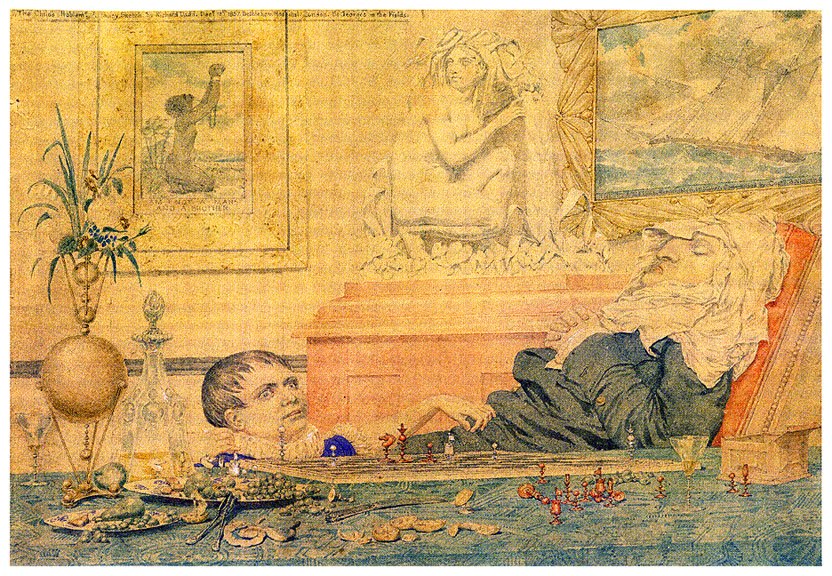
The other long piece is “A Child’s Problem”, inspired by the painting by the 1857 painting by Richard Dadd as seen here:
Dig the look on that kid’s face.
Author Reggie Oliver spins the scene into a tale of self-inflicted revenge, as a boy staying with his authoritarian uncle is challenged to find certain artifacts on the estate, things that the uncle may later wish may have been best left alone. Set in the early 19th century, Oliver does a fine job in capturing the flavor and language of the era without it coming across as arch or artificial. The boy, young George St Maur, is initially timid, at times frightened by his strict, intolerant uncle but in the end matches him with his own bluster and cunningly turns the tables on him, with appropriately gruesome results.
Ramsey Campbell’s “Getting it Wrong”, a dark twist on quiz shows that offer helplines like Who Wants to be a Millionaire? would fit nicely in any revival of The Twilight Zone. It’s also a cautionary tale on being a deliberate jerk. If everyone posting juvenile, insulting comments on the web suffered the same consequences as the story’s too-clever-for-his-own-good protagonist, the web would be…a little more polite. Let’s be realistic, even knowing the consequences, some people will still be jerks.
Robert Shearman’s “Alice Through the Plastic Sheet” is an odd, funny and at times gag-inducing take on dealing with noisy neighbors in suburbia, with a vibe halfway between the off-kilter feel of the mannequin episode of the original Twilight Zone and something more darkly comedic.
While the collection is a less horrifying than the title suggests, there’s enough here to please most horror fans. Those expecting monsters, gruesome deaths and terrifying sights in every story may be less satisfied.
Doctor Sleep tells the story of the adult Dan Torrance, son of the late Jack Torrance, who was last seen getting blown up by an overloaded boiler in the Overlook Hotel in Stephen King’s 1977 novel, The Shining.
The bad news for the surviving male member of the Torrance clan is he’s picked up his dad’s habit of drinking heavily, getting into fights and living a bleak, unhappy existence.
King chronicles the painful bottoming out of Dan, who finally finds some hope and a great deal of danger in a small town in New Hampshire. At the same time he has been developing a psychic bond with a young girl whose own powers far outstrip Dan’s. This girl–Abra–eventually becomes the target for a group of near-immortals that call themselves The True Knot. The Knot maintains its longevity by inhaling “steam”, the psychic essence that escapes from someone experience pain, either mental or physical (a big payday for them early on is the 2001 attack on the World Trade Center, where the suffering and anguish fills them like an all-you-can-eat buffet).
The leader of the Knot is a woman with a few psychic tricks of her own named Rose the Hat. By turns caring and threatening, she leads her group across the U.S. and through the centuries. Upon discovering Abra’s existence she fancies the girl could be tapped as a nigh-endless supply of steam.
King does a fine job of weaving the various sides of the story together, intertwining them neatly as they converge toward the inevitable confrontation. The ending–which I won’t spoil here–surprised me in being conventional yet satisfying.
Dan’s descent as he hits bottom with his drinking is perhaps even more horrifying than the ghosts of the Overlook that seek him out. King’s own battles no doubt informed these scenes and they have a stark authenticity that buttresses the supernatural elements.
My strongest criticism–and it’s overall fairly mild–is one I often have with King’s characters, and that’s the way so many of them have an almost prescient ability to correctly guess the actions or motivations of others, as if every person in King’s universe has some low-grade version of the shining. Having said that, King does explain in Doctor Sleep that many people do have exactly that, so it’s a convenient way to retcon the ability in the characters in his previous billion or so novels.
Doctor Sleep is vintage King, as trite as that sounds. His storytelling and characterizations remain as vital as they were when the original tale of the Overlook Hotel debuted 36 years ago.