
Book review: Paperbacks from Hell

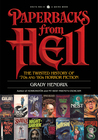
Paperbacks from Hell: The Twisted History of '70s and '80s Horror FictionPaperbacks from Hell: The Twisted History of ’70s and ’80s Horror Fiction by Grady Hendrix
My rating: 4 of 5 stars

Equal parts snarky and respectful, this look back on the paperback horror novels of the 1970s and 80s is a gruesomely delightful trip down memory lane.

Hendrix’s language in describing the outlandish stories moves beyond colorful and into tasteless at times, but I could never decide if it was in keeping with the spirit of the books described or if he was trying (and perhaps failing) to adopt the presence of a guy at a bar sharing some whacked-out stories with you. It doesn’t come up a lot and I suspect it won’t be an issue for most people attracted to this book, but be warned all the same.

How you read this book will greatly affect your enjoyment of it. This is not something to read on a Kindle or Kobo ereader. If you are not in possession of a paper copy, you owe it to yourself to read this on a larger tablet, all the better to take in the dozens of gaudy, gory and inevitably skeleton-filled book covers. I recognized a few here and there, but even as a fan of horror in the 80s, a lot of these were new to me.

Did I mention the skeleton covers? Skeletons were very popular.

When you’re not drinking in the bloody book covers, Hendrix provides a somewhat truncated overview of the period, dividing the chapters into different themes such as Hail Satan, Creepy Kids, Weird Science and so on. For everyone who scrunched up their toes at that scene in Stephen King’s IT (hint: it involves sex and kids), Hendrix lays out stuff that is far worse here, stuff that layers on one outrageous, offensive, gory, horrible, disgusting thing on another, then slices them all in half with a machete and serves them up for dinner, with the boiled blood of babies as the gravy. I’m probably underselling some of these novels on how gruesome they are–and this is before Hendrix even gets to the actual splatterpunk sub-genre.

In a way, Paperbacks from Hell is sad, as it chronicles the rise of popular horror fiction that began after Rosemary’s Baby became a hit in the late 60s, and follows along as it sputters out in the early 90s. This is when horror proper gave way to thrillers (aka a million variations on “killer on the loose” stories). While Grady doesn’t talk about contemporary horror, a visit to any decent-sized bookstore (those that remain) will reveal that not much has changed. Horror is again a niche, and in some ways worse (or better, depending on your perspective), with endless series based on zombie apocalypses, other apocalypses, or zombie apocalypses mixed in with other apocalypses. If you like zombies, though, you pretty much have a lifetime smorgasbord already waiting for you.

In the end, though, it’s the lurid full color book covers that make Paperbacks From Hell worth looking through. There is enough here to keep a Ridiculous Book Cover blog going for years.

Recommended for fans of horror or fans of paperback art who don’t mind the occasionally gruesome work. And lots of skeletons.

View all my reviews

Book review: Strange Weather

Strange WeatherStrange Weather by Joe Hill
My rating: 3 of 5 stars

I’d easily give Strange Weather four stars, but one of the stories just didn’t work for me. Having said that, this is still an easy recommendation for both fans of Hill and horror in general.

The first story, “Snapshot” has a nice Twilight Zone vibe going on. Set in 1988, it tells of a surly, strange man with a not-quite Polaroid camera that does more than just take your picture, it takes you, a piece at a time. The man encounters an awkward, clumsy, but bright teenage boy and…things happen. It’s better to just read and enjoy the story.

The second story, “Loaded” is about a murderous psychopath who acquires a lot of guns and goes on a shooting rampage and kills a lot of people. And that’s it. In the Afterword Hill describes it as “my attempt to make sense out of our national hard-on for The Gun” and while the story certainly has plenty of guns and gun-related violence, it didn’t work for me, even as I imagine Hill leaning back in his chair, pointing a finger gun at the monitor after writing the last sentence of the story and saying, “Nailed it!” If “Loaded” were a movie, it would be an unrewarding slog, a series of killings that say little more than “a psychopath with guns is probably not a good thing.” I also felt the characters didn’t always act believably. The reporter makes a long string of stupid decisions for no apparent reason, while I think the psychopath would likely have killed himself after one particular event in the story.

spoiler
specifically after he accidentally shoots and kills his son
The forest fire that serves as a backdrop is maybe meant to be a metaphor, but it could have been cut from the story and not affected it at all.

I did think it was clever setting the story in Florida, though, allowing the character of Kellaway (the killer) to represent everyone’s crime headline favorite, Florida Man.

The third story, “Aloft” is a fantasy involving a petrified skydiver who, on his first jump, lands on a cloud that turns out to be more than just a cloud. It’s funny and weird and the background story that intersperses his travails on the cloud is touching and engaging. The whole story just hangs together tightly.

The final story, “Rain” is a bleak, nasty tale that asks the question, “What if it rained super-sharp shards of crystal?” If you guessed “a lot of people would die”, you’re right! Things tie together a little too conveniently at times and the whole “Comet Cult” group that serve as neighbors to the main character, seem more in service to the plot than being necessary to the story. Still, Hill skillfully paints a truly frightening picture of a world where the weather can suddenly kill. A certain president with a fondness for tweeting insults adds further to the story’s sense of despair.

Overall, Strange Weather is a terrific collection, even if “Loaded” was a misfire (sorry) for me.

View all my reviews

Book review: What the Hell Did I Just Read

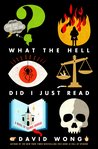
What the Hell Did I Just Read (John Dies at the End #3)What the Hell Did I Just Read by David Wong
My rating: 4 of 5 stars

Even though the title of What the Hell Did I Just Read is self-referential in the same the previous novel was (This Book is Full of Spiders), I still kept reading expecting some sort of arcane book to play a part in the story.

Don’t be dumb like me. The only book is the novel itself, the third adventure of David, John and Amy, twenty-somethings living in Undisclosed, a small town beset by supernatural as well as super gross manifestations.

Like the previous entries, What the Hell Did I Just Read is filled with weird (Batmantis???) and gruesome (giant squirming larvae) monsters that the would-be heroes must stop before the town and possibly the universe itself is destroyed.

It’s more fun than it sounds.

The story starts with a child kidnapping and as the saying goes, things escalate quickly, with seemingly immortal not-government agents, a biker gang and others tossed together as an unceasing storm threatens to sweep the town away in a devastating flood.

Jason Pargin, going under the pen name David Wong, does his usual excellent job juggling all of the elements while tossing in regular dollops of absurdist humor. There are even a few serious moments of personal growth for some of the characters. But only a few. Mostly it’s dildo guns, silicone butts, dimensions of endless despair and children who may not be quite as they appear.

My only real disappoint with the story is how it builds to a climax that never really happens. Sure, stuff happens but not necessarily what you’d expect, although you could argue that’s not necessarily a bad thing, either. It’s open-ended when I was not expecting it to be open-ended. Maybe Pargin wanted to leave room for a direct sequel, because who can’t get enough of giant squirming larvae that could potentially destroy the world?

This is an easy recommendation for anyone who enjoyed the first two Books (the first being John Dies at the End). For anyone else who is not averse to some well-written and occasionally gross-out horror with tongue in/through cheek, it’s still a solid recommendation (though you should still read all three in order for maximum effect).

View all my reviews

Book review: Lost Signals

Lost SignalsLost Signals by Max Booth III
My rating: 4 of 5 stars

As with most anthologies, the quality of the individual stories varies in Lost Signals and while a few didn’t do much for me, the collection overall is well worth reading if you enjoy horror.

A lot of enjoyment comes from how the authors make use of the broad theme of the book, with the inevitable stories about weird radio transmissions, and others that get even weirder, darker or both. There are references to the Cthulhu mythos, Twilight Zone-ish dead people calling on phones, jovial electronic devices that seem to enjoy killing, time displacement and enough electrical discharges to put your hair permanently on end.

“All That You Leave Behind” is a haunting tale by Paul Michael Anderson in which a couple experiences the sorrow of a miscarriage and the surreal joy of birth simultaneously. Keeping with babies, Damien Angelica Walters’ “Little Girl Blue, Come Cry Your Way Home” will make you look twice at baby monitors.

David James Keaton’s “Sharks with Thumbs” (apparently you needed at least three names to get into this anthology) nearly lost me up front as it’s written from the second person perspective, but the off-kilter story of a man and a fly that acts as a supernatural transmitter is so daft the unusual choice of perspective ends up working.

While I normally don’t give much thought to the actual order of stories in a collection, I had expected the long “All That You Leave Behind” to be the concluding tale, but it’s followed by a rather glib tale presented as an epistolary of a video game that inspires many of the children in a small town to kill themselves. The quiet, powerful conclusion of “All That You Leave Behind” would have been a nice conclusion for the book, but “somethinginthecode” feels like an attempt to abruptly lighten things up (weird, I know, given the plot of the story). It’s a minor thing, and others may react differently (or indifferently).

Overall, the range of styles and subject in service of weird horror and the specific theme are strong and varied enough to warrant a recommendation. Just be advised that the tinfoil hate probably won’t help.

View all my reviews

Book review: The Boy Who Drew Monsters

The Boy Who Drew MonstersThe Boy Who Drew Monsters by Keith Donohue
My rating: 3 of 5 stars

The ending of The Boy Who Drew Monsters caught me by (pleasant) surprise, which was a fun way to end the novel, but it also made me reflect back on the story’s events that lead up to that ending, and I’m left with the feeling that while this is a good, creepy story, it falls short of its potential.

The potential goes unfilled for a couple of reasons. On the plus side, all the ingredients are here for a spooky tale–a remote(ish) seaside location during a snowy winter, a strange child with some rather unique talents, old shipwrecks and their possible ghosts, unearthed bones, sightings of weird people and animals. Into this author Keith Donohue inserts an unhappy family–a young couple straining to hold everything together as they raise their son, a ten year old with Asperger’s and agoraphobia who spends most of his time withdrawn into himself.

Things get progressively weirder as the house and area are beset by unusual sounds and fleeting glimpses of monstrous things. Holly, the wife, finding little comfort from her husband, the once unfaithful Tim, returns to church, seeking guidance from a surprisingly skeptical priest and his odd Japanese housekeeper, who speaks openly of ghosts over the objections of the priest.

All of this is good material but there are problems. The pacing feels off. When the first big storm of the winter arrives you know it’s going to lead into the story’s conclusion. The problem is that while a lot of plot points are introduced, there is no sense of escalation, things just keep happening until the storm hits and the story leaps forward to an abrupt conclusion.

The priest is an entirely odd character, seeming to fit more of a “skeptical scientist” role who adds little to the story. The housekeeper offers more, bringing comfort to Holly and speaking to the boy, Jack Peter, holding out the promise of a breakthrough with him, but this gets abandoned without further exploration, again making her character seem superfluous.

Jack Peter, the boy, is unsympathetic. While the reader will naturally feel bad about his afflictions, his behavior is compulsively strange and remote, and never really changes.

In the end the story just needs more flesh on its bones. What is here is decent enough, there’s just not enough of it, leaving the story feeling thin and underdeveloped. Donohue’s writing has a lyrical rhythm to it, which makes the relatively thin material all the more frustrating. This could have been a great read instead of just a good one.

View all my reviews

Book review: Ghostland: An American History in Haunted Places

Ghostland: An American History in Haunted PlacesGhostland: An American History in Haunted Places by Colin Dickey
My rating: 4 of 5 stars

Ghostland is at turns frightening and horrifying, not because of the alleged ghosts said to haunt homes, bars, hotels and other places across the U.S., but due to the sometimes unspeakably awful ways the people who lived, worked or occupied these places behaved.

In the hands of author Colin Dickey, Ghostland is an examination of how crime, class warfare, sexism, racism and more are often the root of so many ghostly appearances. Where people have suffered, Dickey argues, stories of ghosts thrive, borne variously from anxiety, guilt and loss. Sometimes the stories have an economic motivation–people making a few bucks off tours of allegedly haunted houses. Other times the stories are a way of translating some human horror–the mistreatment and abuse of slaves, for one–into something more easily-digested. As Dickey notes, “Ghost stories like [these] are a way for us to revel in the open wounds of the past while any question of responsibility for that past blurs, then fades away.”

As Dickey details the operation of massive insane asylums constructed in the mid to late 19th century, with their horrific overcrowding and cruel experimentation on patients in search of “curing” them, it seems inevitable that ghost stories would emerge from the real-life horrors that went on inside the walls of these hospitals.

Dickey also covers some well-known haunted locales, such as the Winchester Mystery House. Here he lays out evidence suggesting that Sarah Winchester didn’t keep adding rooms to the mansion to ward off the spirits of those killed by her husband’s rifles, but because she had the keen mind of an architect–and nearly limitless funds to indulge her experiments in building.

And so it goes throughout Ghostland, with Dickey deconstructing nearly every haunted place he has researched. A few that he visits give him pause, leaving him genuinely unsettled, but there is no “a-ha!” moment when he becomes convinced–or tries to convince the reader–that ghosts are real.

Rather, this is a fascinating journey through the darker parts of American history, Ghostland is well worth reading for how capably it provides rational explanations for the ghosts, poltergeists and other entities said to haunt so many corners of America’s vast landscape. Recommended.

View all my reviews

Book review: The Folcroft Ghosts

The Folcroft GhostsThe Folcroft Ghosts by Darcy Coates
My rating: 3 of 5 stars

Although not specifically branded as such, The Folcroft Ghosts struck me as a story aimed at middle school kids. It’s short–more a novelette than a full novel–there’s no foul language, the scares are relatively mild, and the heroes are a plucky young sister and brother.

This is an easy read but by the end the experience felt a bit underwhelming. The brevity of the story, along with a curiously abrupt wrap-up at the end brought to mind a treatment for a half hour TV anthology series or perhaps an expanded short story. What’s here is good, it’s just that it all feels a bit thin and rushed, as if written with a short deadline.

I wasn’t bothered by the ghosts not being particularly frightening, as the story is structured more as a mystery, with suspense ratcheting up not because of the ghosts, but due to the folksy homespun charm of the matronly grandmother morphing into some seriously questionable applications of the concepts of family and “love.”

Overall, this is a solid if slight read that eschews big scares for lingering unease. It’s a story that will likely be enjoyed even more by kids around age 12 or thereabouts.

View all my reviews

Book review: American Elsewhere

American ElsewhereAmerican Elsewhere by Robert Jackson Bennett
My rating: 3 of 5 stars

American Elsewhere would sit between 3 and 4 stars if I could rate it accordingly. It’s a solid horror story with a science fiction veneer that could be glibly described as a pan-dimensional family fight come to Earth. It’s an entertaining read, with a strong Cthulhu vibe, though it’s not specifically set in that mythos.

The primary strength of the story comes from its protagonist, the ex-cop Mona Bright, whose past turns out to be way more significant than she could have ever imagined. Mona is tough, resourceful, intelligent and yet has her share of flaws and vulnerabilities, plus a mouth that would make a longshoreman blush. While she doesn’t always make the best choice, it never feels like she takes any action to simply drive the plot forward. It’s refreshing in a genre where all too often people must do really dumb things to keep the story rolling.

On the downside, the novel feels longer than it needs to be, with digressions, exposition and perhaps too many flashbacks weighing it down. The writing is always solid and engaging–though at times the author’s voice intrudes a tad more than I’d prefer–but there is definitely room to tighten things up.

Still, if you’re looking for a story about the perfect American small town and how it’s a front for horrible beings with horrible plans, American Elsewhere will satisfy. Recommended.

View all my reviews

Book review: Five Stories High

Five Stories High: One House, Five Hauntings, Five Chilling StoriesFive Stories High: One House, Five Hauntings, Five Chilling Stories by Jonathan Oliver
My rating: 3 of 5 stars

The five novellas in this collection all tell stories either centered around or at least featuring (sometimes very tangentially) the Gothic residence known as Irongrove Lodge, with narrative bridges connecting the stories together in a manner of sorts.

Irongrove Lodge is a nasty old place, full of tortured ghosts and malevolence that drives its occupants to madness and worse. Its many victims prove that a good design treatment on a hell house just leaves you with a nicer-looking hell house.

I enjoyed four of the five stories quite a bit, while one of them left me a bit unmoved. The linking narrative also didn’t really click for me and probably could have been excised altogether. The passages are brief enough that you can get through them quickly, though.

“Maggots” features a protagonist who may be afflicted by imposter syndrome–or his aunt could actually be taken over by some alien entity. It’s appropriately weird and yet thoroughly grounded at the same time. At one point Will, the young man who feels he may be standing precariously on the edge between worlds, writes down possible explanations for what he perceives as his aunt’s strange behavior, ending with “I have lost my mind.” The whole thing is enjoyable in how the characters behave and react in the most ordinary of ways to to each other and events both mundane and…less so.

“Priest’s Hole” is about a man who discovers he can shape-shift thanks to a rather special room in Irongrove Lodge. He ends up with an agent he never sees who finds him jobs and it gets complicated and messy from there. The shape shifter narrates the story and frequently apologizes for being melodramatic and stupid. It’s a neat take on shape-shifting.

“Gnaw” is a straight-up ghost story, in which a young family moves into Irongrove Lodge, the husband determined to remodel it and make it a home for his wife and two children. Various ghosts and ghost-like entities have other plans, most of them violent and disturbing. The remodeling does not go well. This is one of those tales in which you will find yourself constantly muttering to yourself, “Why won’t they leave?!” but still manages to keep on the side of the characters behaving believably.

“The Best Story I Could Manage Under the Circumstances” is a surreal trip through magically-appearing doors in bedroom walls and ceilings, in which a young boy is ensnared by a demented storyteller. The whole thing is presented in a very droll manner, as a kind of modern fairy tale, and while it is a triumph of style, I found I didn’t care about the characters and nearly stopped caring about how things would turn out. If this style works for you, however, it may make your socks roll up and down in delight. My socks didn’t really move much.

The final story, “Skin Deep” is told as a series of vignettes from the perspectives of those involved, a format author Sarah Lotz used to good effect in her novel The Three and again uses skillfully here. This is another remodeling-gone-amok tale, in which a May-December couple moves into one of the flats at Irongrove Lodge, where Robin, the younger of the two, becomes obsessed with redecorating the place to the detriment of his wife’s bank account, their marriage and his sanity. The remodeling again does not go well, though the cleaners manage to get most of the nastiest stuff cleaned up.

Given the subject matter of most stories, the tone in the majority of them is surprisingly light, yet with the exception of “The Best Story…” the presentation never feels glib. “The Best Story” is all about being glib and weird and gross (you may not want to pass along this story to someone expecting a baby–trust me on this).

While I would overall recommend Five Stories High,/> the marketing of it is deceptive, as only two of the stories are really ghost stories at all. They also happen to be the only two that really make Irongrove Lodge a significant part of the narrative, rather than something shoehorned in to technically fit the theme of the collection.

View all my reviews

Book review: Cold on the Mountain

Cold on the MountainCold on the Mountain by Daniel Powell
My rating: 3 of 5 stars

This is a solid little horror novel that feels more like an expanded short story. There are no side plots or other distractions here, just a Point A to Point B story about a family that takes a shortcut in the Sierra Nevada mountains that leads them into the small town of Adrienne, a place where evil gathers (literally, all the bad people of the world end up here after they die).

As part of the contingent of “normals” that blunder into Adrienne, Phil and Wendy Benson are forced to work for the “dark ones” to earn a chance for a once-a-year lottery that sees a bunch of people, both good and bad, released back into the world via magic portal. Adrienne is host to demons, serial killers, Joseph Goebbels (“Call me Joseph”) and the teenage Columbine killers who are never mentioned by name and are weirdly depicted as cartoonish villains.

There is some nice tension as the family struggles to both follow the rules and sometimes defy them, knowing the dire consequences of being caught, but the story is almost too efficient as it speeds along to the endgame, the various pieces all falling in place so quickly there is little time to allow events to sink in. The reader learns about Adrienne but it only ever feels like the surface is examined.

Phil, the protagonist of the story, comes across as a decent but ultimately bland kind of everyman. Bo, his brother on the other side, leads a search to find him and his family, and at one point he and his girlfriend come to believe it’s essential to get the local sheriff on-board to make their kooky plan to free the normals of Adrienne work, though it’s never stated exactly why he’s needed. The sheriff is nice enough as a character, but he becomes increasingly non-essential as the story progresses, to the point where I almost felt his alleged need was a deliberate red herring.

The conclusion will likely leave a lot of readers with a “What happened next?” feeling but that’s not necessarily a bad thing.

Overall, Cold on the Mountain has a comfortable old school horror feel to it. The journey is brisk–perhaps too much so–but the action certainly keeps rolling along.

View all my reviews

Book review: The Ways We End: Six Tales of Doom

The Ways We End: Six Tales of Doom (Dark Collections Book 1)The Ways We End: Six Tales of Doom by Ann Christy
My rating: 4 of 5 stars

The bland cover of The Ways We End (at least of the ebook edition) is unfortunate because it may turn away potential readers and they would miss out on a terrific collection of stories by Ann Christy that depict apocalyptic scenarios that deviate from or subvert the usual zombies/nuclear war/alien invasion tropes. Even the author’s notes at the end of each story are a delight, conveying the infectious joy Christy had in both writing the stories and their reception.

All six stories are well worth reading and are best without spoilers, so here’s some quick takes, in order:

“A Cottage of Hunger” puts together a rules-following protagonist, her quite mad mother and a lost teenage girl in a world where the sun is permanently blotted out in the sky. It raises interesting questions on how far some people might go to preserve a sense of order, believing they are doing the right–the proper–thing.

“The Mergans” is a story set in the far future, where descendants of Earth have formed a galactic “Peace Force” that uses its military might to intervene in corrupted cultures of planets colonized from seed ships, mostly by blasting everything to smithereens. The particular culture in “The Mergans” is especially ghastly in its treatment of women, but its liberators may not be quite what they seem, either.

“The Mountains of Five” follows the journey of a 12-year old girl exiled from her village and forced to find her way through a dystopian landscape. I found this story particularly evocative, its spare prose perfectly capturing both the spirit of the titular girl, Five, and her dangerous journey. There is a twist ending of sorts, but the astute reader will likely see it coming. It doesn’t make the story any less effective, though.

“The Bridge.” As Christy notes, this is a quick little “spooky campfire” story and it works nicely for what it is, but it is the slightest of the stories collected here. Still, trolls.

“Rock or Shell” is a time travel story that hints at larger mysteries while never fully revealing them, leaving the reader with a sense that there is a lot more to this depiction of a mist-like realm where thought alone can send someone off into nothingness, erasing them from time and space. Dashes of humor lighten the constant undercurrent of tension.

“A Mother So Beautiful” is probably the darkest and most disturbing tale of the collection. It eschews the body horror of “The Mergans” in favor of telling the story of a sociopath whose mother attempts to stamp out aggression through genetics and achieves horrific success. Watching the world disintegrate from the eyes of a profoundly unstable person is something that will stay with you well after the story ends.

Overall, a fine collection of doom, where some hope or happy endings are (usually) at hand. Recommended.

View all my reviews

Book review: Haven

HavenHaven by Tom Deady
My rating: 2 of 5 stars

When I pick up a book by an author I’m not familiar with, I do it because the story interests me, or I heard something positive about it, or it was on sale.

What I don’t do is familiarize myself with the author before reading, and so it was that I found out afterward that Haven is Tom Deady’s first novel. It is also the 2017 Bram Stoker Award winner for First Novel.

There are things I enjoyed about the story, an old-fashioned horror novel about a monster lurking in the lake of a small town–and the perhaps more menacing human monsters that work and live around the lake–but I found the story dragged on too long and the melodramatic writing was distracting at best and eye-rolling at worst. I read through to the end but didn’t feel much reward for having done so.

Given the reviews and awards, it may be that I’m just not getting the tone Deady was going for. He renders the characters well for the most part, though some of the supporting characters are typical small town stereotypes, and all of them tend to be overly explicit in their thoughts and actions. Subtlety is not merely tossed out the window here, it is packaged up and shipped over to the other side of the world.

In Haven the sheriff is a cartoonishly evil man with an equally cartoonishly evil son. They serve as the primary antagonists while the monster–the design of which brings to mind the car devised by Homer in The Simpsons in how it’s a conglomeration of mismatched parts intended to be the ultimate representation of its form–occasionally devours, but more often just weirdly mutilates and kills people who get a bit too close to the lake.

The mystery is slowly revealed over the length of the novel, mostly by having characters remember key details from the past piece-by-piece as their minds struggle with the wicked effects of alcohol, mental trauma or both. Conveniently, everyone remembers everything before the story ends.

The whole thing is hokey and kind of silly and I’m actually okay with that, but the writing ranges from a plain meat-and-potatoes quality to stuff that would have benefited from a more discerning editor. Observe:

“Shut the hell up. Who the hell do you think you’re talkin’ to, your freak friend, huh, Father?” The last word he literally spit out, spraying the priest with drops of saliva.

Eddie’s body was literally in pieces.

It hadn’t rained all summer, literally.

He was literally doubling over he was laughing so hard.

Women had never been a problem anyway, but after nailing Greymore, they literally threw themselves at him.

Next he stole a glance at his partner in crime—literally.

What if his little sermon had worked, and Jake had gone off half-cocked (literally) to the lake to find the thing himself?

And my personal favorite:

The ground was literally shaking under their feet as rocks rained down.

Not figuratively shaking, no sir. This ground was literally shaking. It was the real deal, shaking-wise.

The point of these examples (and there are many others) is that any good editor would have stroked out that one word without hesitation and made every sentence better as a result. That this was not done does Tom Deady no favors as a writer.

But I will say this–while I found the ending ultimately unsatisfying and the story overly long, I kept plugging away at it, anyway, so Deady obviously managed to capture enough of that old-fashioned monster horror novel thing to keep me engaged. If he continues to write and gets better help with editing and revision, his workman-like prose can only improve. He can tell a story so I see promise here.

View all my reviews