
UPDATE: I've gone through and added/edited entries to bring it up to date as of August 15, 2024.
Inspired by a thread on Broken Forum (and an idea I had for a post ages ago) here is a nearly complete list of every video game console and computer system I have owned, with dates (where I can remember).
The Computers
1982: Atari 400. With membrane keyboard! This was really just a video game machine for me but it was awesome. It came with four (!) joystick ports, took cartridges and provided far better sound and graphics than any comparable video game system back in the day. I almost considered buying the kit that replaced the membrane keyboard with actual keys. Instead, I held out until I got my next system.
![[IMG]](http://upload.wikimedia.org/wikipedia/commons/thumb/8/8f/Atari-400-Comp.png/800px-Atari-400-Comp.png)
Open the hatch, insert Star Raiders cartridge, lose rest of day.
1984: Commodore 64. The C64 shipped in 1982, but it cost $600 then and I couldn’t afford it. By 1984 it was selling in huge numbers and had been reduced to a mere $200. The one I got in the early part of 1984 was one of a notoriously unreliable batch (I recall about a 25% or so failure rate) and had a bad keyboard. The replacement worked fine, though, and having a keyboard you could touch-type on was neat. This marked the first time I bought productivity software for a computer, a $130 word processor that I’ve long forgotten the name of. On the C64 you could create files about 2.5 pages long before you had to use dot commands to chain the files together for printing. It taught me brevity. I still have some of the data disks. I wonder if they would still be readable? In addition to being my first computer used for non-gaming stuff, it was also the first that I got peripherals for, namely an Epson dot matrix printer (designed to misfeed paper as soon as you turned your back on it), the 1084S colour monitor and the infamous 1541 floppy drive. The first game I bought on floppy disk was Lode Runner. I actually picked it up before I even had the C64 and marvelled over its floppy diskness. This was also a game machine, of course, with most games running from floppy and the best ones making use of Epyx’s Fast Load cartridge.
I still recall playing Infocom games and knowing I’d successfully figured out a puzzle because the 1541 drive would start clattering away (the game apparently kept the YOU HAVE DIED moves stored in memory).
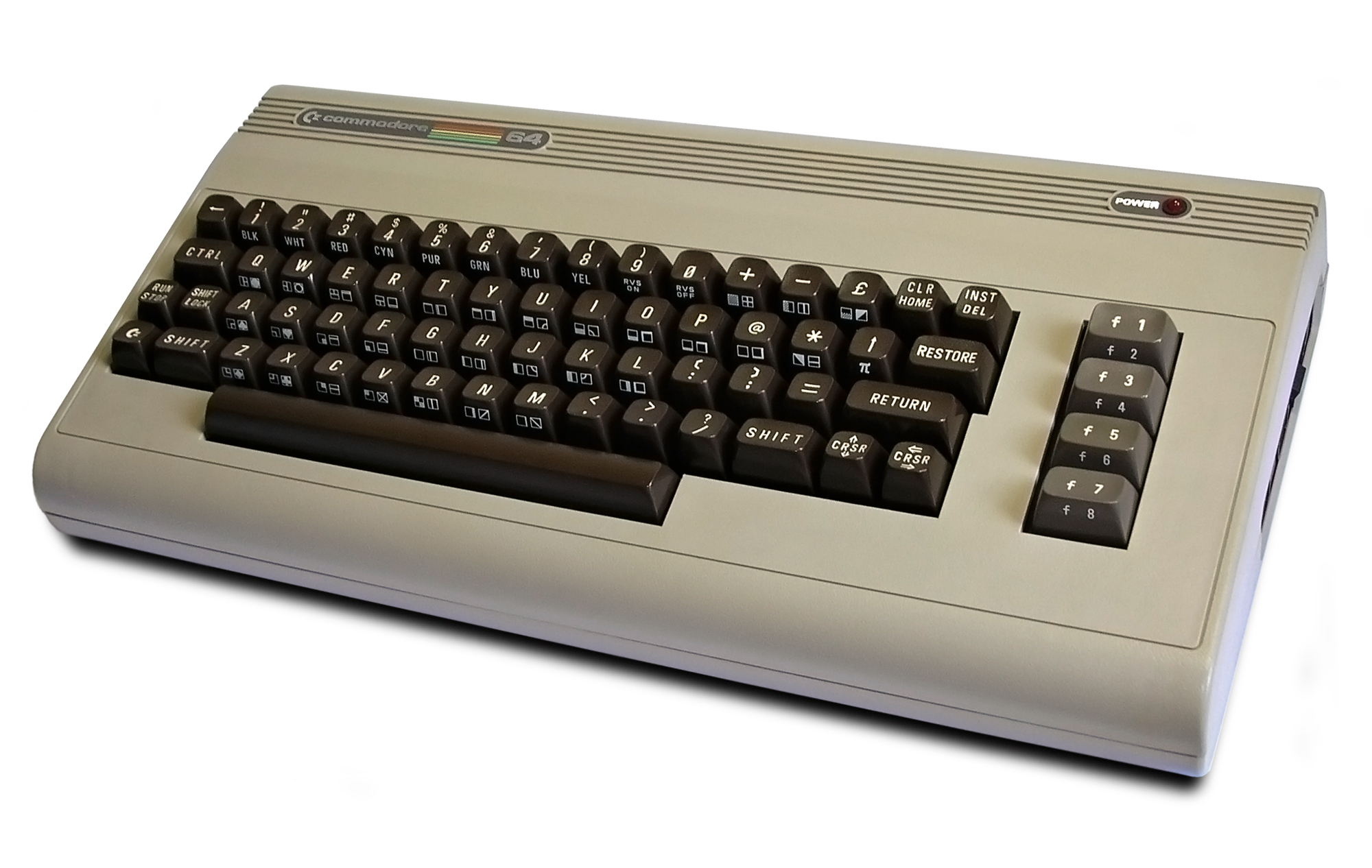
Not shown: 1541 floppy drive a.k.a. Is It Supposed to Make That Noise?
1987: Atari 520ST. I had it with the monochrome monitor, so it was for Serious Business. I had WordPerfect 4.1 and WordWriter ST. I still played Phantasie on it, though. I eventually got the colour monitor and tried and disliked King’s Quest III. I still remember where this computer sat in my apartment on Nelson Street in Vancouver, and even recall writing specific stories with it. This was the first computer where I had dual floppy drives. I was clearly moving up.
![[IMG]](http://upload.wikimedia.org/wikipedia/commons/thumb/3/39/Atari_1040STf.jpg/800px-Atari_1040STf.jpg)
A built-in floppy drive, a 2-button mouse and numeric keypad. Future: now!
1989: Amiga 500. Ah, the Amiga. I loved this computer. It felt sexy and modern and had tons of games and lots of other interesting and useful software for it. I had ProWrite, excellence and I think maybe one other word processor. Some people collected games, I collected word processors. I stuck mainly to ProWrite. I eventually upgraded the Amiga (my first computer upgrades ever) to AmigaDOS 2.1, 3 MB of ram and a 52 MB hard drive. This let me call up ProWrite nigh-instantly. Black Crypt also installed to the HD, which was nice. I kept the Amiga until I finally made the jump to PC and to this day regret selling it. Although pictured below, I did not have an external floppy drive for it.
![[IMG]](http://upload.wikimedia.org/wikipedia/commons/thumb/c/c3/Amiga500_system.jpg/772px-Amiga500_system.jpg)
Like the Atari ST but better.
1994: PC with Athlon 486-40Mhz CPU and 4 MB of ram. I eventually added a 2x CD-ROM drive to it so I could play Myst.
It starts blurring after this, but along the way I had:
- Pentium II 120Mhz. I mostly remember playing Quake II on this with a Diamond Monster 3D video card (Voodoo 1 add-on card).
- Celeron 500 (for about two weeks before it got stolen from my apartment — three days before Christmas, ho ho ho)
- Athlon XP 1800. This was clearly a better system over equivalent Pentiums at the time.
- Athlon 64 (first 64-bit system, though it only ran 32-bit Windows XP)
- Intel Core 2 Duo 6850 with Nvidia GTX 8800. Back to Intel.
- Intel Core i5 2500K (quad-core). This dates back to January 2011. 8 GB ram, Nvidia GTX 580, Windows 7. It was updated to Windows 8 then Windows 10 before being retired.
- Ryzen 7 2700 with Nvidia RTX 2070 (2019) and 32 GB ram. Back to AMD. I’m so fickle. This is my current system as of August 15, 2024.
Bonus laptop entry:
- Lenovo ThinkPad (2018, 6th generation). I sold it in 2023.
And not forgetting the Macs:
- MacBook Air (2013)
- Mac mini (2018). Intel, had crappy Wi-Fi and Bluetooth.
- MacBook Pro (2016). The horrible butterfly keyboard version.
- MacBook Air (2020, M1 version)
- Mac Studio (2022, M1 version)
I currently only have the Mac Studio.
Video game systems
Atari 2600. It was still called the VCS when I got it in 1980. I probably had 30+ games on the system (I had a list somewhere at some point) and favourites would include: Adventure (duck dragons!), Superman, Video Pinball, Canyon Bomber, Circus Atari, Night Driver, Demon Attack (which I thought looked amazing for a 2600 game), Kaboom!, Asteroids (a surprisingly decent port) and a bunch of others I’m forgetting. For its primitive hardware, the system had some fairly captivating, if obviously simple, games.

And it came with two joysticks and two paddle controllers. That’d be $150-180 extra these days!
Intellivision. I didn’t know who George Plimpton was but I knew I had to have the Intellivision. I got it on cheap thanks to my brother’s wife’s employee discount at Woolworth’s. I never had as many games with it as I did with the 2600 but some were classics, even if that thumb wheel proved to be less than optimal. The Intellivision is also where I (more or less) learned the rules of American football. Favorites include Microsurgeon, Skiing (falling was especially painful), Armor Battle, Sea Battle, Astrosmash (this was almost zen-like in the way you could keep racking up a score as the shapes tumbled down from the top of the screen) and Major League Baseball (Yer Out!)
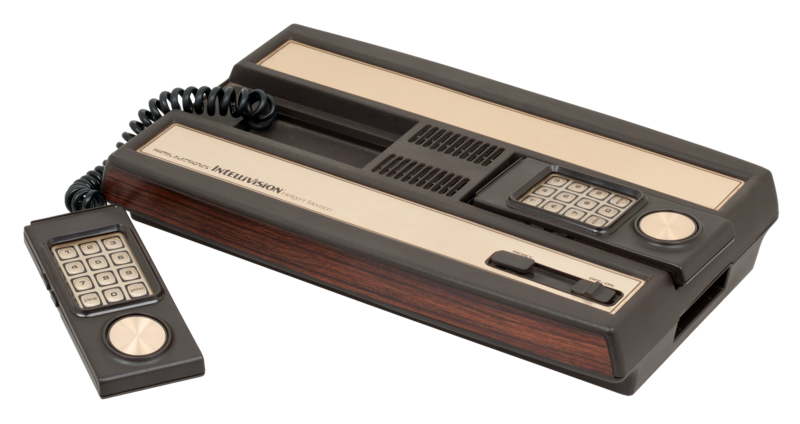
From the era when fake woodgrain was on everything.
Atari 5200. I had this around the same timeframe as the Atari 400, which was appropriate, because the 5200 was pretty much a 400 re-purposed as a game console. The joysticks were wacky non-centering analog things that worked great for games like Missile Command and not so great for games that required precise changes in direction, like Ms Pac-Man. One of the neat things was how the system would switch to a blank screen when you turned it off to switch cartridges, instead of blasting you with the sound of a static-filled TV display. I never had many games for this, mostly some arcade ports, but it was a decent machine. The cartridges were massive.

This sleek design still holds up 30 years later. That joystick…not so much.
ColecoVision. This had the potential to be the ultimate console, but it came out just before the whole market crashed in 1983. I still enjoyed it for what it was: a machine that consciously improved in many ways over its predecessors. The joysticks were better than the 5200’s, the keypad and buttons better than Intellivision. Graphically, it offered the closest to arcade-style graphics at the time. It also had an awesome pack-in game: Donkey Kong (this was before Nintendo locked it up forever). Most of the well-known arcade hits were already licensed to other companies so Coleco had to go with more of a B-list, but there were some excellent games among them, if less known: Venture, Looping, a Smurf game that featured so-so gameplay but astonishing graphics for 1982, Carnival, Lady Bug and Mr. Do! The load screen was annoyingly long — apparently in an attempt to get the ColecoVision name permanently embedded in young and impressionable minds.
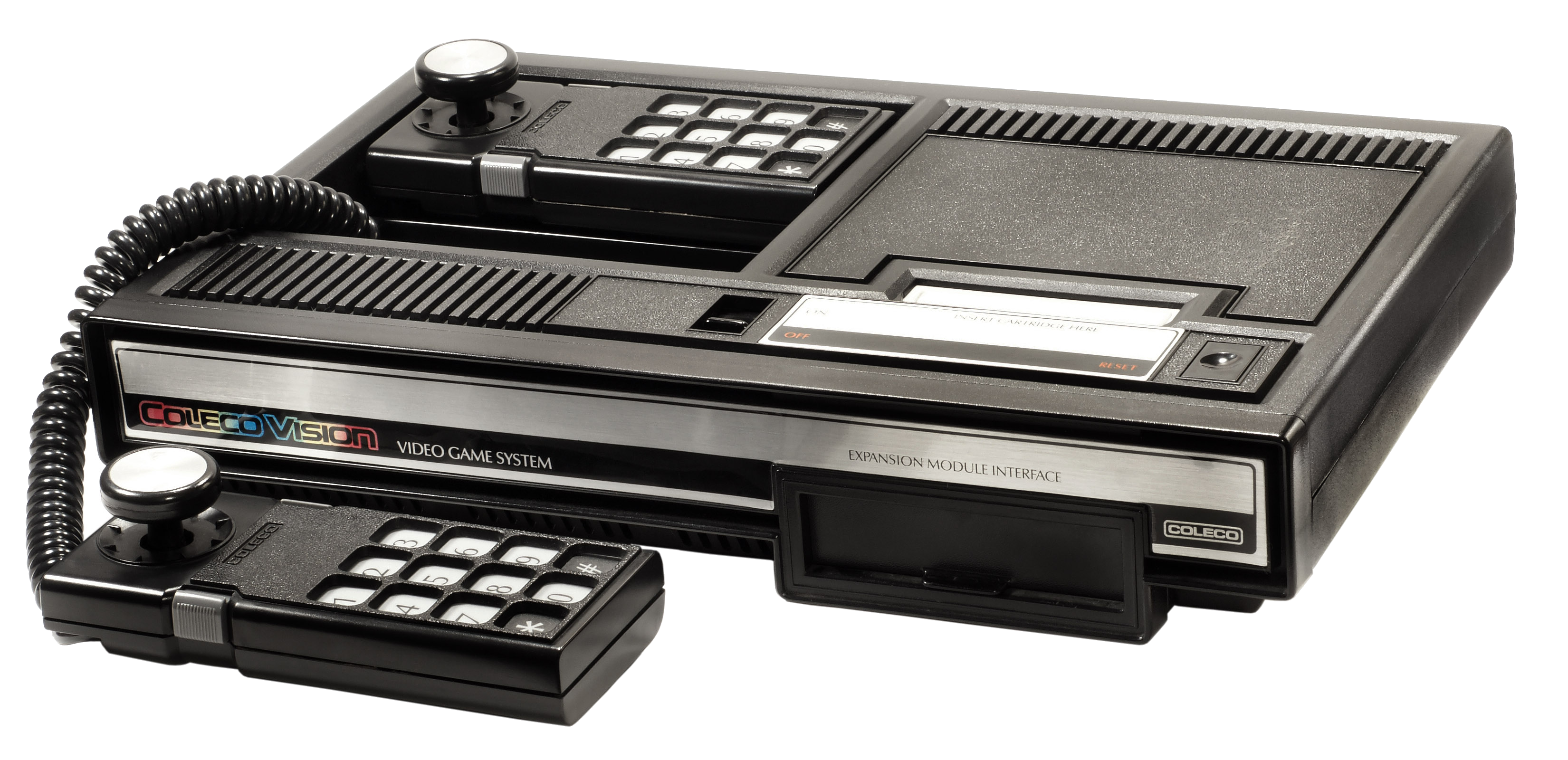
Kind of cheap-looking but the games were good!
After the ColecoVision I turned to computers for the next 20 years. It wouldn’t be until 2003 that I would pick up an Xbox. Three years later I got an Xbox 360 but found I used it so little I ended up selling it off.
Later:
- Xbox One (still have it, but not connected to anything)
- Xbox Series X (Microsoft is so bad at naming consoles). This is hooked up to the TV and is mostly used as a media player.
- Nintendo DS. Used pretty regularly until I got an iPhone.
- Nintendo Switch. Rarely used. I bought it at the start of the pandemic, but never really got into it.
 Share this post on social media.