With more people talking about the idea of a dead internet, I find weird comfort in the gaming site Blue’s News, which served as my homepage over 20 years ago and looks pretty much exactly the same now as it did then:
You can almost smell the HTML.
I still don’t get the three lines at the top, though.
One of the few perks of being old is I got to see the video game business grow from basically nothing to the monster it is today. Sometimes it’s a bad monster, but I’m going to talk about the good one here.
As a kid, I remember seeing coin-operated Pong machines in places like restaurant waiting areas and being dazzled by the technology. Around 1976 my family got a home Pong machine, probably from Sears. It might have been this one, which looks the way I remember:
My brother managed to pull the paddles out and rewire them to be handheld. Neat! A few years later, I got my first Atari 2600, then still called the VCS. While I’ve had other consoles over the years (and decades) the 2600 was where I cut my video game teeth and I had more games for it than the other systems–partly because it was my first system, and partly because there were so many games made for it.
Most of the games were not great, because the 2600 hardware was pretty primitive, even by the standards of the time. But still, there were games I came back to again and again. Here’s my list, in no particular order (you may wonder why some notable titles, like Pitfall, are missing–it’s because I didn’t have them. I was a kid, I could only afford so many cartridges!)
All links to Wikipedia.
Adventure(Atari). Yes, you’re a square with an arrow and the dragons look like ducks. But back in 1980 this was one of the few home video games to make you feel like you were in an actual world.
Superman(Atari). Flying around as Superman was engaging on its own. The rest of the game almost didn’t matter and if you squint, it’s kind of a variation on Adventure. Still, flying!
Asteroids(Atari). This was a pretty simple game in the arcade, so it translated well to the 2600. Better, it was in colour and contained a bunch of variations the arcade version lacked.
Demon Attack (Imagic). As a Space Invaders clone, this had one trick–some enemies could split in two. But it was the graphics that dazzled me here, which seemed amazing for the 2600.
Video Pinball (Atari). This was my first “cozy” game and I didn’t even know it. While it crudely approximated pinball, what I liked was getting into the zone and being able to rack up ludicrously high scores. If I needed to capture some Zen, I played Video Pinball.
Super Breakout (Atari). Surprisingly good sound design elevated this game, along with its variations.
Missile Command (Atari). Another arcade port that worked surprisingly well. It simplified things, but the joystick control was tight, and the sound was great.
Circus Atari (Atari). The key here was the paddle controller, which worked really well. Popping balloons was strangely addictive.
Stellar Track (Sears). A Sears exclusive, this was my first taste of strategy gaming–and I liked it!
I had about 30 cartridges or so, and a bunch of these were Activision games, so you may be wondering why none of them made the list. It’s mostly because they looked great, but actually didn’t have a hook that kept me coming back. Barnstorming and Freeway were fine, but I’d keep going back to Asteroids or Missile Command. But here’s a few runner-ups:
To be fair, Diablo has always been big on Hate™. Also, the demon art they are using for the expansion (Lord of Hatred–see?) looks…kind of silly? Imagine him trying to squeeze through a narrow door with those horns.
The first two paragraphs of the Mastodon post below resonate with me–my first computer was an Atari 400, but my second and “real” computer (the 400 was basically a gaming machine) was a Commodore 64. And I had an Amiga, too. The C64 and Atari 400 were completely offline, my Amiga and Atari ST connected to BBSes via 33.6 baud modem. It wasn’t until I had my first PC that I ventured out onto the internet at large, but even then, circa 1996 or so, the whole world of computers, rapidly evolving in performance and capabilities, still held such tremendous promise. I had absolutely no conception of how it might all be turned against us and exploited by capitalist companies more interested in earning ever-expanding profits, no matter the cost to the world, or the individual. I just enjoyed it in the moment, whether it was doodling with a Koalapad on my C64, writing short stories using ProWrite on my Amiga, or discovering weird blogs on my Windows 98 PC. Or starting my own weird blog (this one, to be specific).
datarama on Mastodon:
@Tattie I think one of the reasons I never really got into retrocomputing – despite nerding out with a C64 or an Amiga sure did feel a lot more fun than computing in the current day – is that what made it feel so great back then was that it felt like I could just make out the contours of the future, and it looked like it would be amazing. So much creativity waiting to be unlocked! We’d make kinds of art not even conceived yet! We’d be making wonderful discoveries!
Now I live in that future, and it fucking sucks. The fruit of all those great discoveries have turned out to be mostly figuring out new ways to spy on people and manipulate them – and now, to declare all-out war against even the concept of human creativity. My C64 still runs (I no longer have a working Amiga), but playing around with it won’t bring back that feeling of a promised future of wonders – all I see is that it turned out to become a present full of horrors instead.
I’m sure part of all this – from a purely personal perspective – is just that I’ve hit the point where I’m supposed to be having my regularly-scheduled midlife crisis. “Did I waste my entire life?” sure does feel to fit the stereotype. I’ve thought about trying to retrain to do something else, but I honestly have no idea what that could even be. I’m disabled, I’m getting old, and there’s not a whole lot I can do that anyone would want to pay me for that isn’t related to software development. (I’m currently an embedded dev; prior to that I taught CS at a community college for ten years.)— datarama (@datarama@hachyderm.io)
I still dabble in retrocomputing and gaming, not because I have any illusions about things being better back then. They were simpler, and that had its own charm, but mostly it’s just straight-up nostalgia for being younger, and for the technology I geeked out on so much growing and improving year after year, with the possibilities of that growth suggesting so many great things to come–even if that fantastic tomorrow ultimately never arrived. Instead, we got Facebook and AI slop. 😛 This isn’t to downplay all the technological advances in computing since the 1980s and 90s, of course. I love great graphics as much as the next person, it’s just a shame so much of it is done now in service of garbage.
But you know what? It’s also not just nostalgia, it’s about looking back on a time when people wanted to make money off computer hardware and software, of course, but many also cared about providing a quality experience, whether it was through improvements to a word processor, a great sequel to a favourite game or better specs on the hardware that made everything run a little bit smoother. And as I noted in my recent reminisce on software stores, we used to have what now seems like a crazy number of not just operating systems, but dedicated hardware for each OS, and many companies–that today wouldn’t think of doing more than developing an app only for iOS (with IAP, ads, or both)–would release a game or program on five different platforms, because none of them were truly dominant (the PC won out in the end, of course).
Some still carry on that spirit of just wanting to make good things (and sometimes make money from it) from the early days of computing–indies, mainly–so it’s not completely gone. We just need to choose what and who we support, to keep the things we valued back in the early days from disappearing.
A floppy disk. Kids, ask your parents! I graduated from 5.25″ floppies to DVDs over the years.
In the weird old days when you wanted software for your computer (because software for a portable phone was not a thing yet), you had to go to a physical store, buy a box with a disc in it, take it home, install the software, then hope (especially if it was a game) that the copy protection didn’t screw things up. If you didn’t want to insert the disc every time you ran a game like some kind of savage, you’d have to go to some skeevy-looking website and grab a no-CD fix.
Sometimes the no-CD fix worked flawlessly, sometimes it required the tech equivalent of arcane magic to work, sometimes it did nothing (or put malware on your PC).
I don’t look back fondly on any of the stuff I just described…except for the actual experience of looking for new software/games in stores. Back in the timeframe I’m describing, roughly the mid-1980s to the early 2000s, I would learn about new games through magazines like Computer Gaming World or PC Gamer. Or sometimes I would learn about them by actually finding the new games sitting on the shelves of a software store. It seems absolutely quaint now that this was how you could discover a game, but it’s true!
Some random memories:
Convincing a store clerk to sell me the Not For Sale version of the Commodore 64 game The Castles of Dr. Creep, circa 1984. A friend and I played it co-op in the store and I had to have it. I can’t recall what store I bought it from, other than somewhere just outside of Victoria.
Going to the Eaton’s store in Duncan and buying some generically-packaged versions of old Infocom games for cheap, back around 1985 (think Zork and a few others). To this day, I have no idea if these were legit copies. They were about $20 each, which was very cheap back then.
Buying OS/2 4.0 on floppy disk at Egghead Software. I don’t remember how many disks it came on, but more than a few! It was also surprisingly cheap, around $50 or $60 because IBM was trying to undercut Windows upgrade pricing. I never made much headway with it, and IBM abandoned OS/2 not too long after.
I want to say I bought my Windows 95 upgrade (on CD ROM!) at Computer City, where I worked during the launch of Windows 95 (at the Coquitlam store), but I’m not 100% sure. It seems like the logical place to have picked it up, and I know I grabbed it right away. I worked at Computer City for six weeks before quitting. The chain collapsed and vanished the following year.
Going to Super Software in Richmond and splurging one day by buying two games at the same time, each costing $50. I picked up Populous and SimCity, both for my Amiga 500. Probably the best 1-2 gaming purchase I ever made on physical media. Super software was also relatively gigantic and catered to every major platform back in the day: Apple II, IBM, Commodore 64 and Amiga, Atari ST, Atari 8-bit (and probably others I’m leaving out). It seems nutty how many different systems existed back then. There’s actually a 1989 commercial for Super Software on YouTube.
Buying the last copy of Age of Empires II (1999) at a Future Shop location on the day of release. It came in a gigantic box and had a relatively thick manual.
A few years later, I bought Medal of Honor: Allied Assault (2002), one of the first games to come in a mini box, with little to no documentation. Steam was only two years from launching and the end of physical media was nigh, though you’d be able to buy games on disc for some years after.
Video game arcades emerged in the mid-1970s and flourished through the 1980s. During this same period, I was 10–25 years old, so pretty much the prime age to indulge in arcade gaming as a pastime. A friend and I would sometimes even get in his van and drive from Duncan to Victoria, a roughly 50-minute trek, to check out the latest games at the snazzy arcades in the capitol. This was around 1984, just when the first (and as it turned out, some of the only) laser disc games emerged.
I was never great at arcade games, but also not horribly inept, so I usually felt I got my money’s worth when I exchanged a $10 bill for a roll of 40 quarters. Unless I played anything from Williams (Robotron 2084, Defender, Stargate, Sinistar), because their games were technically brilliant, a blast to play and required a level of hand/eye coordination I never had, even as a nimble youth.
But there was one game that I actually mastered and could play from beginning to end (because it actually had an end) on a single quarter. That game was one of the aforementioned laser disc titles, Space Ace.
I was never that good at its predecessor, Dragon’s Lair, but loved the film-quality animation and being able to “control” the same. I put control in scare quotes because both games were ultimately just variations of Simon–hit the button or push the joystick when a colour flashes onscreen, and the animation continues uninterrupted. Guess wrong or take too long to react (measured in fractions of a second in some cases) and you got to watch Dirk the Daring (in Dragon’s Lair) or Dexter (in Space Ace) die in some horrible way, you’d lose a life, and the game would play through the sequence again, giving you another chance.
Space Ace was a bit more generous in the clues guiding you through the game, and this was apparently enough to get me to keep trying, to where I could get through the entire thing for only 25 cents.
Last night, YouTube served up a video of a complete playthrough of the game. The video is about nine minutes long and is linked below. Watching it, I am kind of amazed I managed to get through the entire game on a quarter, even with 20-year-old reflexes, because there were so many times decisions had to be made so quickly, I couldn’t even suss out which was the right one before two more had already popped up and flown by.
Clearly, I was a maniac in 1984.
I continued to hang out and play in arcades until the early 90s, or until I was around 30 years old. By then home video game consoles were getting good enough to make them credible alternatives to the arcades and today arcades are just a niche for either nostalgia buffs looking to play the cocktail table version of Ms Pac-Man (which was the best way to play), or for indulging in novelty games with weird controls that are two bucks a pop or something.
But I’ll always remember those early years and my only single quarter game, even as it seems totally bananas today that I could pull off those moves back then.
I was born in 1964. This means that when the first video games hit the mainstream, I was already in my teens. I got an Atari 2600 when I was 16 years old. It was still cool and I loved it to bits.
But my time of birth meant that many of the games I played as a kid were of the board/non-electronic variety because video games just weren’t there. Let’s have a look!
Note: I have linked to each game on BoardGameGeek when possible, with a few exceptions.
Lawn Darts. I still don’t know how these things were ever legal. We had a nice grassy boulevard in front of our house, which was the perfect place to throw giant metal darts into plastic hoops. No one ever got hurt, mostly because we were just smart enough to know standing on the receiving end was a very bad idea.
Monopoly. Yeah, it’s not really a great game in the popularized form we played (no movie/TV tie-ins back then, just the capitalist “bankrupt everyone else for fun!”) but sometimes you just want to crush others and accumulate piles of money. I am a product of my culture. We played with a lot of the common house rules–fines and payments going to Free Parking being the most prominent.
Careers. I really don’t remember much about this game, other than each career track had its own internal mini-path inside the main board and one career was Ecology because it was the 70s. I do remember playing it a fair bit. I like that the game box seems to make you choose: Fame? Fortune? Happiness? Be rich or be happy! (Ecology was the “be happy” career.)
The grooviest game.
The Game of Life. First, this game was absurd. It looked at Monopoly money and then added three zeroes to everything, because more is more. You could go to school or have a career, but not both (?!) You could have kids. Lots of kids. We often had second cars just full of pegs that represented all the kids. Life is not just accumulating vast wealth, but also making babbies like you were a bunny. But the coolest part of the game were the little 3D hills and buildings built into the game board. They didn’t serve anything but an aesthetic role, but I loved them. The spinner was very satisfying to spin, too.
Just look at it:
The spinner would now be considered “woke”.
Trouble. I remember the TV commercial jingle to this day, cursed thing (“If you’ve got trouble, wait, don’t run/This kind of trouble is lots of fun”). The game was simple, but again, that “Pop-o-Matic” die roller (which meant you could never lose the die) was extremely satisfying. The game itself was fine.
Clue. A classic. One of the first puzzle games for me. I was drawn in by the miniature murder weapons and ornately laid-out rooms on the board, but loved solving the mystery.
Risk. A friend was really into this. I was never any good at it. I guess I’m not a warmonger. Or maybe I’m just bad at strategy. Whatever the reason, most games saw me adopt a defensive posture, then get squeezed and crushed early enough that I spent most of the game reading comic books. (This is the only game on the list I didn’t actually own.)
Tank Battle. I enjoyed this, not just because it came with neat little plastic models of tanks (when a tank was taken out, we would carefully disassemble it to show its defeat), but yeah, I’m a visual person, so it counted for a lot.
Mastermind. Another game of deduction. The presentation was simple, but effective. This was probably one of the first games where I wished there was an electronic version so I could play when a friend wasn’t around (they did, in fact, make electronic versions, but I never got them).
Mouse Trap. If there was ever a board game made for me, it was Mouse Trap. An entire board of Rube Goldberesque contraptions you put together over the course of the game, then set in motion at the end? Yes, yes and yes! The only problem was losing or breaking a piece. We did not have 3D printers back then to replace the boot if it went missing, alas. Apparently, a revamped version of the game swapped out the bathtub for a toilet, which is kind of weird.
Ants in the Pants. Not a board game. You flipped plastic ants into a pair of plastic pants (with suspenders for added difficulty) and the first to flip all ants in won. Simple, mindless, frenetic. A nice palette cleanser to all the brainier stuff.
Ker Plunk. Put a bunch of plastic sticks through holes midway through a chamber, cover with marbles, then remove the sticks without sending the marbles down to the bottom. Sort of a Jenga variant, but more kid-flavoured. The best part may have been that the player with the fewest marbles at the end wins. Now there’s a life lesson.
Down the Drain (WothPoint link). Weirdly, the version I played is not on BoardGameGeeks. Basically, you had a green plastic tube shaped like a drainpipe, with a grate on top. You dropped a bunch of fake coins in and used little toy fishing rods to try to fish the coins out (the coins and rod had magnets). Whoever got the most money won. I mean, not much. This was no Game of Life. A test of hand-eye coordination that would serve as warm-up for future video games, or maybe lawn darts. I did find an image! And the drain was actually yellow, proving memory is a LIE.
“We all have value down here.”
Gnip Gnop. It’s Ping-Pong spelled backwards! And it’s more fun to say. You used paddles to flip ping pong balls through circular cutouts in a plastic barrier. You won by losing all your balls. Another important life lesson. Like Ants in the Pants, this was a great game to play if you were hopped up on sugary soda and just wanted to spazz out.
Yahtzee. Not a board game. Shaking six dice in the cup was great for driving people crazy. I liked the Triple Yahtzee variant, because it was fancier and allowed a tiny bit of strategy. My uncle, who worked at a print shop, would print off scoresheets for us, so we didn’t have to buy extras when we ran out.
Boggle. The weirdest thing about Boggle is I still have it, sitting in its original box on a shelf in the bedroom. Flip the hourglass (how quaint) and write down all the words. Simple, but for a guy who would eventually pursue a BA in English, irresistible.
There are more games, but they are currently on the periphery of my memory. I’ll update this post when they inevitably come back to me.
Further updates:
Scrabble. How could I forget Scrabble? A timeless game that made me think, learn new words, learn that a bunch of words were not really words and when you won, it made you feel smart! And maybe a little lucky, too.
This one from YouTube, inviting you to experience the analysis of every torture scene in the various Call of Duty games. And apparently there are 46 torture scenes.
At over 42 minutes, that’s almost a minute/torture. And the video is a year old, so there are probably more torture scenes now, since I can’t imagine Activision lets more than a year go by without cranking out something Call of Duty-related.
In any case, I am equally intrigued and horrified that there are actual dozens of torture scenes in one of the most popular video game franchises.
I am not going to watch the video, though. The thumbnail is enough.
The above link is the story I saw posted on Mastodon. I didn’t even read the whole thing before downloading Bongo Cat and if you also have an internet-addled brain that can’t read: It’s an idle “game” that sits on your desktop and every time you type or click, the Bongo Cat bongoes and registers the click. At regular intervals, you get items to wear on Bongo Cat’s head, like a chef’s hat or a pineapple. You can get different colours and other things, too. Apparently if you get dupe items you can trade or sell them?
All I know is Bongo Cat sits above my taskbar and is adorable. Sometimes I click the mouse on nothing just to watch it bongo.
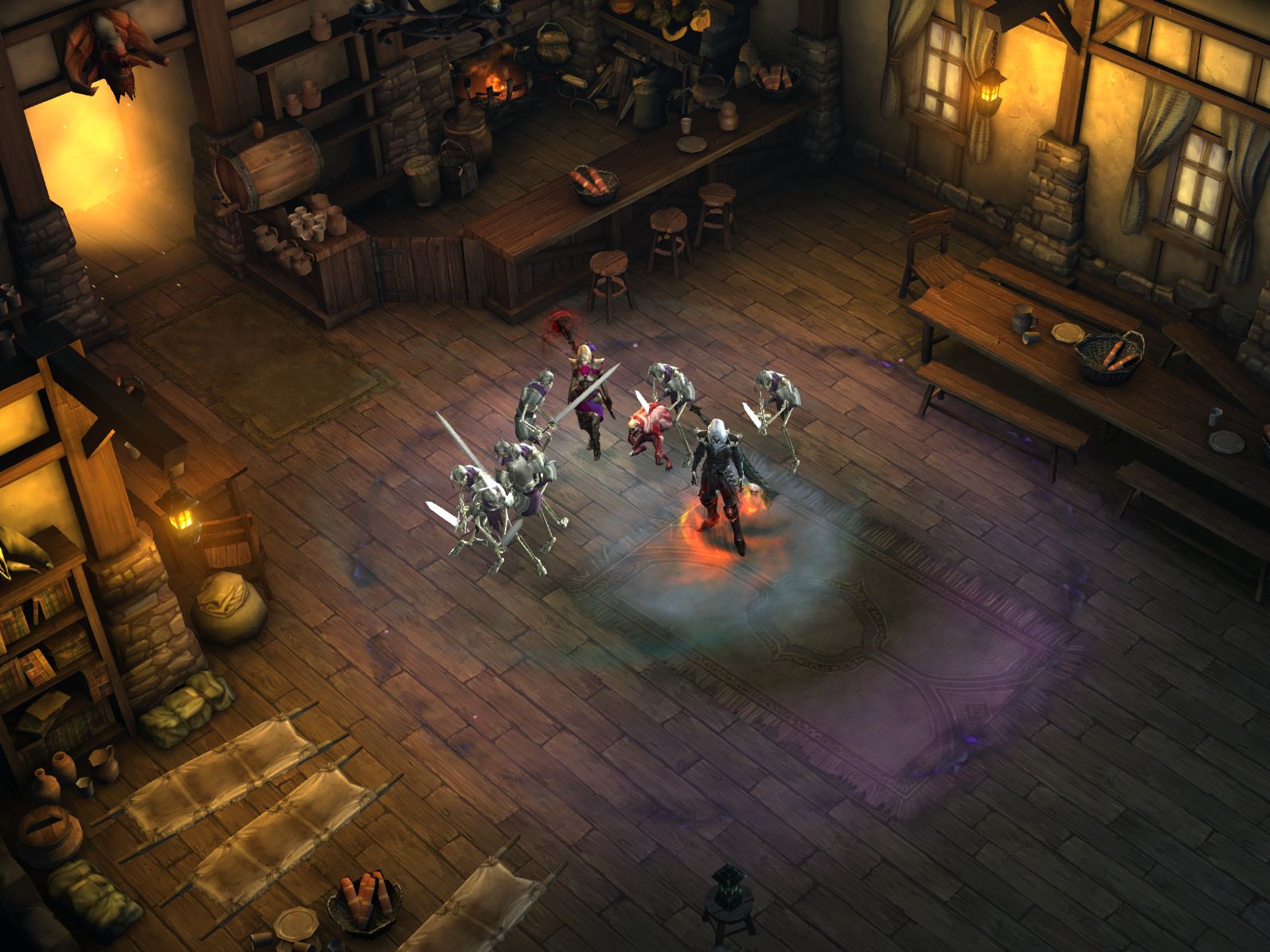
When you go into the inn in New Tristram, there’s no one there, yet it looks like it’s supposed to be occupied. Leah, who has been defeated as Nu-Diablo (spoiler) has her room still intact, as if she’ll pop in any minute.
I don’t know why, but this “take out the NPCs and leave everything else as if they were there” is something I find unsettling, like you’re visiting a memory of the place instead of the actual place.
And I say this while playing a necromancer with an army of skeletons.
Here’s a look back at my gaming in 2024. Yeah, I’m a month late, it’s my style.
First, the non-PC platforms:
Nintendo Switch: I think I turned this on once or twice, but did not play any games on it.
Mac Studio: Played some Torchlight II on it. It ran fine. Also played a bit of Grindstone, an Apple Arcade title. It did not hold my interest.
Xbox Series X: Did not play anything on this, used it as a media/streaming device.
iPhone 12: I do not have any games installed on my phone.
iPad Pro: I played crosswords and some Mahjong until I got back into the habit of reading before going to bed.
The PC is where I do most of my gaming and in order, here’s what I played the most:
PowerWash Simulator. Way too much. But it’s very chill, so it’s probably been therapeutic.
Diablo 3. I got back into this and it’s kind of like PWS–soothing and mindless, but also horribly violent, but in a way that is cartoony and over the top. I have over 8 billion gold now and nothing to spend it on.
Diablo 4. I started this with a druid, then a wizard and it hasn’t been compelling. I’ll get back to it eventually.
No Man’s Sky. One attempt at multiplayer. It was not compelling enough to warrant another go. Maybe it works better in single player?
Morrowind (using the OpenMW patch and launcher and running it on Linux). I’ve only dabbled in this. It runs very well. I’m not sure if I can commit to a deep and bonkers RPG again. But we’ll see.
Pools (also on Linux). A weird walking simulator that plays heavily on mood and atmosphere as you walk through a series of tiled rooms filled with water, slides, odd sounds and things. If I’m in the mood for it, it works really well.
Stardew Valley (Linux). Dabbling in this again to see if it sticks.
Centipede Recharged (Epic). Frantic, and games are short. Scratches a particular itch, but not something I invest a lot of time into.
Train Station Renovation. Gifted by an internet pal, it shares some qualities from PWS, but the UI seems a bit clunkier. I’ll get back to it, though.
Enshrouded. A survival first person thing that I didn’t understand and badly injured my guy first time out. I’ll try it again in the future, if only to prove I can be less dumb.
There were other games, but nothing that would have amounted to more than a few minutes (some Atari 2600 titles, etc.)
For 2025, it’s been mostly more PWS and D3 so far, but I’m looking to get into something else soon™.
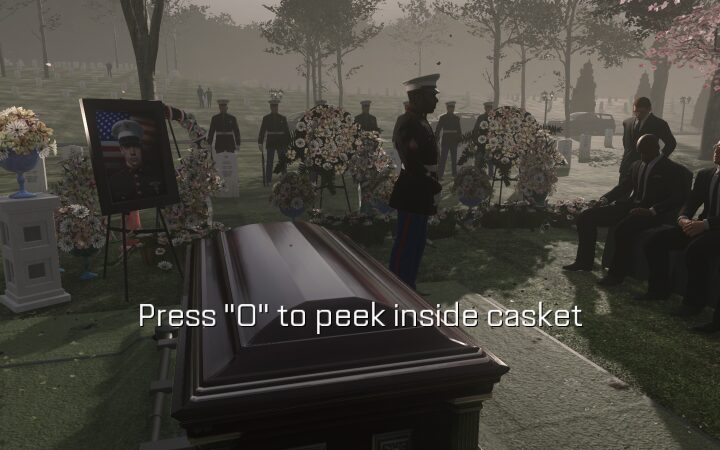
One of my gaming pals of yore posted this from a Bluesky thread, and it’s kind of delightful. It’s called The Death Generator, but despite the title, it just lets you change the text seen in a myriad of gaming screenshots.
I immediately went for the infamous Call of Duty “Press F to pay respects” interactive cutscene:
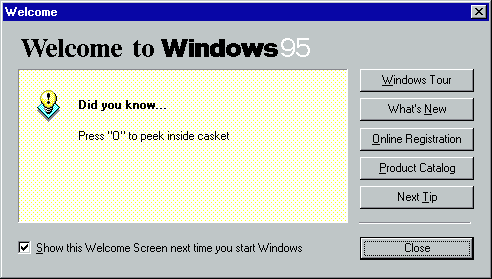
And discovered the generator preserves your text so you can re-use it:
This also made me nostalgic for the Windows 95 UI.