Book review: Opening Heaven’s Door

Opening Heaven's Door: What the Dying May be Trying to Tell Us About Where They're GoingOpening Heaven’s Door: What the Dying May be Trying to Tell Us About Where They’re Going by Patricia Pearson

My rating: 3 of 5 stars

I picked up this book (well, it was an ebook, so the picking up was virtual) for three reasons:

1. It was on sale. Cheap is always a price I like.
2. I’ve loved these sorts of nutty topics (out of body experiences, telepathy, Bigfoot, ghosts, Bigfoot ghosts with telepathy, etc.) since I was a kid.
3. It seemed like good background material for a novel I’m writing that coincidentally embraces the subject of death and near-death experiences.

Journalist Patricia Pearson draws from a range of studies and personal accounts stretching back decades to dig into the near death experience (NDE) and other related phenomenon. The deaths of her sister and father serve as a framing device for the book and Pearson is up front about how their deaths and oddities around the deaths helped develop her interest in and shape her point of view on the subject.

Despite the title of the book, Pearson paints NDEs as more of a spiritual awakening rather than a religious experience. Indeed, more people have apparently turned away from religion after having an NDE while at the same time becoming more spiritual. Throughout the various studies and research Pearson shows how little science has been able to quantify what happens when someone comes close to dying and recovers or just plain dies. In the main the affected individuals seem to traverse into another realm or reality, out of their bodies, often meeting other people they know who are already dead, and for the most part the experiences are positive, even joyful. As you may suspect, conducting experiments around people who have just escaped death is a bit tricky, as scientists, smart and diligent as they may be, cannot hang around intersections indefinitely waiting for near-fatal traffic accidents to occur. Well, they could, but probably not with funding from a university.

My biggest issue with the book is its relative shapelessness. Pearson writes well and has put in a lot of research on the subject (the bibliography and notes are extensive), the tone remains respectful and she never makes declarative statements one way or the other (“The Buddhists are right, if you screw up in your post-life you come back as a dung beetle!”), but the book has no sense of progression. She documents the subject and then the book ends. Maybe I’m trying too hard to impose a narrative structure on something that doesn’t necessarily need one.

In any case, if you have any interest in the subject matter–and yes, most NDEs center around being surrounded by glowing light, a tremendous sense of love and no fear of death–this is a sober and serious look at it.

View all my reviews

The Easter Day run: bikes, not eggs

Run 369
Average pace: 5:42/km
Location: Burnaby Lake (CW)
Distance: 5.03 km
Time: 28:44
Weather: Sunny
Temp: 14-16ºC
Wind: light to nil
Calories burned: 385
Total distance to date: 3055
Device used: iPhone 6

I missed last Sunday’s run due to a flu-like virus that made bed more appealing than jogging, but was ready if not exactly raring to go today.

Conditions were once again terrific, with sun and mild temperatures. I expected the pleasant weather, combined with the holiday, to result in crowded conditions but while there were plenty of people about, it wasn’t bad at all navigating the trail.

However, I saw so many cyclists I lost count. The first was at the park entrance, contemplating the map of the lake while surrounded by conspicuous NO BICYCLES signs. I later saw him just after I’d finished the run, about 5 km in. Oddly he was off the bike and taking a  photo of what seemed to be nothing in particular. The second cyclist was also at an entry point looking at a map. I didn’t see him again so maybe he got taken down by an off-leash dog.

A father and young son nearly plowed into me at a corner. Thanks for teaching your kid to be a Jerk, pops!

A pair of bikes were parked at Still Creek but I think they belonged to a couple of guys that were kayaking, so I give them a pass. A family of six starting in as I was heading out of the park I offer no such benefit of the doubt. May they all have suffered flat tires and collisions with each other.

There were probably more I’m forgetting but you get the idea–it was biking madness like I’ve never seen it before. Blergh.

As for the run, it went about the same as last time, only a few seconds slower. A stitch in my lower left side popped up to annoy me like a biker about the 3K mark but I pushed through it. There were no other issues to speak of, just the usual early season rust. I will start regular runs soon.

Book review: The Forge of God

The Forge of God (Forge of God, #1)The Forge of God by Greg Bear

My rating: 4 of 5 stars

I’d probably give this book 3.5 stars but Goodreads (where this review originates) doesn’t allow half stars, so I’m giving it four, since I lean more toward that than three.

This 1987 novel is dated politically (set in 1996 but not foreseeing the collapse of the Soviet Union) and technologically (it predates the Internet so a lot of data in the story is gathered and stored on fancy optical disks) but otherwise feels fairly fresh nearly thirty years later.

The plot is a downer–mysterious aliens arrive to destroy Earth–and the resolution, such as it is, is a bit abrupt because the story continues in the 1993 follow-up, Anvil of Stars. But The Forge of God is more about the journey than the destination, as Bear unfolds what begins as a galactic mystery and ends with humanity reduced to a murmur in the great vastness of space.

The story almost feels like two different tales stitched together. There’s the initial mystery and scientific investigation–a moon of Jupiter disappears and months later strange artificial rock formations appear in Death Valley and other spots around the world. The leading characters are geologists and there is much speculation before an alien appears out of one of the formations with a dire warning that Earth is doomed, destined to be torn apart by a fun bunch described as “planet eaters.” The latter part of the story chronicles the months leading up to what appears to be the end of the world as we know it (and no one feels fine), with a plan by the mysterious but apparently beneficent warning aliens to cobble together the remnants of the world in order to create some aspect of it elsewhere.

These two halves also stand apart with distinct tones. The first half is filled with politics, scientific theorizing, investigation and generally lots of “big picture” stuff, while the second half zooms in on some of the characters and becomes more personal, following them as they grapple with a seemingly sealed fate. Bear does a good job transitioning from the big picture to a more intimate one, capturing the despair–and faint hope–as the last days of the story (and possibly the planet) play out.

If you like a good doomsday scenario supported by credible science, a chilling answer to the Fermi paradox, and have always wanted geologists to be the leads in a novel, The Forge of God comes recommended. My only regret is I didn’t research ahead of time to find out it was part of (an admittedly very short) series, so I know feel obligated to read the sequel, to find out how it all turns out (until the inevitable sequel after that one).

View all my reviews

Book review: The Deep

The DeepThe Deep by Nick Cutter

My rating: 3 of 5 stars

The Deep starts out strong but has an odd ending that perhaps goes a little too far in explaining the proverbial man-behind-the-curtain and the overall story is diminished somewhat as a result.

Conversely, if you hate horror stories that end with “it’s all a spooky mystery that no one will ever be able to explain!” you may actually prefer the almost Bond villain-level of explanation that wraps up the novel. I discuss the ending a bit more in the spoiler section at the end of the review.

The premise is in broad strokes similar to Cutter’s previous novel, The Troop (Cutter is the macho pseudonym of Canadian author Craig Davidson). Both stories feature a small group of people confined to a space where very bad things are happening. In The Troop, it’s a scout troop on a woodsy island that gets visited upon by a man carrying a horrifying and very contagious disease. In The Deep it’s the crew of an underwater facility researching a substance that holds promise in curing “The ‘Gets”, a disease that causes people to essentially forget how to live.

The rest of this review contains spoilers. The biggies are behind spoiler tags at the end.

Where The Troop’s premise is straightforward and further fleshed out through interviews, journals and other bits sprinkled between chapters, The Deep aims for a greater mystery and ratchets tension by revealing more and more disturbing little details, layering on levels of psychological horror until it finally goes all out with blood and body parts everywhere.

The story starts out with a global scale suggested–The ‘Gets is a worldwide phenomenon–but quickly focuses on a handful of scientists on the Trieste, a research station situated eight miles below the ocean surface in the Marianas Trench. It is there that a seemingly miraculous healing substance dubbed ambrosia is found. After the lead scientist, the misanthropic Clayton Nelson, sends out a strange request to have his estranged brother come to the station, the story plunges (ho ho) into the meat of the matter.

The protagonist, Luke Nelson, is a troubled veterinarian, divorced from his wife after their son vanished from a park when he briefly let the boy out of his sight some seven years previous. On top of that, his brother is essentially an unfeeling robot that likes to experiment on animals, his father is a cowed, ineffective guardian, and his mother–deceased as the story begins–was pretty much a monster. He joins a tough but sensible soldier named Alice to descend to the Trieste and find out why his brother summoned him.

Things get increasingly weird after that.

Cutter again uses journals to document large parts of the action that the protagonist would otherwise have no knowledge of. While it’s a blatant cheat, it’s done with enough finesse that it didn’t pull me out of the story. The concept of slipping into “dream pools” is handled well, too. At times the characters realize they have nodded off and moved around, having dreams that feel seamlessly connected to the waking world, producing extreme disorientation when they awaken.

It gets increasingly bizarre and disturbing until Luke decides to get out before it’s too late. It’s at this point that the story abruptly shifts tone as the ending goes into specifics about what is behind the mystery of the ambrosia.

[spoiler title=”Ending spoiler” icon=”plus-square-1″]

The creatures responsible for the ambrosia go on at length describing their thought processes and rationale for essentially creating a trap to lure people down to the bottom of the ocean and as I mentioned at the start of the review, the dialogue in this section feels like a Bond villain going on and on about his clever and dastardly plot.

On the one hand, kudos to Cutter for actually trying to tie everything up, but at the same time it felt hokey, sort of like Trelane playing with his human toys on the original Star Trek. It also turns out that The ‘Gets is just a coincidence so what is billed as a major plot element ends up seeming like a red herring.[/spoiler]

Despite my issues with the ending, the trip there is still one worth taking. If you like old-fashioned horror that doesn’t shy away from gore, The Deep is recommended.

View all my reviews

The not-as-middling mid-March run

Run 368
Average pace: 5:39/km
Location: Burnaby Lake (CCW)
Distance: 5.06 km
Time: 28:34
Weather: Sun and cloud
Temp: 15ºC
Wind: light to nil
Calories burned: 394
Total distance to date: 3050
Device used: iPhone 6

Another mild day and a bonus weekday afternoon run due to an at-home online course that ended at 1:30. The main advantage of running during the week is the relative lack of people/dogs/renegade cyclists on the trail and such was the case today.

My only goal again was to improve my pace and I did, woo! My pace of 5:39/km was seven seconds better than my previous run and my best time so far this year (only four runs in, but I’ll still take it).

The only complication was a cramp in my right shoulder. This has never happened before and is odd as I don’t run on my shoulder. The cramp threatened to spread down to my right side but never quite did.

I started out fairly strong and this predictably led to a big drop-off at the 2K mark. I gained time on the third and fourth km, though, before falling back a bit on the last km. I did manage to pick up the pace on the last 200 m or so (the Nike phone app doesn’t do the countdown like the iPod app, which makes it harder to judge when to put on the gas for the final stretch).

In all, another small improvement on my way to a regular running schedule.

The mild March middling run

Run 367
Average pace: 5:46/km
Location: Burnaby Lake (CCW)
Distance: 5.03 km
Time: 29:02
Weather: Sunny
Temp: 16ºC
Wind: light to nil
Calories burned: 392
Total distance to date: 3045
Device used: iPhone 6

For the previous two Sundays I gave into the allure of sitting on my duff come Sunday and did not run. This weekend was shaping up to be a repeat, especially since I did a brisk 16 km walk on Saturday, burning plenty o’ calories and thus justifying a burst of non-activity on the following day. But on Sunday the sun part of the day lived up to its name and then some. It was too nice to stay inside, so I changed into my jogging clothes and headed out.

That’s the good news. The better news is this run was an improvement on my previous run in pretty much every way.

I went out early afternoon and the temperature was an unusually balmy 16ºC (about five degrees higher than the monthly average). I ran counter-clockwise, shaved three seconds off my previous pace (a still-slow 5:46/km but these are early days in the running year). I did not suffer any stitches, cramps or foot weirdness. The only real issue was just generally being out of shape. After the first km the rest of the run was manageable but not exactly pleasant.

And even though it’s only the first week of March, I could already see the yellow bulbs of skunk cabbage starting to appear along the lake edge, ready to stink to high heaven any day now. Many trees are already unfurling freshly green leaves, weeks ahead of the start of spring. It’s nice but also a little odd given I half-expect to still need mitts and instead find myself wearing t-shirts.

As I mentioned previously, I did in fact practice putting the iPhone into my new large pocket spibelt and found it worked best without the case. I was able to get it into the pocket on the run without the comedy of errors that was my previous run’s experience. These little details matter when you are setting out to light your lungs on fire for the next half hour.

All told, it was a solid effort for the third run of the year. Here’s to each run getting a little faster, a little sleeker, a little sexier.

Okay, I’ll settle for faster.

The in-stitches run

Run 366
Average pace: 5:49/km
Location: Burnaby Lake (CW)
Distance: 5.09 km
Time: 29:38
Weather: Foggy early then clear
Temp: 5-8ºC
Wind: light to nil
Calories burned: 397
Total distance to date: 3040
Device used: iPhone 6

It was foggy and chilly heading out this morning so I opted for a long-sleeved t-shirt and was glad I did as the mist was not the sort of thing you’d cuddle up on the couch with.

Today’s run was a mix of good and bad. On the good side, I actually improved my pace over the last two km and my post-run recovery was much faster than the previous week. Additionally, my drop-off from the first to second km was not as steep (11% vs. 16%).

On the bad side, my overall pace and time was slower. This was mainly due to developing a stitch in my lower left side during the first km. It stubbornly persisted through most of the run and instead of going away it migrated up into my chest where it hurt in a different way. My first km in particular suffered, being much slower, before I managed to pick things up a little. Still, it was a decidedly unpleasant run. Here’s hoping I can run stitch-free next time and see some real improvement.

The other thing of note was the complete bobbling of the new large-pocket Spibelt™® at the start of the run. Purchased to accommodate my larger iPhone 6, I not only failed to stuff the phone into the belt before the run timer started, I managed to get the run paused, restarted and paused several times before it finally seemed to sort of work. I say sort of because while it did indeed track the run, the sound coming from the phone sounded like something you’d hear from a speaker with a loose wire, with a weird cutting out/fuzziness. My guess is a clash between the earphone connector on the phone and the zipper of the belt. Oddly, I never had the issue with the iPhone 5c.

I may need to practice with the belt before the next run.

Book review: How Not to Write a Novel

How Not to Write a Novel: 200 Classic Mistakes and How to Avoid Them--A Misstep-by-Misstep GuideHow Not to Write a Novel: 200 Classic Mistakes and How to Avoid Them–A Misstep-by-Misstep Guide by Howard Mittelmark

My rating: 4 of 5 stars

“Why would you read a book about how not to do something?” he asked quizzically, his eyebrows knitting together like two large black caterpillars intent on copulation.

“I don’t trust myself. I never have!” I sobbed sadly. “If I don’t have someone telling me what not to write, surely I will write it!”

“You sound just like my Uncle Norman the unpublished novelist!” he said ruefully.

“I’m drawn to cliches but try to avoid them like the plague,” I explained earnestly. “I’ve told myself a million times to never use hyperbole when creating characters but I never learn. But this book–How Not to Write a Novel–has been like manna from Heaven when it comes to what not to write.”

“Tell me more!” he exhorted.

I began counting on my fingers in order to visually illustrate my points. It was a technique I learned in college and have used throughout the long, lonely years since then, often counting out the days of relentless rain, when everything is as gray as the embers that once sparked inside me, beaten down into dust by the burden of living in a heartless and unfeeling world. I took a sip of my Pepsi Cola that I purchased in a six pack at WalMart, then continued. “The book shows you how to write unbelievable characters, how to change tense in whimsical, nay, unpredictable ways, how to insult your reader with strident or weird positions you hold that are expressed by the people populating your story, and how to write unconvincingly about things you love to talk about but have little to no knowledge of. It wraps up with examples of the worst query letters and pitches you could possibly compose, anything likely to turn away an editor or agent forever.”

“Wow!” he blurted.

“So I just do the opposite of everything and walla–yes, walla!–I’ve written a surefire bestseller!” I smiled broadly, my grin an irrepressible rictus.

“Wow!” he shouted again, spittle flying from his mouth like a jet taking off from an aircraft carrier. “This book sounds great. How would you rate it?”

“Hmm,” I puzzled. “On a scale of one to ten failed writers living on dirt and gum, I rate it a solid eight failed writers.”

His face suddenly caved in, like a cave where the top part collapses onto the floor. “Eight out of ten? So there is room for improvement?”

“There’s always room for improvement,” I said sagely. “Now I must get back to my epic tale, All the Shades of Grey The Light Cannot See Games.”

View all my reviews

The first February fun fitness run of 2015

Run 365
Average pace: 5:45/km
Location: Burnaby Lake (CW)
Distance: 5.04 km
Time: 29:01
Weather: Sun and cloud
Temp: 14ºC
Wind: light to nil
Calories burned: 393
Total distance to date: 3034
Device used: iPhone 6

The last run I did was on October 26, 2014. According to my superb math skills and calculator, that was 104 days ago. My pace on that day was a not-great 5:25/km. How would I fare some three months later?

The results were pretty close to what I expected. My pace was worse still at 5:45/km but for the first run back that’s actually very close to what I would have predicted.

The conditions were downright spring-like, with a mix of sun and scattered cloud and the temperature climbing over 14ºC. This is while the eastern half of Canada is buried under a half mile of snow. Due to recent heavy rains I chose to run clockwise because I expected the trail to be nicely flooded around the athletic fields, which would have meant navigating through giant mud puddles if I’d gone counter-clockwise.

This turned out to be true. I finished my run about 100 meters away from The Great Flood. Then I either had to turn around and walk back or just march straight through it. I chose the latter as I hate going back the way I just came.

The ever-problematic left foot behaved itself for the run but felt a bit sore after. I walked home and it never got as bad as it’s been in the past but that foot still ain’t right. Getting it checked is on my 2015 fitness to-do list.

The first km was the usual “hey, it doesn’t feel like I haven’t run for 104 days!” (a very nice pace of 5:05/km) while the last four km was the usual “everything hurts, make it stop, make it stop!” I felt a few cramps threaten but held them off and while the tendons felt on fire at times, by the end everything seemed pretty much fine. My pace after that first km was remarkably steady, with almost no variance at all. I hit a wall and stuck to it. Or something like that.

I’m not sure when I’ll run next as it’s still getting too dark for me to run after work but we’re only a month away from the return of Daylight Savings Time, so I’ll try to squeeze in a few more. It’s nice that I could come back after months off and emerge intact, at least.

This was also my first run using my iPhone 6. It behaved well, though I will need a larger Spibelt™® as the current one I use is too small for it. The case I use is grippy so it wasn’t at all uncomfortable holding it. It’s just nicer not having to.

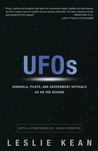
Book review: UFOs: Generals, Pilots and Government Officials Go On the Record

UFOs: Generals, Pilots and Government Officials Go On the RecordUFOs: Generals, Pilots and Government Officials Go On the Record by Leslie Kean

My rating: 4 of 5 stars

It’s probably accurate to say that most people think of UFOs–Unidentified Flying Objects–as being craft controlled by extraterrestrials. This is to say that few people think of UFOs as being quite literally what the acronym stands for, objects in the air that are unidentified. Since the modern UFO era began in the 1940s the subject has, especially in the U.S., been treated as one not worthy of serious study or investigation. Project Blue Book, the Air Force group tasked with checking out UFO reports, was closed down in 1969 with a summary that essentially said “UFOs lol!!”

UFOs (the book) argues the case for returning to the serious study of UFOs, advocating the U.S. government take a leadership role as the world’s leading technological power. With the current congress stuffed full of climate change deniers, it seems a less likely prospect than when the book was published in 2010, but stranger things have happened. Many are documented in this book.

The book’s chapters switch between the author’s advocacy for serious investigation, with ideas on how such investigation could be organized in the U.S., to first person accounts of UFO sightings from credible witnesses ranging from commercial and military pilots to generals and even a state governor. Throughout, none of the witnesses nor Leslie Kean, the author, assert that UFOs must be alien-controlled craft. Instead, she describes herself as a militant agnostic, refusing to commit to what UFOs are because we simply don’t know yet. She doesn’t deny that extraterrestrial craft may be the likeliest explanation.

On the question of the validity of UFOs as a phenomena, she is much more certain. There are hundreds of well-documented sightings (often by multiple credible witnesses) with physical evidence, radar tracking and photographs that stand up under the scrutiny of modern image analysis. In light of all the evidence, Kean argues that the question isn’t if “UFOs are real” but rather, what are they? She repeatedly comes back to a primary reason for investigating and that is the unknown nature of the UFOs, coupled with their physics-defying properties (ignoring gravity, being able to move instantly and silently at great speed and so on) and the tendency for so many to appear near sensitive sites like military bases and nuclear power plants makes them potential threats.

I wonder how many skeptics will read this book and come away buying into Kean’s arguments. Her case is well-researched, detailed and presented without sensation, but as she admits, the taboos surrounding the subject are strong and have become ingrained over the last half century, especially in government circles, where admitting to the reality of UFOs–whatever they may be–is tantamount to acknowledging that with our current technology, there is little to nothing we can do to control or if need be, defend against them.

If you have any interest in the subject, this is a highly recommended read.

Plus come on, UFOs are neat. And scary.

View all my reviews

Book review: Mr. Mercedes

Mr. Mercedes (Bill Hodges Trilogy, #1)Mr. Mercedes by Stephen King

My rating: 4 of 5 stars

This is one of King’s thrillers, with no supernatural elements, and because of that it has a decent ending, a plus right from the start…er, finish.

Mr. Mercedes is a book with few surprises. The good guys have their flaws but they’re all nice people. The bad guy is a psycho with loads of issues but not so much that you feel any real sympathy for him, more pity than anything.

The good guys–recently retired police detective Bill Hodges, a teenage boy who helps the Hodges with various chores, and a woman in her mid-40s with mental issues–are sufficiently clever enough to put together the identity of a mass killer that Hodges couldn’t collar before retiring. The villain, the 30ish Brady Hartsfield, is portrayed as a man brilliant with technology but one who also shifts between thinking of everything and being strangely careless and sloppy. In a way the depiction of the protagonists and antagonist reminds me of Stoker’s Dracula, where the heroes easily outmatched the vampire. Here the retired Bill Hodges and helpers make all the right guesses and even when they slip up they recover in time. Brady not so much.

King gets most of the technical details right, though there is some over-explaining, particularly by one character to another. There is the expected noble sacrifice and the brief final scene is a cute callout to Halloween.

The way I’ve described the book probably makes it sound predictable, even boring, yet King’s writing is smooth enough I found myself willing to forgive the flaws. It also helps that I don’t read a lot of thrillers so I’m likely easier to please in that regard.

Thumbs up, then. This is better than King’s sloppiest work but falls short of his best.

View all my reviews

Book review: The Haunting of Hill House

The Haunting of Hill House The Haunting of Hill House by Shirley Jackson

My rating: 4 of 5 stars

Shirley Jackson has apparently fallen out of favor these days, though many still get exposed to her work in school through the classic short story, “The Lottery.”

A take on the Gothic ghost story, The Haunting of Hill House applies some modern touches by having the characters gather at the house under the pretext of a scientific investigation of the alleged ghostly phenomenon, a nod, perhaps, to Stoker’s use of science to battle Dracula in the self-same novel (I was amused at just how poorly the ol’ vampire managed against the array of instruments and techniques used against him).

Hill House does not surrender so easily and focues its malice on an emotionally vulnerable woman named Eleanor. While the characters are at times a little too busy saying clever and silly things to each other, Jackson still does a nice job of casting the house as a sinister character of its own. This is as much a tale of psychological terror as it is about things that go bump in the night.

Worth reading if you are interested in one of the early modern horror classics.

One warning if you are reading the Penguin Horror edition — Laura Miller has an opening essay that is filled with spoilers. It would probably have been better at the end of the book.

View all my reviews