
Just 17 hours after my Pulmonary Function Test, I was out and about for a PET scan (Wikipedia link) at 8 a.m. this morning.
PET stands for Positron Emission Topography, which sounds both futuristic and maybe not something done on a human body, necessarily. But it is! And it would be done on my human body this morning.
Transit connections were unusually good, so I got to the lab early and filled out a form in Waiting Room 1. After this, I was directed to Waiting Room 2. I briefly wondered how many waiting rooms there would be (there are two). But even before 8 a.m. arrived, I was whisked off to what I will call The Chair Room. The central object in The Chair Room is, you may have guessed, a chair. Specifically, a large black easy chair, complete with cupholder. There is a reason it is a big comfy chair and that reason is you spend close to an hour sitting in it and being very still.
I knew the process because I’d read the email they sent beforehand, and despite fasting, I was not really hungry yet, though I was a tad thirsty. The first lab person showed up to insert the IV. This is now old school for me, after having IVs this year for a CT scan, an MRI and an ongoing one for 11 days (that had to be replaced partway through) when dealing with the kidney infection in January. I was nonplussed and told her she could use the left arm.
If you’ve never had an IV before, the process usually takes a few seconds. If it takes longer, something has gone wrong.
It was taking more than a few seconds. There was pain, but more like an annoying sting. She worked on that left arm for what felt like about a minute. That doesn’t sound like a long time, but remember, this is with a sharp needle being repeatedly worked into your flesh.
She finally gave up and switched to the right arm. The IV was inserted in a few seconds. Apparently, the selected vein in my left arm was big and strong, but also had a tendency to “roll” when she attempted to get the IV into it. Those pesky veins always causing trouble.
My blood sugar was measured, because if it’s 11 or higher, it complicates things. Mine was 5.6, which is well below their threshold and also a little below the regular threshold of pre-diabetic (my blood sugar has always skewed high for some reason. Maybe I’m just a really sweet guy).
Next was waiting. I am unsure why, but at this point I was left in the room with the IV inserted and had to wait for about 15 minutes.
Another tech showed up to administer the radioisotope tracer (nuclear medicine!) I believe it was Fluorodeoxyglucose, which is used when trying to detect cancer. It took about 30 seconds to go through the IV. Interestingly, once the drip started, the tech stepped out of the room and stood by the doorway until it was complete. I was now radioactive and would be for about the next 12 hours. I was warned I would feel a cold sensation in my arm as the nuclear juice was delivered, and I did, but the sensation was pretty mild.
The next part was the real waiting. I was to sit still and let the tracer work its way through my body. I was told to stay still and move as little as possible. I asked if I could read. That got a frowny face, so I was left with the lights dimmed, alone with my own thoughts.
Time passed quicker than expected, but that’s because about 15 minutes before the final part, yet another tech showed up and directed me to the washroom, to pee. I did so. Then I sat back in the chair in The Chair Room. Roughly an hour and a half after starting, the first tech returned and took me to the PET room.
The scanner looked pretty much exactly like the one in the Wikipedia article, except with me in it:
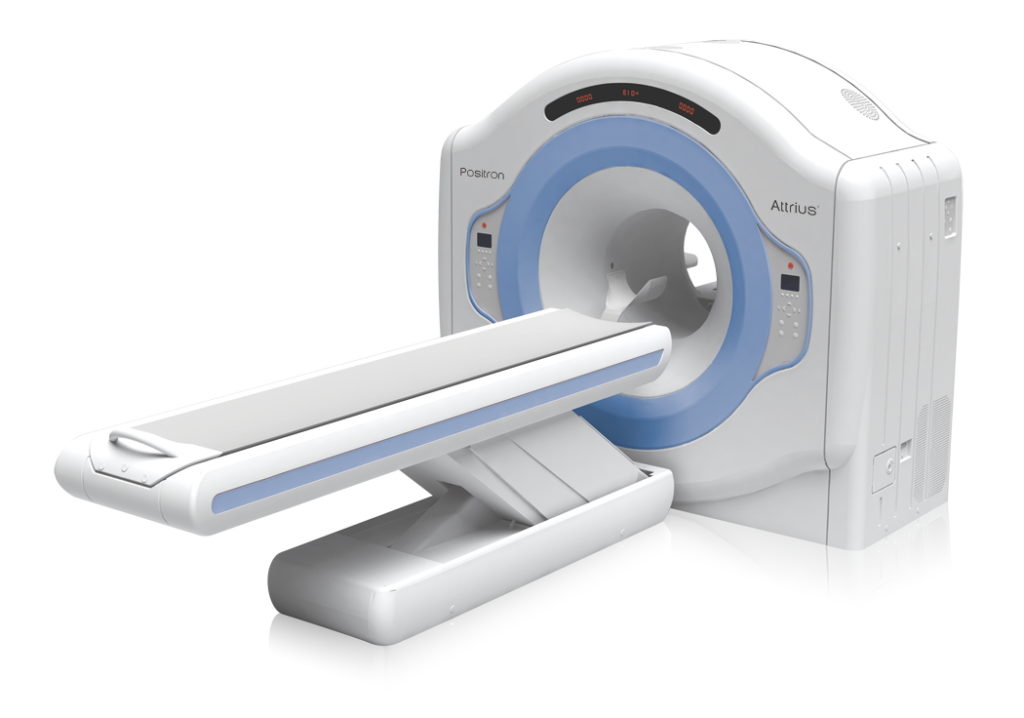
I doffed my cap, watch and glasses and laid down on the bed. I was told it would take around 15–20 minutes and there would be some noise. My legs were propped up and, somewhat annoyingly, I had to hold my arms above my head, like I was being put on a rack. This is not the most comfortable position to hold for 15–20 minutes.
After being told to breathe normally, the bed slid in, the machine lit up, hummed, and started doing its thing. It moved me back and forth a few times and at one point, near the end, my head was mostly sticking out the back end and nothing seemed to be happening, but I assumed it was. Then, just as I was getting close to asking if something had broken down, the bed moved me fully back under the donut for the last few minutes.
Overall, the experience was not pleasant, but it was pleasant compared to the MRI. The tube did not feel claustrophobic at all, the noises the machine made were mostly soft hums and gentle thunks. Occasionally, it would light up brightly, but the light was soft, like “Walk into the light” light. I didn’t have anything annoyingly attached to me, like a camera or IV. And it ended before my arms cramped up.
I felt a little lightheaded after, but that was probably more from being hungry than anything.
I celebrated getting through the PET scan by having an Egg McMuffin. Not there, at the lab, though that would have been extremely convenient, but at a nearby McDonald’s. I tried to avoid pregnant women and children after leaving the lab, which I was advised to do for about six hours. As I type this, I am confident there are no pregnant women or children in imminent danger of getting irradiated by my presence.
I will have the results in about five business days.
Next up: I rate CT scans, MRIs and PET scans on various criteria. Find out which wins each category. Coming Soon™.
 Share this post on social media.