The problem:

The solution:

And yes, I did actually uninstall the game. My wrist and overall productivity are already thanking me.
And the hours played? Pretty sure that’s a typo. Yeah, that’s it.

The problem:
The solution:
And yes, I did actually uninstall the game. My wrist and overall productivity are already thanking me.
And the hours played? Pretty sure that’s a typo. Yeah, that’s it.

Well, as many thoughts as a smartwatch can have.
My Garmin Forerunner 255 got a software update recently that allows it to track naps. I don’t take naps very often, but I did take one after a run last week and sure enough, the watch tracked the nap. It said I picked a good time to nap, but napped too long.
Today it tracked my second nap. Except I was awake the entire time. And I was playing a computer game.
Apparently, PowerWash Simulator (which is exactly what it sounds like) is such a mellow game that my watch thought I was napping while I was playing it. It also said I napped too long again. I can verify it is indeed a relaxing game, but now I’m curious about what my stats (heart rate, etc.) look like when I’m playing. Is the nap-tracking glitchy, or do I enter such a relaxed state that playing the game is effectively the same as sleeping? Questions!

Back in the olden times of CRT monitors that weighed half as much as I did, I started playing MMOs1. Although several already existed, like EverQuest and Ultima Online, I didn’t dive in until I got into the beta for City of Heroes (CoH) in early 2004 (the game launched in April of that year). As I learned later, CoH actually broke convention with typical fantasy MMOs in several crucial ways, apart from the obvious theme of superheroes. I played and adored it and made many characters, usually themed around fruit or vegetables, because why not?
In the fall of 2004, two more MMOs launched, within two weeks of each other. The first was EverQuest 2, the other you may have heard of, something called World of Warcraft. Everyone I played CoH with pretty much abandoned it for the hamster wheel of WoW. Eventually, I did, too.
As the years went by, play ebbed and flowed across various games:
Eventually, every game, even the well-oiled hamster wheel of WoW, wore on me and I left them all behind, apart from occasional forays into CoH, which is completely free to play now (the servers run on donations). And I was fine with that.
But just lately I’ve had a slight urge to revisit an MMO, to level up a character and be part of a big stinky world filled with other players. But which one?
On the one hand, some of this has been decided for me, because the MMO is dead (Vanguard, Tabula Rasa) or because I have little interest in revisiting it (Champions).
But that still leaves more than a couple. I ponder.
I’ll probably just keep not playing any of them. Maybe I should dig up some old RPG from my Steam backlog and just pretend it’s massive.
I don’t remember why I made this, but I did! I remember being very proud of how authentic it appeared.
It’s what The Elder Scrolls: Skyrim might look like if it had been designed as a typical piece of Windows 98 software. Enjoy! (?)
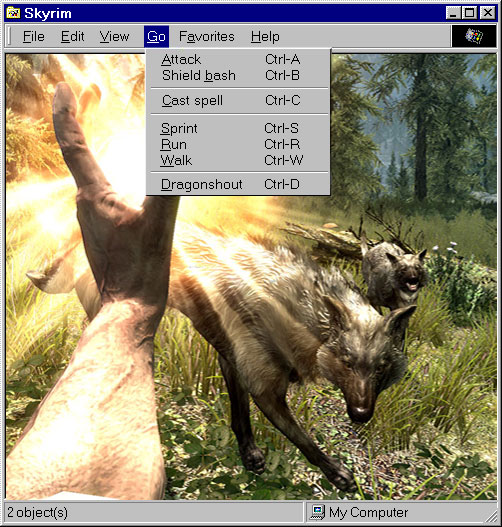
It’s true!
I have made several games in GameMaker and a few in Godot. I mean, they are not good games, but several are at least as entertaining as some of the Atari 2600 titles I played as a teenager.
And now, I work on my own stuff, rather than just following various tutorials. Exciting! Terrifying! With results hopefully more compelling than some of those Atari 2600 games. If I end up remaking ET: The Game, I will voluntarily submit myself to an endless parade of Nelson Muntz GIFs.

I buy Lotto 6/49 tickets–I consider them a charitable contribution–and never expect to strike it rich on that 1 in 14 million chance, but it’s fun to imagine.
This morning I got two emails announcing I’d won two prizes. Two! Was I now a millionaire? (No, the “Gold Ball” jackpot is unclaimed at $22 million.)
It turns out that on the last draw I won a free play and my free play won another free play, plus my own regular ticket won a free play. It’s free plays all the way down.
I’ll post next on this when I become a millionaire. Any draw now, I’m sure.
After almost two years of fighting regulators, Microsoft finally completed its $69 billion merger with Activision Blizzard. Here are a few thoughts on the deal, in no particular order:
I’m doing something I’ve never done before on this blog: I am setting up a reminder to check back on this post on a specific date. In this case, that date is January 1, 2024, and I’m doing so because I’m really interested in what happen next in this little saga that burst into being during Apple’s iPhone event on September 12th.
Some brief background: A company called Unity makes a game engine called Unity. It is free to use and very popular–over 38,000 games on Steam use it. The company has long advertised that it is royalty-free. Larger dev teams do pay, as Unity’s enterprise subscription plan costs thousands of dollars per dev–but any revenue you make from your games is yours to keep.
This is set to change on January 1, 2024 when Unity introduces URF (they don’t call it that, but I totally do, because it’s the sound most devs make when looking at the new pricing schemes that were announced while everyone was watching the unveiling of the iPhone 15), or Unity Runtime Fee. Whatever you do, don’t call it a royalty!
Basically, if your game hits a threshold for revenue and installs, Unity will charge you a fee (to be assessed monthly) per install. For smaller games, it will be 20¢ per install. If a person installs your game on two devices? That counts as two installs and you get dinged 40¢. The install number will be based on “aggregated data” Unity gathers using proprietary means. Or, as the entire internet has correctly surmised it: Trust us!
To say this new scheme has not gone over well would be a grand understatement. Unity has already sent out corrections, clarifications and some minor walk backs, but they have, to many devs, already irreparably broken the trust between them. And even with the clarifications, you still end up with stuff like this:
As one YouTube channel put it: “THEY SAID DISTRIBUTORS LIKE GAMEPASS – FEES WOULD BE ON THE DISTRIBUTOR – IE: MICROSOFT – LOLOLOLOLOLOLOL OH GOD. HAHAHAHAHA”
Some devs have said they will never use Unity again. Some have even vowed to switch engines on games in progress–a huge and costly undertaking. No one is happy about this, and no one should be, because the whole plan is harebrained and ill-advised. The string of clarifications show that it was obviously pushed out without any careful thought or consideration. Unity has also deleted their TOS changes from GitHub and removed parts of its TOS, rewritten it, then, as the cherry on top of the poop cake, stated that this will apply retroactively to every game in release NOW as far as determining those minimum thresholds. It’s Vader’s “I am altering the deal” except with fewer Stormtroopers in the background.
Why is this relevant to me? Well, it intersects several of my interests: gaming and tech. Also, I have been using Unity for my own indie game, and while I would need about 50,000 new friends to hit the thresholds where I’d have to pay the URF, this is such a cosmically scummy move that I am considering moving everything to another game engine.
The two I am most strongly considering are:
Technically, I have prior experience with the Unreal Engine, if you count the UT levels I made, uhm, almost 20 years ago. How much could it have changed since then, really?
The main pros for Godot are it’s open source and free, so there is no possibility of URF-like shenanigans happening. The main cons are the resources for it are far fewer than Unity, and it’s not as full-featured or simple to learn.
For Unreal, it’s also free until you generate revenue over $1 million U.S. (a boy can dream) and even then, they only take 5% of total revenue. It has a lot of resources available, but the engine is honking big, designed more for giant 3D games, and not so much 2D indie platformers. So it may be serious overkill1Serious Overkill is also the name of my Cure cover band.
For the moment, I am going through Godot’s documentation to see what I think. At this point, even a complete reversal from Unity would probably still make me hesitant to go back to it.
We’ll see what happens on January 1st, though!
I made a terrible mistake. Actually, I made two terrible mistakes:
On the other hand, I’m now a Sr. Gemfinder1This is kind of a dumb rank. I mean, the screen is literally filled with gems. Or maybe it means I’m a senior, age-wise, and because of my old and ailing eyes, I should get an award for just seeing the gems at all., see:

I mean, I don’t need to be solving the climate crisis or brokering world peace here, but I feel like I should be doing something more substantial.
I have a solution! I’ll switch to the Mac. There’s no Bejeweled there!
Right after just one more game…

After some chat about the olden days of gaming in Discord that include recollections of the original Unreal, released in 1998, I felt the silly urge to re-install the game–and did!
For other people who are thinking, perhaps unwisely, of giving in to their nostalgia, here is what I did:
Amazingly, the unpatched original CD version actually worked. It defaulted to 800×600 resolution. I then applied the UnrealClassicPatch227i, a community-made patch that builds on the efforts of Epic to allow the game to work with modern renderers and fixes a few bugs and glitches. The patch is on the community site OldUnreal, found here.
I made the following change to the console in the unreal.ini file, found in the Unreal/System folder, under the [Engine.Engine] section. This enables the UT-style Umenu system, which gives access to some of the newer options (and makes changing keybinds easier, too):
Console=UMenu.UnrealConsole
The original line is Console=UBrowser.UBrowserConsole.
I set the resolution to the same as my monitor, 2560×1440, which looks fine, though the HUD shrinks to micro-sized. Apparently HUD scaling is coming to the 227j patch.
I originally chose OpenGL for the renderer, but it was too dark and changing brightness had no effect. I switched to the Direct3D 9 renderer and was able to change the brightness from Impenetrably Dark But Undoubtedly Moody to Moody But I Can Actually See Some Things Now.
Finally, I installed some high resolution textures, which look fine, though there’s a jarring difference when you see a fuzzy original texture next to a high-res one. You can fix most of these by also installing the HD Skins pack, available from the same link. HD Skins is actually a mutator, but the readme.txt file doesn’t note that you must start a new game to first enable the mutator. You can save the configuration so the mutator always runs after that.
The game itself plays great, of course. I could probably run it at 100,000 x 100,000 resolution and still get 140 FPS. Now we’ll see how long a 25-year-old first-person shooter can hold my interest.
Bonus shot:

Ars Technica has a story on how Linux has now surpassed the Mac on Steam, thanks to the popularity of the Steam Deck, which uses Linux as its OS. The race between Linux and Mac is close, but compared to Windows, it’s like a 100-meter dash where the first runner finishes in 10 seconds and the other two cross the finish line an hour later1Windows:: 96.21%, Linux: 1.96%, Mac: 1.84%.
But this post is about that old internet maxim, “Never read the comments.” On Ars, you can vote a post up or down. Too many down votes and the post gets hidden (though you can always click to see it). You know you’re in for a fun ride when the first four posts in a comment thread are hidden:

The first post was a benign but contentless “Ok…”, the second post a comic that Wheels of Confusion points out may have gotten the order of the panels wrong (and for proper comic effect/ting, he is right). The third post was the word “green” (presumably a suggestion for the colour of the dragon, another content-free contribution), while the fourth was the following insightful reflection on the first post: “Sensing pissy Mac fan boy. Could be wrong, could be right.”
It’s actually not nearly as bad as I would have guessed!
For context, here is WoC’s post, which includes the comic in question, in case you are lazy, like me, and don’t want to click links and stuff:

I have to admit, when I started this post, I hadn’t looked at the comments and thought they’d be particularly dumb/juicy. Instead, they’re just kind of lame. This will teach me to look for blog gold in a pile of…stuff that isn’t gold.
Jeff and I finally returned to Eaglequest in Coquitlam to play 18 holes of mini golf for the first time in a few years. It was fun!
The weather was nice–sunny, but not overly hot (around 25?). Being a Sunday, it was quite busy, and we did have a family eventually catch up to us, but let them play through, and it was fine otherwise. We never felt rushed. The kids were playing in that style little kids favour for golf: Everyone hit their balls one after the other, then general chaos all over the hole until mom goes, and they clear out and move on. It’s fun to watch–for a time.
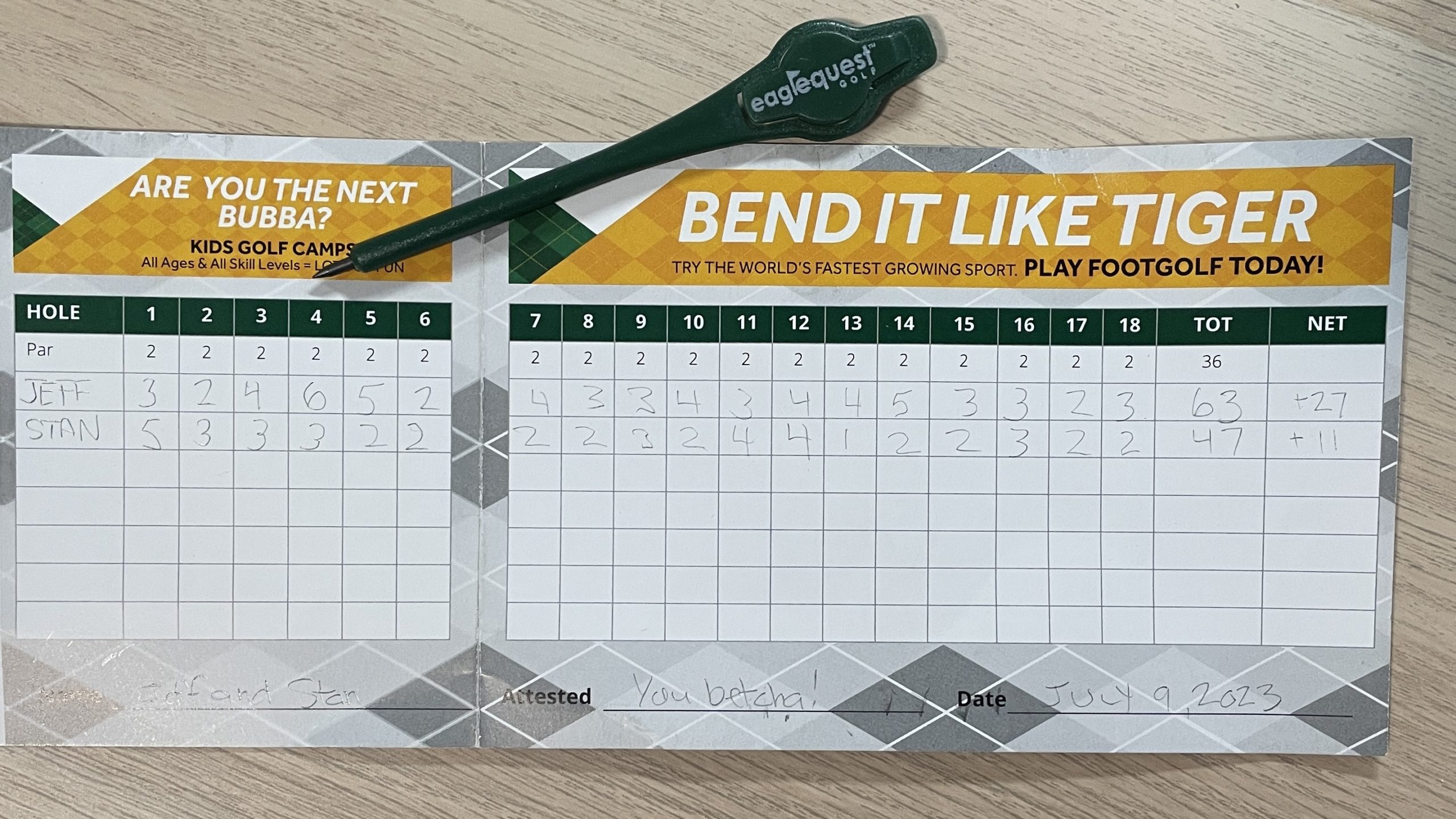
As for us, we usually end up being only a stroke or so apart, with Jeff often taking the edge, but I was in rare form today!
Technically, we both got a hole in one, Jeff on Hole 2 and me on Hole 13. I say technically because every hole has a Hard and Easy option and being hardcore mini golfers, Jeff suggested we go for the Hard holes. Jeff’s hole in one came when he accidentally sank his first shot into the Easy hole on Hole 2. Whoops! Mine was the normal way on Hole 13, which proved to be lucky for me.
I usually start strong and fall apart toward the end, but this time I started out with my worst hole – a par 5 on Hole 1, then stayed pretty consistently around par after that. Jeff seemed to have a knack for making the ball veer just slightly left and won the Most Balls to Catch The Rim Then Go Rolling Past it Like a Rocket using Gravity to Slingshot it Out of Orbit Award. He corrected this after a while, so we both finished showing off the awesome form we knew we were capable of. You know, as hardcore mini golfers.
Here’s the official™ scorecard:
A view of (part of) the course:

A short video of me almost getting a hole in one on Hole 17:
Jeff getting ready to tee up at Hole [unknown because I cut the sign off, oops]: