Book review: Fade-Out

Spoilers ahead. Read at your peril!

I first read Fade-Out back in 1978 when I was an impossibly shaggy-haired 14 year old. I read the revised edition in 1987 when I was a svelte-haired 23 year old. And now, over two decades later I have read it a third time, as a fuzz-haired 48 year old.

This time around I read the revised 1987 text in ebook format. The revised edition doesn’t change the story in any notable way nor does it add to its length, as most of the revisions are just updated pop culture references. Somewhat humorously, the politics remain the same, something that would have altered more drastically if author Patrick Tilley had held off for a few more years (when the Berlin Wall and Soviet Union collapsed in 1989 and 1991, respectively).

The story presents an unfolding mystery that starts with a global “fade-out” of all radar systems that lasts 22 minutes. This proves to be quite a bother, especially for airplanes, but everyone gets through it okay. Tensions between the U.S. and USSR ramp up as the Americans suspect Russian shenanigans.

When a large craft with unusual reflective properties appears in orbit, the U.S. again fear the Soviets have developed some Star Wars-style space weapons platform (before Star Wars even existed, how prescient!) Another longer fade-out occurs and when it ends the craft is gone. It’s later discovered that a meteorite that crashed at Crow Ridge, Montana may be related and the government is all over the place like the NSA on your tweets and likes1A reference to the NSA’s vast snooping program, which will hopefully seem quaint and outdated in a few years.

The story follows the government team assembled to investigate the site in Crow Ridge, among them nebbish Arnold Wedderkind, science advisor to the President, General Mitch “tolerates civilians only to a point” Allbright, the head of Strategic Air Command, and and Bob “everyman” Connors, special advisor to the President. And of course, the President (who is daringly depicted as Italian American).

What this group finds at Crow Ridge is a dome-shaped object rising out of the ground. It’s made of an incredibly hard crystal-like substance and is impervious to testing. Beneath its translucent surface is a creepy pattern that looks like a brain cortex. With no fanfare the object blankets the immediate vicinity with a mini fade-out, making most electrical equipment and vehicles non-functional. This goes away in time and the science team sets up shop, with Allbright and the military mucky-mucks waiting for the first sign of hostility so they can start a-shootin’.

Instead, the dome reveals a complex hatch that opens and lets out a large mechanical spider-type thing. It appears to be weaponless, a probe of sorts, so it is observed, rather than shot.

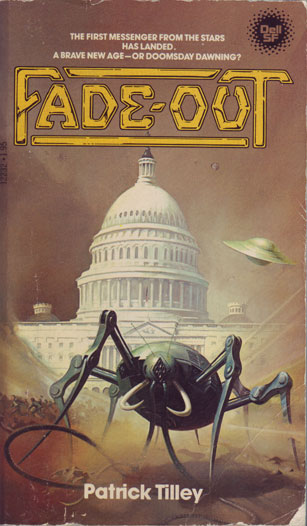
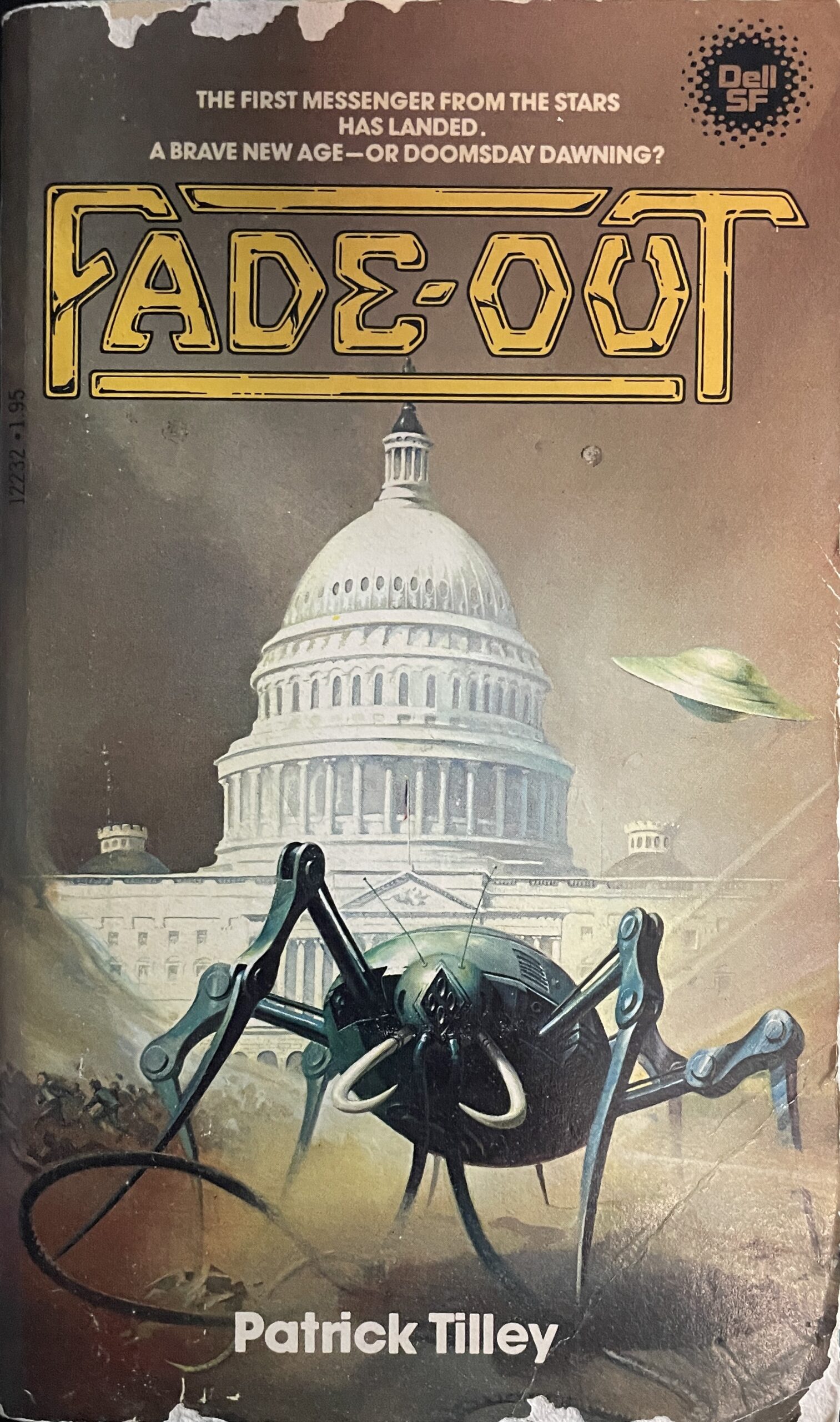
The 1978 paperback edition luridly depicts the spider terrorizing Washington, something that never actually happens:
Click to see gigantic version

Original version for posterity:

Fade-Out book cover

It got me to buy the book, though, so I can’t properly condemn the bait and switch.

Over the course of the story, the mystery of the dome and spider deepens, with their enigmatic presence and a sudden reappearance and spread of the fade-out effect prompting discussion of military options up to and including, effectively, nuking it from orbit (except actually from a jet).

The worst aspect of Fade-Out is probably the maleness of it. The few female characters are peripheral–not a bad thing, necessarily–but are treated somewhat disrespectfully. It brought to mind the R.E.M. lyric “a simple prop to occupy my time”. This is a bad thing. I suppose you can defend this by saying the male characters are the ones out of touch, not the author, but it doesn’t quite ring true. The characters also have the habit of engaging in philosophical debates that don’t sound like actual people conversing, but rather the author playing out different points of view for the reader’s benefit.

Despite that, the story itself is intriguingly presented, with no easy answers or pat revelations. The scientists struggle against the unknown technology, trying to divine the purpose of machinery that defies testing and reveals little about an overall purpose. There is the feeling that perhaps a test is being conducted, but to what end is left an open question.

If you like your science fiction set in the here and now (well, the here and now of 1987–there’s nary a smartphone in sight) and filled with riddles wrapped in mysteries inside enigmas, you may like Fade-Out’s depiction of Man vs. Mysterious Machine. I liked the premise enough to nick it for a short story.

EDIT, June 11, 2025: Hello, it’s me from the future. I came upon this post and made a few minor tweaks to it, then wanted to find a higher-resolution of the book cover from the original 1978 paperback. I tried DuckDuckGo, Google and Start Page. None provided satisfaction, though Start Page was at least amusing, because the fourth result…was the image I scanned myself for this review:

Also, I still have the 1978 paperback, so I have scanned (or rather, taken a photo of) the cover using modern high-resolution equipment [my iPhone 12]).
Book review: A Deepness in the Sky

I’d never read any of Vernor Vinge’s crazy space stories before but A Deepness in the Sky came highly recommended by friends and Vernor Vinge is an awesome science fiction author name so who was I to refuse?

To summarize the plot would be difficult. Basically you have three groups in a story that, thanks to deep sleep/stasis employed by all three, spans many decades but with characters aging much more slowly, though still getting older. It all takes place 8,000 years in the future and apart from the snazzy tech on display, paints a curiously depressing view of our future.

The three groups are:

Qeng Ho: Or as I call them, Capitalists Ho! These are people who love to trade and trade to love. Their goal is to trade as far and widely across the universe as possible. They are loosely federated with no real formal government structure.

Emergents: As the name suggests, these people recently emerged from a dark age and although technologically advanced in many ways, they are kind of bad, evil and whatnot. They aim to conquer and subjugate and conscript people into working as virtual computers by means of a mind-altering effect known as Focus.

Spiders: Living on a planet creatively dubbed Arachna by the humans, this is a race of large, intelligent spider folk. Like Earthlings, they are divided into factions and have a tech level similar to mid 20th century Earth, with space travel just becoming a possibility. The system they live in is the focal point of the overall story, as it features an improbable sun that burns normally for a few decades before effectively shutting off for a few centuries before lighting again. The humans, again demonstrating their cleverness, call it the OnOff Star.

For some reason the two human groups think this mysterious system will hold untold riches/power/something and they each dispatch fleets to secure the spider world. Deception and a surprise attack by the Emergents against the Qeng Ho leads to the survivors being forced to work together for decades while waiting for the spider technology to develop enough for them to appropriate it so they can all get back home and screw you, stupid spiders and your dumb OnOff sun.

The bulk of the story follows a large cast of characters, switching between the three groups and weaves in an exhaustively detailed level of the technology–everything from “localizer” nanites a-plenty to 3D holo displays that don’t require glasses or anything. This may sound glib but Vinge actually makes it all sound very believable, intriguing and yet commonplace to the people of the story.

Vinge also weaves in layer upon layer of deception and intrigue, sometimes tipping the hand for the reader to see, other times leaving it an open question on who can be trusted–if anyone.

I especially liked the depiction of the spiders. For a long time their actions and voices are identified by Focused interpreters who can only hear their transmissions and this creates a more human vision of them. That carries through to the spider sections of the story, with only occasional references to their spider-ness–“eating hands”, welts for holding babies on their backs, perches to sit in rather than chairs. And yet they have everything a good civilization would want: vehicles to tool around in, nice homes, clothes (of a sort) and, of course, nuclear weapons. It’s only when the humans and spiders meet that you really appreciate just how alien they are. And yet still adorably cute, somehow.

This cuteness would not probably translate to a film version. Unless they were depicted as Muppets.

I really enjoyed Vinge’s world building, something I’m not usually much into (and a large part of why I skip book series) and the sophistication of the plots the various characters act upon are equally interesting. The bad guys get what they deserve, which is always cathartic, especially after some of the vile things they perpetuate over a very long period of time.

If you like grand scale science fiction with deep (no pun intended) worlds and ever-twisting, slow-burning plots, you’ll love this. Unless you’re an arachnophobe, perhaps.

Book review: Twilight Zone Anthology

The Twilight Zone Anthology (2009) is a collection of 19 short stories commissioned for the 50th anniversary of the original The Twilight Zone TV series. Each story is book-ended by a paragraph that simulates Serling’s introductory segments and closing narration from the show. You’ll have to imagine him standing there, head cocked at that familiar angle, cigarette burning away in his hand. The effect is perhaps not as successful in print format.

As expected with most collections the quality of the writing varies, though there are no real stinkers like in Poe’s Children, my most hated anthology of all time.

It opens with a bizarre story set during World War II where a soldier suffers delusions and/or tells stories to his compatriots as shells rings out around them. Making it even more bizarre is the rather inept formatting of the different segments, a sadly common occurrence in ebooks. One day publishers will realize that ebooks do in fact need to be handled differently when it comes to formatting. Anyway, I’m going to spoil the twist of “Genesis” in the spoiler text below:

[spoiler title=”Genesis spoiler”]It turns the protagonist is Serling himself, telling stories that will later form episodes of the series.[/spoiler]
The twist is cute but the story is curiously bland and could have been excised from the collection.

“A Haunted House of Her Own” is a nice modern ghost story variation with bonus revenge fantasy and twist included, though a few parts of the setup are a bit too convenient (almost inevitable, really).

“On the Road” is one of the standouts, where two hitchhikers from 1970 meet again through happenstance decades later. It’s a story that is sweet without being sentimental.

“Puowaina”, set in Hawaii prior to the attack on Pearl Harbor, is a vivid tale of premonition and inevitability.

Whitley Strieber’s “The Good Neighbor” is a nightmarish story of revenge by fire, with alien weirdness tossed in. Whether you believe he’s had contact with “visitors” or not, there’s clearly something fuelling his disturbing depictions on the subject.

Many of the other stories are perfunctory, inoffensive but not particularly memorable. “The Wrong Room”, for example, has a tragic twist that doesn’t resonate because the setup for it is simply too much to swallow, a neat concept that fails its own ambitions.

Overall this was a nice collection. I don’t mean “nice” in a dismissive way. Most of the stories are good and worth reading but I wasn’t compelled to immediately grab the follow-up to the anthology. I may eventually, because speculative fiction is not one of the better-served niches in short story format.

The rush hour run

Average pace: 5:16/km
Location: Burnaby Lake (CW)
Ran Piper Mill Trail, Conifer and Spruce Loops
Distance: 11.32 km
Weather: Sunny
Temp: 19-24ºC
Wind: light
Calories burned: 818
Total distance to date: 2438 km

I pretty much hated everything about today’s run.

After a week of cooler, cloudy weather with showers tossed in, the weather strangely turned summer-like for the long weekend. I decided to head out relatively early to beat the heat.

The temperature matched my last run a week ago (more on that gap later), starting at 19ºC and rising to 24ºC. You notice that kind of rise. It also started out and stayed humid, which was the real problem. I started out not exactly fast but moving along crisply and felt light on my feet–a good thing. It was pleasant. As the temperature rose the effect of the humidity also rose and I began to flag.

I picked up the pace by the end but it was too late. I braced myself for the overall average: 5:16/km, a full four seconds slower than my last run. Bleah.

I’m going out again in two days and plan on breaking in my new MY110s (2013 edition). They’re a full size bigger than my last pair (9s instead of 8s) and I’m hoping the extra roominess will make my toes happier.

The gap in the run doesn’t have a good reason to go with it like “I was abducted by aliens and only just returned to the planet” or “I was rescuing orphans caught in a typhoon”. I was just indolent and unmotivated. This summer has been hard for running (I’ll expand on that later in a separate post).

The rush hour part was due to the number of people on the trail, quite a few more than I’ve seen recently. I chalk this up to it being a sunny Saturday and will probably stick to Sundays in the future, although as we enter Fall and the weather changes crowds of people on the trail probably won’t be a problem.

The actual run went okay for the most part. My left foot began to feel a bit sore toward the end and once more I skipped the walk back. This concerns me but it’s not affecting the runs yet. Bollocks was about the same as always, needing some time to warm up and then fine until my pace flagged. When my stride becomes more plodding the tendon definitely feels it a lot more. It doesn’t feel like it’s ever slowing me down but I do wonder. I haven’t been able to break five minutes on a 10K+ run in quite awhile and did it regularly last year so obviously something has changed.

Anyway, none of the geese chased or bit me so there’s that.

The eight days later run

Average pace: 5:12/km
Location: Burnaby Lake (CW)
Ran Piper Mill Trail, Conifer and Spruce Loops
Distance: 11.16 km
Weather: Sunny
Temp: 19-24ºC
Wind: light
Calories burned: 806
Total distance to date: 2427 km

After last Sunday’s 3 hour 15 km hike at Brothers Creek I found my lower back suddenly hurting the next morning. Because of this I skipped my Tuesday run. By Thursday I was planning to resume regular runs but instead found I had a huge honking blister on my right foot. Running on that did not seem wise.

And so I ended up waiting a full eight days before running again. With the long layoff my only goal was to best my previous pace. To give myself a minor edge I set out earlier in the morning and started the actual run at Burnaby Lake at 10:13 a.m. This had a couple of nice effects. It started out cooler (though you can see above that the temperature climbed predictably rapidly by late morning) but because it was also clear the humidity was also down to a reasonable level. These things, coupled with a light breeze helped make this the most comfortable run in some time.

My time did improve, though not as much as I’d liked. I came in at 5:12/km, two seconds better than the previous run but I also ran 11K+ rather than the 10K of the last run. My left foot began to feel a bit sore toward the end–not enough to slow me down but earlier than it usually would. I wonder if the lack of runs had an effect there.

On the one hand I was hoping for better but overall I’m not too disappointed. I will likely be doing a few 5K runs before tackling another long one on the weekend. For those I’m hoping to at least get under 5K again.

Book review: Under the Dome

As a gift I got Stephen King’s Under the Dome, his latest mega-book* filled with a cast of thousands. This was the hardcover edition so it was heavy enough to double as a weapon to bludgeon with. It proved too unwieldy for my daily commute so I picked it up in ebook form and started in, hooked by the simple yet undeniable high concept of “What would happen if an essentially impenetrable invisible dome suddenly cut off a small town from the rest of the world?” If you guessed “very bad things” you would be correct!

King is adept at handling a large cast of characters and in Under the Dome he does a good job of giving the various characters distinct personalities that you will like, hate or just plain loathe. Especially loathe.

Spoilers ahead without spoiler tags. If you haven’t read the novel and plan to, read on at your peril!

Overall I liked it. For a big fat book the pace moves along quickly. In fact, the pace also seems too swift, with with everything in the quaint burg of Chester’s Mills going to hell in just a few days. I kept flipping back and forth between thinking it was unrealistic that civility and social norms would collapse so quickly and accepting that this is exactly what would happen. Shorter: people suck. King plays on that big time.

For the citizens of the town it doesn’t help that their corner of Maine is under the thumb of second selectman Jim Rennie, as vile a villain as King has ever written. At times almost cartoonishly evil, Rennie is perfectly rotten to the core and many a reader may find themselves distracted mulling over the horrible end King has in mind for him, because surely someone as evil as this man (who has gotten away with murdering his wife before the story begins and finds murdering people who get in his way kind of like eating a bag of Lay’s) is going to come to a fitting end.

Ah, the end, the bane of so many otherwise outstanding King stories. On the one hand the ending of Under the Dome works well enough and King certainly doesn’t try to pull a fast one on the reader. Quite to the contrary, the ending is heavily foreshadowed and is the ultimate Very Bad Thing that happens to the hapless people caught under the big bubble. But it also feels a bit like a cheat because it deliberately subverts and destroys nearly everything that has happened in the story up to that point. All of the machinations of Rennie and his cronies literally go up in smoke (and lots of fire), which is convenient in terms of bringing events to a conclusion but I am left wondering if the story would have been better served by letting the dome persist and have the battle between Rennie and his opponents play out over weeks or months rather than a mere four days.

Still, this is a case where the journey is still worth it even if the destination isn’t entirely to your taste. Some of the science is wonky and certain plot points are a inconsistent or little too convenient (people become very bad shots at the worst times) but none of this bothered me, not even Chester’s Mill–a town of less than 2,000–being home to the largest meth lab in the U.S. Hey, why not?

Under the Dome may have its flaws but it’s still an interesting, if depressing, take on how tenuous our civilized world is.

* distinct from his other books, which weigh less than four pounds

Pesky photo galleries, now with working links

It seems that one of the updates of the NextGen Photo Gallery plugin I use on the blog reworked things to the point where most of my gallery pages were nothing but a spectacular mess of exposed, broken code. While interesting in an abstract sort of way it was not very practical for the viewing of photos.

I finally went through and cleaned up most of the pages and broke off Hiking into its own separate category. Still to come are better descriptions for each page and improved old photos, as I realized a lot of them were scanned with particularly poor brightness/contrast. But it’s a start.

The general Photo Galleries and Hiking may be found by clicking on the words you just read.

The return to humidity run

Average pace: 5:14/km
Location: Burnaby Lake (CCW)
Ran Piper Mill Trail and Conifer Loops
Distance: 10.03 km
Weather: Cloudy, a few sprinkles, humid
Temp: 22-25ºC (felt like 24-26)
Wind: nil to light
Calories burned: 725
Total distance to date: 2415 km

I was bad this week. I kept putting off runs after work due to lack of motivation and a few days of distinctly un-summerlike weather. And so it was that five days passed after my quite decent previous run.

I set out today a few minutes past noon with the temperature already climbing above the average but with the sky overcast and threatening showers. The tone was set a mere two blocks out as I started to sweat from the humid conditions.

Along the river trail I noted two changes. The tipped-over port-0-potty has been removed, likely until next summer (if it returns at all) and a crew had been by to fill the majority of potholes, no small task since there are approximately five million of them. This time they put a little more effort into the job as they used a crushed gravel mix that had a cement-like solidity. Each hole was filled to just overflowing then tamped down firmly. This compares to the previous job, where loose gravel was poured into the holes to less than full, so that any vehicle that passed over a pothole would shoot the loose gravel out from under its tires.

I started out the run trying to repeat last time with a brisk initial pace and was mostly successful, coming in at 4:39/km vs. 4:37/km five days prior. That two second difference became three on the second km. Not great and a sure sign this run would be slower but if I could keep it up for just a few more km…but the bottom fell out on the third km. Last Sunday I was at 14:21 but today I was a pokey 14:32, 11 seconds off. And I had eight km to go. Blargh.

The rest of the run was a variety show of weather–mostly clouds but occasional sun, a few sprinkles, no wind for the most part but an occasional breeze, including an especially welcome one that came just before I reached the Deer Lake Brook bridge. By this point my head and body both felt like they were starting to overheat from a combination of the rising temperature, high humidity and still air. I contemplated ending the run earlier about four times.

In the end I pushed on to the 10K mark and stopped there, walking the last km, mostly along the Avalon Trail. I knew my time would be mediocre at best and feared that adding another km would make it that much worse (it probably wouldn’t have but tell that to a heat-addled brain 10 km in).

My average pace ended up at 5:14/km, not quite the disaster of my 5:19/km pace a week and a half ago but still a letdown from last Sunday.

My next run will probably be a 5K in a few days.

The left foot behaved, though it started getting a little sore on the walk back. Bollocks* started stiff, loosened up, then started to mildly ache again for the last few km, possibly due to my sluggish pace, which seems to be harder on it. I don’t think it affected my time.

* my new official term for my right Achilles tendon until I come up with something better

On spiders and the distance between them and me

It occurred to me as I wrote a couple of posts over on Broken Forum that I have had several spider incidents recently and also read a story featuring a giant mechanical spider from outer space. So while the Discovery channel may have its Shark Week, I am dubbing this my Spider Week.

The two spider stories are recounted below, largely unchanged from their appearance on BF:

Two nights ago I went to get ice cream from the deep freezer we have on the deck (we live on the ground floor, it’s not as weird as it sounds) and a spider had built a large web in front of it and was happily perched in the middle of the web. I examined the deep freezer from multiple angles and concluded that the only way to the ice cream was to remove the web.

So I skipped the ice cream.

If I come back in several days to discover a very fat spider in its web and no ice cream in the deep freezer I will be very cross with it.

I generally defer to spiders given their overall beneficial qualities (black widows biting you in the back of the neck excepted) and this is why I chose to leave the spider that had taken up residence in front of the deep freezer alone. I think if I tried to unhook its web (the gentlest way of getting past the spider) I would have ended up wearing it, to the detriment of both the spider and myself.

The other night I went to brush my teeth and a spider was in the sink. It was having quite a bit of trouble navigating its way out and I lamented that it would never escape and that I would be forced to brush my teeth at a different sink. Just as I began to contemplate what to do next the spider disappeared into the drain. I waited what I felt was a respectable length of time then engaged the stopper so the spider could not change its mind. I brushed my teeth.

Afterward it occurred to me that the spider may not have come up from the drain originally but instead may have lowered itself into the sink, unaware of the impossibility of it getting out. If that was the case and my actions caused the spider’s demise in our sewer system, I apologize to all arachnids for my careless act. If, however, the spider mutates to giant size in the sewer and comes back to try to eat me or my neighbors, I’m going to be quite cross with it.

The return to form run

Average pace: 5:03/km
Location: Burnaby Lake (CW)
Ran Piper Mill Trail and Conifer Loops
Distance: 11.06 km
Weather: Sunny, somewhat humid
Temp: 21-24ºC
Wind: nil to light
Calories burned: 799
Total distance to date: 2405 km

This morning I was greeted by the shocking sight of rain showers. Normally rain showers rate very low on the shocking scale in the Metro Vancouver area but given that we had no rain at all in July and August thus far has been rather dry, I was surprised to see a fairly heavy shower merrily showering away until about 11 a.m. I pondered the pros and cons of running when the sun returned. On the plus side, cooler temperatures. On the con, higher humidity.

I wanted to at least “finish” yesterday’s run so off I went around 1 p.m.

(I forgot to mention that yesterday was the first run where the fire hazard signs had gone back up at the entrances to the trails. It is somewhat ironic that the next day I see the sign is after it had rained.)

The sun made quick work of any rain that hadn’t already soaked into the ground, so there was nary a puddle to be seen, apart from the top of the dam, whose uneven concrete serves to collect and retain water much like one would expect a dam to do. Even that had mostly dried up by the end of the run.

As I had to make use of the port-a-potty before heading out I opted to run clockwise, my less-preferred direction for assorted reasons. Given that two of the three previous runs were dismal and the other being salvaged through the expedient of ending it prematurely I did not have high hopes. I set off.

Immediately I felt different. I made a spontaneous decision to try a rare balls-out approach and deliberately run faster for as far as I could, hoping I could bank enough steam to get to the end without a total second-half collapse.

Surprisingly, it worked!

I was confident my 1K time was pretty good and when I hit the 4K mark shortly after starting along the second boardwalk I was suitably encouraged. This meant I’d covered over a third of the run without my pace appreciably falling off.

I thought that with the rain in the morning the shaded areas may feel cooler than they might otherwise and that the air in general would be fresher, despite the higher humidity (68-73%) and this was indeed the case. For once the humidity didn’t make the run feel like a slog. That, combined with a modest rise in temperature allowed me to keep the energy level higher until about the last km where the run finally started to catch up to me.

But it wasn’t enough to drag down my overall pace appreciably, which was my best in quite awhile–5:03/km. That’s a full 16 seconds better than my last 11K run. It was, as they say, just what the doctor ordered, at least in terms of encouragement.

The only down note was my right tendon began to feel sore for the last few km. Not enough to slow me down but a sign that the total distance over the last two days was probably more than it was able to comfortably manage. It’ll get a couple of days to rest so should hopefully be good by the next run.

Book review: American Gods

I recently read Neil Gaiman’s American Gods (preferred text edition). I’ve never known any of the plot details of the book, reaching back to its debut in 2001 but the title alone, so simple yet evocative, has always intrigued me. In the years since the book’s release I’ve experienced assorted movies and stories by Gaiman, so I’ve became familiar with his work and style. When the ebook version of American Gods went on sale I snapped it up and dove in.

The preferred text edition adds about 11,000 words, which is a fair chunk, but having not read the book before, I have no idea what was added or changed. There didn’t seem to be any conspicuous padding, so I can tentatively declare the additions a success.

Overall I enjoyed it, though I was never fully engaged by the protagonist, Shadow. Even the reveal at the end didn’t quite make up for how glibly and readily he accepted all the weirdness suddenly appearing in his life. But maybe some people (especially in a world where gods literally walk the earth) are more adaptable than others.

Gaiman does his usual excellent work at weaving the fantastic and mundane together, something that works especially well with a backdrop that amounts to a road trip across America. The Lakeside scenes are especially good at capturing that quaint, almost mythical (ho ho) small town feeling.

There’s not much else to say, except that this edition includes a bizarrely exhaustive set of reading material at the end of the book, including classroom discussion topics, deleted scenes and more. The classroom stuff made me feel I was back in my grade 10 English class. I’m not altogether certain I liked that. 😛

The reacquisition of my youth continues: The Dream of the Blue Turtles

Many years ago when I was fabulously poor (I was living downtown, I was urbane, young and almost hip but perpetually in low paying jobs or between the same) I sold off a whole pile of CDs because there was a store a few blocks from where I lived that would buy them for $5 each. Back then $5 was a couple of meals or more if you played your budget just right.

In the following years I have reacquired many of those CDs and there’s only one I can immediately think of that is still missing: Brothers in Arms by Dire Straits, also known as The First CD Everyone Bought. It’s not that I don’t think it’s a fine album, I just never think about it.

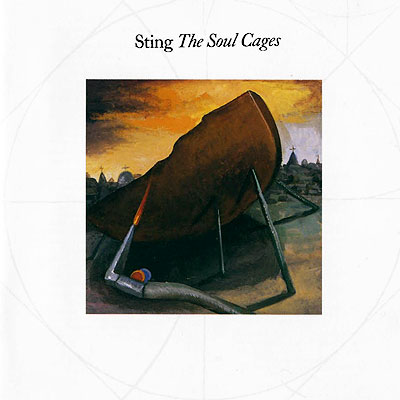
It was just by happenstance that I ended up claiming back another lost disc, Sting’s debut solo album The Dream of the Blue Turtles. I came across a reference about a new Sting album coming out and thought it had been quite awhile since his last, looked up his discography on Wikipedia, read notes on his first few albums and remembered that the light and catchy “All This Time” was featured on the otherwise Very Serious The Soul Cages. I mean, just look at the album cover. It’s all art and stuff:

The Soul Cages album cover

I don’t even know what that’s supposed to be. I’m calling it Picasso’s Tent. Also mysterious is why this album (and only this one among Sting’s) is not available on the Canadian iTunes store.

Anyway, back to how I reacquired The Dream of the Blue Turtles. I watched the video for “All This Time” which is perhaps uncharacteristically silly for Sting then noticed a link to “Fortress Around Your Heart” from Turtles. I started watching that, instantly remembered how much I lurved the song, went to Itunes, saw it was under $10–impulse buy territory– and bang, re-bought the album.

Having given it a few listens for the first time in many years the album is not quite as jazzy as I’d remembered, though there are a number of jazz-influenced songs. At the time of its release (1985) jazz was strange and alien to me, so that was probably a good thing. As it is now, I find it adds texture to what is otherwise a very finely crafted pop album and the next logical step in Sting’s maturity as a songwriter. The lyrics are more sophisticated than The Police’s last album Synchronicity and the appeals delivered and causes raised have a more personal tone to them. It’s a good album and I’m glad I have it again.

I’m still not sure I want to re-commit to buying Prism’s Armageddon again, though.