My Steam library lists 316 games. It’s actually more because several of the games are actually compilations of games. It’s probably still less than 10,000, though.
316 games is a lot of games. When I first started buying computer games for my Atari 400 back in 1982 they cost anywhere from $40-50 each. Sales were rare, so rare I seemed to have missed nearly all of them. When you paid that much for games two things happened as a result:
You didn’t buy a whole lot of games
You were very choosy about what you did buy
I once crazily indulged myself by picking up two games at the same time. It was back in 1989 and the games were Populous and SimCity (both for my Amiga).
I chose wisely that day.
But with taxes, it came to over $100. Even for someone working full-time it wasn’t exactly couch change.
Today, all of that has been blown away by Steam and other digital stores offering more games at (much) lower prices. The Steam Summer Sale is on as I type this and some of the games list for under $2. That’s 1% of what I paid for SimCity (SimCity 4 can be had for $4.99). This has made it absurdly easy to collect a giant pile of games if you exercise a little patience and wait for sales and I’ve accumulated more games than I could ever play. And I will accumulate more.
Which ones do I play? Which precious few do I actually engage in so that I can at least claim a tiny dent in that massive backlog?
None of them.
I have reached peak Steam backlog absurdity. I still play some World of Warcraft and a Mahjong on the iPad but the Steam games remain untouched. Okay, I will sometimes start up a game or two, sometimes an old classic like Titan Quest or a new title like The Long Dark. But it never lasts long. Has my attention span turned to mud? Am I paralyzed by too many choices? Do I worry that I’ll play the “wrong” game? The one that’s kind of buggy and janky, instead of the one that purrs along, doling out its rewards efficiently? Yes! Yes to all these, and more.
I don’t have a solution or grand insight to offer here but I am thinking more about it as I keep getting email reminders from Steam that 60 games on my wishlist are on sale.
(Also I’m not sure why but I’ve bold-faced the names of the games in this post, Dvorak-style. Man, that suddenly took me back to when I bought actual paper magazines, like PC Magazine.)
Pong was the first popular video game. I first played it in a darkened pizza restaurant in 1974, the video screen casting an eerie blue glow on those gathered around it. I was nine years old.
And hooked.
In 1976 we got the home version of Pong. It had two control knobs built into the console. My brother used his advanced high school electronics wizardry to pry the knobs out and then attach them to longer wiring, allowing us to sit back and play while reclining on those giant weird pillows that were so popular in the 70s. It was great.
Through the mid-70s and early 80s, my love of video gaming saw me spending many an hour in video game arcades–my first full-time job was handing out quarters at an arcade. The job was about as exciting as it sounds, but it was still cool to be surrounded by the light and noise of forty arcade cabinets. My manager was less impressed when a group of teenage boys gathered around a machine one night, managed to jimmy it open, and then empty all the quarters from it. Hey, I just thought they were really into Sub-Roc 3D.
Looking back, some of my memories and recollections of arcade games include:
the Williams games were technically dazzling and impossible for me to play competently. These included Defender, Stargate (no relation to the movie or TV series) and Robotron 2084. I loved these games but my roll of quarters would vanish all too quickly attempting to play them. I’m pretty sure I lost a ship just pressing the one player button in Defender.
while I enjoyed Time Pilot, there was something almost transcendental about its sequel, the space-oriented Time Pilot 84, that really hooked me. I actually got pretty good at this one. A local laundromat in Vancouver had it and I probably spent more money on it than others did doing their laundry.
I never quite mastered Dragon’s Lair but could play through (the superior) Space Ace with a single quarter. It was pretty much watching a cartoon with a joystick. That sounds wrong and in a way it was.
A friend and I played Super Mario Bros as player vs. player since you could push or otherwise manipulate the other player into the crabs, turtles and mean ice cubes. You didn’t get points by indirectly offing the other player but in a way that made it even better.
I remember thinking laser disc games were not the future. I was right (fortunately). Williams had one called Star Rider that was decent, cleverly using the laser-y part as a fairly seamless background to a respectable racing game (there’s even a YouTube video).
The cocktail table version of Ms. Pacman was awesome. Suddenly, standing in an arcade was obsolete (several arcades started providing stools).
The Movieland Arcade in Vancouver was one of my regular haunts and had a row of Sega’s Daytona USA machines near the front. Racing against friends was great fun. The arcade and those Daytona USA machines are still there more than twenty years later, but the arcade always looks forlorn and empty. The sign in the window also still advertises “girlie movies” in the back. I never watched the girlie movies.
by the mid-80s, we reached a kind of golden age of arcades. Most games were still 25 cents, with new games sometimes being 50 cents. Graphics had improved dramatically so titles like Toobin’ still look pretty good today. Home consoles were in the pre-Playstation era, so arcades still had a place with a technically superior presentation. That would fade by the early 90s. Coincidentally I was edging toward 30 and my own interests began pulling me away.
a friend and I played Cyberball against the Deluise brothers. I don’t remember why they were in Vancouver at the time.
another friend and I would drive from Duncan to Victoria to play games like Star Rider and Crystal Castles at Xanacade. Yes, we drove nearly an hour just to play video games. Both ways, in the snow!
Video arcades still exist, mostly on the appeal of massive novelty machines that cost a lot more than a mere quarter, but like many things you adore in your youth (hello, Mad magazine), the magic has faded. Alas and such.
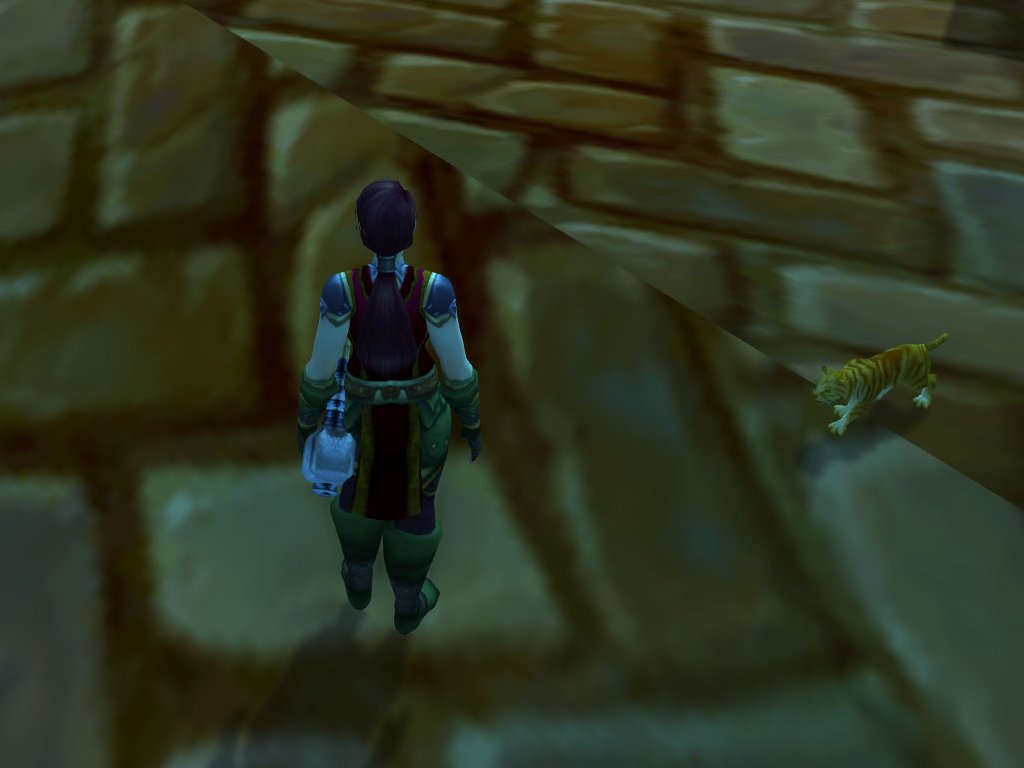
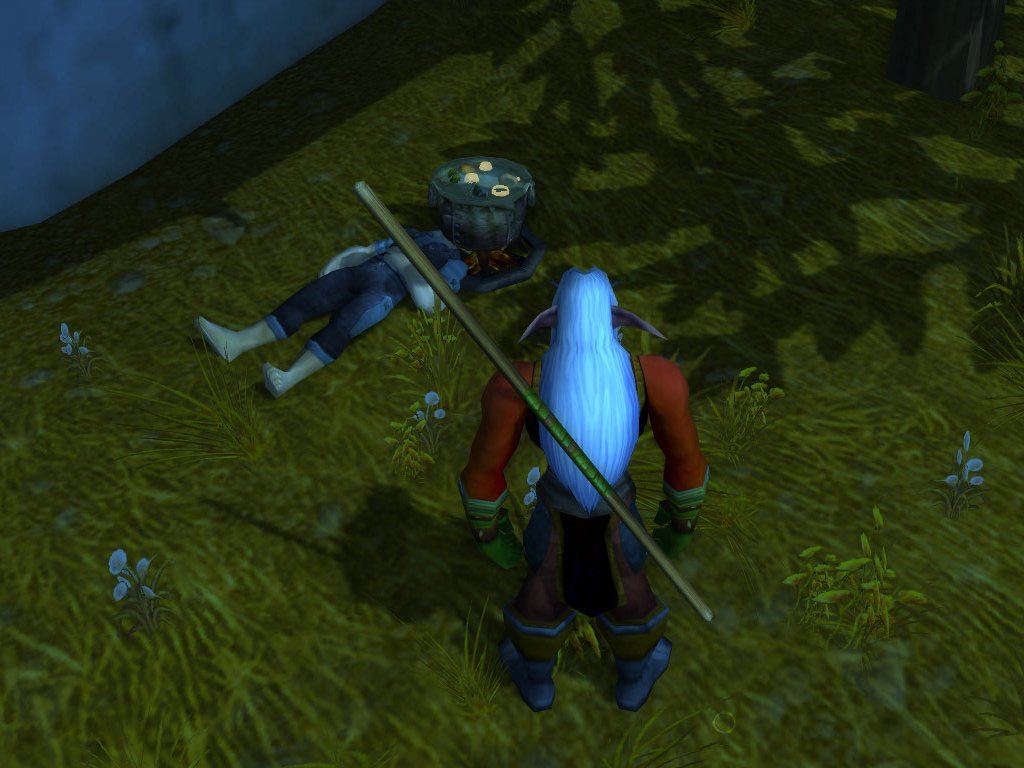
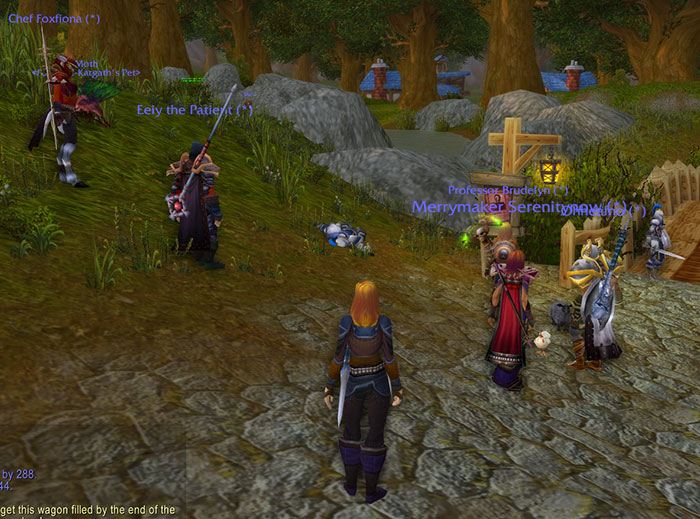
Six players (including my human rogue) waiting for Guard Thomas to respawn in Elwynn Forest so we can turn in quests. He was killed by a Horde (opposing faction) player. There is no reward for killing an NPC like this, nor any challenge–you just click a button and the NPC obligingly keels over, taking several minutes to magically spring back to life. There’s also no real way to stop this from happening.
Guard Thomas, we hardly knew ye.
This is the regular low level experience in World of Warcraft, an ongoing opportunity to observe sociopaths in the wild, as it were (or more accurately, their aftermath).
EA recently updated the iOS version of Bejeweled. I bought the game awhile back and spent an unhealthy number of hours playing it. I previously chronicled that it had finally loosened its grip on me.
Thanks to the new update I’m not only free of my addiction, I’ve uninstalled the game altogether. Why? In a word: greed.
The update adds one genuine improvement: the game loads faster. However, the animations now run in a jerky manner that’s just noticeable enough to be annoying. If you read reviews of the current version you will see a number of people complaining about this.
There’s also a new game mode called Poker. It’s fairly dull, probably the weakest mode they’ve added. And you need to pay $2.99 to play it more than three times.
The price is a bit of a joke for what you get, but at least the new mode is easily ignored.
More insidiously, the update also added ads–and plenty of them. EA doesn’t care if you already paid for the game, you’re going to see the ads–unless you pay $2.99 to remove them. This is a move best described as a slimy money grab.
I didn’t remove the ads. Instead I removed the game from the iPad.
I now have more time to read at night. Thanks for being greedy, EA, you’ve helped improve my quality of life a tiny smidgen.
The developers of Star Wars: The Old Republic recently added the mood “creepy” to the game. Moods are sort of fixed emotes that are meant to convey the current emotional state of your character. I’m not sure what “creepy” is meant to suggest.
Let’s look at my Jedi consular Nedolin (yes, I am very clever coming up with names):
The black soulless eyes and weirdly stretched proto-grin do indeed convey a level of creepiness, but it also suggest he is under a great deal of strain maintaining the look, as if he were putting on a mask. Perhaps he’s just learned his family has been trampled to death by a herd of Banthas and he is struggling to maintain his composure while at one of those interminable Jedi council meetings.
This is weird. I took another shot of Nedolin feelin’ creepy just tonight and it turned out like this:
Here he looks like the jerk in school who always shook you down for the candy bar your mom packed in your lunch. “You don’t need that snack, padawan. Don’t make me take it from you by force. Get it? Hahaha.”
Now I can’t decide what is more disturbing, that they added “creepy” to the game, that it apparently has different looks or that I’ve spent an entire post wondering about it.
One of my best gaming memories was going to Super Software and indulging myself by buying not one but two games. It felt positively decadent. This was in 1989 so the Internet effectively didn’t exist yet and magazines were still my main source of gaming news and previews. Super Software was a large software-only store in Richmond that carried games for nearly every major system. At the time that meant everything from the Apple II and Commodore 64 to the Atari ST and Amiga. I had my trusty Amiga 500 and there was a good selection of games for it.
As I strode in on that day in 1989 I found two games that were both part of what would become called ‘god games’ or sandbox titles: SimCity and Populous. Each went on to be massive hits, spawned numerous sequels and I sank many an hour into constructing urban paradises or smiting my computer opponents.
In the long term SimCity got its hooks into me more deeply. I’ve always enjoyed making things–not necessarily in the woodshop sort of way. In fact, I hated woodshops as a kid. Saws and other sharp tools held little appeal except as tickets to the hospital for a klutz like myself. A virtual way to build and create, though, that I could get into.
The original SimCity was fairly simple and only nodded in the direction of realism. You could construct a city with a rail-only transit system (no roads at all) and it would work. It may be that the pseudo-realism was part of what made the game click. When the sequel, SimCity 2000 came out, it introduced numerous improvements, an increased level of sophistication and an entirely new (and glitchy) water/pipe system that was almost universally disliked. Sure, having to make sure the water flowed added realism but the process of laying pipe and making it work felt more like an uninteresting chore. By the time the eminently charming SimCity 3000 appeared, the pipe-laying was gone.
SimCity 4 was the most ambitious of the titles yet, with full regions that could interconnect and layers upon layers of charts and simulation. I confess I never played it much because the drive to be more realistic–while perfectly logical–just didn’t have the same appeal to me as the slightly goofy earlier titles.
And so we come to the newest version, just released today. It’s not called SimCity 5, just SimCity, as if being framed as a reboot. And in a way that seems about right. The cities you can build are smaller but the simulation is even more detailed and realistic than ever. The game requires an always-online connection and while it doesn’t force you to build alongside other players, it does take away the option to save your city at certain points, instead relying on EA’s cloud storage to do the work (and in the first 24 hours it is working with predictably spotty success). While I marvel at the look of the game and genuinely applaud the game moving even more toward being a true simulation, I can’t help but feel that this is the next step in me being pushed away from the series permanently.
Maybe I can’t reconcile my creative drive with a proper simulation. If I want to build something silly, I don’t want to be (unduly) punished for it but the new SimCity torpedoes that philosophy.
I guess there’s always Minecraft and its (literal) castles in the air.
All I can say is I’m glad this is not how driving works in real life, as nearly every trip I take in a car in GTA3 ends this way.
I never finished the game when I originally played back in 2002 (dig those awesome textures) so I’m going in this time with a specific goal: to collect all 100 packages hidden throughout Liberty City. I’ll also be doing any other bonus activity as I see fit (taxi, ambulance and fire missions, other optional missions, stunt jumps and so on). My goal is pretty much to just do the things I find entertaining and skip as many of the ‘real’ missions as possible. I dimly recall a number of them being quite annoying so I’m happy to avoid them if possible.
My original plan was to play the game as a ‘good’ bad guy but I don’t think you can open up the rest of the city without shanking at least a couple of (no doubt deserving) people so I abandoned that fairly quickly. If all goes well (or especially if it doesn’t) I’l be recording my efforts for posterity on Broken Forum, which has a huge and frightening sub-forum devoted to the Let’s Play format.
There’s nothing quite like the sensation of laying down to sleep and finding yourself unable to breathe. This happened a few nights ago when my über-cold left my nose completely stuffed up. I had to breathe through my mouth, which made me dizzy. I eventually fell asleep probably due to exhaustion. When I awoke in the middle of the night one of my nostrils had kindly opened up enough to permit semi-normal breathing.
Worst cold ever.
Also the last post I’m making about it. Colds are pretty boring to read about and if I could capture the misery of the past week in a way that was truly entertaining, I’d be rich. Hmm. I may have to think about this.
Onward to the rest of what should hopefully be a healthy remainder of 2013:
Valentine’s Day is coming up. My favorite manufactured holiday when I was a kid because of the candy. I was especially fond of chocolate-covered marshmallow hearts. Mmm. Now I prefer the day after when all the candy gets marked down 50%. I usually treat myself to something small that I can work off without too much guilt/effort.
Running: This is probably still about three weeks off. I’m going to start stretching exercises to make sure my tendon is ready. The first run will be a short test that will also serve to calibrate my new iPod nano. The best thing about it, apart from the electric green case…
…is that it incorporates the Nike+ sensor/receiver so I don’t need to attach any extra hardware to my shoe (or the iPod). An added bonus is no more infernal clickwheel to deal with, especially one that refuses to function in the slightest bit of rain, making the end of a jog unusually difficult to, well, end. The test run will be done at a track to ensure maximum accuracy for the calibration. In the meantime I’ll try to return to the pool/gym at least a few times each week until the runs resume. Excelsior!
Diet: My weight has steadied out around 156-157 but should start going back down soon as I start packing a modest lunch to work and resist the siren song of the donut. My goal is to be back to my usual weight by my next physical, probably a few months from now.
This site: I have found a few themes I may be able to hammer into something serviceable for my needs. This is a long term project so I’ll probably work away at it a little at a time. I am planning on having a revamped site up before the end of the year.
Back when I was unable to gamble legally I accompanied my parents on summer vacation to, among others places, Reno, Nevada. As Mom and Dad were not heartless monsters, they found fun things for us underage types to do or better yet, activities we could all indulge in that didn’t involve one-armed bandits, roulette tables and such.
One of those activities was mini-golf at a stupendously elaborate mini-golf course outside the city. In retrospect it may have been outside of Las Vegas but I remember it definitely being in Nevada. Each hole was elaborately dressed with windmills and tunnels, hills, chutes, all the zany obstacles you expect at a deluxe mini-golf course. I’d always wanted to play again and finally, over 30 years later, I did just that today with Jeff.
The course we played on is far more modest than that Nevada wonderland — the 18 holes at Eaglequest Coquitlam (by coincidence we did indeed see an eagle up high in the sky overhead) are all rated at par 2 and while they feature a variety of layouts, slopes and obstacles (rocks or pilings) they’re pretty basic as mini-golf goes. But while the presentation wasn’t quite up there (including a mostly non-functional stream that was barely filled with some stagnant water) the holes were still zany good fun.
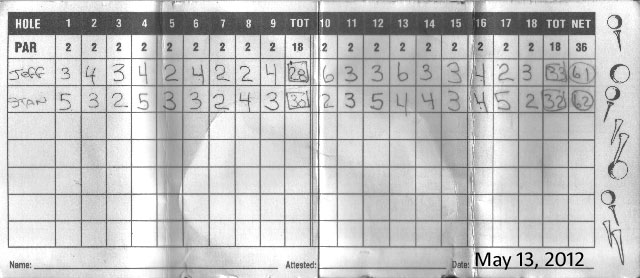
Neither of us managed a hole-in-one though we both had our moments. Neither of us managed par very often, either. 😛 I scored a solid par 5 on four holes, while Jeff took 6 shots on a pair. In the end we finished a mere point apart, with Jeff edging me for the victory 62-61.
Here’s the scorecard to make it official. I have added the date using advanced computer technology:
Mini-golf, maxi-scores
The weather was downright balmy, with temperatures in the low 20s, quite unusual for the first half of May. It felt as if we had been transported two months ahead and landed directly in summer. The best part of the game is neither of us landed balls in the stagnant water or on someone’s head.
We shall do this again. And then for a real good laugh, we may try real golf. I can already smell the sand traps.
UPDATE: I've gone through and added/edited entries to bring it up to date as of August 15, 2024.
Inspired by a thread on Broken Forum (and an idea I had for a post ages ago) here is a nearly complete list of every video game console and computer system I have owned, with dates (where I can remember).
The Computers
1982: Atari 400. With membrane keyboard! This was really just a video game machine for me but it was awesome. It came with four (!) joystick ports, took cartridges and provided far better sound and graphics than any comparable video game system back in the day. I almost considered buying the kit that replaced the membrane keyboard with actual keys. Instead, I held out until I got my next system.
Open the hatch, insert Star Raiders cartridge, lose rest of day.
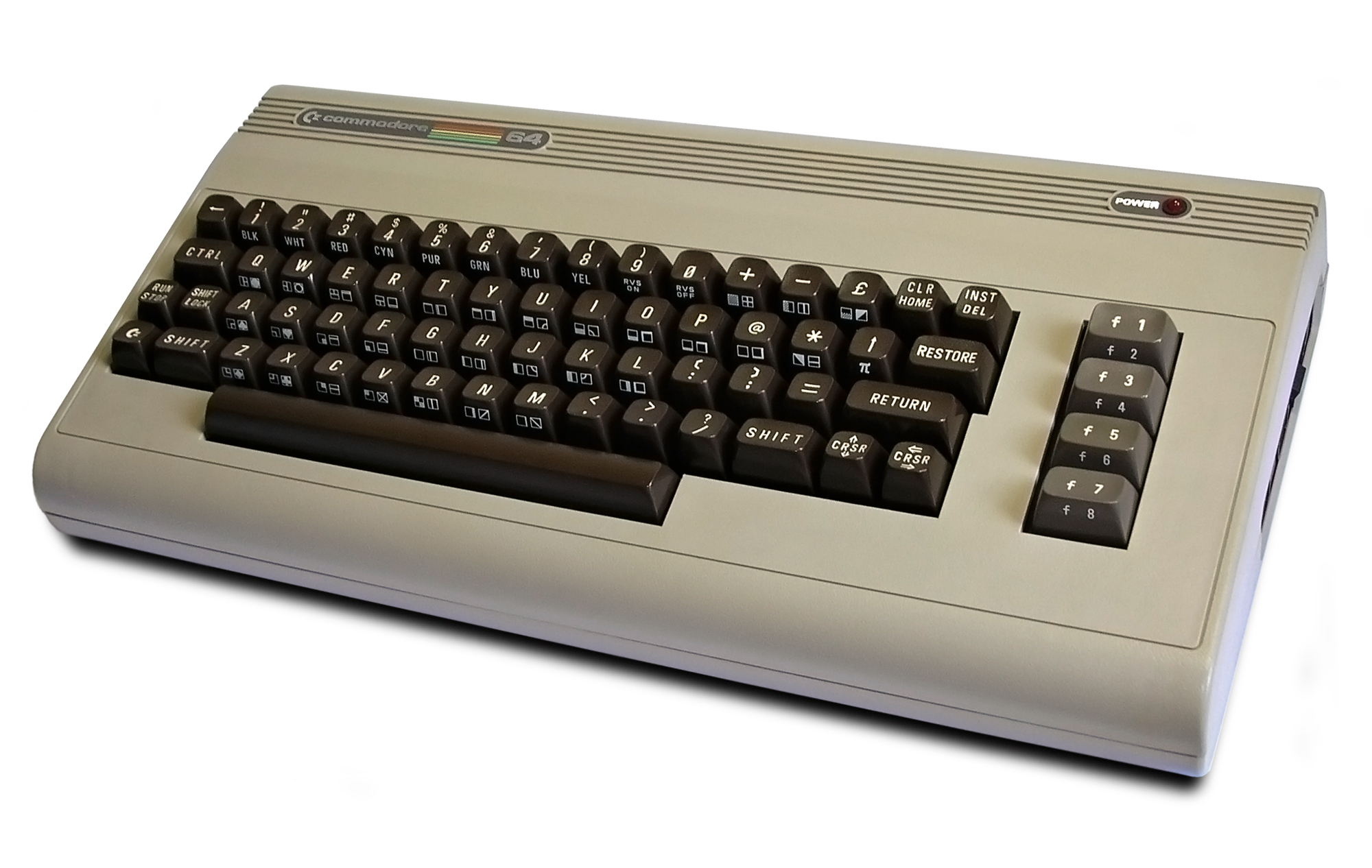
1984: Commodore 64. The C64 shipped in 1982, but it cost $600 then and I couldn’t afford it. By 1984 it was selling in huge numbers and had been reduced to a mere $200. The one I got in the early part of 1984 was one of a notoriously unreliable batch (I recall about a 25% or so failure rate) and had a bad keyboard. The replacement worked fine, though, and having a keyboard you could touch-type on was neat. This marked the first time I bought productivity software for a computer, a $130 word processor that I’ve long forgotten the name of. On the C64 you could create files about 2.5 pages long before you had to use dot commands to chain the files together for printing. It taught me brevity. I still have some of the data disks. I wonder if they would still be readable? In addition to being my first computer used for non-gaming stuff, it was also the first that I got peripherals for, namely an Epson dot matrix printer (designed to misfeed paper as soon as you turned your back on it), the 1084S colour monitor and the infamous 1541 floppy drive. The first game I bought on floppy disk was Lode Runner. I actually picked it up before I even had the C64 and marvelled over its floppy diskness. This was also a game machine, of course, with most games running from floppy and the best ones making use of Epyx’s Fast Load cartridge.
I still recall playing Infocom games and knowing I’d successfully figured out a puzzle because the 1541 drive would start clattering away (the game apparently kept the YOU HAVE DIED moves stored in memory).
Not shown: 1541 floppy drive a.k.a. Is It Supposed to Make That Noise?
1987: Atari 520ST. I had it with the monochrome monitor, so it was for Serious Business. I had WordPerfect 4.1 and WordWriter ST. I still played Phantasie on it, though. I eventually got the colour monitor and tried and disliked King’s Quest III. I still remember where this computer sat in my apartment on Nelson Street in Vancouver, and even recall writing specific stories with it. This was the first computer where I had dual floppy drives. I was clearly moving up.
A built-in floppy drive, a 2-button mouse and numeric keypad. Future: now!
1989: Amiga 500. Ah, the Amiga. I loved this computer. It felt sexy and modern and had tons of games and lots of other interesting and useful software for it. I had ProWrite, excellence and I think maybe one other word processor. Some people collected games, I collected word processors. I stuck mainly to ProWrite. I eventually upgraded the Amiga (my first computer upgrades ever) to AmigaDOS 2.1, 3 MB of ram and a 52 MB hard drive. This let me call up ProWrite nigh-instantly. Black Crypt also installed to the HD, which was nice. I kept the Amiga until I finally made the jump to PC and to this day regret selling it. Although pictured below, I did not have an external floppy drive for it.
Like the Atari ST but better.
1994: PC with Athlon 486-40Mhz CPU and 4 MB of ram. I eventually added a 2x CD-ROM drive to it so I could play Myst.
It starts blurring after this, but along the way I had:
Pentium II 120Mhz. I mostly remember playing Quake II on this with a Diamond Monster 3D video card (Voodoo 1 add-on card).
Celeron 500 (for about two weeks before it got stolen from my apartment — three days before Christmas, ho ho ho)
Athlon XP 1800. This was clearly a better system over equivalent Pentiums at the time.
Athlon 64 (first 64-bit system, though it only ran 32-bit Windows XP)
Intel Core 2 Duo 6850 with Nvidia GTX 8800. Back to Intel.
Intel Core i5 2500K (quad-core). This dates back to January 2011. 8 GB ram, Nvidia GTX 580, Windows 7. It was updated to Windows 8 then Windows 10 before being retired.
Ryzen 7 2700 with Nvidia RTX 2070 (2019) and 32 GB ram. Back to AMD. I’m so fickle. This is my current system as of August 15, 2024.
Bonus laptop entry:
Lenovo ThinkPad (2018, 6th generation). I sold it in 2023.
And not forgetting the Macs:
MacBook Air (2013)
Mac mini (2018). Intel, had crappy Wi-Fi and Bluetooth.
MacBook Pro (2016). The horrible butterfly keyboard version.
MacBook Air (2020, M1 version)
Mac Studio (2022, M1 version)
I currently only have the Mac Studio.
Video game systems
Atari 2600. It was still called the VCS when I got it in 1980. I probably had 30+ games on the system (I had a list somewhere at some point) and favourites would include: Adventure (duck dragons!), Superman, Video Pinball, Canyon Bomber, Circus Atari, Night Driver, Demon Attack (which I thought looked amazing for a 2600 game), Kaboom!, Asteroids (a surprisingly decent port) and a bunch of others I’m forgetting. For its primitive hardware, the system had some fairly captivating, if obviously simple, games.
And it came with two joysticks and two paddle controllers. That’d be $150-180 extra these days!
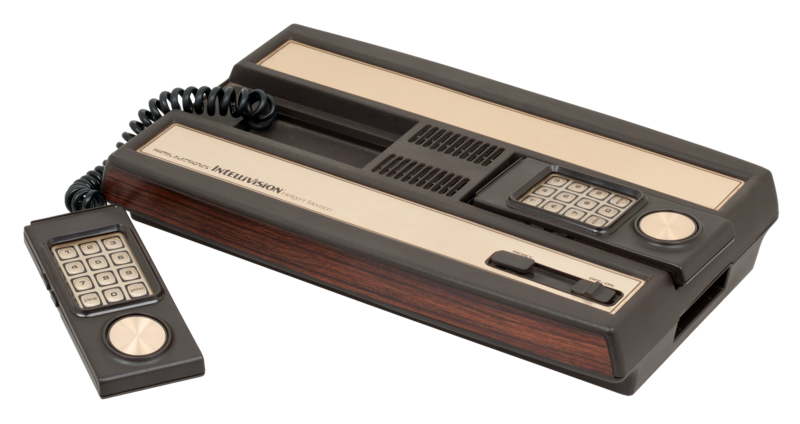
Intellivision. I didn’t know who George Plimpton was but I knew I had to have the Intellivision. I got it on cheap thanks to my brother’s wife’s employee discount at Woolworth’s. I never had as many games with it as I did with the 2600 but some were classics, even if that thumb wheel proved to be less than optimal. The Intellivision is also where I (more or less) learned the rules of American football. Favorites include Microsurgeon, Skiing (falling was especially painful), Armor Battle, Sea Battle, Astrosmash (this was almost zen-like in the way you could keep racking up a score as the shapes tumbled down from the top of the screen) and Major League Baseball (Yer Out!)
From the era when fake woodgrain was on everything.
Atari 5200. I had this around the same timeframe as the Atari 400, which was appropriate, because the 5200 was pretty much a 400 re-purposed as a game console. The joysticks were wacky non-centering analog things that worked great for games like Missile Command and not so great for games that required precise changes in direction, like Ms Pac-Man. One of the neat things was how the system would switch to a blank screen when you turned it off to switch cartridges, instead of blasting you with the sound of a static-filled TV display. I never had many games for this, mostly some arcade ports, but it was a decent machine. The cartridges were massive.
This sleek design still holds up 30 years later. That joystick…not so much.
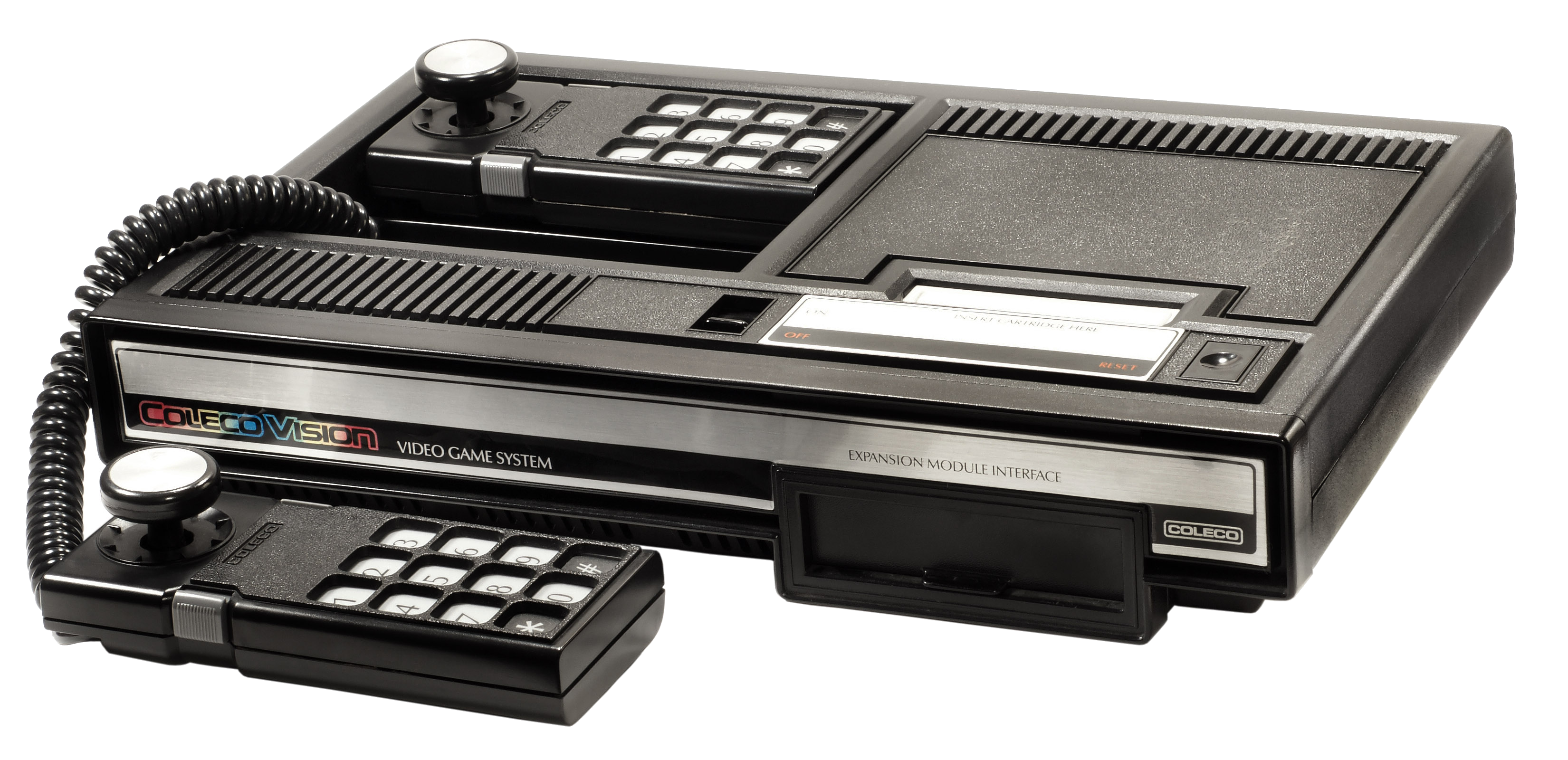
ColecoVision. This had the potential to be the ultimate console, but it came out just before the whole market crashed in 1983. I still enjoyed it for what it was: a machine that consciously improved in many ways over its predecessors. The joysticks were better than the 5200’s, the keypad and buttons better than Intellivision. Graphically, it offered the closest to arcade-style graphics at the time. It also had an awesome pack-in game: Donkey Kong (this was before Nintendo locked it up forever). Most of the well-known arcade hits were already licensed to other companies so Coleco had to go with more of a B-list, but there were some excellent games among them, if less known: Venture, Looping, a Smurf game that featured so-so gameplay but astonishing graphics for 1982, Carnival, Lady Bug and Mr. Do! The load screen was annoyingly long — apparently in an attempt to get the ColecoVision name permanently embedded in young and impressionable minds.
Kind of cheap-looking but the games were good!
After the ColecoVision I turned to computers for the next 20 years. It wouldn’t be until 2003 that I would pick up an Xbox. Three years later I got an Xbox 360 but found I used it so little I ended up selling it off.
Later:
Xbox One (still have it, but not connected to anything)
Xbox Series X (Microsoft is so bad at naming consoles). This is hooked up to the TV and is mostly used as a media player.
Nintendo DS. Used pretty regularly until I got an iPhone.
Nintendo Switch. Rarely used. I bought it at the start of the pandemic, but never really got into it.
In 1973 the population of Duncan, British Columbia was about 5000. Today, nearly 40 years later, it is still around 5000. Duncan is a small town, but it struggles to maintain that small town feel with outlying municipalities springing up subdivisions like mushrooms after a heavy rain. The tiny footprint of the city — all of two traffic lights on the Island Highway as you pass through — is being stamped with every kind of franchise imaginable, from Burger King to Home Depot to casinos and multiple McDonald’s.
But it wasn’t always like this. In the early 1970s the outlying area around the city was largely undeveloped. You could ride your bike (with banana seat, of course) on trails that ran for miles along the Cowichan River. The annual exhibition took place on agricultural land that existed within the city limits. When that first McDonald’s opened in 1978 it signaled the end of an era.
In 1973 one of the popular local eateries was an Italian restaurant called Romeo’s. To my young eyes it was a place of mystery and intrigue, an ‘adult’ restaurant with subdued lighting that made me think of a coal mine (the aesthetics were more appreciated when I got a bit older). The small lobby area, like the rest of the place, was dimly lit and had everything you’d expect — a coat rack, some seats, the stand where the hostess would greet you and take you in. But one day we went in and something new was there. It was a machine unlike any I’d seen before.
I’d heard of Pong and now I was staring directly at it: a cocktail table-style cabinet housing a TV screen, with controls on two sides that consisted of simple knobs. The surface of the table was glass. I watched the strange phosphorous glow of the display, simple lines and a small square of light gently arcing back and forth between two rectangular blocks or ‘paddles’. This was like something from Star Trek. I had to try it!
25 cents for one play. In 1973 and to someone who had yet to hit double digits, 25 cents was a lot of money — more than the cost of a whole candy bar! I rarely had any money on me. My older brother did, though. He regarded me as his personal slave, so it seemed unlikely he’d give or loan me the money to try it out. To my good fortune it turned out that Pong required two players. My brother would pay then ‘force’ me to play against him, keeping the hierarchy of owner/slave intact. Win-win, as far as I was concerned.
I don’t remember how that first game went. I’m going to say I won due to that intuitive little kid video game sense that so many little kids seem to have. What I do remember is how the simple act of turning that knob, seeing the paddle on the TV move in reaction and then hit that little square of light was magic. Magic.
A few years later we got a home Pong unit. My brother, who liked to tinker with electronics, managed to take the controls that were hardwired to the console and break them out into handheld units, allowing us to play without being three feet in front of the TV. We still played sitting three feet in front of the TV because that’s what you did but we had the freedom to move if we wanted to.
Pong led to the first video game system I owned myself — no negotiating with the big brother required! — the Atari VCS (later renamed the 2600). It didn’t come with Pong. The new world of video games moved quickly and already Pong was passé. It didn’t matter. Those early days of ‘electronic tennis’ had already confirmed that I had a new lifelong hobby, one I didn’t even know existed until I saw that glowing screen in Romeo’s when I was nine years old.









![[IMG]](http://upload.wikimedia.org/wikipedia/commons/thumb/8/8f/Atari-400-Comp.png/800px-Atari-400-Comp.png)
![[IMG]](http://upload.wikimedia.org/wikipedia/commons/thumb/3/39/Atari_1040STf.jpg/800px-Atari_1040STf.jpg)
![[IMG]](http://upload.wikimedia.org/wikipedia/commons/thumb/c/c3/Amiga500_system.jpg/772px-Amiga500_system.jpg)