
Fall, when the leaves go
I ask only for one thing
Rains not be endless
Writing
Am I thinking about writing a novel again?
Sort of.
The AI debacle over at National Novel Writing Month prompted me to look at my collection of unfinished novels and ask myself, “Hey, would I like to start yet another novel and probably not finish it?”
And the answer is…maybe!
The nice part is that this time I’d be doing it outside NaNoWriMo, meaning I can work on whatever schedule I like, such as:
- Write 500 words per day
- Write 1,000 words per week
- Think, sincerely, and at length, about one really great idea for a novel while writing absolutely nothing
- Write 2,000 words, start over in a different piece of software, then repeat several times before being distracted by something else
- Switch to longhand, write three pages, have my hand cramp up horribly and wonder what the hell I was thinking
- Look, it would have been a great novel, OK?
I’ve got options, is what I’m saying. Let’s see what happens next!
The angry screeds are coming from inside the blog
UPDATE, September 27, 2024: Fixed some details. Also, here is a longish piece by Josh Collinsworth that covers the whole sorry affair in detail. The only thing missing is Mullenweg's announcement to give WP Engine a four-day "reprieve", written in the same churlish tone as everything else he's put out recently. I would not invite this guy to your next birthday party.
It seems that a dispute has erupted between WordPress and WP Engine, a company that makes use of WordPress in ways that the WordPress founder and CEO Matt Mullenweg apparently does not like. There are cease and desist letters, lawyers and all that involved now.
This has led to a couple of unusual entries in the normally quiet WordPress Events and News section of my blog’s dashboard, as seen below.

Clicking the links (you can’t click them in the image, sorry!) will lead to the WP founder saying mean things about WP Engine, even calling it a “cancer.” He had threatened to bad mouth WP Engine at a major public WP event (ironically sponsored in part by WP Engine) if WP engine didn’t share some of their sweet lucre with him through some vaguely defined licensing something-or-other that Matt appeared to have invented very recently. WP Engine asked for more time, Matt took that as no and the bad-mouthing took place). It’s ugly all around.
And what this person–the CEO and founder of WordPress–has done has made people start to question the actions of WordPress as an organization, and how much it can be trusted moving forward. It takes a long time to build a good reputation, but only moments to ruin one.
I was already revisiting my (ever)quest to move my blogging, and this is…helping. I’m not sure if that’s the outcome Matt Mullenweg was looking for.
I’m going to be rich!
See:
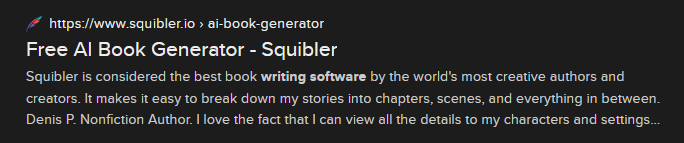
But (a little) more seriously, I’ve been looking at novel-writing software and there are a few trends I’ve noticed:
- A lot of software has moved to the browser (kind of yucko).
- Most software has a monthly or yearly subscription attached (definitely yucko).
- No one really recommends Microsoft Word, but a few recommend Google Docs (??).
- Most non-browser software seems to run on Windows or Mac, but rarely both.
- Scrivener is the unicorn because it supports Windows, Mac and has a one-time purchase price. It even works on Linux if you are willing to fiddle a bit (no actual fiddle skills required).
- There seems to be a split between software that is pretty and modern, and One Dude Who Knows How to Code But Uses UI by Caveman Design.
- None of the “best of” lists I looked at offered anything for Linux. Sorry, Tux! This is mildly surprising, because novelWriter is open source software that runs on all three desktop platforms: Windows, macOS and Linux. I’m trying it out now and will have more on it soon™.
In reality, I probably have the best option already, the aforementioned unicorn of Scrivener. But I am still traumatized by how it munged my work, and it does not play nice with network drives or cloud services, and I’m not yet certain if I want to restrict my writing to one platform. Maybe I should.
Also, this is my way of saying I may start writing fiction again. Woo. Or at least woo-ish.
I write at the intersection of tragedy and farce
Not really. But it seems popular these days to be writing at or about the intersection of some thing and some other thing or things, and as I get older, I descend more into, “How do you do, fellow kids?” territory, wanting desperately to seem hip, cool, and relevant while being only a little of each.
Things I also write at the intersection of:
- The street I live on and the one nearest it
- Apple and why it’s so much fun taking shots at the company
- Apples and pears, the eternal battle for snack fruit dominance
- Technology and penguins
- This and that
Have a favourite intersection you want me to write at? Let me know!
NaNoWriMo no-no: Weird messaging on AI
I have long-since given up on participating in National Novel Writing Month (and have no plans to take part this November), but it popped up recently for a reason I didn’t expect: The organization’s stance on AI (which they think is A-OK).
More to the point, they think rejecting AI outright is classist and ableist. You can read their (modified multiple times) statement here: What is NaNoWriMo’s position on Artificial Intelligence (AI)?
As I state in the title above, this seems like a weird stance to take and is probably insulting to the people NaNoWriMo thinks they are championing (and I’ve seen several posts from people in the target group on Mastodon saying just this). No one needs to use AI to write a novel, and I’d argue that no one should, especially for something like NaNoWriMo, where many participants are new writers just learning their way. Using the crutch of AI could easily lead them to writing worse fiction, reinforce bad habits and suck the soul from their work. It could impede them from finding their own voice by bumbling through and learning from their mistakes.
And this is all apart from the ethical arguments surrounding AI being largely or even mostly built on the theft of the work of others (sure, some AI companies are starting to make deals, but how will a writer possibly know if the AI they’re using is “clean” or not?)
I’ve toyed around with AI a few times on this blog, mostly as a kind of joke, because the results are usually awful, bland or blandly awful. I’ve stopped now because the energy costs make me feel bad about using it just to fart around.
Some have pointed out that NaNoWriMo might be beholden to its sponsors, as one of them has AI features–ProWritingAid–but they have been a sponsor since long before they adopted AI tools. Here I was going to point out that another sponsor, Ellipsus, has a very anti-AI stance, but…it looks like they pulled their sponsorship in the last day (statement here: We’re stepping down as a NaNoWriMo sponsor. Here’s why.)
I expect more fallout to continue, and it already seems like an opportunity for replacements for NaNoWriMo has begun–one is already in the works that I know of: https://writingmonth.org/.
Of course, none of this will stop anyone from trying to write a 50,000 word novel in the month of November. You don’t need a big website–or AI–you just need an idea, and a lot of dedication to see it through (and about 1–2 hours per day of free time, in my experience).
I’ll post more as the situation develops.
Also:

Blogging: On the other hand…
When I think about moving from WordPress to something perhaps simpler and easier to manage, it also occurs to me that since October 2023 I’ve not exactly struggled to post, but my output of roughly 2 posts per day has dipped to something like 1.1 posts per day. Maybe I don’t have enough to say anymore to warrant switching to another (paid) service.
Or maybe I’m just in a creative funk.
Or maybe I’m lazier than I used to be.
So many possibilities.
I will continue to ponder.
Meanwhile, here is a smart-looking cat1Yes, I’ve used this one before. Like I said, I’m lazy. I mean, I’m recycling and saving e-trees or something.:

Blogging and thinking about blogging (includes blogging)
I saw a link on Mastodon1aka the one social media platform I still use that led me to write.as, which is one of the blogging solutions I pondered when I was thinking a lot about moving away from WordPress. Then some things happened:
- I got distracted (this happens a lot)
- The easier route of just tolerating WordPress and doing nothing settled in and took root
- Not to mention, I know WordPress quite well after using it for almost 20 (!) years, so there’s muscle memory and all that encouraging me to stay put
But as someone who hopefully isn’t just an AI scraping my blog for weirds and probably untrue things to add to the AI Slurry of Knowledge (SOK), you may have noticed I’ve also been engaged in something I call The Culling for the last few years. I can’t recall if I’ve ever fully explained what it is, but it’s pretty simple.
The Culling, explained
- Big corporations are generally bad
- Big tech corporations seem to be extra bad, in that, “You think YOU’RE bad? Hold my beer. Hold all of my beers” way.
- Growing increasingly disenchanted, while also experience things like subscription fatigue, I have begun The Culling. The Culling is meant to move me away from services and software offered by Big Tech™ and to use either free (possibly even FOSS) or paid options from smaller companies that still see their customers as humans and want to treat them fairly, a radical notion on the current interweb.
WordPress has made some dumb (IMO) moves regarding AI and are generally heading in a direction I don’t like. Also, the platform is bloated, creaking and there’s way more here than I need to just write inane things and post pictures on a daily basis to an audience of one to five people, of whom I count myself. Thus began the search for a replacement, which would also be part of The Culling.
And then lazy, too easy to do nothing, etc.
But now I’m looking again. I feel I’ve somehow managed to tap into one of those moments where I am invigorated for [x] period of time, and I am seizing it to move forward in several areas, one of which is this here blogging thing.
I will report back soon or soon-like.
“It felt like opening the front door at my birthday party to welcome in a group of iPads on wheels instead of people I like”
Today I came across this wonderfully horrifying blog post about someone using AI (an LLM1Large Language Model, or as I’ve seen some people call them, a very fancy parrot to be precise) to write an email to a friend. Why a friend would do this to another friend is a very good question, because it seems terrible and awful.
The post is filled with great lines, though, one of which forms the title of this blog post, which was generated by LTF2Less than Ten Fingers typing, which is the way I’ll always roll, I think technology.
18 again
Not to be confused with Eurythmics’ 17 Again.
There is a science fiction time travel trope/plot (yes, it’s Time Travel Week on my blog) that goes something like this:
The protagonist is sent back in time, put back in the body of their younger self, but while retaining the memories of their present-day self. Shenanigans follow.
I’ve played with a variation of this for a novel or short story where a middle-aged dude (someone probably 50+) gets sent back to the day of their 18th birthday, waking up in their 18-year-old body and then deciding on what to do to change/preserve the future. The hook would have been something like they know they have an incurable disease or some such and have a second chance to try to change the inevitable course of their demise. Something light and fun like that.
I never did write the story, but it’s been rattling around long enough that I wondered how I would handle such a scenario. This would be too personal for a blog entry, but I can give some broad strokes and raise inevitable questions about the whole thing.
Being put back into my 18-year-old body would mean waking up on the morning of September 19, 1982. I’d be in my bedroom in the family home in Duncan, City of Totems®. At this time, my main activity would be attending Malaspina College in Nanaimo in the theatre program. I did share a small apartment with a classmate there, but came back to Duncan for the weekends, because Duncan was still my home and Nanaimo would never be.
The first thought, once I’d checked out my amazing 18-year-old body (it was not that amazing, really, but it was pretty flexible), would be: Once I get out of this bed, anything I say or do or not say or do could drastically affect the rest of my new, second life. I would be a living version of the butterfly effect. That would stress me out for a bit. Maybe a long bit. I have no idea how well people compartmentalize profound, world-changing thoughts like these.
And while all of my present-day memories would be fully intact, I can tell you I remember not a single thing I said, did or thought on my 18th birthday, so I’d have to get good at acting like I totally knew what everyone was talking about really fast. But what would I actually do, once I settled in? What would be my short term plans? Long term plans? Would I just go with the flow and not plan anything different at all? Would I draw elaborate diagrams trying to plot out cause and effect? “If I do X, I will probably never meet Y”, things like that. It’s hard to say without actually magically going back into my 18-year-old body, so my best guesses would be something like these:
In the short term, I’d eat healthier, get more attractive glasses, a haircut, and start jogging regularly (the regular jogging didn’t start until I was in my mid-40s). This would make me look better, feel better and make me more confident. This could potentially change a lot, so it gets really fuzzy after this. I’d finish that first year of college out of a sense of obligation, but knowing I didn’t finish the second year, I’d have to decide whether to preemptively skip the second year or commit to it and see what happens. I’m not sure which I’d do, but lean toward acting preemptively and skipping the second year right away. But then what? Move to Vancouver in 1983 instead of 1986? Maybe!
On a more mercenary level, how could I use my advanced 2024 knowledge to benefit myself in 1982? There are obvious things, like buy Apple and Microsoft stock. I could solve all of my money issues with just a few wise early investments. That would also change a lot.
As for other people, the big one would probably be my dad. He smoked like the proverbial chimney, and it literally cost him his life, via a massive and fatal heart attack in 1991, at age 58. That untimely end would come nine years after I return to my 18-year-old body. Would I be able to convince him to stop smoking before it was too late? I don’t know, but it would probably add a level of anxiety and dread that would undercut everything else, like having a quietly ticking bomb in the background and knowing exactly when it’s going to go off.
Speaking of, at my 10th high school reunion in 1992, I asked an old friend and classmate how his younger brother (who would have been 24 or so at the time) was doing, only to find out he’d died from a brain aneurysm in January of that year. Awkward and depressing. But with this foreknowledge, could I have saved the younger brother by letting him know what was to come? Not to mention, how do you even convince someone of something like this without coming across as a total lunatic? Establish a pattern of correctly predicting the future to prove you’re the real time-travelling deal? Probably. And because I couldn’t bring any fancy 2024 tech back with me, I’d have to rely 100% on my memory. What if I misremembered a “prediction” and got some aspect of it wrong, damaging my credibility? Complications!
In a way, it wouldn’t feel exactly like reliving my past because all of my actions would be constantly altering bits of my previously known future, making them less known and different. That could be liberating, in a sense (a clean slate), but also terrifying. What if something significant didn’t happen, as I’d expected it to? What if it became clear that things were heading in a new and unknown direction, and I clearly had no control over any of it? Would I want to relive all those years (40+) again without being able to mentally prepare for what comes next? If everything comes down to generally unknowable fate, I could end up with a worse life instead of a better one, but it would be even worse than that, because I’d know about the better life I did have, then lost. There’s a classic Twilight Zone twist. All it needs is Rod Serling to come out and pontificate on what a sap I was to leave my known life on the gamble of something better. Be happy with all you have, etc. (Serling died of lung cancer because he, too, smoked like a chimney.)
Still, I’d at least be rich from all that Apple and Microsoft stock. And this time I’d keep my Amiga. And I’d dress at least a little better.
Moving from WordPress, Part 4
This will be a quick one, because it’s just me explaining why it’s been a while since I had an update. Mainly, I have been preoccupied with other more pressing matters and this has taken time away from my search. I’m also increasingly skeptical that any alternative will give me what I want, despite my issues with WordPress, which means I might just stay with WordPress. But we’ll see.
I’ll have a more detailed report in Part 5, in which I will have actually tested write.as, as promised earlier.
A fictional life
Sometimes I feel like my life is just there to provide fodder for my fiction. I wonder how common this is for people writing fiction. Sure, you change the names, maybe the profession if it’s mentioned, but I have cut whole chunks from my life and put them into my fiction, sometimes well-disguised, other times not. Sometimes I just carry the feel (or vibe, as the kids say) over from my reality, not actual details.
I have a feeling I am stating the obvious here, but we all learn things in our own way, at our own speed.
I wonder what fiction I’ll be writing by year’s end. I’m not sure if I want to know, and at the same time am deeply intrigued.