Quest for a new laptop, Part 2

Based on my previously discussed criteria, here are some candidates I’m considering. It’s deja vu all over again, as I did this back in 2016 before buying the non-touch bar version of the 13″ MacBook Pro (which I’m now replacing because I just plain don’t like the keyboard and also I’m kind of afraid of getting stuck keys now that it’s past warranty).

Unless otherwise noted, these laptops all come with the following:

  • touchscreen
  • quad core Core i5 CPU (8th generation)
  • 256 GB SSD
  • IPS FHD display running at least 1920 x 1080

Microsoft Surface Laptop

Pros:

  • lightweight at 2.76 pounds
  • among the best Windows laptop trackpads
  • solid keyboard
  • long battery life
  • slightly better than HD resolution at 2256 x 1504 and large 13.5″ display
  • 3:2 display ratio means less vertical scrolling
  • Windows Hello support
  • Alcantara fabric on keyboard (possibly also a Con)
  • four colors!

Cons:

  • few ports. Really only one USB 3 and mini-DisplayPort
  • no USB-C ports
  • screen wobbles a bit when using touchscreen
  • uses 7th generation CPU
  • doesn’t include a pen

The main selling point of the Surface Laptop is it does everything decently. You might find laptops that offer better individual features but none that offer all of them at the same consistent level as the Surface. Still, the design has always struck me as being very conservative. When you look at it closely it appears to be a Surface Pro with a permanent keyboard attached, down to the same deficiencies that the Pro has, with few ports, no USB-C and so on.

That said, because it gets all the basics right, it’s a strong contender.

Dell XPS 13

Pros:

  • even lighter with the 2018 redesign at 2.70 pounds
  • sexy slim bezels
  • excellent if slightly glossy display
  • excellent keyboard
  • good touchpad
  • good battery life
  • USB-C ports
  • Windows 10 Pro is an option
  • optional fingerprint reader
  • Windows Hello support

Cons:

  • still has that nosecam, just moved to the bottom center now
  • FHD (1920 x 1080) models do not include touchscreen
  • no legacy USB 3 ports
  • battery life not as good as previous Core 8th gen model

The Dell XPS 13 is often cited as the best Windows laptop (The Wirecutter calls it the best Windows Ultrabook) but the current version ditches all legacy ports, meaning you’re probably going to need dongles. It’s also a poor choice for those who need a webcam, though that’s a non-issue for me. Nearly everything about it is appealing or at least livable, but for some reason Dell is not offering the HD model in a touchscreen variant. This gives me serious pause, as I’ve come to really like touchscreens on Windows laptops.

HP Spectre x360

Pros:

  • light at 2.75 pounds
  • fairly compact design
  • includes both USB-C and USB 3 ports
  • 2-in-1 design, so screen can be folded around to use for drawing, watching video, etc.
  • Windows Hello support
  • includes pen
  • good keyboard
  • good display
  • great value for what it includes

Cons:

  • some persistent complaints in reviews about coil whine give pause
  • wobbly touchscreen
  • battery life is only average (but still good)
  • screen brightness is only average

The Spectre x360 comes close to hitting all the marks, with battery life, brightness and a wobbly touchscreen primarily holding it back. Plus the snazzy dark ash silver color is hard to find without ordering direct from HP (I prefer darker-colored keyboards to others, especially silver, which is the other color option here).

Lenovo Yoga 920

Pros:

  • Very good battery life
  • 2-in-1 design
  • capacious 13.9″ display
  • sexy slim bezels
  • Windows Hello support
  • fingerprint reader
  • includes pen (when buying from MS)
  • Windows 10 Pro is an option
  • 3 colors!

Cons:

  • a bit heavy at 3.1 pounds
  • not as compact as other ultrabooks
  • shallow keys “similar to a MacBook Pro keyboard” (The Verge review) – yikes!
  • screen brightness is only average

The main reasons to get the Yoga 920 are its large screen and battery life. Unfortunately the keyboard appears to be reminiscent of the 2016 MacBook Pro–and the MBP’s keyboard is the primary reason I’m looking for a replacement, which may prove to be the 920’s fatal flaw (I’d probably need to test it in person to make a final determination).

Microsoft Surface Book 2

Pros:

  • detachable screen doubles as a tablet and can be reversed to offer drawing/tent modes
  • among the best Windows laptop trackpads
  • solid keyboard
  • outstanding battery life
  • better than HD resolution at 3000 x 2000
  • Windows Hello support
  • comes with Windows 10 Pro
  • USB-C port

Cons:

  • USB-C port is limited by not including Thunderbolt 3
  • Core i5 version uses 7th gen CPU and is more expensive than comparable ultrabooks
  • Core i7 version is $600 (!) more (you also get an integrated Nvidia GTX 1050 at that price)
  • on the heavy side at 3.38 pounds
  • that weird fulcrum hinge with the big dust-collecting gap
  • pen is now a separate purchase

The Surface Book 2 is big, expensive and on the heavy side. On the plus side, it’s powerful, has a large, excellent display, and a very nice keyboard. It’s tempting but…expensive.

Beyond these laptops are plenty of others that get most but not all things right, sometimes by design (to keep price down, for example) and sometimes for no apparent reason.

If Apple revealed a MacBook Pro with a completely redesigned keyboard this year I’d probably consider sticking with it, but that seems very unlikely. They’ll just continue to tweak their existing butterfly design (which some people admittedly love) to make it more reliable, without fundamentally changing the feel of the typing experience.

The XPS 13’s baffling lack of a touchscreen in its FHD model almost puts it out of contention, but I’m keeping it in mind for now. My current ranking would probably look like this:

  1. Surface Laptop – best all-around mix of features
  2. HP Spectre x360 – same as above, but dimmer display, less battery life–but 2-in-1 versatility
  3. Lenovo Yoga 920 – keyboard might be an issue, heavier, bulkier
  4. Dell XPS 13 – no touchscreen option but solid otherwise (webcam is a non-factor for me)
  5. Surface Book 2 – powerful and strong in most respects, but big, heavy and expensive

And now I ponder and, where possible, try some hands-on demos. Most of these are available to look at locally (heck, the Microsoft Store carries most of them), though the newer Yoga 920 appears to be not unlike hen’s teeth in the Lower Mainland currently.

Signs of spring, 2018 edition

While heading out for my run yesterday I spotted these flowers coming up through the dead leaves. Spring will soon be…springing. Yay.

Addendum: The sun was out, as you can see, and I didn’t fiddle with the photo so it looks a little blown out. I thought these fancy new smartphone cameras were supposed to magically turn me into a great photographer. Maybe next year.

Run 571: It’s all in the knees

Run 571
Average pace: 5:53/km
Location: Burnaby Lake (CCW)
Start: 12:29 pm
Distance: 5:03 km
Time: 29:37
Weather: Sunny
Temp: 9-11ºC
Humidity: 43%
Wind: light
BPM: 163
Weight: 168.5 pounds
Total distance to date: 4440 km
Devices: Apple Watch, iPhone 8

This is what happens when you take five days off between runs. You get sore knees. Actually, the sore knees is kind of new (both being sore, that is), which is a tad worrisome but we’ll see if they’re just creaky from lack of use or getting ready to fall apart when I resume a more regular running schedule.

Which should start happening soon as we switch to Daylight Saving Time tomorrow. Yay!

The bridge replacement at Still Creek is still being rescheduled so I took advantage and ran counter-clockwise. The mild conditions meant I wore my usual–t-shirt and shorts–and apart from the arms being a bit chilly early on, it was fine.

This run was curiously hard. I mean, I’m not in peak condition, obviously, and five days off between runs is not great, but still, it just seemed like more of an effort. The topper was ending up over two minutes slower than last Sunday’s run. Oy. I opted out of doing a full 10K as it seemed like it might be a special agony, but ended up jogging on and off regularly for the 9 km walk back home. The average pace of that walk was 8:33/km, which is approximately impossible at an actual walking pace.

While I didn’t suffer any issues during the run, I could feel my leg muscles already getting sore on the walk, home, much like the previous run. The knees also seemed achy, though that diminished significantly once I got home.

As good as I felt with the last run, this one has left me with more of a “Hmm” feeling. But I am going to try running more often now and that should help (?).

The floppy disk comes back to haunt me

Somewhere in a box I have a bunch of old floppy disks that date back to the early to mid-90s, in formats for Amiga, PC and the Atari ST. I even have a box of old Commodore 64 floppies that date back to the mid-80s–more than 30 years ago now.

I doubt many or possibly even any of these would work now. For the Amiga and Atari ST disks I have no convenient way to find out, as I last owned the hardware for each…back in the early to mid-90s. And the current PC I have, already about four years old, is like the two I had before–no floppy drive. I suppose I could get a USB floppy drive if I really wanted to test the disks, but I’m not that curious.

Basically what I’m saying is the floppy is long dead and I don’t miss it.

But today it came back to haunt me in a way I could never have predicted.

I was taking an online course for Windows 10 and the labs involve using virtual machines through your web browser. In the final lab of the final day of the course, at Step 39 of 47, I suddenly hit a block. And it was shaped like a floppy disk.

Step 39 required me to copy some files to a floppy disk on VM #1 and then put the floppy in VM #2 and run the files from there. I thought it a bit odd to do this because really, no one uses floppies any more. Why not copy the files to a network share and move them that way? Or simulate a USB flash drive? I’m guessing a floppy disk was easiest with the VM setup. Or maybe someone just wanted to be all old school up in the hizzy. No biggie, it’s not like I needed to write a batch file to make it work or anything.

But after copying the files to the floppy and then “ejecting” it by clicking the appropriate icon, I found after “inserting” it into the second VM that it was not showing the proper files. As it turned out, both VMs refused to “eject” the floppy disk, even after restarts. The instructor dubbed it weird, copied the needed files over the network and kindly dumped them on the desktop of VM #2. I completed the lab a few minutes later. But for about 15 minutes I was suddenly reliving every bad experience I’ve had with floppy disks–and I’ve had a few. Press the eject button and you hear the disk try to eject, but it doesn’t. Instinctively start looking for a paperclip you can straighten out and stick into the little hole to force the eject mechanism. Wonder how much–if anything–would be readable once you got the disk out. Contemplate having to go to the computer store to buy another 10-pack of disks. Forget the whole thing and play an Infocom game instead because they’re on the fancy new hard disk you have in your PC and you never have to worry about ejecting it.

Then contemplate how long it will take to get an Invisiclues hint book mailed to you because you’re stuck. Again.

(This was before the internet. It was a dark and scary time, though perhaps less dark and scary than having the internet, come to think of it.)

Anyway, the instructor summed it up best by calling it weird. It truly was. This is not how I like my computer nostalgia.

On the plus side, I’m pretty sure I won’t need to handle a floppy disk–real or virtual–again any time soon.

“Alexa, stop laughing at me”

This story really tickles me for some reason. Maybe it’s because of the sudden seeming obsession with and elevation of AI as a very important thing, coupled with prominent people like Stephen Hawking and Elon Musk warning about our grim SkyNET future if we don’t keep an eye on it.

You can find this story all over but here’s Ars Technica’s: Unprompted, creepy laughter from Alexa is is freaking out Echo owners

In short, Amazon’s Echo smart speaker is randomly laughing due to a bug. It sounds like the start of a horror movie.

The kitchen is quiet. You’ve just come home from work and set your keys on the counter. You haven’t turned on the lights yet, so it’s dark, the only light filtering in through the closed curtain over the sink. You don’t notice the soft glowing edge of the Amazon Echo over on the far end of the counter. But the moment the keys hit that same counter you hear it. A laugh. You swivel around, startled. It stops and you turn back and notice the lit-up ring on the top of the Echo. Did they keys wake it up? That shouldn’t be possible.

And even if it did, why would it laugh?

You stand for a few seconds to see if anything else happens. It remains quiet, so you flick on the light switch. And hear the laughter again. This time you are looking directly at the Echo and it’s clearly the source of the laughter. You’ve never heard Alexa laugh before. It’s unnerving and illogical. You think it must be a bug. You’ll look it up later on the internet (suddenly the thought of using Alexa for the task is incredibly unappealing). For now you decide to unplug it. You’ve just come home from work. You want to relax, not be harassed by a defective hundred dollar AI. You reach behind the Echo to pull the plug and wonder what you’d do if it kept laughing after…

Book review: Let’s Get Digital: How to Self-Publish, And Why You Should

Let's Get Digital: How To Self-Publish, And Why You Should (Third Edition)Let’s Get Digital: How To Self-Publish, And Why You Should by David Gaughran
My rating: 4 of 5 stars

Let’s Get Digital is a concise, current and captivating collection of considerations on why and especially how you might go about self-publishing your books. It also doesn’t suffer from the terrible alliteration I used in the previous sentence. Sorry about that.

Author David Gaughran has updated his book with this third edition and considering the changes that have occurred since the first edition in 2010, it’s a thoughtful and interesting look back at the early days of self-publishing (through ebooks rather than a vanity press) and an excellent primer on what the current market is like. Gaughran covers the pros (many) and cons (a few) of self-publishing and doesn’t just focus exclusively on Amazon, acknowledging that other online stores exist. He highlights where you may want to spend money (editing, a good book cover) and advises against the necessity of many things that don’t apply to those working outside the traditional model of publishing.

He backs up his advice with anecdotes, both personal and at the conclusion of the book where 30 self-published authors share their successes, along with statistics on the growth of indie publishing. Likewise, he offers detailed advice on pricing, researching your market/genre and provides a good set of resources for further investigation and follow-up.

If you write and have toyed with the idea of self-publishing, it’s hard not to be enthused about the prospect after reading Let’s Get Digital. This is an excellent, clearly-written primer and highly recommended to aspiring authors looking to break into the burgeoning world of indie fiction (and non-fiction).

View all my reviews

Run 570: Hello legs

Run 570
Average pace: 5:27/km
Location: Brunette River trail
Start: 2:06 pm
Distance: 5:03 km
Time: 27:29
Weather: Cloudy with some sun
Temp: 5ºC
Humidity: 72%
Wind: light
BPM: 162
Weight: 169 pounds
Total distance to date: 4435 km
Devices: Apple Watch, iPhone 8

Answering the question, “How well will a run go if I take three weeks off?” with “I’m pretty sure my legs are going to be super-stiff tomorrow but otherwise not bad!”

The only runs I’ve done since February 10th were three on the treadmill ranging from about 12-120 minutes total and the last of those was almost two weeks ago. Since then I’ve done almost no exercising at all while battling a cold.

The cold is largely vanquished now and I actually wasn’t feeling bad at all after yesterday’s unplanned 16 km walk, so I set off to the river under a semi-cloudy sky, bundled up with two layers up top because it hovered around 5ºC.

I had no expectations, I just wanted to get through and keep my BPM under 170. I ended with a pace of 5:27/km, only a few seconds off from February 10th’s run, which is pretty good, and my BPM was actually lower than that run, coming in at 162. I was also tubbier today, a fairly chunky 169 pounds. That’s like 500 stones or something. A lot of stones. The weight was a not-insignificant factor in prompting me to get out.

Along the way I felt a few minor creaks but nothing really of note. The left knee was fine. I experienced a bit of cramping right near the end, but that was probably a combination of me pushing to end the run and also an impending bowel movement. I swear my bodily functions are now wired directly to running.

Overall, a pleasing result after a long stint off. With Daylight Saving Time starting next week, I should be able to start doing runs after work pretty soon, too, so woot for that. 150 (pounds) here I come! (And also no more snacking, I swear-ish.)

The long way to the shopping mall

Today it was pleasant and mild and I went to Lougheed Mall, except I decided semi-spontaneously to detour a bit at Burnaby Lake, to see what the trail is like in anticipation of actually maybe running there again soon™.

I got distracted by the sun or something and ended up doing a full loop around the lake. I know my legs will regret this tomorrow as I am definitely not in peak condition after no exercise for the past week and a half.

Still, it was nice to be back there. The trail was in good shape, with only a few dabs of snow here and there, mostly off to the sides. A few sections have been patched up, which was nice to see.

Signs reported a delay in the construction of the new bridge at Still Creek, but the supports for it are now in place. It will sit directly east of the current bridge. They still say there will be no access for three weeks, but I’m reasonably confident they’ll finish early. I’m curious to see what the new bridge will look like. I’m pretty sure I have a photo or two of the current one around somewhere.

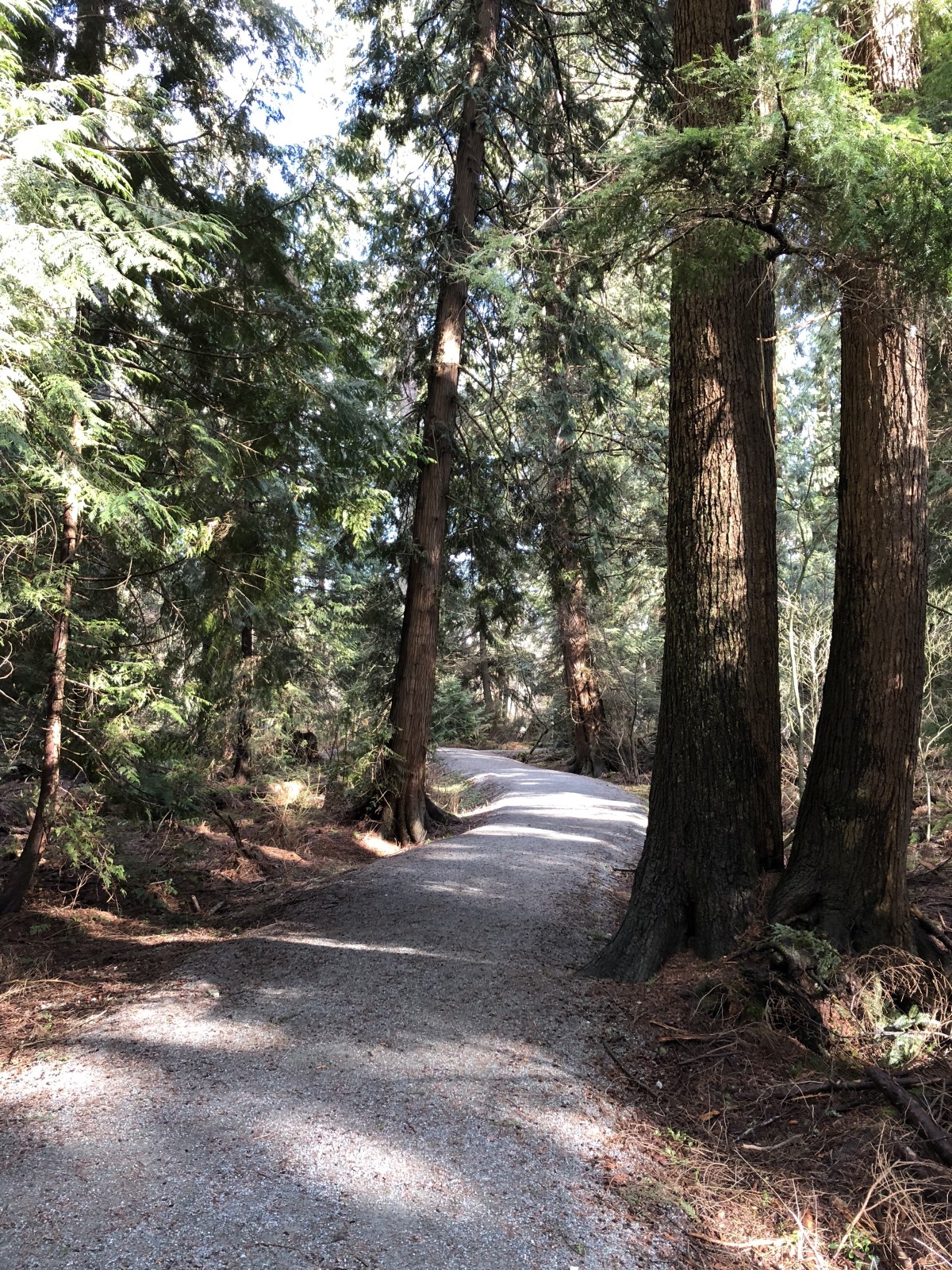
Speaking of photos, here’s a shot on the north side of the lake, just before you get to the fork for the Spruce Loop, approaching from the west. I actually sweated! My average pace was 9:26/km, which is fairly zippy considering how inactive I’ve been. The total walk, in which I stopped only to pee (twice) took just over two hours and thirty-two minutes. Surprisingly my feet never got sore. My left knee did, which proves it may just be a thing now–I’ll ask my doctor about it when I see him in a few weeks. The knee recovers fairly quickly, though.

Scenery:

Burnaby Lake March 3, 2018

I like shots like this because you can pretend you’re actually in the woods and not in the middle of a huge urban sprawl.

Also, I hate to say this, Apple, but I honestly don’t see a difference in the images from my iPhone 8 compared to my iPhone 6. I know they should be better and maybe they are better, but I ain’t seeing it. They’re still nice! And I’m willing to admit I have pretty much no eye for photography. I point the camera (or phone), try to hold still and press the button. Caveman photography, basically.

Quest for a new laptop, Part 1

The most important parts of a laptop, from my perspective:

  • Keyboard. I use laptops primarily for writing, so the keyboard is paramount
  • Display. This is #2 because I am going to be looking at the screen intently, riveted by my deathless prose, and I need a sharp, high-resolution display. It doesn’t need to be 4K and probably shouldn’t be, given how it affects battery life. Speaking of…
  • Battery. I need enough battery to allow me to use the laptop multiple times throughout the day without needing to plug it in. The ideal is 10 hours, as this provides plenty of breathing room based on my typical usage.
  • Trackpad. A mediocre trackpad can make editing infuriating. I shouldn’t need to add a mouse to make the laptop feel usable. On the other hand, I can use a mouse if I really need to.
  • Light and compact. I don’t want something that I feel I’m lugging around. At the same time I don’t mind a bit of extra heft if it means not sacrificing anything else on this list.
  • SSD. This is pretty standard these days. It insures that loading programs and saving files happens fast, to minimize disruption.
  • CPU. A Core i5 of some sort is usually good enough. Faster is always better but here it’s more nice than essential.
  • Ports. I don’t really plug a lot of things in, so a wide port selection isn’t necessary. At least a couple of USB-C ports is nice, though lacking those I’d want at least a USB Type A and maybe something to connect to an external monitor, like mini-DP or HDMI.

Everything else would come after this. For a Windows laptop a touch screen is nice to have but not essential, as is the 2-in-1 form factor. I don’t really watch any media on a laptop so have little need for a tent mode. Being able to draw in a tablet mode can be handy at times, but again is merely nice to have.

What laptops meet these criteria? Next post!

February 2018 weight loss report: Up 2.2 pounds

There is no positive way to spin these (fat) figures, but I will offer a few caveats:

  • I was sick for the last week of the month and did no exercise, ate about the same and was generally slothful during this time
  • um, that’s about it. I was going to say I had fewer days this month to lose weight, but I also had fewer days to gain weight, but I managed the latter handily

On the bright side, I did manage to remain donut-free and reduced my general snack intake. I obviously did not eliminate it, as the numbers below attest. I did slow the rate of weight gain, which will be a nice precursor to actual weight loss…this month. Yes, this month. March is Weight Loss Month. Slim is in. Svelte is the new black.

February 1: 164.9 pounds
February 28: 167.5 pounds (+2.2 pounds for the month)

Year to date: From 162.3 to 167.5 pounds (up 5.2 pounds)

And the body fat:

January 1: 18.5% (30.2 pounds of fat)
February 28:
19% (32 pounds of fat–up 1.8 pounds)

A haiku to the common cold and resultant dreams

Not that I’m complaining. This is more observation. Yeah.

Coughing sneezing yuck
The common cold is no fun
NyQuil my best friend

In this post from May 16th 2017 I complained about an eerily similar circumstance:

This one bugs me because it just seems so random and out of the blue. Friday I was fine, Friday night I was sick.

This same sequence happened where I felt fine all day Friday and in the evening my throat had that telltale scratchiness. Unlike then, this one doesn’t seem random at all because I have been surrounded by other sick people lately, including several at work. I powered through a two-day workshop on Monday and Tuesday as it was too late to reschedule, but to my dismay actually felt worse instead of better on Tuesday. Today, upon waking early in the morning I could feel the cold nestled deep in my chest like the chest burster from Alien and opted to stay home. I like to think this is me being generous and saving fellow co-workers, among others, from experiencing the same mild agony of sneezing, running nose, sore throat and so on, but it’s really me just wanting to curl up and nap and imagine how wonderful it is to feel healthy and how can I possibly take it for granted again after being so sick? Which I will inevitably do, because that’s just the way our brains work.

My hope is that I will feel peppy enough to return to work tomorrow. My fear is that I will rank a smidgen too low on the peppy scale and be faced with choosing between a) feeling like poop but going in anyway and risk spreading my illness around or b) staying home, feeling guilty about how I feel like poop but knowing I could probably shuffle, zombie-like, through the work day somehow, especially if I loaded up on handy cold remedies first.

Today, though, the level of guilt I felt in staying home was a big fat zero. I also had very strange dreams in the morning when I’d normally be up that included:

  • some strange medieval setting that was a quasi-musical with a knight lamenting in song about always having to fight
  • another person lamenting about something where he repeated the same word three times but I can’t recall the word now, dang it
  • the scenery was this weird pastoral plain that felt like it was at the top of a mountain, with giant redwood-like trees that didn’t render properly until you got right next to them. Yes, it was like being in a video game with poor drawing distance.
  • I think there may have been fighting, but it was bloodless from what I can remember
  • there were other dreams that were sufficiently weird that I can only remember them being sufficiently weird

All that and I did not take NyQuil first, as I’d run out a day earlier. I’m getting more tonight and look forward to what my subconscious will present to me.

And I hope I feel at least better tomorrow. Seeing the activity rings on my watch go unfilled makes me sad.

Book review: The Afterlife Revolution

Afterlife RevolutionAfterlife Revolution by Whitley Strieber
My rating: 4 of 5 stars

In which I once again dive into the weird yet strangely fascinating world of Whitley Strieber.

Strieber was originally known as a horror author known for books like The Hunger and The Wolfen. He branched out with a pair of novels in the mid-80s that posed “What if?” scenarios regarding a limited nuclear war and the destruction of the environment. Both are still compelling reads today, and Warday especially presents a chillingly authentic take on how devastating a “small” nuclear exchange would be.

Then came 1985’s Communion, in which Strieber relates experiences with what he calls “visitors” (not aliens) to his cabin in upstate New York, the now infamous grays. Unlike the pseudo-documentary style of Warday and Nature’s End, Communion is presented as fact, events that actually happened to Strieber, his family and others around him.

Some people dismiss this as a con, but it strikes me as too detailed and comprehensive to be the book equivalent of a snake oil salesman. I’ve seen people recount experiences with aliens and there is a strong sense of delusion in the way they present their stories, with obvious gaps and little evidence to suggest anything happened other than in the alleged victims’ minds. And one could claim the same here, that Strieber is similarly deluded, that he is simply not well. But if you’ve read the narrative he’s formed over the last 30 years it is impossible to dismiss everything without assuming a level of paranoia about all the others going in with him on the scam.

All of this is a long way of saying Strieber reports a lot of weird shit happening to him, and who am I to tell him it didn’t? I think what we know of the world and the universe is a tiny slice of a very thick wedge, and as advanced as we think we are with our internet-connected refrigerators and smart cars that almost never crash, the stuff we don’t know towers over what we do.

And that is a slightly-less longer way of saying I’m willing to give anyone the benefit of the doubt when it comes to weird shit, especially if they can present their case with humility, at least some circumstantial evidence, and make it interesting, too.

The Afterlife Revolution posits one thing: that when we die, the physical body ends, but the soul–or whatever you want to call it–persists, leaving the body and returning to a non-physical realm where it exists both as a separate thing and also as part of a giant consciousness that encompasses the entire universe. Anne Strieber describes it as “universal love” during her many chats with her husband Whitley.

Anne Strieber died in August of 2015.

Since then Whitley Strieber claims he has been contacted by her and the book is in large part a dialogue between himself and his late wife, as she tries to answer his questions about what lies beyond the end of life. Mixed in with this is a somewhat urgent need to create a “bridge” to better facilitate communication between the living and the not-so-living because the world is on the brink of catastrophic change. For those who have read Strieber’s other books, this will be familiar, as he has long been warning of cataclysmic climate change and the immense toll it will take on humanity–usually estimating billions dead and humanity possibly extinguished altogether.

By bridging the gap between the living and the dead, it is suggested we would be able to at least mitigate the worst of the effects and humanity would survive, albeit probably not with internet-connected refrigerators. At least not for awhile. There is talk of how hard it is for the dead to appear before the living due to being so much lighter and faster and existing in a different space, which accounts for why they prefer making loud noises and being spooky. Apparently taking any sort of “physical” form is very demanding. Anne also talks about how some of the post-living are denser that others and that their souls sink instead of rising (to where is never really specified, though it’s suggested that “bad” people get reincarnated and keep getting sent back until they straighten out).

Strieber provides the circumstantial evidence, some of it in the form of coincidences (asking for a sign of Anne’s presence, then seeing something shortly after that seems “planted” by her, mixed in with a few out of body experiences, strange sightings and yes, loud noises. He freely admits there is no way to prove any of it, but the scenarios involving other people suggest that if this were a fraud, it’s one in which he has conscripted quite a few others.

In the end I was–being the logical, rational, but open-minded guy I like to think I am–intrigued by the ideas presented. There is a strong spiritual element throughout the book, but it’s not tied to a specific religion, it’s offered up more as an explanation of why these religions came into being, along with stories that persist across cultures, like a great flood. I admit I like the idea that there may be something beyond the physical, if only because a non-physical version of me would probably have nicer teeth. Or wouldn’t need them. I begin thinking in practical terms before long–how would an eternal non-physical entity keep itself entertained or interested? What would it do? How would it have fun? But that’s just me sitting here with a head cold not being able to fully comprehend questions of the universe.

I still like the idea, though. And if nothing else, The Afterlife Revolution is a sweet, and touching encapsulation of the life of a loving couple.

If you are absolutely sure that once we are dead, that’s it, this book will not convince you otherwise. You may even shout out, “Bah!” and toss it aside. But if you’re willing to at least entertain the notion that there is some other realm we lowly humans can inhabit after we expire, The Afterlife Revolution presents some interesting ideas on what it might be like, and frames it as a kind of thriller in which the dead and the living better learn how to talk to each other–and soon.

View all my reviews