Friday during lunch the college closed early due to snow and everyone got to start the weekend early. I was home by 2:30 p/m/ and safely tucked inside from all the snow. Yay.
Friday evening I felt that telltale tickle in my throat that said “Yep, you’re getting sick–probably that thing that knocked out a co-worker for a few days.”
Late Friday the tickle becomes more of a barb and I seek solace in a bottle of NyQuil. It mostly works.
I think about going to the Canada Games Pool on Saturday. It’s not that bad, I think. I can do it. I go to the store and earn about half my exercise goal (30 minutes) on the watch Activity app. That wasn’t so bad, I think, though the urge to nab has arisen suddenly.
I have a nice bubble bath. I nap. I do not go to the pool.
Today I wake up and the barb is gone or at least sufficiently buried to no longer feel like a bar. My sinuses are stuffed but it’s hard to tell if it’s from my ongoing sinus issues or due to this cold or whatever it is. I again muse over going for a workout. As a bonus, most of the snow has already melted away and the sun is out.
I have another bubble bath. I nap once more.
I do not work out. I give up on meeting my activity goals. Whatever streak I have is ended and I hear a little imaginary sad trombone play.
And now just past 7 p.m. I fight the urge to go to bed early, my strength ebbing away as I type. It’s too early, I think. I need to write. Or read. Or explore my vast Steam backlog. I can’t go to bed, not just because of a little cold.
There’s probably several hundred million reviews out there for Apple’s true wireless earbuds known as AirPods, so I’m not going to go on at length about them. But here are a few thoughts after having them for several months.
Setup on my iPhone 6 was effortless. Bluetooth devices often have trouble pairing and Apple aimed to fix this with a custom W1 chip that makes pairing with an Apple device painless. And it works.
I got my AirPods after a critical software update that expanded the actions you could take by tapping the pods, as well as allowing separate actions for left and right. For me I chose Pause and Next Track for left/right as they are the most common options I use, other than volume control (which is not an option). I skipped the “Hey Siri” integration because if I want to talk to Siri, I’ve always got my watch with me. While having controls on the AirPods themselves is nice, the reality leaves something to be desired. More on this later.
The fit is nearly identical to the existing EarPods and really, apart from the long “stem” these could easily be mistaken for the same. It’s a bit disappointing that Apple didn’t try to push forward more on the design. Luckily, the EarPods fit well in my ears, so the AirPods stay in securely, too.
This is important because one of my regular uses of the AirPods is when jogging. Because they aren’t sealed, they allow other sounds to be heard (traffic, marauding bears, my wretched gasping breath, etc.) In the times I’ve used them on runs I’ve never felt them budge and the freedom of going true wireless is great. I’ve also done workouts on elliptical trainers and treadmills with the music on my watch playing through the AirPods, no phone needed, and again it’s great to have music for workouts without any wires.
The sound quality is not great but it’s perfectly decent. I have lousy ears but to these lousy ears the sound quality seems a little better than the EarPods. They won’t replace a pair of good quality headphones but for their size they do a good job of pumping out music without noticeable distortion, even if the overall presentation is slightly flat.
The battery life is perfectly fine for my usage. Apple promises five hours and I generally don’t use the AirPods for more than an hour at a time before they go back into their handy and compact charging case. The case is small enough to easily carry in a pocket and does a good job of boosting the battery life by proxy. It’s rare that I put the AirPods on with them charged below 100%. Being able to see the charge by flipping open the case near my iPhone is nice, too (it pops up an animated card similar to the one you see when pairing the AirPods).
I’ve worn them a few times when the weather has been a bit misty and while others report no issue wearing them in the rain, I’m hesitant to do so, simply because they cost $200+ rather than the $35 of the EarPods. I’ll probably get braver as they get older because going wireless is so much better when running.
On the downside, the controls are fussy. You double-tap to invoke an action and I find, especially when jogging, that the AirPods happily ignore the taps. I can be rapping on them like an insane woodpecker and they do nothing in response. I discovered you can tap the back of your ears to activate the controls, but sadly, this is also somewhat inconsistent. The inconsistency means that if I want to skip a track I usually just hold up my watch and tell Siri to skip to the next song. The lack of volume control is also a major omission. While I can use the watch for this, it’s not as easy to do while running as an actual physical control on the earbuds would be.
They have dropped connection a couple of times, but only briefly. Otherwise the connectivity has been very solid, something I really never expect with a Bluetooth device. It’s been a pleasant surprise here.
Recent rumors suggest Apple is developing new AirPods that can work with hands-free Siri (no interest) or offer actual water resistance (very interested). The latter is rumored for 2019, though, to which I say boo.
Overall, I’m surprised at how much I like the AirPods. I have come to terms with the weird look of them, which is mitigated partly by their increasing proliferation, but wouldn’t object to a tweak to the stems to make them shorter or…something.
On a scale of 1 to 10 Steve Jobs Cooing Over the iPhone 4 On Stage, I rate the AirPods 8 Steve Jobs Cooing. There is room for improvement here but they are a very solid version 1.0 product.
+ Things I Like:
– good fit (for my ears, anyway)
– comfortable (for the lengths of time I wear them)
– perfectly decent sound quality
– quick, painless Bluetooth pairing
– almost never lose connectivity
– very good battery life for true wireless earbuds
– charging case is compact and insures the AirPods always have some charge in them (assuming you periodically top up the charging case itself)
– automatically stops playing music when you remove one from your ear
– Things I Don’t Like:
– controls are flaky and unreliable
– no volume control
– you can get them in white, white or white
– they still look kind of funny
– no water resistance limits their use for outdoor activities (unless you’re willing to risk it)
– reasonably priced for the product category but expensive in Canadian dollars (currently $219)
Technology always marches forward, except for things like the Dark Ages and I guess World War III. But generally, it marches forward. The pace of change can sometimes be startling, while in other cases it feels like it’s taking a lot longer to progress for unspecified reasons (example: car technology has improved but not substantially changed at a mass production level in over a hundred years. The majority of vehicles are still fueled by gasoline that powers an internal combustion engine. Sure, whizzy electric cars and hybrids have gained, but they’ve yet to take over on a mass scale).
I was born in 1964, the same year a bunch of stuff happened. The Beatles were pretty popular. The American space program was in full swing and only five years away from a moon landing. And cars ran on gasoline that powered internal combustion engines.
But what technology over the past 50+ years has become obsolete or so little-used that it’s effectively obsolete? Most of it is stuff I grew up with. Do I yearn for any of this bygone technology? Let’s have a look at The Obsolete List and find out!
Rotary dial telephones. People often still refer to “dialing a number” but no one actually does it anymore. I remember back in Duncan you only had to dial the last five numbers instead of all seven and at the time it made dialing bearable, though you still hoped people had numbers like 222-1111. By the time the proliferation of phone numbers required you to enter all seven digits, plus the area code, we had moved on to push button phones and it was inconvenient but not the utter madness that it would have been on a rotary phone. Do I miss these devices? No. There is no nostalgia value in having to wait for a rotary dial to finish turning before you can enter the next number.
8-track tapes. I’ve discussed these before and the short answer is no: digital music does everything an 8-track tape did, without all the weirdness of putting songs out of order, duplicating tracks, splitting them in two and not to mention the inevitable tape-eating that happened. These had one minor convenience over cassette tape, in that you didn’t have to flip the tape over (if you were one of those poor sods that didn’t have a tape deck that could play both sides automatically). Speaking of…
Side A and Side B. Okay, this isn’t technology, strictly speaking, it’s more about how albums were always split into two halves before the Compact Disc (see below) took over. While this allowed some bands to experiment by doing different things on each side, I think the benefit of having a single cohesive whole makes for better albums overall.
Cassette tapes. These are still around, so like vinyl, technically not dead, but it’s very much a niche product. While more compact than vinyl, durability was always iffy, with tapes unceremoniously unspooling and getting eaten in the tape deck. You also ended up with the degraded tape exhibiting a lot of pops, cracks and other un-musical sounds. May casette tapes rest in pieces, I say.
Floppy disks. No one in their right mind would miss these. Everything now is better. I still have a box of them dating back to the mid 90s. I wonder if they would be readable today? (I checked and you can get a USB floppy disk drive for $30. I’m not sure it’s worth $30 to find out.)
Compact Disc (CD). Officially introduced to the world in 1983, they became the dominant music format by the end of the decade. Now, with digital music and especially with the rise of streaming music, the CD is not dead but is on life support. It had a few advantages over vinyl: better audio quality (provided the recording was managed properly–vinyl aficionados will always argue that records offer a “warmer” sound than CD), a more, ahem, compact format, the ability to hold more music (about 75 minutes, where vinyl was pushing it at 48-50 minutes) and because the disc was read by a laser, you no longer had to worry about a needle scratching across your record when you bumped the player. Instead you had to worry about the laser blinding you. Do I miss CDs? Really, no. They were better than vinyl and tape, but ultimately they now look like more of a stopgap on the way to digital music. And they could still get scratched and have playback suffer. Plus the album art was hard to make out.
Compact Disc-Recordable (CD-R). These were discs you could record to (multiple times in the case of CD-RW) and they allowed for early mass backup/storage. But they were slow, prone to errors and clunky to use. DVD-Rs were not much better, just higher capacity. I do not miss these. As with floppy disks, everything now is better.
Cathode Ray Tube (CRT) TVs and monitors. You know, the big, boxy things that you could warm your cat on and weighed between 50 and 1000 pounds. While the cats probably miss them–LCD monitors and TVs offer little room to accommodate sleeping felines–the only aspect I miss about CRT monitors is how blacks were much..blacker. This is offset today by OLED technology, but OLED hasn’t really percolated into widespread use, apart from some TVs, smartphones and laptops, because it’s still really expensive. I don’t miss the weight, energy cost, blurry text or industrial beige styling of most CRT monitors, though.
Digital watches. OK, these aren’t obsolete, but with watches now being more fashion statements than actual timepieces, who would still wear one? Anything a digital watch can do can be done better on a smartphone, or even a smartwatch. Still, I kind of miss that Casio I had back around 1978 or so. It could play 12 songs for no real reason and it was cool to set alarms. It felt like being in the future. As digital watches go, it wasn’t hideously ugly, either. At least that’s the way I remember it.
Mimeograph machines. I remember these from elementary school, circa 1971-1977. They produced weird purple text and the ink smelled strange and alien. Smudges abounded. It felt like 1850s technology that somehow lasted into the 1970s. I don’t miss them. I suspect teachers may have paid for the privilege of smashing these machines when photocopies and printers replaced them. Speaking of…
Dot matrix printers. These are still used in some places where multi-part forms are needed and the people there haven’t figured out how to load a tray with three different kinds of paper at once. They were noisy, slow, pretty bad at graphics, did I mention noisy, required ribbons you had to wind and worst of all, they would go haywire as soon as you turned your back to them. It was like they knew and waited to misfeed the paper. Again, I don’t miss these. Ink jet printers are better in all ways, save for ink drying out if not used for long periods of time, but that’s easily solved by getting a laser printer instead. Or just go paperless, like we were supposed to 40 years ago.
Microfiche. This was very cool in the early 80s. It’s been superseded by, well, computers, and the ability to digitize content. Back in the olden days you had to load a negative from, say, a newspaper, into a microfiche reader, then zoom in and pan around like you were using a microscope, except instead of bacteria, you were examining old news stories. I actually do kind of miss this. Looking back on the times I used them, it felt like I was doing real research and making real discoveries instead of just typing something into Google’s search box and getting 10 million results. The latter is still better, mind you.
Tonight I did an elliptical workout at the Canada Games Pool and it was a good, sweaty half hour in which I burned 336 calories. The bonus, as always, is being able to look down at a bevy of people with actual swimmers builds. One guy was helping with a young children’s swimming lesson and at first I thought he was sucking in his stomach. But he wasn’t. It was just so flat that it actually curved in instead of out.
My stomach does not curve in.
Also I ate a bowl of Chocolate Cheerios today. They were delicious.
As I watched ol’ inwardly curved stomach guy teach small children how not to drown (a skill I still have yet to fully master) I thought about how well my weight loss is going in this early part of 2018–I’m at 167.2 pounds and 18.9% body fat, both up from this time last year and up from pretty much all of last year–and consider the balance between exercise and snacking.
I am still exercising. This is good.
I am still snacking. This is not as good.
I am exercising less regularly. This is not really good. When combined with the snacking, the results are obvious: fat, and plenty of it.
The solution, then, is to cut down on my snacking. I lost about 40 pounds by changing my diet in 2008. Maybe I can do the same for the 10 year anniversary, Except I don’t want to lose 40 pounds because I’m still 20 pounds lighter than 2008 me, so a 40 pound loss would result in me being “tumbled down the street by a strong gust of wind” light.
But can I reduce my snacking? I’ve remained donut-free so far, but I’ve pretty much just turned to donut substitutes. Maybe reduction isn’t the answer and elimination is.
And so I pledge here on this blog and to the several people that accidentally stumble across it from time to time, perhaps hoping to find some tasty creole recipes, to go 100% snack-free.
Starting on Saturday.
Why Saturday? It’s a run day and I tend to eat less on run days. Also there are still snacks about so I need tomorrow to figure out what to do with them, even if it means shoving them into my mouth. But no more after Saturday.
I will report back on my inwardly curved stomach progress some time in March.
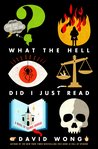
Even though the title of What the Hell Did I Just Read is self-referential in the same the previous novel was (This Book is Full of Spiders), I still kept reading expecting some sort of arcane book to play a part in the story.
Don’t be dumb like me. The only book is the novel itself, the third adventure of David, John and Amy, twenty-somethings living in Undisclosed, a small town beset by supernatural as well as super gross manifestations.
Like the previous entries, What the Hell Did I Just Read is filled with weird (Batmantis???) and gruesome (giant squirming larvae) monsters that the would-be heroes must stop before the town and possibly the universe itself is destroyed.
It’s more fun than it sounds.
The story starts with a child kidnapping and as the saying goes, things escalate quickly, with seemingly immortal not-government agents, a biker gang and others tossed together as an unceasing storm threatens to sweep the town away in a devastating flood.
Jason Pargin, going under the pen name David Wong, does his usual excellent job juggling all of the elements while tossing in regular dollops of absurdist humor. There are even a few serious moments of personal growth for some of the characters. But only a few. Mostly it’s dildo guns, silicone butts, dimensions of endless despair and children who may not be quite as they appear.
My only real disappoint with the story is how it builds to a climax that never really happens. Sure, stuff happens but not necessarily what you’d expect, although you could argue that’s not necessarily a bad thing, either. It’s open-ended when I was not expecting it to be open-ended. Maybe Pargin wanted to leave room for a direct sequel, because who can’t get enough of giant squirming larvae that could potentially destroy the world?
This is an easy recommendation for anyone who enjoyed the first two Books (the first being John Dies at the End). For anyone else who is not averse to some well-written and occasionally gross-out horror with tongue in/through cheek, it’s still a solid recommendation (though you should still read all three in order for maximum effect).
In the interest of keeping to a complaint-free lifestyle, I’ll emphasize again for Bad Design I am doing a couple of things:
pointing out the bad design as a way to highlight how something should not be done, even if it seems logical or a popular way to go, in the hope that it encourages others not to repeat what I feel are mistakes in design
offering a solution or alternative design that addresses the flaws
And I only pick a lot on Apple because I own and use a lot of Apple products (which I will address in another post) and because as the world’s largest, richest company, they have the power to influence a lot of others (see Samsung and its weird and lawsuit-attracting tendency to follow Apple’s designs very closely).
And with that, I present:
The iMessage fireball
For those unfamiliar with Apple’s message app, it works like most text messaging apps and allows people to send and receive messages across Apple devices, including the iPhone, iPad, Watch and Mac. If you send a message to a non-Apple device, it shows in a green bubble as a regular text message. If you send a message to an Apple device, the bubble turns blue and it becomes an iMessage, sent through Apple’s servers.
With iOS 10 Apple revamped the Message app, expanding what you can send.
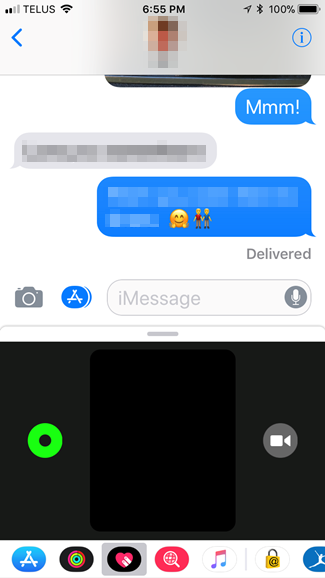
When you are in the Message app, tapping on the App Store icon presents a small black window that you can doodle and do other things in (it defaults to this, though tapping the icons to the left or right of the heart will allow you to use stickers from other apps, search for images and more):
By tapping on the horizontal gray line above the window it expands to give you more room and also exposes a small information icon in the lower-right corner that, if tapped, presents an explanation for the various actions you can perform:
The Heartbeat option only works if you are wearing an Apple Watch, as it includes a heart rate monitor.
The first option is Sketch and it seems pretty straightforward. Draw with one finger.
The next option is Tap. What is a tap? There is no explanation.
The fourth option, Kiss, puts a pair of lips in the window.
Let’s go back to the third option, Fireball. This puts an orange fireball-like blob in the window and as long as you keep pressing you can move it around. As soon as you release, the Fireball message sends.
Bad design #1:
Some actions send the message instantly, others require you to tap a send button to send it. This is inconsistent and can result in messages being sent prematurely.
Bad design #2:
There is no explanation for what a Tap is. The others are straightforward, but what is a Tap? It’s a ring that dissolves. If you do a bunch of taps in succession you can send multiple rings–er, taps–but if you pause too long the message auto-sends. I am unsure as to why anyone would ever want to send a Tap.
Bad design #3:
The Fireball and how it is invoked. Like the Tap, I’m not sure why you would send someone a Fireball. It looks more like a glowing orange ball than an actual fireball and it also auto-sends. The worst part, though, is that to invoke it you press your finger on the screen. You might think this is the same thing you do to make a Sketch, but there is a subtle difference. The difference is so subtle that you may find yourself sending off fireballs when you meant to start a sketch, and you may receive fireballs for the the same reason. In fact, since iOS 10 launched I have only sent two fireballs deliberately. The first was to see what it looked like, the second as a joke. Pressing the screen is a very basic gesture and it shouldn’t be tied to a fairly obscure action that few people would seemingly ever use.
Solutions
Bad design #1: Require tapping the Send button for all actions before the message is sent. Give options to edit or cancel the message.
Bad design #2: Rename Tap to Rings. Change text to “Tap with one finger to place one or more rings.”
Alternate solution: Remove this option altogether if it is seldom-used.
Bad design #3: Change the action required to invoke the Fireball to something that is not likely to be used accidentally, like tapping with three fingers.
Alternate solution: Remove this option altogether.
My personal feeling is the Tap and Fireball options could be removed. I have no evidence to back this up, but based on anecdotes and my own experience, neither is used much at all and the Fireball is almost exclusively used unintentionally.
Run 569 Average pace: 5:25/km Location: Brunette River trail
Start: 1:53 pm
Distance: 5:02 km
Time: 27:15
Weather: Sunny with high cloud
Temp: 5ºC
Humidity: 54%
Wind: light
BPM: 174
Weight: 166.5 pounds
Total distance to date: 4430 km
Devices: Apple Watch, iPhone 8
Due to a very late start and being naughty again by not running during the week and also recovering from a pulled muscle in my mid-back, I opted to skip the full 10K run at the lake today for a 5K at the river. I did get some extra walking in by starting at the end of the trail first.
It was a rare sunny day but a brisk 5ºC so I wore two layers up top, but stuck to the shorts. It worked out fine.
I briefly experienced two issues: a cramp near my right shoulder that sorted itself quickly, and my left knee started feeling a bit stiff about 3.5 km in. The knee never got really sore and was not a factor, really, as my fastest pace was in the last km.
My overall pace was 5:25/km, which is not bad for a pudgy, out of shape 5K run. The BPM was 174, which is again too high, but perhaps understandable given the combination of cold, flabbiness, and exertion.
I may run again tomorrow, assuming I don’t wake up in the morning feeling like a broken pretzel.
The gate to gate distance on the river trail is said to be 1.9 km, so after I started my run, I checked when I got to the second gate and it was, to my surprise, showing 1.9 km. What’s weird is that the 5K ended with around 610m left. If you add up the two full lengths I ran–3.8 km–then add what is needed to hit 5K–1.2 km–that means there should have been about 700m left when I stopped running. Now, there was a delay of a few seconds after I stopped the run and started the walk, but not enough to account for 90m of walking. Still, it’s actually better than I expected, so maybe the GPS is in the iPhone 8 is magically improving or something.
Anyway, here’s to more runs and staying healthy in 2018.
The newest Mark III SkyTrain cars feature a few nice improvements:
all four cars are joined together through an articulated “accordion” section, meaning you are free to move between all cars on the train. This also means there is more room overall for passengers
larger windows provide a better view and the lower frames work better as pseudo arm rests
better fittings all around mean the trains are quieter
roomier design all around, so there is less of a sardine can feeling, even when the train is full
But in among these improvements is another that doesn’t really work, and it’s not the fault of the designers. It’s more of a people problem.
The first and last car on each train has one of the middle sections of seats removed and in its place a single bar that runs underneath the window. This is a designated bike area. Making trains bike-friendly is definitely a nice move, as more people are commuting by bike.
However, there is a problem with the execution: it doesn’t take into account normal human behavior and the general likelihood of bikes being on the train at any given time. This leads to the following:
as the train fills, people move first into the seats
they next stand in the areas that are most open (not between seats), such as the doorways
conveniently the bike space is wide open, so it often fills up with standees before the rest of the train
a cyclist boarding the train at this point will find it impossible to park their bike in the already-occupied space. Even if people wanted to let them, it’s unlikely there is room for the people in the bike space to stand elsewhere; the cyclist typically props their bike in the doorway area, same as they would without a bike space on the train
Given that cyclists are still uncommon on the SkyTrain and that they have no better chance of boarding before anyone else, there is only a small chance they will actually get to use the designated space for their bikes. There’s also no way to keep other people out of the space (nor should there be).
Conclusion: the dedicated bike area is a well-intentioned idea that ultimately doesn’t work. It’s really just a standing room section that would be better serviced by putting the seats back in.
However, there is a better solution that, while still subject to the whims of the crowd on the train, at least doesn’t remove a bunch of seats. Some rail systems have hooks in the ceiling that bikes can be hung on. This works well for a couple of reasons:
the hooks aren’t likely to be used for something else, so they will almost always be free for cyclists to use
the bikes stand vertically as a result, taking up a lot less space on the train
the hook provides a solid anchor for the bike, reducing the chance of it hitting someone or getting away from its rider
I hold out hope that Translink will ultimately switch from the dedicated space to a hook system and am doing my part by suggesting it to them, not just here, but directly via email as well.
Until then, the bike space on the Mark III trains is likely to remain standees-only.
Things I have done to complete all three activity rings on my Apple Watch:
paced quickly back and forth in the living room
gone for a spontaneous six block walk
walk to the grocery store to buy several non-essential items
jumping jacks without the jumping
running on the spot (this can actually get your heart rate up pretty quickly, just like running where you actually move forward)
hung my arm down at my side (to get a Stand goal during a meeting. It’s a cheat but it totally works and beats suddenly standing up in a meeting and staying like that for a minute while everyone stares at you)
gotten up to use the washroom (also for the Stand goal; this is one of those win-win situations, killing two birds and all that)
reduced the Move goal for the day (when I’ve been sick. Since getting the watch this has worked every time I’ve fallen ill except one day when I was too weak and just laid like a lump and broke my streak)
The reason I’ve done all the above is to maintain a streak, because streaks create a positive feedback loop and you don’t want to break them. Breaking them is where the donut-eating starts. And Apple doesn’t allow for mulligans, so you can’t take a day off due to illness/accident/utter laziness.
It’s worked pretty well so far. I did four of these just today (I am unwell). I prefer hitting the goals all legit-like, though, because it means I’m healthy and stuff.
Back in 2014 I proposed a writing exercise on a now-defunct site I ran. It was to write a scene or short story based on this photo:
(You can see the photo in context as Blue Mist Road here.)
Being the clever type, I called my effort “Road Closed” and somehow tied it in to being about ghosts, somehow.
As I fleshed out the story I realized it was going to be more than just an exercise or even a short story and it became my official National Novel Writing Month project in November 2014. I won! I didn’t actually finish the novel, but I did complete 50,000 words, so it was more a technical win.
Four years later and I have made progress on the story (it’s sitting at 72,000+ words) but stalled late last year after making some good progress.
The essential problem is I’m not confident in the story arc I’ve developed and I’m hesitant to invest more time if it all ends up being poop. Or ghost poop.
At some point I want to properly write out the outline of the story but this post is really about the title.
The title “Road Closed” made sense when it was a short story and the road played a big part in the whole thing. It may not even survive the final draft now, so I’m casting about for something new. It could even provide a spark that could lead to other changes and get the whole ball rolling again.
Or I could just write that outline and go from there.
Here’s the elevator pitch for the story:
A 20 year old moves to a new town and starts college as a journalism student, determined to get away from a troubled past. His efforts to start over are stymied by two things: a drinking problem he brought with him, and a ghost he starts dating without realizing the ghost part.
And the initial lackluster titles I’ve come up with to replace “Road Closed” are:
Ghosts and Other Spirits (a play on spirits referring to both ghosts and alcohol–geddit?)
Impersonal Demons (I’m not even sure what this one means)
School Spirit (simple, accurate, but also very banal and easy to misinterpret)
When I look over these titles I feel driven to make “Road Closed” work. While the name suggests street construction and detours, it can also suggest that an avenue is closed off, which can work on several levels for the story. Still, it’s also pretty generic.
I know!
BOOze
I’m sorry, I’ll see myself out.
(I’ll do the outline this week and report the grisly results.)
Run 568 Average pace: 5:57/km Location: Burnaby Lake (CW)
Start: 12:29 pm
Distance: 10.03 km
Time: 59:41
Weather: Cloudy
Temp: 8-10ºC
Humidity: 86%
Wind: nil
BPM: 161
Weight: 166.6 pounds
Total distance to date: 4425 km
Devices: Apple Watch, iPhone 8
I was bad and did not run last weekend–but I was also good because I used an elliptical trainer for half an hour on both Saturday and Sunday. While the combined calorie burn is similar to a 10K, there is no doubt that it’s an easier experience, so I was ready for today to be a bit tougher.
Because there was a chance of rain I wore a long-sleeved shirt, but it stayed dry and was quite mild.
The iPhone 8 again was consistently reporting distances as shorter. Suddenly 4 km was not really 4m so to walk 4 km I had to walk more than 4 km. Kind of annoying but no so far out of whack that I feel compelled to spend time researching the issue. Plus a little extra walking and running is fine, anyway.
I was unsure of the status of the bridge at Still Creek–the original end of the replacement project is this month and as of two weeks ago they’d done essentially nothing–so I chose a clockwise route. This would allow me to get to 5K regardless, and allow me to turn back to get the other 5K. This didn’t prove to be necessary because while the project has advanced (new additions to signs note that Phase I began on January 25) the only change was several large piles of dangerous-looking rocks near the bridge, along the river bank.
Surprisingly, my legs felt pretty much fine, though I had a few moments of creakiness in my right knee (the good one). The lack of running may be having the side benefit of healing. I did feel some cramping in the abdomen and it persisted for awhile, though it wasn’t too severe. It was hard to imagine it was from running too fast because I did not feel too fast. Or fast.
Still, I kept going and there was no doubt I’d complete a full 10K, so even though the pace was pokey–5:57/km–the BPM was fine (161) and I generally felt okay.
The bear in the woods part came around the 9.27 km mark. I had used the bathroom before heading out (I’ve learned my lesson) and even took a quick whiz upon arrival, but a little over halfway through it became clear that I would have to commit to number 2. Just past the 9K mark the urge to go was becoming, let’s say, a force of nature. It would take me 6-7 minutes to finish the run and get to the Jiffy John™ and those minutes felt like hours. I made a bold decision.
I paused the run and leapt off the trail like a deer spooked by a poopmonster. Then I committed the deed behind a large tree. Just in time, as I passed someone shortly after resuming the run and frankly the big tree didn’t really provide as much cover as you would expect from a big tree.
The rest of the run felt much better.
I should also point out that my weight loss regime has gone completely bonkers and I weighed 3.2 pounds more at the start of today’s run vs. the last one. Yeesh. At least I finished lighter (TMI, I know. sorry.)
Overall I was glad to get back out again, and doubly glad to do so without being in the rain. Triply so for the BPM staying reasonable.
I can feel the legs already stiffening up. There will be a reckoning for all those regular runs I’ve skipped. Stiff legs, basically.
Still, progress! This time last year I was still not able to run outside at all due to the Snowpocalypse and the mild temperatures means there is little chance of a sudden repeat this year. Yay.
There were 11 school shooting incidents in the U.S. in the same month that I read Columbine (January 2018). That the number of shootings has actually accelerated since the April 20, 1999 attack at Columbine High School, is testament to both the gun epidemic in the United States, and a broad failure to apply lessons learned from Columbine.
As author Dave Cullen sees it, the significant takeaway on Columbine is how important early detection is for teen depression. Eric Harris was a psychopath but not necessarily beyond control. He conscripted Dylan Klebold, who spent the last years of his short life mired in depression, anger and sadness. Early detection and treatment would likely have stopped the attack from happening or even from being planned at all. There’s no way to ever know for certain, but Cullen’s plea for better help for troubled teens stands against a backdrop of dozens upon dozens of school shootings since 1999.
Cullen also holds out blame for the media for sensationalizing these types of attacks, for giving the killers the fame and notoriety that many of them seek. Local media in and around Littleton, Colorado ran stories on the shootings every day for months after. Cullen offers deliberately ghoulish advice to would-be killers to make his point: you need to go big to crack the top ten (up the body count) or go all-in for “performance violence”–spectacle murder.
Today the spectacle murders have left as many as 58 people dead at the hands of a single individual, the usual empty “thoughts and prayers” offered, while help for those that need it most goes unfulfilled, and the guns continue to pile up.
Against this, Columbine offers little hope. Cullen has researched his subject exhaustively, starting at the school less than an hour after the attack started, and kept researching and interviewing for years after, compelled to determine why and what to do with that knowledge.
He deconstructs the myths that quickly built up around the shootings–that the killers were victims of bullying, that they targeted jocks, that they were Goths or it was “The Trenchcoat Mafia” behind them. What he found is a lot simpler than all of that. Eric Harris was a full-blown psychopath and used his charm to recruit others in his nihilistic plan to exterminate “inferior” humans. He convinced others to secure weapons and supplies, but it was Klebold that he was most successful with, tapping into the existential despair of his friend and conscripting him as an ally against everyone else. The world.
While Columbine is remembered as a shooting, Cullen points out that it is only Harri’s incompetence at bomb-making that really made it that way. The intricate plans, had they worked, would have seen propane gas bombs explode in multiple locations, such as the cafeteria, to maximize casualties. Harris further planned on covering exits to pick off survivors. He wanted to kill hundreds, to destroy the school because he could not destroy the entire world.
But the bombs all fizzled.
They still killed 13 before killing themselves and Cullen details how the families of victims handled the aftermath and–in some of the few hopeful moments in the story–how some survivors overcome the shooting to triumph over the tragedy.
Columbine is not an easy read and given the climate today, it is hard to remain hopeful that anything has changed for the better (one thing that did change was the idea of creating a “perimeter defense” around the area of the shooting. This setup allowed the killers to freely wander the school for over an hour before SWAT teams entered, shooting any and all they encountered. That doctrine has been abandoned in favor of going in as soon as possible to take out the threat). Even Cullen himself admits to depression following his immersion into the story.
All this is before you even take into account all the information suppressed by local law enforcement. They knew about Harris early on, but ultimately did nothing and later covered it up. This serves to further underscore how important early detection is. The killers extensively recorded and spoke of their plans, and were largely ignored.
The book is a tough read, but it’s an important one. Too many people slip through the cracks. Cullen vividly details the events of Columbine as both lesson and warning. Highly recommended.