Pigeon patrolling near Lougheed Town Centre Station.
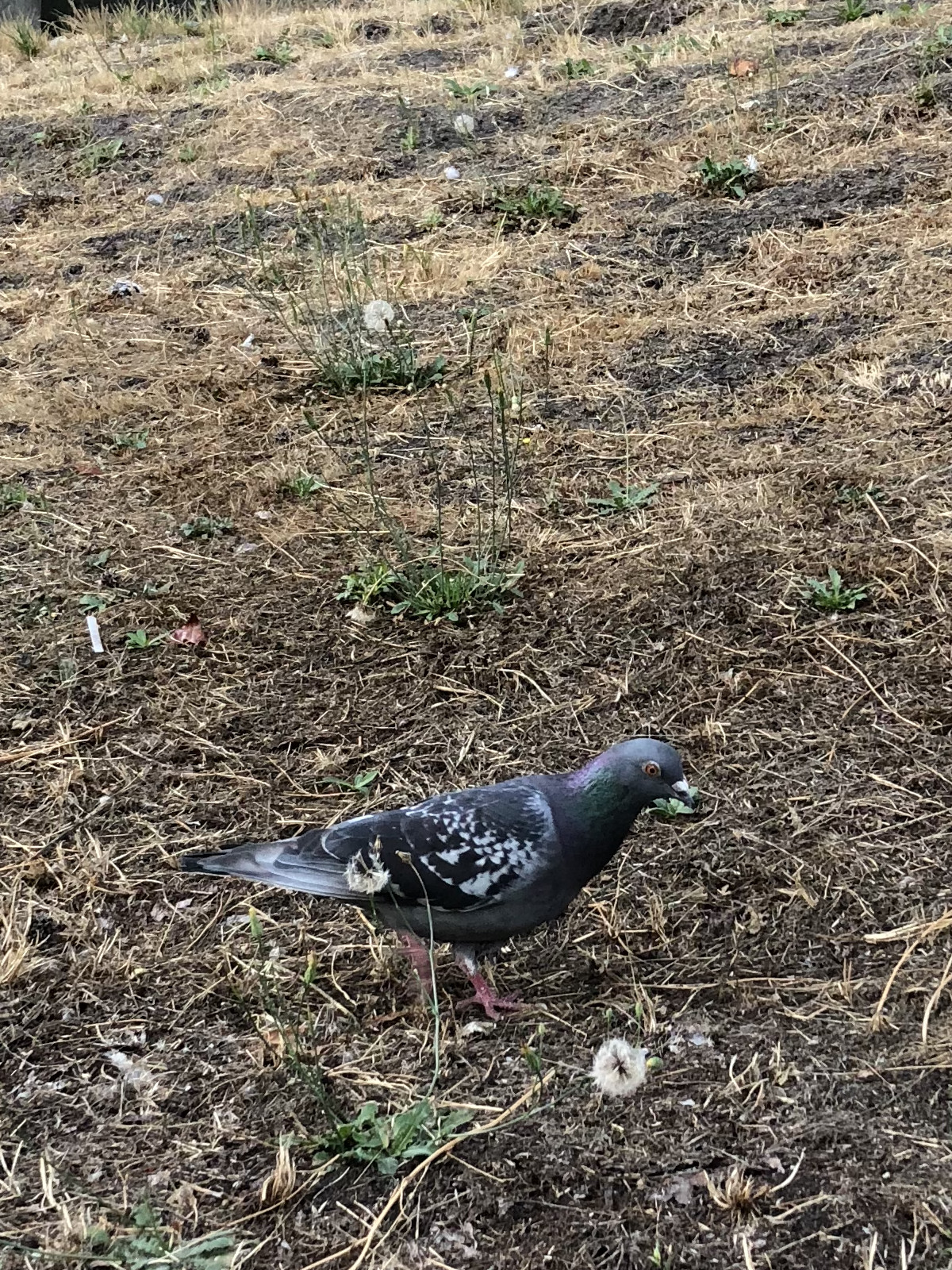

Pigeon patrolling near Lougheed Town Centre Station.
Immovable dachshund on Fader Street.

 2k to 10k: Writing Faster, Writing Better, and Writing More of What You Love by Rachel Aaron
My rating: 4 of 5 stars
This is the second book I’ve read recently about how to greatly increase the volume of your writing. I note with some irony that both books have been very slim.
I was surprised that 2K to 10K had so little overlap with 5,000 Words Per Hour, so in a way the two books complement each other nicely.
Rachel Aaron offers some very specific advice that can be distilled down to two words: plan everything. And two more bonus words: track everything. She strongly advocates outlining a novel before diving in as the key to being more productive in your writing and boosting your daily word count. Unlike Chris Fox’s book, Aaron draws repeatedly from her own work to illustrate her tips, and it works to good effect, while also adding a more personal touch to the advice.
Like Fox, she is clearly enamored of her methods and the success they have brought her, and that enthusiasm is just as infectious here as it is in 5,000 Words Per Hour. You want to immediately dive in and follow the approach she advocates.
The second half of the book is a bit more of a traditional how-to, covering (and endorsing) the classic three-act structure, going over techniques on editing–here I find it interesting that she doesn’t let her beta readers look at her story until she is done with it, arguing that it’s not fair to have them offer feedback on what is still a work-in-progress.
There are no exercises here, unlike 5,000 Words, so the expectation is to take the advice and run with it.
Overall, a quick read and well worth it for both new writers or those who find themselves struggling with the process of simply getting words down in a regular, consistent manner.
Washroom light switch.

Sunrise through smoke haze, Sapperton station.

 Acceptance by Jeff VanderMeer
My rating: 4 of 5 stars
The Southern Reach trilogy concludes with Acceptance, and it’s not a spoiler to say the title tips the author’s hand a bit.
As with the second book, Acceptance bounces between multiple characters, but here VanderMeer dives fully in, not just shifting perspective, but also switching between first, second and third person, as well as jumping between the onset of Area X 30 years earlier, the present day, and points in-between. Combining all this with the general enigma of Area X could lead to confusion, but VanderMeer keeps things focused. More than that, he begins stitching together different threads, by introducing and following characters hinted at or only briefly mentioned in the earlier books, such as Saul, the lighthouse keeper.
Again, it is difficult to say much without getting into huge spoilers, but what I enjoyed the most about the concluding book was the escalation of events and the contrast with the very ordinary and human characters swept up in Area X in its early days. There is a sense of unease running throughout this part of the story and VanderMeer works that unease well as unlikely alliances are forged in the face of increasing weirdness and the sense among some of the characters that humans can do little to stop the spread of Area X and its effects.
While the trilogy does come to an end of sorts, it also wouldn’t surprise me if VanderMeer returned to Area X at some point. He has created a deep and deeply weird place, and it’s one I would enjoy visiting again. After putting on my safety mask first, of course.
If you enjoy science fiction mysteries crossed with a bit of horror, you’ll likely enjoy the Southern Reach trilogy, but be warned–you will not have all the answers by the end. This is most definitely not a “pull back to reveal the man behind the curtain” type of story.
Recommended.
 Authority by Jeff VanderMeer
My rating: 4 of 5 stars
Book 2 of the Southern Reach trilogy changes gears, switching from the first person perspective of the biologist to third person and switching between several characters, though focusing primarily on John “Control” Rodriguez, the newly-appointed erstwhile director of the Southern Reach. While Annihilation explores deep within Area X itself, Authority focuses on the organization investigating the area.
Perhaps not surprisingly, much of the Southern Reach is as weird and off-kilter as Area X itself, the product of 30 years of mostly fruitless efforts to reveal its mysteries, along with the after-effects of excursions both official and unauthorized.
VanderMeer peels back the layers here, and where Annihilation is steeped in mystery and things out of reach, here things are a lot more pointed, right down to nearly every character having an ironic name. Control is rarely seen to be in any kind of control. The assistant director, Grace, is cold and ruthless. Severance, Control’s mother, is…well, you get the idea.
The strength of this book, for me, comes in two parts. One is the interaction between Control and the biologist (referred to here as Ghost Bird, a name originally applied to her by her late husband) as he tries to wrestle information from her and comes to sympathize with her instead, the other being the increasingly frustrating attempts to understand or, well, control, what is happening in Area X, coupled with the feeling that it could get a lot worse without any notice.
The book ends on another cliffhanger, with the fate of the biologist and Control seemingly intertwined.
 Annihilation by Jeff VanderMeer
My rating: 4 of 5 stars
While each book of the Southern Reach trilogy has its own feel, it’s hard to imagine anyone reading the first book and not pushing through all three to see how it ends (assuming they liked the first book). That said, while I view this as essentially one story split across three books, there’s enough unique in the approach of each to warrant separate reviews.
First, I’m a sucker for concepts like this. It’s simple and grabbed me immediately: Something weird has happened to a stretch of “forgotten coast” that the government is describing as an ecological disaster, but is far weirder than that. An organization called the Southern Reach sets up shop just outside the border of “Area X” to investigate. The first novel picks up about 30 years after the appearance of Area X, with the research team at the Southern Reach sending endless expeditions into the zone, but coming away with nothing to show but riddles, and for many of the expedition members, death.
Annihilation is told from the perspective of a biologist, part of an all-women team sent in as the “twelfth” expedition. None of the members of the team address each other by name, only by profession–the biologist, the surveyor, the psychologist. This detachment is meant to keep the group focused (and more easily malleable by the Southern Reach). The biologist serves as an interesting narrator, combining a cool, aloof attitude with passion for her work and fascination with the things she finds in Area X.
The story, told in the form of a journal kept by the biologist, details how things quickly go sideways for the team. To say more would be to enter spoiler territory and since all three books trade heavily on the mystery and enigma of Area X, it’s best to go in knowing as little as possible.
Suffice to say that by the end of Annihilation, the biologist has seen and gone through a lot. She urges everyone reading the journal to make no attempt to follow her into Area X. The cliffhanger ending all but has TO BE CONTINUED… on the last page.
And it worked. I was intrigued by the mysteries presented and keen to learn more in Book 2. VanderMeer writes with what is at times an almost lyrical style, which complements the strangeness of the setting the story takes place in. There’s also the open question of whether the biologist is a reliable narrator, but no hand is revealed in Annihilation.
Here I can say I would recommend the trilogy to those who love mysteries, especially ones involving fantastic or weird places. For those who love mysteries and even more love to see them neatly solved by story’s end…maybe not so much.
Jeff suggested a bike ride around Barnston Island, so today we packed up the bikes and headed over for a leisurely 10 km loop around the island, all of which is private land, save for two tiny regional parks, Robert Point and Mann Point. The former has a couple of picnic tables and paths out onto a sandy beach, while the latter is all beach.
The weather was the same smoke haze we’ve had for most of the past few weeks, giving photos of the day a weird alien light. It was otherwise pleasantly warm, not hot, though it did start feeling muggy by early afternoon.
The full gallery of photos can be seen here: Barnston Island photo gallery
The ferry ride, which is really a tugboat affixed to a barge, takes just over two minutes. Once on the island, we headed counter-clockwise. I’m not sure why, we just did. One site suggests going clockwise, though again I’m not sure why. There’s not enough traffic to really make a difference either way.

Speaking of traffic, we encountered numerous cyclists and a total of five motor vehicles–two cars, two truck and a motorcycle, for an average of one vehicle every two km. All of them came from the opposite direction, so I say we chose the right way to travel.
Most of the land is agricultural and Avalon Dairy has a large farm here, full of mooing cows. The Katzie First Nation also has a reserve here on the south side, though the majority of it is located across the river in Pitt Meadows. Mann Point also offers a nice view of the Golden Ears Bridge, if you like looking at bridges with weird names.
Our first stop was at Robert Point. This is not so much a park as a parket or perhaps a parkling. There are a few picnic tables on a small patch of grass, a washroom, some trash bins and that’s pretty much it. A group of people were there and because they were a group, they pretty much filled the entire park. They were playing, of all things, croquet. The park does not really lend itself to a good croquet layout, but they didn’t seem to mind. We went down to the beach, checked out the log booms, then headed back to the road and onward to Mann Point.
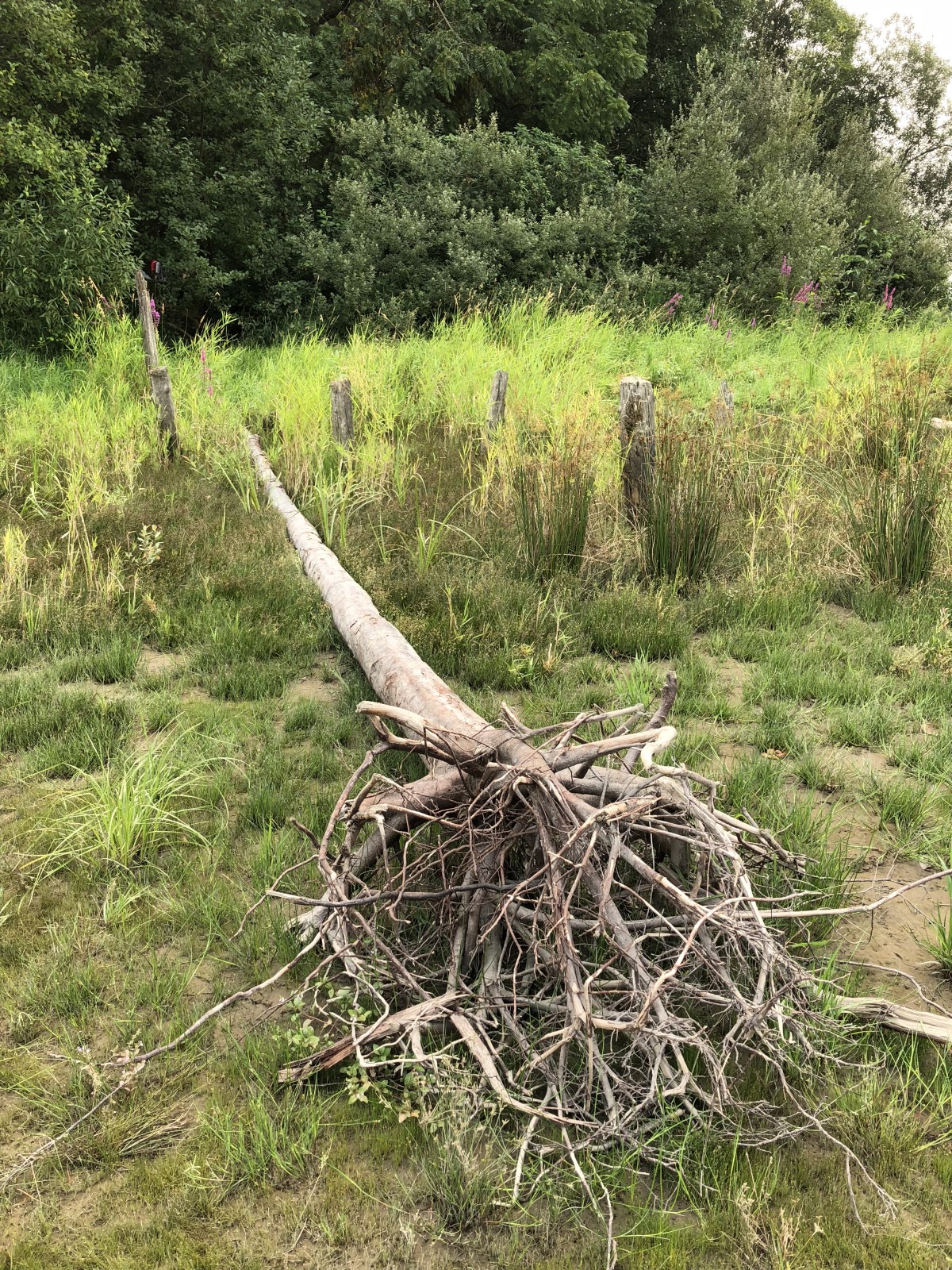
Mann Point is where we spent most of our time, stopping at the beach to chill out, have some lunch and in Jeff’s case, work on the essential all-body tan. I opted to explore along the shore and edges of the beach and grabbed a few photos. I was surprised that there was no one else on the beach. It’s not a huge place like the beach at English Bay, but I expected there’d be at least someone else there tromping around in the sand and cursing the smoke-filled sky.

A couple of guys did briefly show up on bikes, but turned around when they saw the beach because riding bikes on a sandy beach is basically impossible.
We left Mann Point and continued on back around to the ferry dock, passing by fresh skid marks on one of the smoother sections of road (is this what the locals do for fun?), an abandoned house being slowly consumed by vegetation, and several other properties that actually looked pretty snazzy. In all, it was a perfectly pleasant way to spend a few hours.
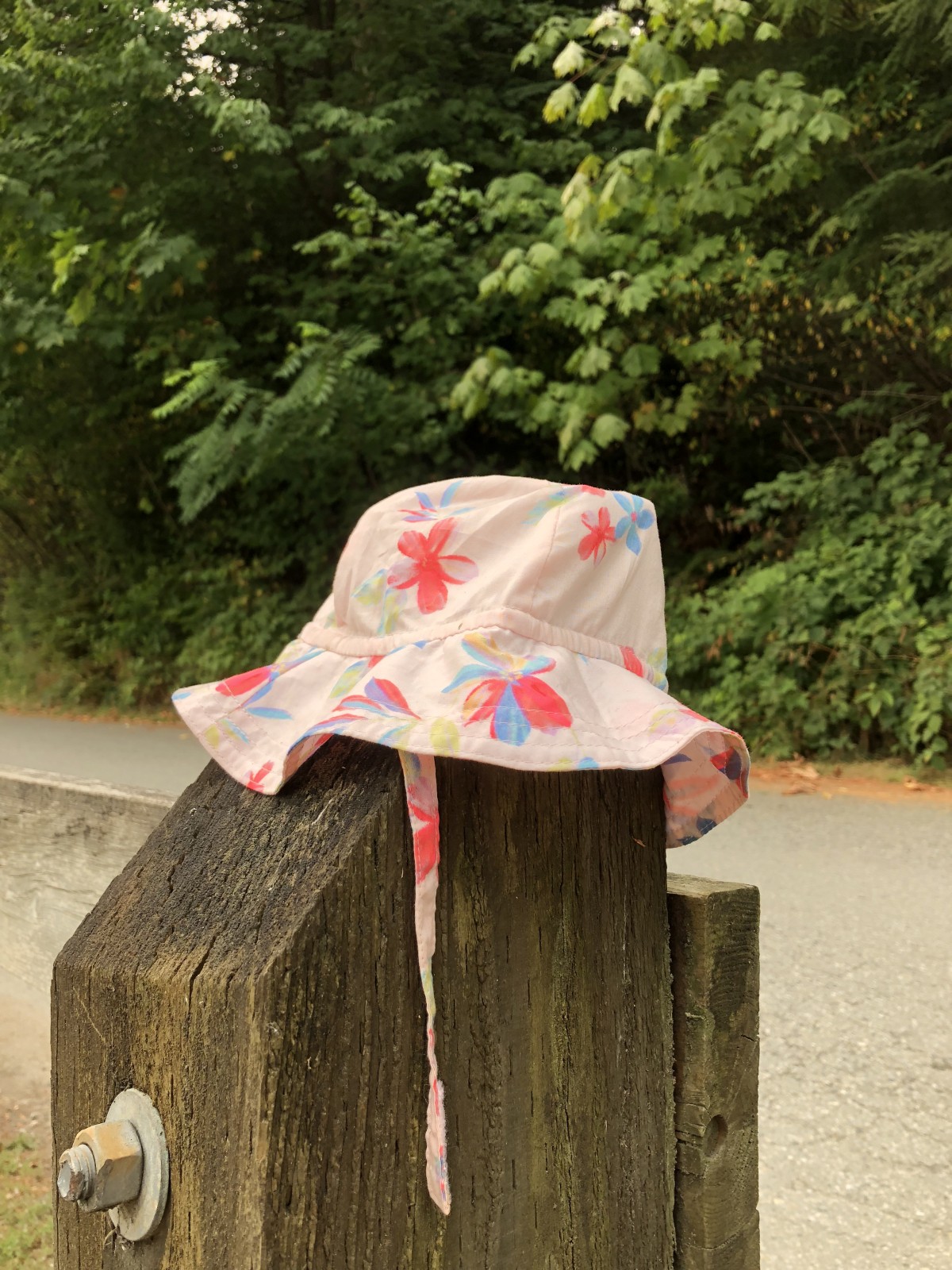
A seemingly abandoned child’s hat in Lower Hume Park. Note the slightly weird lighting is due to smoke haze from the million forest fires currently burning around the province.
Run 592
Average pace: 5:49/km
Location: Burnaby Lake (CCW)
Start: 12:12 pm
Distance: 5:03 km
Time: 29:22
Weather: Smoke haze
Temp: 20-21ºC
Humidity: 60%
Wind: light
BPM: 162
Weight: 161 pounds
Total distance to date: 4540 km
Devices: Apple Watch, iPhone 8
The wind shifted again and the smoke haze was back, again giving the light a weird alien cast, sort of a sunset yellow, but at noon.
On the plus side the temperature was comfy at 20ºC. On the negative, the humidity made it feel a lot warmer and I sweated copiously. My BPM was also up a bit as a result, though 162 is not bad.
I all but ignored the knees for most of the run, only becoming peripherally aware of them at the end. More noticeable was a tinge in my right hip, something I haven’t felt for awhile. It persisted for a few km, but then faded away. There were no other issues to note, other than the aforementioned sweating.
The oddest part of the run, other than seeing no cyclists–I’m kidding, there were a pair of cyclists–was how my pace went in reverse, as I got faster on each km, as if I was literally warming up. Which I was. My starting km was 5:55/km, as was my second, but I was down to 5:44/km by the last km. Still not lightning fast, but given the conditions and virtual lack of breeze, still pretty decent, especially given how many runs it took me to finally get back under 6:00/km.
Overall, then, a perfectly cromulent run and a further extension of my regular run routine. I may yet try a full 10K run around the lake before summer is officially over.
Awhile back I wrote why I would not be subscribing to Ulysses after having paid for both the iOS and Mac versions of the program. Essentially I said that Ulysses was already functional, so I couldn’t imagine them adding enough on an ongoing basis to justify constantly feeding money to the company behind it.
According to their own website, here are the features added in versions 12 and 13, the two that have released since the switch to a subscription model, with my comments on each:
These three are all related to the goal-setting feature:
You can see I’m indifferent to most of these new features. As I said in my post last year, Ulysses was already an outstanding writing app and there was nothing I felt it really lacked. Yes, you can always come up with more “nice to have” features, but the core program was and remains feature-complete at a base level.
If you ask me if I would pay $25 on top of the money I’d already sunk into the program to get the above features, my answer would be no.
If you ask me if I would pay $50 (the normal going rate–and the only one available to me now) on top of the money I’d already sunk to get the above features, I would offer a clipped laugh, or perhaps make a quiet choking sound.
One year into its subscription model and Ulysses demonstrates what a poor fit it is. All improvements and feature updates are welcome, of course (assuming they don’t introduce bugs or affect the core functionality negatively), but there just isn’t much value to be had here, because the program was already complete when they changed revenue models.
Addendum: On the Canadian App Store Ulysses does not appear in the Top 200 list for Free Productivity apps. A few other writing apps do, such as Google Docs, Microsoft Word and even Bear at #194 (another dubious value, IMO, as it also requires a sub). Meanwhile, the pay-once-and-it’s-yours Scrivener is #44 in the Top 200 Paid Productivity apps list. Things that make you go, “Hmm…”