Deer Lake Brook, from the Burnaby Lake Loop. Yes, it actually makes sense!
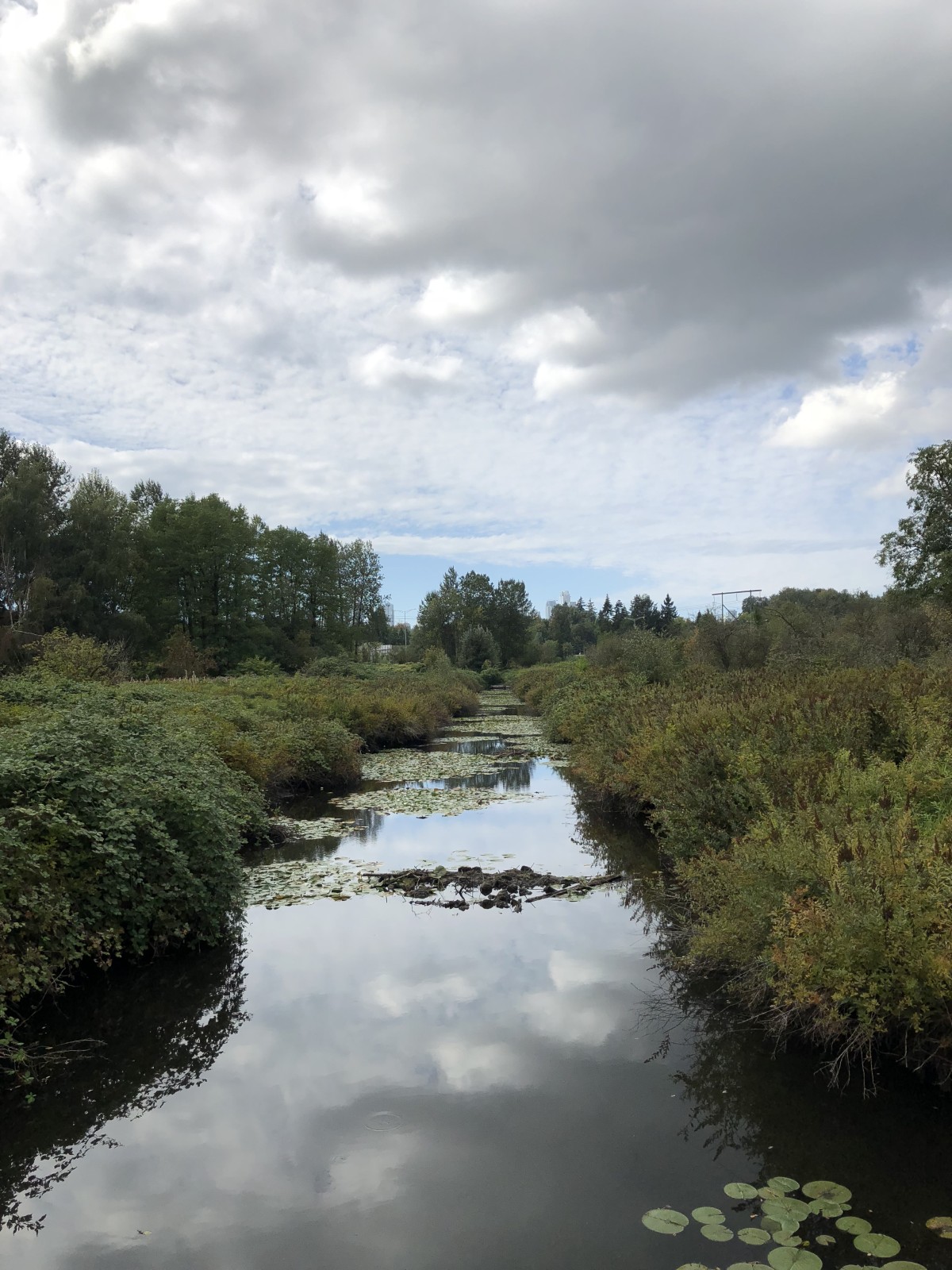

Deer Lake Brook, from the Burnaby Lake Loop. Yes, it actually makes sense!
Run 594
Average pace: 5:43/km
Location: Burnaby Lake (CCW)
Start: 12:08 pm
Distance: 5:03 km
Time: 28:51
Weather: Cloud, some sun
Temp: 19-20ºC
Humidity: 54%
Wind: light to moderate
BPM: 163
Weight: 161.7 pounds
Total distance to date: 4550 km
Devices: Apple Watch, iPhone 8
Today’s run was mostly a repeat of Saturday’s, but with a few minor differences–it was very slightly cooler, the clouds managed to obscure the sun for the entire run (it cleared up after on the walk out) and I improved my pace by another three seconds. My BPM was also up slightly to 163, but that’s to be expected as I worked a little harder.
A pleasant breeze was blowing for most of the run, providing a nice bit of refreshment along the way.
It was also kind of crowded, as it usually is on stat holidays, with many people out for a walk, as well as a larger than normal number of joggers. This wasn’t really an issue, as even the “oh, I didn’t see you!” people were able to get out of the way before an inevitable collision. Strangely, at least three male joggers were topless. I say this was strange because it’s rare to see any guy running topless, let alone a gaggle of them. The first one zipped by me before I began my run, as I was looking for a place to pee (I’ll get to that in a moment).
He had a perfectly bronzed and perfectly chiseled body, so obviously did more than run. He didn’t have any earbuds or phone with him. He was here to run, not enjoy himself. He looked very serious. And he wasn’t jogging, he was running. He zoomed by. I estimated that I would see him again somewhere on the Cottonwood Trail, once I got started.
I was delayed a few minutes because I had to pee (no surprise) and the Jiffy John® was occupied (also no surprise). But when the occupant vacated the loo, a bee buzzed me and I backed off to prevent getting stung and the like. Then I noticed more bees gathered around the Jiffy John, including some buzzing along the bottom of the door, which has a generous-sized gap (generous for a bee, anyway). I contemplated the possibility of sharing the potty with one or more bees and maybe getting stung before the run.
I decided to pee elsewhere.
There’s a big tree on the other side of the dam and in the summer the surrounding foliage provides ample cover, so I relieved myself there and headed off.
After that it was pretty much smooth sailing, with no discomfort, no issues. I started slower so there weren’t the dramatic swings in the splits like Saturday, bit overall my pace improved. This was even nicer as counter-clockwise is the “hard” way.
I also ran more aggressively post-run, putting in what I estimate as probably about three km of running after officially finishing the 5K. I’m probably ready to try a 10K. My knees are afraid.
Overall, though, another good effort. Yay me.
 Plot Gardening: Write Faster, Write Smarter by Chris Fox
My rating: 3 of 5 stars
This is a perfectly cromulent book on outlining a novel and Fox goes into detail on two popular methods, the traditional three-act approach and the perhaps less-familiar story circle.
Running with the gardening metaphor, Fox provides step-by-step instructions and illustrates them with examples from several popular movies (relying primarily on Star Wars) and also drawing from his own work–including examples where he failed, and then learned from the failure.
Each chapter has exercises to follow at the end and Fox knows a lot of people will just read straight through, so he has thoughtfully included all exercises again at the end of the book.
Overall, there’s not much more you could ask for in a book about outlining a novel. Fox explains everything in a clear manner, provides examples, and even throws in a bit of neuroscience here and there. Despite all this, I never found the book overly engaging, perhaps because I’ve always resisted outlining my stories–and I can’t claim they’ve been better for this lack, either.
Still, don’t let my own indifference sway you–this is a well-constructed template on how to outline a novel and would serve any new novel writer well.
The Canada Line is the ALRT that runs from downtown Vancouver to Richmond, splitting off to either the airport or central/”downtown” Richmond. It opened for service in 2009 and one of its intended functions was to help move people from the airport to Olympic venues during the 2010 Winter Olympics.
Obviously the construction of a subway is always going to be disruptive to the neighborhoods it goes through, but the Canada Line’s first bad design was the decision to use cut and cover tunnels for most of its route. Cambie Street is the main route the line follows and it literally follows it–being cut and cover, they dug up Cambie Street, keeping two of its six lanes open during construction–and laid down the subway route along the road, following the same route, including a prominent “bulge” around Queen Elizabeth park. Businesses sued over the construction, some went under or moved and in the end it was declared such a mess that the entire Millennium Line extension from VCC-Clark to Arbutus is going to be a bore tunnel.
But the construction was only the first tangible aspect of the bad design. Once open, the line revealed its other flaws to the public. Namely, it was built on the cheap and with no thought put into expansion.
Much of this can be laid at the feet of the former BC Liberal government, who wanted the line built cheap and fast. They got both of those, but what they didn’t get was the unspoken third part–good.
Fixing the Canada Line would be difficult and costly, but it will likely have to be done eventually, simply because it’s already reached its capacity. There’s no happy ending here.
Run 593
Average pace: 5:46/km
Location: Burnaby Lake (CW)
Start: 12:51 pm
Distance: 5:02 km
Time: 29:01
Weather: Sun and cloud
Temp: 18-22ºC
Humidity: 60%
Wind: light to moderate
BPM: 161
Weight: 162.9 pounds
Total distance to date: 4545 km
Devices: Apple Watch, iPhone 8
After battling and re-battling a cold, I was finally back out running for the first time in two weeks.
Surprisingly, my pace was also three seconds better. I find this doubly surprising, not just because I wasn’t expecting to be faster after a two week layoff, but I was deliberately not trying to push in the early part of the run, to minimize issues arising from rust/decrepit age and so on.
The knees made their presence known early on, but after a few km they were no longer an issue. I also experienced no cramps or other problems and my stamina held up nicely. Overall, a solid run and under welcome conditions–mild temperatures, a decent and refreshing breeze, and no tangible smoke haze (it’s still there, but it’s not enough to really notice–the mugginess and most especially the discernible smoke odor are currently absent).
I went clockwise, so delighted in spending much of the run on the freshly-resurfaced areas. The small dogleg just before you emerge alongside the sport fields is still closed off, though. I have no idea why this particular trail repair is taking so long, but I suspect it will look mostly the same when completed, but still be different, somehow (my hunch is shoring it up so it doesn’t flood, so it may be raised up a bit).
The one odd part of the run, such as it is, was during the third and fourth km. My pace dropped off significantly–more than I would have guessed if you had asked–and I can’t pin it to any one thing. Here are the splits:
5:39
5:42
6:01
6:00
5:30
The first two km are consistent and then my pace drops a whopping 19 seconds, holds there, and then improves by an even more impressive 30 seconds as I move through the home stretch. I’m not surprised the pace picked up in the final km, as I was pushing at that point, but by 30 seconds seems a bit nutty.
Other than sudden slow leg syndrome (SSLS), this was a perfectly decent run, especially after the two weeks off.
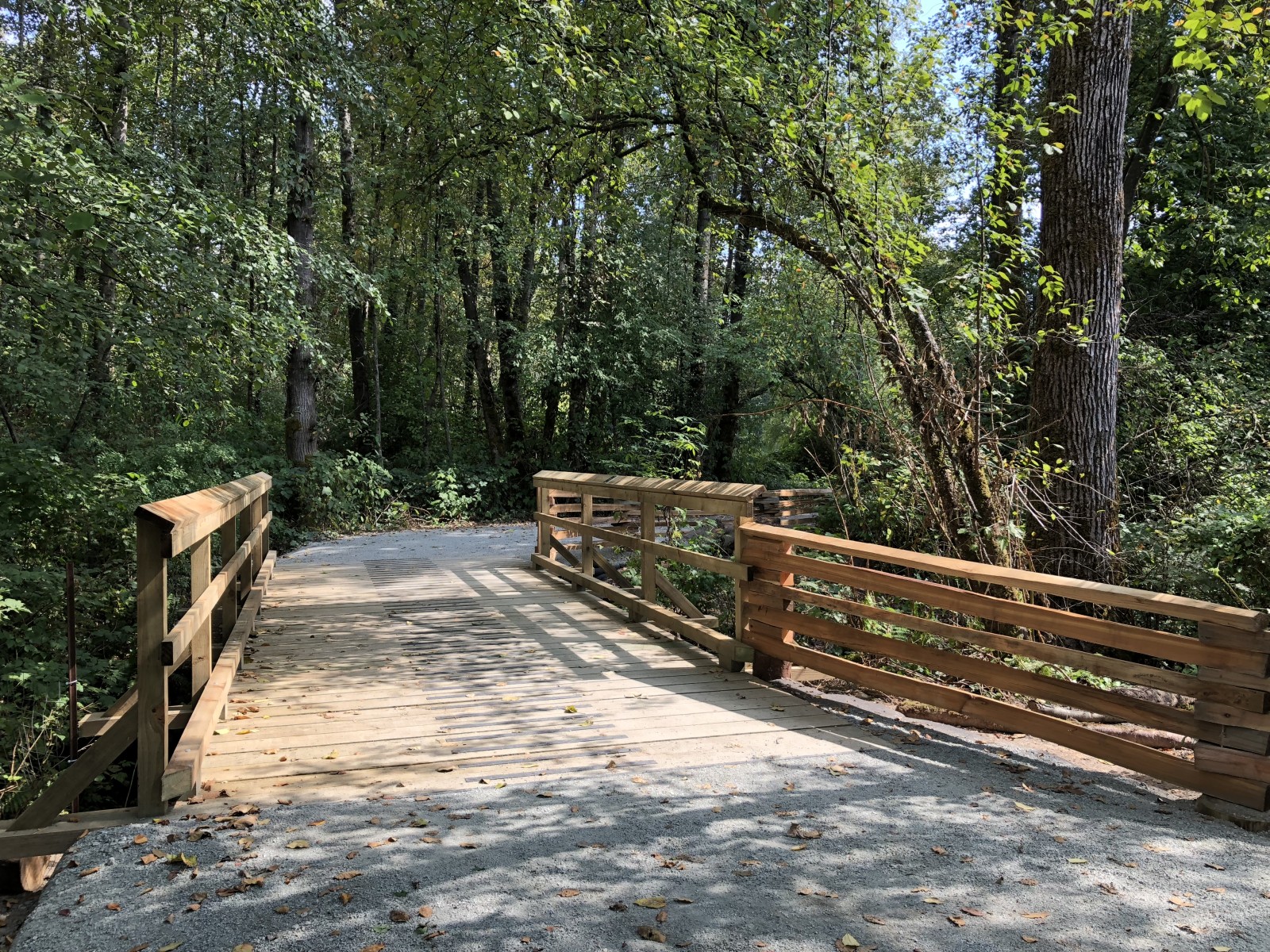
As a bonus, the bridge at Silver Creek is finished and the replacement has a rustic charm the older one didn’t really have.
Fizzled after a few weeks. I realized I hadn’t logged in for the better part of a few weeks and canceled my subscription.
Unlike days of yore, the cancellation process no longer makes you go through a series of steps that gently plead with you to change your mind. Instead, you click Cancel Subscription, get a Yes/No pop-up to confirm and that’s it.
I certainly can’t say I didn’t get plenty of enjoyment out of WoW, but one of the main attractions of MMOs for me is the early (yes, early!) character growth and exploring the world and these things have grown very stale in WoW, through a combination of the game not changing much for my playstyle and me just playing the heck out of it for nearly 14 years.
I’d like to find another game with a big world to explore, but I’m not really sure there’s one out there that would fit what I’m looking for, because I’m not even sure what I’m looking for. I’d like a game with other players around–like an MMO–but not too many to make it feel crowded. I don’t want to have to line up to kill ten bears. I don’t actually want to kill ten bears particularly, either.
I know there are online survival games and a nigh-endless sea of clones building (ho ho) on what Minecraft started, but I’m nearly as out of touch with gaming as I am with pop music.
I am old.
Maybe I’ll just start drawing more. It’s simple, kind of soothing and doesn’t require a subscription.
Hydrant in the grass.

A strange thing happened in August.
My weight neither went up nor down.
Technically if I go from August 1 to August 31 I was up 0.5 pounds, but my stats for the first and last day of the month are exactly the same as they were for the first and last days in July. On July 31 I weighed 162.8 pounds and on August 31 I weighed…162.8 pounds.
Kind of weird.
I dipped below 161 a few times, hitting a low of 160.4 pounds once, but never quite got to my stated goal of under 160, alas.
It now becomes my September goal.
However, I did run more in August and the nil weight loss may be a result of a little muscle gain. My body fat actually dropped decently over the month and is now at 27.8 pounds, down 2.4 pounds on the year.
And I’ve remained donut-free.
In all, I take these things as signs of a positive trend. Onward and downward! (weight-wise)
August 1: 162.2 pounds
August 31: 162.8 pounds (up 0.6 pounds for the month)
Year to date: From 162.3 to 162.8 pounds (up 0.5 pounds–unchanged from July)
And the body fat:
January 1: 18.5% (30.2 pounds of fat)
August 31: 17.9% (27.8 pounds of fat (down 2.4 pounds)
 Confessions of an Alien Hunter: A Scientist’s Search for Extraterrestrial Intelligence by Seth Shostak
My rating: 4 of 5 stars
This is a fun read and my biggest complaint is that it came out in 2009 (just as the Kepler space observatory launched) and hasn’t been updated, so there’s a lot of near-future discussion about systems that have since come online.
Conversely, we still haven’t detected extraterrestrial intelligence since then, either. 😛
Some might be put off by Seth Shostak’s breezy writing style, peppered with puns and humor, but I felt he always pulled back just in time to let the hard science and sober speculation take over. And if you’ve seen Shostak on TV–having more than a casual interest in astronomy, aliens or some combination thereof makes it likely, as he’s not just SETI’s senior astronomer, he’s also their main go-to for interacting with the media–then the light tone is not surprising. He is passionate about his work, but he is a wonderfully droll person. I suppose that may help when you’re willing to offer straightforward commentary on episodes of Ancient Aliens.
Despite being nearly a decade old at the time of this review, the book remains a thorough examination of SETI’s history, its goals, and its then-current operations. Shostak brackets the nuts and bolts of SETI with his own background leading up to joining the group, and offers tidbits from his work as an advisor on films like Contact and the remake of The Day the Earth Stood Still (he helped them make the scientists sound more like real people and less like jargonbots).
A lot of the book centers around the inevitable questions arising from SETI–what would SETI do if a signal was confirmed? How might the public react? What would aliens look like? How long will it take to scan the visible galaxy? Is it all just a goofy waste of time?
People who favor the “waste of time” side may not be moved by Shostak’s arguments, but most others are likely to come away with an appreciation of SETI’s work, and perhaps even a sense of hope in the continuing search for signs of intelligent life somewhere out in space.
Recommended. (But an updated version would be spiffy.)
Flowers outside the Langara College library.

Umbrella in tree, Langara Golf Course.
Berries on Cambie Street.
