It’s time for another update on my short story collection 10 Pairs of Shorts.
This thing is taking a lot longer to assemble than expected. I wish I had a sassy writing robot to help me. Or a million dollars. Both would be neat.
As of today I have these stories more or less ready to go:
Cervidae
Learning to Die
The Cobalt Sensation
The Chicago 8 vs. Armageddon
The Chicago 8 vs. Time
Slice of Life
The Lunch Gnome
The Sometimes Island
Even if I add another to the list at the rate of one per week that still means the collection won’t be fully assembled until around May. Not that it’s a race. But like Kirk to Khan, it tasks me.
I’ll pick the next story for revision tomorrow and hopefully find it perfect as written.
Area 51 – An Uncensored History of America’s Top Secret Military Base is without a doubt the longest title of any book I’ve read in the last five years.
This 2011 title is also a thorough and engrossing recounting of the military base dating back to the 1940s, using both declassified documents and interviews from the men who worked there, some now in their 90s, to paint a still-incomplete picture of what happened–and still happens–there.
Author Annie Jacobsen does a stellar job with this, following a mainly chronological progression through Area 51’s history, venturing off to related matters when relevant and covering the politics that always served as the backdrop, from the end of World War II through the Cold War and on to the present-day where unmanned drones do the surveillance and unleash rocket-propelled judgment in one deadly (and expensive) package.
Area 51’s most infamous connection is to the 1947 crash of a flying disc near Roswell, New Mexico. Jacobsen addresses this and it forms one of the lingering puzzles of the base. More on that later.
The main focus is on the secret testing done mainly by the CIA, the U.S. Air Force and the Atomic Energy Commission (renamed several times, presently the Department of Energy). The first two conducted extensive tests on stealth planes, starting with the U-2 and the A12 “Oxcart”, jets designed to fly at unheard of heights–as much as 90,000 feet–and faster than any other aircraft, with speeds reaching up to mach 3. The first striking part about these tests is how relatively ineffective the stealth part was, even after many years of development and billions of dollars spent. Both jets were regularly spotted and sometimes shot down, though the data they provided was invaluable to the U.S. It wasn’t until the 1980s that stealth technology really advanced with the F117a.
The second and more grimly striking part of the testing were the astonishing number of crashes and fatalities, with more than one pilot dying due to malfunctioning equipment while ejecting.
While the CIA and Air Force built planes in secret, the Atomic Energy Commission was testing atomic bombs–lots of atomic bombs, with yields many times greater than those dropped on Japan. I found myself repeatedly shaking my head over how utterly reckless these tests were. A dirty bomb simulation exploded radioactive material mere miles from Area 51, with no protection offered to anyone working there. The debris was never even cleaned up, just cordoned off with signs and fencing. One atomic bomb was exploded directly in the ozone layer, even though the scientists conducting the test had no idea what might happen.
Today a large swath of the Nevada desert looks like a moonscape, the ground dotted with dozens of craters from dozens of bomb tests. It’s a wonder the state doesn’t glow at night.
And what of Roswell? Jacobsen doesn’t spend much time on it but does drop a few interesting and somewhat conflicting accounts from those who worked there. Some insist they saw craft and bodies that were unmistakably alien. But Jacobsen puts forward a more prosaic view, that the flying disc was a craft designed in Stalin’s Soviet Union sent to the U.S. to frighten or warn the U.S. government. The aliens? Genetically or surgically modified children made to look like aliens, to scare everyone or something. The unusual flight characteristics of the disc–its ability to hover in defiance of gravity, to move rapidly and silently–are never explained. Nor is it explained that if this was Soviet technology why it was never seen nor heard from again, nor why any other country has ever developed anything like it. If one were paranoid, one might think there was some kind of cover-up going on.
The lingering impression that Area 51 leaves me with is one of discomfort. A lot of dangerous testing and experimentation has taken place there and much of it remains classified, with even the U.S. President often declared not having a “need to know”. This kind of ultra-secrecy, where projects are “born classified” is not healthy for a democratic society nor for the world in general. Edward Snowden may have famously blown the lid off the NSA last year but what went on and still goes on at Area 51 (still never officially acknowledged as existing) is more insidious and dangerous.
Jacobsen concludes with a chilling interview with an unidentified engineer who hints broadly at a huge number of horrifying experiments on humans (think Nazis in WWII) conducted at Area 51 and elsewhere in the U.S. that went on at least through the 1980s and could still be happening today.
Area 51 is a comprehensive and meticulously researched look at the world’s most infamous military base. It neatly captures everything from the camaraderie of test pilots flying experimental craft that guaranteed no safe landings to the blatant disregard for safety in the hundreds of nuclear weapons tests. Highly recommended.
Or how to review a really long book series in a really short blog post.
I picked up the original paperback release of the first Dark Tower novel, The Gunslinger, way back in 1982. I generally stay away from book series, especially unfinished book series, so I didn’t read it. In 2003 a revised paperback edition came out with a much spiffier cover. Unlike most King revised editions, this only added 35 or so pages instead of 3,000.
I still didn’t read it.
Finally last year I decided to get the ebook version of the revised edition, read it and enjoyed it. I read two other books before tackling The Drawing of the Three, read one other book after and at that point read the last five of the seven book series back to back. In all I compressed a series that stretched out over 20 years to about two months.
Here are my ultra-brief takes on each book. Overall I found the series quite enjoyable, but with inevitable flaws and writer decisions that almost derailed the whole thing for me.
The Gunslinger. Tight, excellent portrait of Roland as a man obsessed. His journey across the desert is filled with searing and bleak imagery. 9/10
The Drawing of the Three. An excellent continuation, bringing in the new players and giving Roland some good foils. 9/10
The Waste Lands. This book probably best captures the epic journey as just that–an epic journey. It also introduces Blaine, a lovably insane monorail that threatens to kill everyone on board if they can’t answer his riddles. 9/10
Wizard and Glass. This is effectively a standalone novel where Roland recounts the time spent as a teen in the Mexico-styled town of Mejis. Certain key events and items tie into the larger story. I enjoyed it as a change of pace but was anxious to get back to the main thread. 7/10
Wolves of the Calla. This is another story that is effectively standalone as the group defends the citizens of Calla Bryn Sturgis against the “wolves”. Enjoyable but ultimately seems kind of unnecessary. This may have worked better as a book published after the series concluded. 6/10
Song of Susannah. A worthy continuation, with action taking place in our world and Roland’s. Lots of King the character here. I rolled my eyes at first then just rolled with it. Still not a huge fan of him inserting himself in his own story. 8/10
The Dark Tower. A gloomy, somewhat sour book to end the series, though most characters sort of get a happy ending. King ends with a nice bit of symmetry and the spider is an effective monster here, unlike the lame one in IT. 8/10
Average pace: 5:21/km
Location: Brunette River trail
Distance: 5.03 km
Weather: Partly cloudy
Temp: 4ºC
Wind: light to nil
Calories burned: 398
Total distance to date: 2506 km
With two weeks between runs again I was not expecting to exactly zip along, though I was hoping that my walk yesterday would give me a boost to my stamina.
As it turned out I recorded my best pace of my few runs so far in 2014, coming in at 5:21/km. For the first km my legs from the knees down were lighting up like an emergency panel at a nuke plant going through a meltdown. My muscles cried out. My tendons joined in chorus. I got a stitch in my side. I felt like a slug. But I kept going, found my pace and my legs settled down. The only negative afterward is the blister on my right foot is even bigger, mainly due to the walk to the river.
The weather was crisp but dry. I wore two layers–a long and short sleeved t-shirt. I think I would have been fine with just the long sleeved shirt. I didn’t take gloves nor did I need them.
A little over halfway through the run I passed an older man and though I couldn’t hear him due to the earphones he seemed to be relaying enthusiastic encouragement. That was nice. I’m guessing it looked like I was in agony and he thought it might keep me from collapsing.
I had a nice soak in a tub filled with lavender Epsom salts after. It made me feel like a princess. A fat, hairy princess but a princess all the same.
Now that February has arrived, the first real deep freeze has come along with it. Four years ago they had to truck in snow for the Winter Olympics, so this is about right, weather-wise. Our weather has a well-developed sense of irony.
Instead of running today I opted to do a walk as a warm-up to a run tomorrow. I walked from home to Burnaby Lake, around the lake, then up to the Production Way SkyTrain station, a total of around 16 km or a bit more. My time was two hours and twenty five minutes, which is my usual exercise walking pace. When you maintain it for 2+ hours it really starts to feel like exercise, too.
I have a big ol’ blister on the lower inner part of my right foot now, just like when I did the same walk a month ago and it tasks me now much as it did back then. I could feel it forming while I walked but what can you do? Curiously I did not get the mirror blister on the left foot like last time, which leads me to the scientific conclusion that my right foot is weird.
As is usually the case when exercising, I expect my weight to be up tomorrow but I can rest easy knowing it is not because of the evil that donuts do.
Jonathan Strange & Mr Norrell (Susannah Clarke) is one of those books I’d been meaning to read for some time and I finally picked it up last year. Perhaps fittingly I have also taken my time in finally committing to a review. Unlike the novel, I will be brief (this is is no way a criticism of the book, its length is perfectly suited to the tale it tells).
This is a dense yet whimsical novel, one that is amazingly polished for being the author’s first. Clarke vividly depicts an alternate Victorian era where magic exists but has fallen into disuse, something that the titular characters first separately then jointly work to change, with unexpected results for both.
Strange and Norrell are each in their own ways difficult men who do not always get along with others, with Norrell being a near-misanthrope. The married Strange is more accommodating to others and bolder, putting aside Norrell’s studied approach to reviving magic in favor of grand displays of magic done on behalf of England in its wars against the French. The conflict between the men forms one of the main pillars of the story, with another being the abduction of several people by a malevolent fairy. Clarke does a terrific job in bringing the various events together, employing archaic language that gives the feel of being a history recorded by someone who lived in the time.
Each chapter includes footnotes that are often pages long and that Clarke apparently expected these to be rejected by the publisher. Their addition adds a quirky scholarly feel that further contributes to the book’s presentation as historical artifact. At the same time, the author occasional intrudes to offer a pointed opinion about one character or another. It’s something that could come across as twee but Clarke handles it confidently.
I have not read many alternate history novels (actually, I don’t if I have read any) but this still strikes me as being an excellent example of the genre. Recommended.
When I picked up The Best New Horror 6 (Stephen Jones, editor) I didn’t realize it was first published in 1995, so this made it not just an anthology of horror stories but also a bit of a trip down memory lane because as hard as it is for me to wrap my head around, 1995 was nearly twenty years ago.
Without any overall theme driving it, this collection covers everything from splatterpunk to Lovecraft homage, with plenty of sex, drugs and rock and roll mixed in. Overall I found the stories worthwhile, without any I actively disliked.
The introduction by Jones is a rather exhaustive look at the year in horror writing, along with a forecast of doom for the genre in the years ahead, a curious way to set the tone for the stories he has collected. Likewise, the book concludes with a look back over notable people related to the horror industry (book, film, TV) who have died that year. It’s been twenty years since Claude Akins died. That seems kind of weird to me.
My favorite stories were:
Sensible City (Harlan Ellison). The world’s best curmudgeon writes a horribly fun tale of just desserts about a pair of thugs who take a very wrong turn. This one has a neat Twilight Zone feel to it and is written with a nice economy and droll wit.
Sometimes, in the Rain (Charles Grant). A moving story about old age and the ghosts that haunt those still hanging on.
Isabel Avens Returns to Stepney in the Spring (M. John Harrison). Another tale that uncoils its horror quietly, about a woman obsessed with flying and unfortunately getting her wish.
The Alternative (Ramsey Campbell). Another Twilight Zone-ish story about a family man with everything who seems to have an alternate life where he has nothing and what happens when the two collide.
The Singular Habits of Wasps (Geoffrey A. Landis). A Sherlock Holmes story told from the perspective of Watson that blends Jack the Ripper with alien intrigue.
Out of the Night, When the Full Moon is Bright (Kim Newman). A long story that weaves together two narratives, one about a modern British journalist riding along on police patrol in near-future Los Angeles, the other about a werewolf in the past that co-ops (or creates) the Zorro legend.
I didn’t dislike any of the stories, which is surprising for me, as I’ve found horror collections to be notoriously uneven. The weakest was probably “Dead Babies” and it wasn’t bad at all, just a very conventionally told horror tale. Recommended.
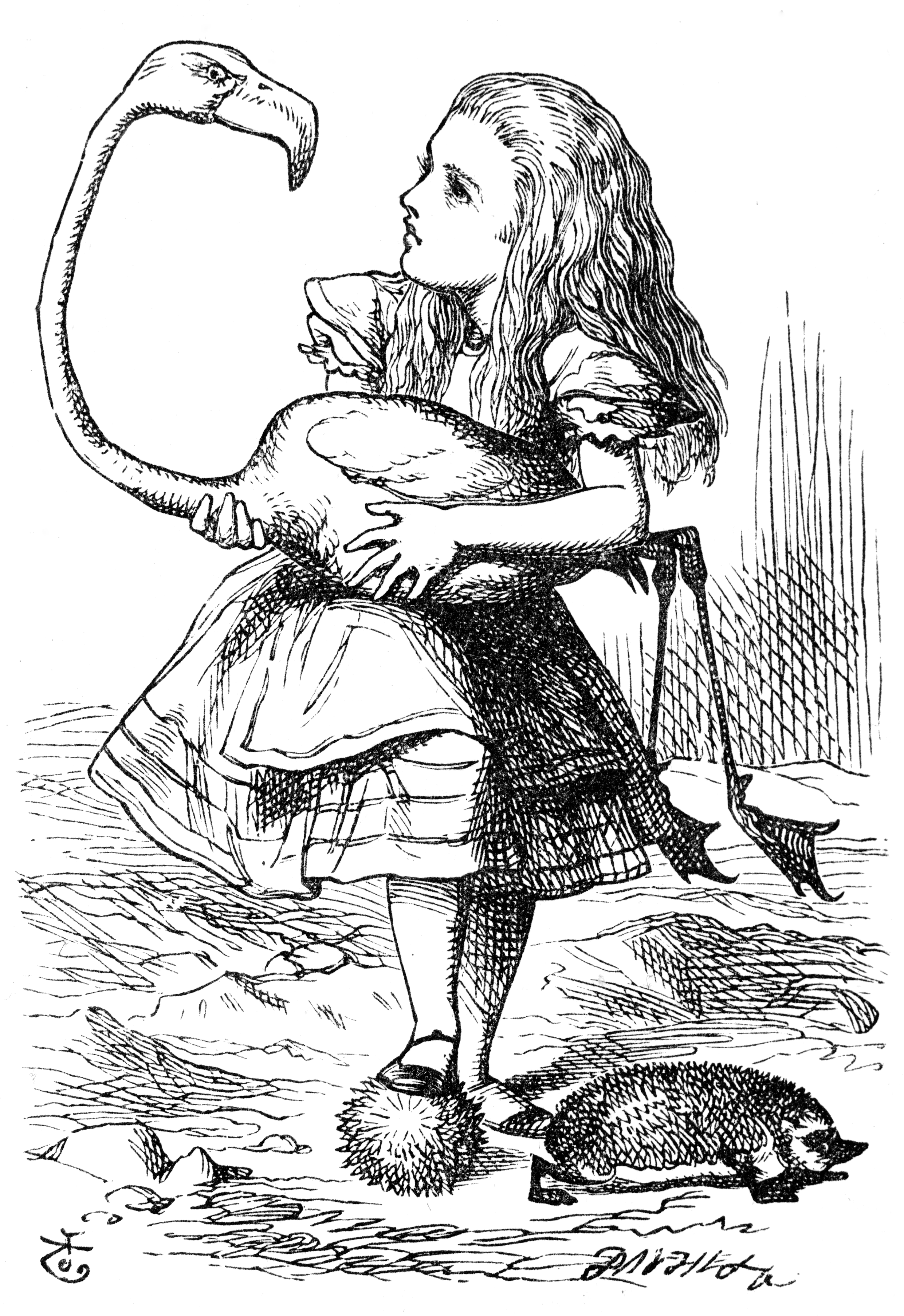
I try to read a few classics or pseudo-classics every year and the first one I tackled for 2014 is Alice’s Adventures in Wonderland because all of Lewis Carroll’s work is in the public domain, which means it is free, baby, free. And the ebook edition I read is based on the original 1865 edition that includes John Tenniel’s wonderful illustrations.
Here’s one of them, courtesy of the Wikipedia article. I love these. Yes, enough to marry them.
Having never read either of the Alice books and getting the ebook edition, which weights exactly zero of anything, I had no idea the story was so short and finished it in a day. As befits the literary nonsense genre it belongs to, the story is filled with absurd imagery, copious amounts of word play and puns a-plenty. My biggest surprise was probably how daft Alice is, often having long and odd conversations with herself and obsessing over her size, among other things.
This was a pleasant read but one that did not leave me necessarily hungering for more.
This Book is Full of Spiders is David Wong’s pseudo-sequel to John Dies at the End. Unlike the latter book, Spiders has a much tighter narrative and is darker overall, though the irreverence, drunkenness and general ineptitude of the main characters carry over from the first volume.
The title is also accurate. Arachnophobes will be left squirming uncomfortably at the giant piles of spiders that lead to a kind of zombie apocalypse in Wong’s hometown of [Undisclosed].
What I like most is the way Wong balances the disparate elements and makes them all work. The protagonist is flippant, his best friend ridiculous, yet you are made to care about them. There are scenes that are both horrifying and moving. There are photos of John’s penis. Repeatedly.
Wong writes dialogue that is both direct and believable, even when (or especially when) people are discussing things that are outrageous or terrible. The only lapses are minor ones–he relies a bit too much on happenstance and coincidence to move the story along at certain points, but never to the point where it seriously detracts. Likewise, the conceit of never naming the town–in order to keep people from going there and having bad things happen to them because the place is so screwed up–falls apart after he describes the town being a headline all over the world after it is placed under quarantine. That and a video shot there gets 18 million hits on YouTube. Not so much [Undisclosed] anymore.
Overall, though, This Book is Full of Spiders builds nicely on the groundwork laid in John Dies at the End and is–dare I say it–a more mature book. Plus, how can you resist a story where the author describes his hair as looking combed by an angry cat?
A haiku in tribute to a month of nearly zero weight loss. Not that I’m bitter. I’m totally not. At all.
Maybe a little.
I confess to having nipped at a cookie or two, so I have no one but to blame but my stupid hands and their ability to pick up edible things and shove them into my willing mouth. I’ll work on this in February. In the meantime, haiku:
A desire to slim
The donuts are forbidden
But sprinkles linger
This month I decided I would try to trim away all the extra flab I acquired in the last few months of 2013. Here are the results in graphical form from myfitnesspal.com, where I have been tracking my weight on a daily basis:
As you can see, over the course of 30 days I managed to lose…zero pounds.
For the curious, the low point on that chart is 171.6 pounds on January 12.
On the one hand this is not terribly impressive because it means it would take approximately infinity for me to lose any weight at all. On the other hand I didn’t gain weight, so I’ve at least stemmed the fat-filled tide.
Successes for January
I managed to reduce my snacking/donut addiction at school (where I work) to a single donut one Friday afternoon and that single donut was provided free of charge. I resisted the candy bowl filled with chocolate that sat on the front counter until it was completely empty. As the bowl itself was not made of chocolate I was safe at that point. I reduced my incessant gorging of snacks at home.
Failures for January
I did not run or exercise as much as I planned to. This is important because I typically eat less on exercise days. My snacking at home was still higher than it should be and often consisted of the wrong sort of snacks–potato chips instead of yogurt, cookies instead of carrot sticks. There is room for much improvement here. I also need to start making my own lunch again as this will reduce my caloric intake by a few hundred each day.
Goals for February
Only healthy/low cal snacks at home or no snacks at all.
Exercise at least three times per week.
Do not eat my weight in muffins or anything muffin-like.
I was going to have a snack tonight before bed but resisted. To quote GlaDOS from Portal, this is a triumph.
I will post the results of tomorrow’s weigh-in (the last for the month) tomorrow. If I actually end up for the month I am going to force myself to pee until that changes.
UPDATE, January 31: I weighed in at 172.8 pounds, down 0.6 pounds, thus saving the need for any extra peeing. 0.6 pounds down for the entire month. Woo, I say.
“How It’s Made” is like comfort food for my brain. There’s something about watching the assembly of mundane, everyday items I find soothing. Sure, I don’t need to know how fig newtons are made or what goes into putting together a model train car but dang it, I like it.
Here are five items you probably won’t see featured on “How It’s Made”:
Electric chairs
Vibrators
Bedpans*
Money shots
Anthrax
* there’s an outside chance they could actually do this one