The other day I found that my copy of mIRC was showing as unregistered, with the nag screen back in place, something I hadn’t seen for years. I’d just done a Windows update so naturally assumed it was to blame because it was a convenient coincidence.
I had my doubts, though, so when mIRC opened a browser tab that took me to a handy “register your copy of mIRC” page, I looked it over and found this:
Question: Will my registration work with newer versions of mIRC? Answer: If you are a home user, your registration entitles you to ten years of free updates to new versions of mIRC.
I looked up my original registration email and discovered I had done so in 2004. I actually got a bonus year out of registering, apparently. Strangely, I was still annoyed. On the one hand, getting to use the software for ten years before having to pay again is a pretty good deal when most similar recurring licenses (Office 365, Adobe Creative Cloud, etc.) charge yearly. And yet there was something about the program wiping out my registration as if it never existed–and doing so without warning–that rubbed me the wrong way. I started looking at open source IRC clients but eleven years of using mIRC has made me very comfortable with its interface (and quirks and flaws, of which it has more than a few).
Right now I am running it in “free” mode and putting up with the nag screen while I ponder what to do. I’ll probably pony up the $15 registration fee and be good until 2025. By then I’ll have forgotten all of this and will write this post again.
I have always regarded buying lottery tickets as charity donations, as the odds of winning one of those nice multi-million dollar jackpots is about 1 in 14 million. Those are not good odds. And yet I buy because it’s easy, relatively cheap and the money I spend does go to good things. I’m not one of those unfortunate types who has become addicted to gambling, nor am I one who thinks my odds are improved by buying ten tickets instead of one, I sensibly buy only one per draw.
If I won I wouldn’t spend all my money on hookers and blow. I’d give some to charity, some to friends and family, I’d buy a nice place to live, maybe some new furniture. Nothing fancy or extravagant. Sure, I’d quit my job, but I wouldn’t become the idle rich, I’d work to improve myself. I’d travel and draw and write and help others with their worthy projects. I’d be a swell rich person.
Now I just need a big fat win to demonstrate how wisely I would use my newfound wealth.
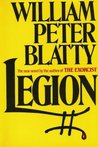
In 1983, twelve years after The Exorcist, William Peter Blatty wrote Legion, a sequel of sorts that switches focus away from Regan MacNeil to the rumpled, philosophical and schmaltz-loving police detective William Kinderman as he investigates a series of gruesome murders in Georgetown. The novel presents the possibility that the supposedly deceased serial killer known as The Gemini Killer (modeled after the real-life Zodiac killer) has somehow started murdering again. As Kinderman investigates he begins to see signs that tie the new killings to the events surrounding the exorcism of Regan more than a decade earlier.
Kinderman is a character Blatty obviously loves writing about and it shows throughout Legion. The detective goes from long ruminations on the nature of evil to complaining about a live carp his mother-in-law is keeping in his bathtub (she likes her fish fresh). As the body count rises and Kinderman heads into the psych ward of a hospital looking for leads, things turn increasingly dark before coming to a head when it seems no one is truly safe from the killer or killers. Blatty has characters fighting to determine what is real and what isn’t as the demonic influence strengthens. Although I never found the novel especially scary, it is unnerving and the suspense toward the end is well-executed (pardon the pun). The prose often has a lyrical, dream-like quality to it, most obviously when Kinderman or others muse about life, the universe and other suitably cosmic topics.
Legion manages to retain many of the same strengths The Exorcist had while standing apart as something more than just a sequel. If you’ve read The Exorcist and enjoyed the character of Kinderman, Legion is easy to recommend.
It doesn’t seem like the Christmas/holiday ads have started any earlier this year. A small mercy.
Curiously, I have seen numerous ads for licensed products for the new Star Wars movie, The Force Awakens, but none for the actual movie itself. You can buy Stars Wars cosmetics. I don’t know why. But you can.
The controversy over the Starbucks holiday cups is dumb. The initial impulse is perhaps to despair over how many people seem upset over this non-issue but there’s always been people like this, we just have the Internet to insure every one of their voices now gets heard. Hooray for technology.
Our late fall weather has been cold and dry with random violent storms sweeping through every few weeks or so. This is probably due to El Niño, which is also responsible for the warmest October on record (it was pretty mild, which is nice for here, less so where it means ice caps melting/climate change doom).
I had my yearly egg nog.
Apple spice candles smell nice.
I do not want a white Christmas.
The Black Friday nonsense seems to be on the wane, though that may be partly related to the U.S. Thanksgiving coming so late this year. I’ll take what I can get.
We’re putting up a tree this year. AND DECORATING IT WITH STARBUCKS HOLIDAY CUPS.
Technically I didn’t forget since I’m writing this and it’s still a few minutes before midnight. I was all prepared to write something fascinating, had the blog composition window open, and then got distracted fooling around with Word and WriteMonkey. I think I’ve decided to go back to WriteMonkey for Road Closed because a) it’s already in WM format b) I’m used to WriteMonkey and c) I’ve discovered a few more handy WM features I can use for the novel.
engadget: Consumer-focused tech gear reviews and related stories, with trying-too-hard-to-be-hip writing and just enough typos to make you wince. Every story features a stupidly gigantic image that rarely adds anything but takes up lots of screen real estate.
Ars Technica: Sort of a grown-up version of engadget, with more substantive stories and fewer typos. Some of their writers look too young to drive.
AnandTech: Anand himself left to join Apple but his site lives on, offering exhaustively detailed reviews of products that includes pages and pages of benchmarks that are probably appreciated by robots or benchmark fan clubs. The layout and design is something a computer might love.
Autopsy Number 1 Name Weirdsmith Body Identification Novel Date of Birth November 1, 2015 Date/Time of Death November 18, 2015 Coroner Creole Ned Cause of DeathFatal lack of interest Due ToLack of planning Due ToLack of motivation
Yesterday I officially declared my 2015 NaNoWriMo attempt dead. What caused its tragic demise? Read on for more (or skip to the TL; DR summary at the end, I won’t mind).
For months I wavered back and forth on whether or not I would participate this year. I finally decided that if I was in the middle of writing something and going like gangbusters (what are gangbusters, anyway?) I would keep writing and skip NaNoWriMo, as it seems silly to suspend one writing project for another without having a really good reason for doing so.
Come the latter half of October and the only thing I was writing were inane posts to my blog. I promised myself back in August that I would write every day, whether it was posting to my blog, working on a short story, writing on a forum or handcrafting a nuanced grocery shopping list. I’ve kept to this (writing every day, not handcrafting nuanced grocery lists), mainly by writing on my blog. The posts vary in quality and quantity, but I’ve written something every day for the past three months, even if it was sometimes no more than “here’s an amusing cat image I found”. Establishing the discipline of writing every day was important. I hoped this routine would smooth the way for my return to writing fiction, but apart from a few writing prompts, that didn’t happen.
So here it was, mid-October and I was ready to take part in NaNoWriMo again, to get the ol’ fiction juices flowing. Don’t ask what fiction juices are, you don’t want to know.
Here’s a summary of my NaNoWriMo efforts to date:
2009: Took unfinished short story “The Ferry” and turned it into a novel. WIN.
2010: Took completed short story “Hello?” and turned it into a novel. LOSE.
2011: Took completed short story “The Dream of the Buckford County Church” and turned it into a novel. LOSE.
2012: Wrote original novel The Mean Mind, based on an idea I came up with a hundred years earlier. WIN.
2013: Wrote original novel Start of the World, based on an idea created specifically for NaNoWriMo. LOSE (due in part to catastrophic loss of data)
2014: Took unfinished short story started earlier in year that began as a writing prompt, “Road Closed” and turned it into a novel. WIN.
2015: Took unfinished play “Weirdsmith” (I wrote the first act back in 1991) and adapted it as a novel. FAIL.
You may have noticed a pattern here. In all but one case I totally cheated by adapting existing stories or ideas. NaNoWriMo discourages this and my success rate–2 out of 5–is not compelling anecdotal evidence that it’s a good strategy.
As the days went by I cast about for ideas, looking through my old stories, idea files and cans of fiction juice. Nothing grabbed me. Nothing called out to be written. Not even a grocery list.
Finally, on October 31 I re-read my unfinished play “Weirdsmith” and at 10 p.m.–two hours before NaNoWriMo 2015 officially began–I made the decision to take the play and adapt it as a novel.
The first problem came up the next day. I didn’t particularly like either of the two main characters in the play. I decided to jettison them and replace them with the couple from “The Dream of the Buckford County Church.” I’m a big believer in recycling. It’s good for the environment and lazy writers.
I wrote 1,745 words on Day 1, with the opening scene left hanging at a tantalizing point, so I’d be eager to jump back in the next day. But the next day I did not jump back in. The opening scene was limp and uninspired. There were wiener jokes. I’m not philosophically opposed to wiener jokes, but when you start a novel with them, you’re perhaps looking more at a novelization of an Adam Sandler movie more than writing your own daringly original work. I sat out Day 2 to ponder my next move.
On Day 3 I wrote a new opening scene, jettisoning the two characters that had replaced the previously jettisoned characters. It was like the story was built on a foundation of ejector seats. This time I wrote from the viewpoint of Weirdsmith (William Smith) himself. It felt better, though I only had a vague inkling of how the already vague story would proceed.
On Day 4 I pondered my new direction. I pondered for the next five days after that. I finally wrote part of a second scene on November 10. Then I pondered some more. I knew I wasn’t going to jettison Smith, because the story would be jettisoned along with him and that would be the end of it.
Yesterday, November 18th, I jettisoned the story, realizing there was no way I was going to finish by November 30, and more importantly, feeling strongly that my time would be better invested in other efforts.
So what went wrong? Here’s my quick analysis, in handy list form:
I waited too long to come up with an idea. This gave me no time for any sort of planning, outlining or just plain thinking about the story. Adapting an unfinished play should have helped but it didn’t in the end because…
I cribbed from existing material, decided on Day 2 it wasn’t working and had nothing else ready to fall back on. I didn’t want to just damn the torpedoes (“Torpedoes, I damn thee to a brief and violent life!”) and keep going because I really didn’t like that opening scene. Continuing on from there would have felt like I was wasting my time, simply writing out of obligation and nothing more.
My new opening scene written on Day 3 was better, but it was like a sketch that has faded so much you can barely see any detail. You’re not even sure what exactly you’re looking at. I didn’t know where to go from that opening scene and NaNoWriMo demands that you go, you go, and you do not stop. I stopped.
A few more days of pondering yielded no insights or bursts of inspiration. Sitting down and forcing myself to write resulted in me pecking out a few more words. The only mercy was no more wiener jokes. But it wasn’t enough.
That’s pretty much it: poor planning, flat writing and in the end all I had was something I wasn’t interested in pursuing. It was kind of like visiting some place you’ve always dreamed about going to and when you finally get there you realize you can make better tacos at home. Or something like that.
Anyway, my plan for next year is to write a novel about writing a NaNoWriMo novel. It should be a breeze.
National Novel Writing Month, Day 18 Word count: 5,181
The answer is no. I’ve officially given up on this year’s limp attempt. I’ll conduct a full autopsy later but little planning and little enthusiasm played major parts in the death.
My writing continues here and elsewhere, so while this particular effort has ended, all is not lost. As part of the autopsy (coming soon™) I’ll post excerpts from both of the opening scenes I wrote. It’ll be fun and a little sad. But mostly fun.
The first major update for Windows 10 came out recently. It adds the usual assortment of enhancements, fixes and tweaks, but of all of these things the one that pleases–nay, delights–me the most is allowing title bars to actually have color again.
In Windows 8 it was possible to adjust the color of the title bar but not the color of the text, which was always black. This meant you could make the text effectively invisible by making title bars black or some other dark shade. Windows 10 changed this by taking away all choice. You had black text on a white title bar, except for arbitrary apps Microsoft slapped color title bars on–and you also couldn’t adjust those, even to make them match the white ones. It was interface design channeled through a 1970 Soviet committee.
Now, though, I can have a friendly, soothing blue title bar on every program. I open Word and a wave of calm washes over me, like a gentle and warm tide. Then I struggle to remember how to make hidden text visible and start grinding my teeth. Focus on the title bar, I think, let the blue calm me. And it works. That and closing Word. Really, after a billion versions Microsoft should be doing more than slapping a coat of paint on the thing every couple of years. I’m leaning toward going back to WriteMonkey or some other tool that focuses more on actual writing and less on doing everything ever with text and stuffing the means to do these multitude of things in an endless series of icons, ribbons and dialog choices. (Hidden text can be shown by going to File > Options > Display and checking “Hidden text” under the “Always show these formatting marks on the screen” option. But you probably already knew that.)
Anyway, colored title bars are nice. Windows 10 is now officially 23% better.
I’m actually having a difficult time articulating my opinion of Futuristic Violence and Fancy Suits. On the positive side, David Wong (aka Jason Pargin) continues his breezy, effortlessly sarcastic way of writing that for me is the equivalent of a belly rub for a dog. Okay, that analogy was a little labored. Let me try again. I like the way Wong writes. His characters are smart and funny, the situations he puts them in are equally silly and dangerous and somehow all the gonzo stuff he throws together manages to work.
In this novel he shifts to third person to tell the story of Zoey Ashe, a young woman in the near(ish) future who inherits the estate of a father she never saw or liked much, along with technology that can turn an ordinary person into an unstoppable force of destruction (ie. a supervillain). The setting is a designed city in the Utah desert called Tabula Ra$a, a largely lawless place peopled by dozens of millionaires and those who work for, prey on and gawk at them.
So far, so zany. My first stumbling block is Zoey. She’s presented as tough and independent, but also makes some very (unbelievably) stupid decisions, usually in service to moving the plot forward. I really dislike characters doing things solely to keep the plot rolling. King was right–story is good, plot is bad. Wong does this a number of times throughout, using coincidences, slip-ups and kooky hijinks to make sure the plot continues from A to B to C.
On the other hand, the novel is less about the clever machinations of the characters and more reveling in the excesses of this future world that takes the smartphone/always-connected thing to its ludicrous conclusion, where everyone has a video camera, a live feed and the insatiable need to draw an audience, whether through quirky or homicidal means.
Tone is another issue here. As the title promises, there is violence aplenty and much of it is graphic. While many of the characters are cartoonish, some are genuinely repugnant in their actions (even as they are simultaneously ridiculous in presentation). The main villain, Molech, is a self-obsessed diva who brutalizes Zoey repeatedly, all of it depicted in vivid detail. It feels a bit at odds with the sillier parts of the story, but maybe it’s just edgy and I have insufficient hipness left to appreciate it, given that I am mere years away from wearing suspenders and inexplicably hiking my pants up to my nipples (which is to say, getting older). None of this was enough to keep me from wanting to see how it all turned out, but it did lessen the experience a bit. Maybe I just don’t like reading (in detail) about terrible physical violence being inflicted on people.
The big finale also felt a bit thrown together and was anti-climactic, but wasn’t actually bad. I mean, we’re talking barely registering on the It-o-meter for bad endings. Still, it could have been better.
If you liked Wong’s two previous novels, you’ll almost certainly like Futuristic Violence and Fancy Suits. In the end it’s a goofy, gory, gross ride whose strengths overcome its weaknesses. It’s not as good as This Book is Full of Spiders but it’s still a fun read, with more than a few laughs tucked in among the copious flying bullets, severed heads and talking toilets.
National Novel Writing Month, Day 15 Word count: 5,181
I did not write today. I didn’t even think much about the story. I think in its present shapeless form it’s a non-starter. I won’t say it’s dead because there’s a germ/seed/substitute-your-own-thing there that could be nurtured into a proper story but as it is now, I have neither the will nor imagination to prop it up, flesh it out or just plain wing it.
In a way it’s a relief to realize this year’s project is going nowhere at the halfway mark, because I can go back to my other writing projects that much sooner. Which I will do, for real!
I may have a brilliant revelation overnight and take back everything I’ve just typed out but I would not bet large, small or any sums of money on it.
National Novel Writing Month, Day 14 Word count: 5,181
I didn’t write today, a day I could have devoted a lot of time to making up lost ground. There were a few reasons behind the non-writing. Some of it was lack of motivation. I was feeling lazy and unambitious today, not just writing-wise, but in general terms. More concerning, I’m not feeling much from the restart of the story. It’s not bad, but it’s not really grabbing me, either. The spirit of NaNoWriMo says sit down, start typing and see what happens, because something will happen. But at the same time I think you have to know yourself and decide if that hour or two or three spent writing (or trying to) will yield anything useful or not.
I’ll see what happens tomorrow and mull the story tonight. I’m not confident that this revised version will fly, but there may be a kernel there that I can use…somewhere.