Average pace: 5:12/km
Location: Brunette River trail
Distance: 5.02 km
Weather: Clear
Temp: 12ºC
Wind: light
Calories burned: 398
Total distance to date: 2531 km
Tonight’s run was the opposite of Monday’s. I initially felt stiffness in the shins and my endurance pegging but then I found my pace and fairly early on at that. The discomfort washed away and I completed the run a full ten seconds better than the previous pace at 5:12/km. It’s also my best run so far in 2014.
I may run on Friday or opt to wait the extra day and do a bit more on Saturday at the lake. Plus the lake has cute ducks.
Average pace: 5:22/km
Location: Brunette River trail
Distance: 5.03 km
Weather: Clear
Temp: 12ºC
Wind: light
Calories burned: 399
Total distance to date: 2526 km
This was my first run on the Brunette River trail in awhile and tonight the river smelled a little stinky.
Speaking of stinky, my run was less than swift. I felt tired and never felt any momentum. Even the usual little burst at the end of the run was flaccid. I ended up five seconds off the previous pace, coming in at 5:22/km. While I expected to be slower, as this was my first run-one day off-run in awhile it was still disappointing.
The final irony is that I did the run while listening to the R.E.M. album Accelerate. Thanks a lot, R.E.M.
The Troop is a horror novel written under the pseudonym of Nick Cutter by Canadian author Craig Davidson. I assume he chose a pseudonym because his literary work has been nominated for things like the Scotiabank™® Giller Prize and he doesn’t want to sully his real name by associating it with the lurid trash that is the horror novel. Also possibly because Nick Cutter is a way more bitchin’ name than Craig Davidson.
It’s relatively rare for me to read a thoroughly Canadian novel and Cutter (hey, it’s shorter than typing out Davidson) does a fine job in sketching out the small town life of PEI and the boy scout troop that sets sail for the otherwise uninhabited Falstaff Island for a few days of camping out with their scoutmaster. As Falstaff represents some of the lesser aspects of being human–vain, cowardly, a braggart–it is appropriate that the namesake island serves as a place where terrible things are done by terrible people.
There are spoilers below. If you want a simple recommendation, I give this book a thumbs up. If you wan to be spoilered, keep reading.
Using a format adopted by Stephen King in Carrie, Cutter mixes the events on Falstaff Island with official reports, online articles and other background information in order to provide the reader with details that are unavailable to the troop on the island. This serves to make the horror–namely a super tapeworm that breeds like crazy, transfers easily to others and ultimately kills its host–all the more frightening. When a man infected by the worm lands a boat on the shore and the scoutmaster takes him in, you know things are not going to work out well.
With the infected man making short work of their only radio and all of the kids conveniently cellphone-free (under request of the scoutmaster) the stage is set for a game of survival as the worm turns…on anyone within reach. Who will survive before the schedule boat comes back a few days later to pick them up? One, as it turns out. For reasons unclear to me, Cutter spoils this fact well before the story has played out, making it a question not of how many will survive, but which one. By the time only two of the five boys are left the deliberate misdirection makes it obvious who the final surviving member will be. It’s a bit disappointing to have the reveal come up and I’m not convinced it was the right choice. It’s a horror novel–milk the suspense over how many will make it!
The only real issue I had with the story, which is otherwise fast-paced and tightly written–Cutter is especially adept at vividly capturing the elements of the island, the sounds and smells and sights–lay in the characterization of the inevitable “crazy kid” and his interactions with others. Starting with the predictably effete name of Shelley Longpre, this psychopath-in-training is revealed through flashback to be a monster, capable of drowning kittens for the simple pleasure of doing so. The scene depicting the drowning is recounted in loving (?) detail, presumably to underscore that Shelley is a cold, emotionless shell of a person and to further set the stage where he will escalate his deeds to other humans once he feels he is free to do so on the island.
Cutter plays a game where one of the five kids may or may not be infected. The stalwart but hotheaded Ephraim lapses into paranoia and apparently becomes susceptible to any nutty suggestion Shelley gives him, ranging from cutting himself repeatedly in order to allow the worms to escape to actually dousing himself with gasoline and setting himself on fire. Good ol’ cleansing fire.
It’s just too much to buy into and it hurts the credibility of a story that has enough horror to spare without saddling it with a crazy person making others do crazy things.
That said, Shelley’s demise comes not long after and the rest of the tale plays out much more believably.
There’s a coda with the surviving boy Max in which his post-island life is depicted as a miserable affair, with him kept in isolation and when eventually freed, finding no one wants to get near him. It is a downbeat but appropriate conclusion that underscores the horrible effects of a biological weapon.
Despite my problems with the psychopath character, I enjoyed The Troop. Cutter captures the language and interplay of the boys well and the island environment is well-rendered and convincing as a backdrop to their terrible adventure. Recommended. Less so if you have a phobia about tapeworms or worms in general because this story is positively squirming with them.
Average pace: 5:17/km
Location: Burnaby Lake (CCW)
Ran Spruce and Conifer Loops and Piper Mill Trail
Distance: 5.03 km
Weather: Cloudy, light showers
Temp: 10-8ºC
Wind: strong
Calories burned: 398
Total distance to date: 2521 km
The wind was blowing up to 25k/hour so I chose to head out wearing my running jacket. My logic was that I’d be fine in a long-sleeve t-shirt if it was windy or if it rained but not both. And the sky looked like it was preparing to stir up a nice brew of wind and rain.
As it turned out, I escaped the rain until after the run ended. At that point it showed on and off for the walk back. The wind blew fairly consistently, though, so I didn’t particularly regret the extra cover the jacket provided.
About halfway through the run I developed a stitch in my gut and it was just strong enough to inhibit my pace. I didn’t want to end up slower than the prior run (falling back is rather discouraging early on when you’re trying to build on each run) and even goosed it a little at the end. I was rewarded by shaving off an entire second off my previous run, coming in at 5:17/km. Sure it’s small enough to be a rounding error, but I’ll take it.
The trail was replete with many a puddle that required dodging and one alongside the athletic field that was so huge I opted to take the field around it–until I discovered the field was a quicksand-like sodden mess. I managed to pick my way along the muddy left edge of the monster puddle.
I also encountered a man with his young boy riding their bikes. I said nothing, as there seems little point when they’ve already reached a place where they’d have already passed at least three “no bikes allowed” signs. I guess it was good they were not racing along.
Speaking of racing along, a pair of women were walking along with both of their dogs off-leash. No surprise here, but the one dog, a collie, was hyperactive and racing off the trail, into a nearby stream, under a small footbridge, back onto the trail and then was off again into the stream. There are several signs along the trail (the parks people really like signs) noting that the streams are fish habitats and dogs are to be kept out. Were there fish eggs in this stream the dog would have shredded them into oblivion. Again I said nothing. It’s not like these people don’t know, they simply don’t care. The best I can do is hope karma deals with them appropriately.
Too bad I don’t believe in karma. 😛
Back to the actual jogging–this marked the first time in months that I completed three runs in the space of a week. Weird! The left shin felt a tony bit tender afterward but other than that the feet and legs are fine and the overall level of post-run stiffness has diminished noticeably.
My next run will probably be a 5K on the river trail so I won’t have as direct a comparison to these last three runs, but it will still be interesting to see how it goes. Excelsior!
How does one review a literary classic, one that has had such impact that the author’s name has become an adjective for the type of totalitarian state depicted in the book?
You don’t. What can I add that hasn’t already been said about 1984? It follows the protagonist Winston Smith as he harbors secret thoughts of defying the all-seeing, all-knowing government that has risen up to control nearly every aspect of a citizen’s life. In the end he finds he has been lured into a trap, is caught, exposed, broken and then released back into public life, fully converted to loving Big Brother while waiting the random and inevitable bullet to the head that will end his life, his existence to be completely erased shortly thereafter.
It is difficult not to be impressed by the level of detail Orwell brings to the totalitarian regime and in particular its use of Newspeak to shape and control the language, beliefs and the very thoughts of those under the government’s control. The past few years of revelations that every government around the world is spying on everyone all the time makes the novel more timely now than it has perhaps ever been.
And yet in the end, as horrific the depiction of life in 1984 is, and as terrible, controlling and untrustworthy as so many modern governments are (even those in supposed democracies), 1984 still requires the reader to buy into some less-than-credible premises: that the world would coalesce around three major powers, all of them equally matched militarily to the others, and that a government could maintain the exhaustive level of control depicted to not only stay in power, but to reinforce that power and strengthen it, especially in the age of the Internet (though some governments have certainly tried to keep a lid on things).
In the end the complaint about credibility is a minor quibble. The world of Airstrip One (nee England) is presented so vividly that it’s hard to not be affected by the utterly bleak depiction of a world where crushing hope is a fundamental principle.
1984 is not a fun book, but it is one that should be read by anyone at all interested in the state of government and the influence it has on our daily lives.
I spent some time thinking–several long minutes–over what to write for the one-thousandth post of this blog.
Should it be something deeply profound and insightful? Haha, no. I’m not about to take the blog in some bold, new direction.
How about a list? I love lists. This was very tempting but collating a list about the blog, such as links to “the best my brain could come up with” posts felt too much like work and a random list didn’t seem worthy.
A haiku? They’re fun and simple. But lazy, really. Doesn’t this milestone deserve something that takes more than a few seconds to dash off? Probably not, but I can pretend it does.
After mulling these three ideas my several minutes of thinking was over and here I am.
I now present all three below. What tremendous blogging value I give to the several people accidentally stumbling across the site because I wrote “Zachary Quinto naked” into this post.
Something deeply profound and insightful
I don’t actually have anything for this but take a look at this Wikipedia article on the Observable Universe and try wrapping your mind about how big it is, how small we are and just what the heck is out past the part we can’t observe, anyway? I say space monsters.
[box title=”A list of the 10 most-used tags on this blog in a fancy box” box_color=”#329242″]
59 he’s got legs
57 random stuff
46 he’s got (tired) legs
40 Africa hot
33 random thoughts
32 stupid ankle
28 damn snow
27 National Novel Writing Month
27 book reviews
27 weather you like it or not[/box]
This list demonstrates several things, leading to a bonus list (but not in a fancy box):
I’m obsessed with my legs, admittedly the sexiest part of my body.
I’m also obsessed with randomness. What is the difference between random stuff and random thoughts? A good question.
I complain about the weather. How trite and predictable. Expect more starting this summer.
I’m determined to write novels in 30 days or less.
I am at least semi-literate, having read and reviewed several books.
I am not above puns or terrible wordplay.
A haiku about my blog
What to write each time
A never ending challenge
No naked Quinto
Average pace: 5:18/km
Location: Burnaby Lake (CCW)
Ran Spruce and Conifer Loops and Piper Mill Trail
Distance: 5.04 km
Weather: Cloudy, light showers
Temp: 9-10ºC
Wind: light to nil
Calories burned: 399
Total distance to date: 2516 km
The sky was partly clear when I headed out today but it proved to be all tricksy and deceptive, as it quickly clouded over as I headed to Burnaby Lake. The showers held off for the actual run, producing only a very light drizzle toward the end.
After the run it rained for the next 5K and stopped after I exited Burnaby Lake Park. It was a very localized shower, apparently.
The run felt a little harder compared to Sunday and I hopefully took this to mean I was picking up the pace, though for the first half I couldn’t tell. It turned out I was right as I shaved a full six seconds off the previous run, coming in at 5:18/km. Still slow as heck but not bad for a second run after a long layoff.
In other good news the feet felt more comfortable, and the muscles generally did not feel as sore during or after the run.
My next run will either be Friday or Saturday. It looks to be wet but I think I’m past the newbie stage now where bad weather is a convenient excuse to stay home and eat my weight in potato chips.
The title for this post comes from the fact that a train rolled past me while I was jogging along the Cottonwood Trail stretch. I should mention that it was on the track that parallels the trail, not actually on the trail with me. Why do I find trains so cool? I don’t know. But I do.
Average pace: 5:24/km
Location: Burnaby Lake (CCW)
Ran Spruce and Conifer Loops and Piper Mill Trail
Distance: 5.04 km
Weather: Partly sunny
Temp: 9-10ºC
Wind: light to nil
Calories burned: 399
Total distance to date: 2511 km
With about 50 days separating my last run with today’s I was a bit concerned about how it would go but not overly so.
To insure maximum soreness the day after I did a walk around Burnaby Lake on Saturday, about 17 km or so in total.
I started out around 1 p.m. and it was a pleasant early spring day. The lake was a-hoppin’ with activity and dogs roamed free as they usually do. None parked a cold snout in my crotch so I was not especially bothered. You could tell spring was in the air by the stench. The skunk cabbage was just on the cusp of blooming and it is legion along the lakeshore. The unique odor will fade after the flowers have bloomed and the cabbage takes on its more usual leafy appearance.
The first few km I found the tendons of both feet feeling sore as they got stretched for the first two in nearly two months but by about the midway point the soreness went away, I found my pace and I finished the 5K just as I was stepping off the bridge at Still Creek. My pace of 5:24/km was three seconds off my last run but given the time between the runs I think that’s pretty acceptable.
My plan is to resume runs at least three times a week, continuing with 5Ks until my times start getting closer to my usual pace and then moving back to 10Ks.
I have a rule I try to follow when it comes to posting on this blog and that is to not just air complaints. Sometimes (sometimes more than sometimes) I break this rule, provided I can make the complaint with style or insight.
It is not easy.
But complaining, that is easy. Delightfully easy.
But I resist, because lists of complaints are kind of boring to read.
I hope to be posting more often soon. I know at least several spambots are excited about this.
While the 2011 collection A Book of Horrors isn’t quite the dramatic return to “classic” horror that editor Stephen Jones calls for in his introduction–one where he all but calls readers idiots for favoring “such genre categories as ‘paranormal romance’, ‘urban fantasy’, ‘literary mash-up’ or even ‘steampunk’” over horror–it’s still a perfectly good collection and far less hit-and-miss than others I’ve read.
The fifteen stories cover a typical mix of styles, with King’s intro piece “The Little Green God of Agony” being a traditional monster mash that is mostly build-up but the preamble to the inevitable attack, complete with lightning cracking in the background and the power going out, is good enough to overcome the conventional ending.
The two longer pieces are both standouts, with Elizabeth Hand’s “Near Zennor” neatly weaving together the loss of a loved one, events three decades past and n unsettled present filled with lingering mystery, a sense of dislocation and possibly things lurking in the dark. There are some good chills as the protagonist visits the English homestead of his recently deceased wife and ends up under a burial mound that threatens to claim him as its latest internee. Some might complain that not much actually happens and there’s no traditional resolution as such but this is a good example of the journey taken being interesting all on its own.
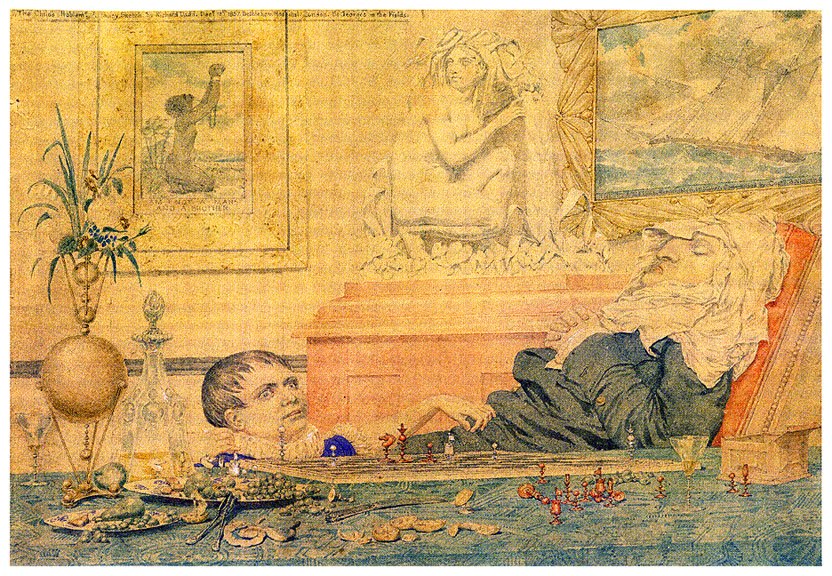
The other long piece is “A Child’s Problem”, inspired by the painting by the 1857 painting by Richard Dadd as seen here:
Dig the look on that kid’s face.
Author Reggie Oliver spins the scene into a tale of self-inflicted revenge, as a boy staying with his authoritarian uncle is challenged to find certain artifacts on the estate, things that the uncle may later wish may have been best left alone. Set in the early 19th century, Oliver does a fine job in capturing the flavor and language of the era without it coming across as arch or artificial. The boy, young George St Maur, is initially timid, at times frightened by his strict, intolerant uncle but in the end matches him with his own bluster and cunningly turns the tables on him, with appropriately gruesome results.
Ramsey Campbell’s “Getting it Wrong”, a dark twist on quiz shows that offer helplines like Who Wants to be a Millionaire? would fit nicely in any revival of The Twilight Zone. It’s also a cautionary tale on being a deliberate jerk. If everyone posting juvenile, insulting comments on the web suffered the same consequences as the story’s too-clever-for-his-own-good protagonist, the web would be…a little more polite. Let’s be realistic, even knowing the consequences, some people will still be jerks.
Robert Shearman’s “Alice Through the Plastic Sheet” is an odd, funny and at times gag-inducing take on dealing with noisy neighbors in suburbia, with a vibe halfway between the off-kilter feel of the mannequin episode of the original Twilight Zone and something more darkly comedic.
While the collection is a less horrifying than the title suggests, there’s enough here to please most horror fans. Those expecting monsters, gruesome deaths and terrifying sights in every story may be less satisfied.
Doctor Sleep tells the story of the adult Dan Torrance, son of the late Jack Torrance, who was last seen getting blown up by an overloaded boiler in the Overlook Hotel in Stephen King’s 1977 novel, The Shining.
The bad news for the surviving male member of the Torrance clan is he’s picked up his dad’s habit of drinking heavily, getting into fights and living a bleak, unhappy existence.
King chronicles the painful bottoming out of Dan, who finally finds some hope and a great deal of danger in a small town in New Hampshire. At the same time he has been developing a psychic bond with a young girl whose own powers far outstrip Dan’s. This girl–Abra–eventually becomes the target for a group of near-immortals that call themselves The True Knot. The Knot maintains its longevity by inhaling “steam”, the psychic essence that escapes from someone experience pain, either mental or physical (a big payday for them early on is the 2001 attack on the World Trade Center, where the suffering and anguish fills them like an all-you-can-eat buffet).
The leader of the Knot is a woman with a few psychic tricks of her own named Rose the Hat. By turns caring and threatening, she leads her group across the U.S. and through the centuries. Upon discovering Abra’s existence she fancies the girl could be tapped as a nigh-endless supply of steam.
King does a fine job of weaving the various sides of the story together, intertwining them neatly as they converge toward the inevitable confrontation. The ending–which I won’t spoil here–surprised me in being conventional yet satisfying.
Dan’s descent as he hits bottom with his drinking is perhaps even more horrifying than the ghosts of the Overlook that seek him out. King’s own battles no doubt informed these scenes and they have a stark authenticity that buttresses the supernatural elements.
My strongest criticism–and it’s overall fairly mild–is one I often have with King’s characters, and that’s the way so many of them have an almost prescient ability to correctly guess the actions or motivations of others, as if every person in King’s universe has some low-grade version of the shining. Having said that, King does explain in Doctor Sleep that many people do have exactly that, so it’s a convenient way to retcon the ability in the characters in his previous billion or so novels.
Doctor Sleep is vintage King, as trite as that sounds. His storytelling and characterizations remain as vital as they were when the original tale of the Overlook Hotel debuted 36 years ago.
EA recently updated the iOS version of Bejeweled. I bought the game awhile back and spent an unhealthy number of hours playing it. I previously chronicled that it had finally loosened its grip on me.
Thanks to the new update I’m not only free of my addiction, I’ve uninstalled the game altogether. Why? In a word: greed.
The update adds one genuine improvement: the game loads faster. However, the animations now run in a jerky manner that’s just noticeable enough to be annoying. If you read reviews of the current version you will see a number of people complaining about this.
There’s also a new game mode called Poker. It’s fairly dull, probably the weakest mode they’ve added. And you need to pay $2.99 to play it more than three times.
The price is a bit of a joke for what you get, but at least the new mode is easily ignored.
More insidiously, the update also added ads–and plenty of them. EA doesn’t care if you already paid for the game, you’re going to see the ads–unless you pay $2.99 to remove them. This is a move best described as a slimy money grab.
I didn’t remove the ads. Instead I removed the game from the iPad.
I now have more time to read at night. Thanks for being greedy, EA, you’ve helped improve my quality of life a tiny smidgen.