Today was the day I finally started my road back to jogging regularly. Which is somewhat ironic, given that I don’t jog on roads.
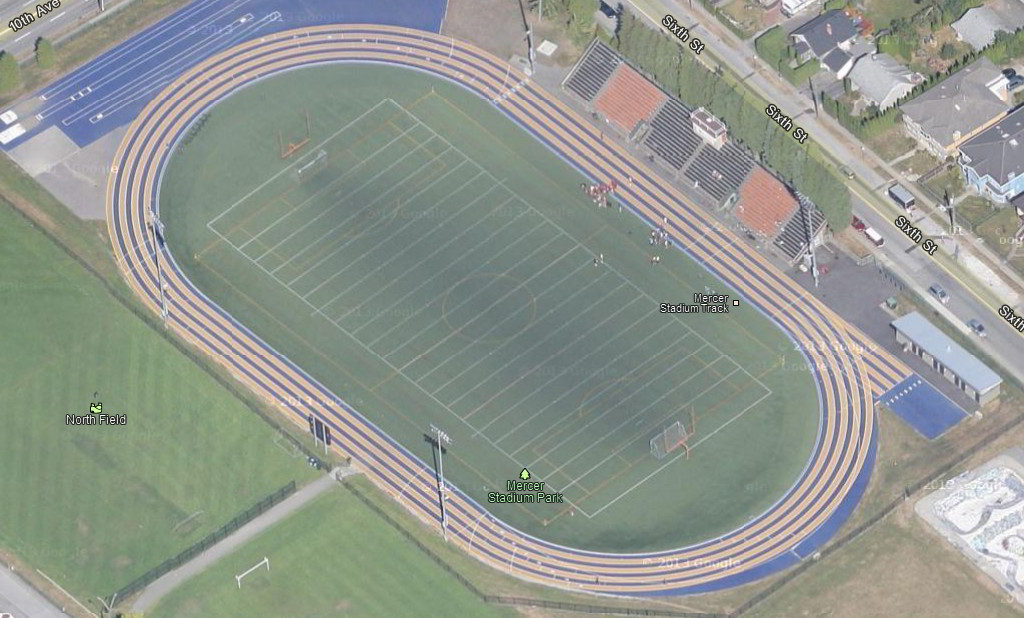
Instead Jeff took me up to the zany looking track at Mercer Stadium (pictured below courtesy Google Maps, as I lack a blimp with which to fly over the track to take my own photos).
After four months to nurse my right Achilles tendon back to health my goal tonight was simple: don’t break anything and complete a couple of 400 m laps to calibrate my new iPod nano.
Some observations:
It felt great to be running again.
The actual running felt like agony, with my lungs on fire after a piddly 400 m lap.
I defeated the entire purpose of the run by screwing up the calibration at the end. I had set the distance to 0.8 km (two laps) and at the end of the run when it pulled up what it thought I’d run vs. what I’d really run, I adjusted it to 0.40 km, exactly half the intended total. I couldn’t bear the thought of running again to fix it so it will have to wait until the next time, probably in a few days. My real pace was around 4:20/km, which is remarkably good for a four month layoff (and probably explains the lungs of fire, too).
The problematic right foot did not hurt, though I could feel where it had been hurt. Ominous sign? Perhaps. The good news is it feels perfectly fine now.
No more clickwheel. Woo!
Here’s hoping that the next run goes smoothly, that I calibrate my iPod properly and that the properly-calibrated data uploads to the Nike+ site without blowing everything up.
I’ll go into more detail at some point but for now here is my ranking of the 10 albums released by The Alan Parsons Project, from 1976 to 1987. It is telling that the best albums are the earlier ones. The Alan Parsons Project is an example of a band (in as much as they were one) devolving its sound into one that became slicker and less interesting with each album before finally getting back to the wacky and evocative sounds of their earlier work.
Eye in the Sky (1982). The first half of this album is some of the most beautifully-crafted progressive rock recorded.
Tales of Mystery and Imagination (1976). By turns weird and wonderful. It sounds almost alien today.
The Turn of a Friendly Card (1980). An entertaining precursor to Eye, stately and always catchy.
Pyramid (1978). A short album with no filler and perhaps the broadest range of material, with the mood ranging from melancholic to bombastic and even playful.
Eve (1979). Not exactly an anthem to women, the lyrics are the most cutting of any Project.
I Robot (1977). A bit dated now but the best tracks hold up well.
Ammonia Avenue (1984). The follow-up to Eye apes that album in a number of ways but has its own standout tracks, especially the title track and the ‘wall of sound’ in “Don’t Answer Me”.
Stereotomy (1986). A decent attempt to return to form that mostly succeeds.
Gaudi (1987). The pop part of the Project was getting a little too glossy by the final album but the closing instrumental is stirring.
Vulture Culture (1985). Not a bad album but not particularly memorable. Without the orchestra a number of songs feel plain. Oddly, the bonus track “No Answers, Only Questions” which is a spare acoustic number, is one of the best.
There’s a thread on Broken Forum about dreams titled “Last night I dreamed…” After the inevitable quote from The Smiths the thread has become a storehouse of dreams that range from the banal to the predictably bizarre or disturbing. I thought it might be interesting to adapt one or two into short stories. Dreams lend themselves well to the format as they tend to be fragmentary experiences that are either short on narrative or lacking it entirely.
After requesting submissions from the dozens of dreams posted, I went with the two that were suggested and will be working on them over the next month or so. If the results are promising I’m contemplating an entire short story collection using the same idea of pulling together dreams and adapting them as short fiction. I’m sure someone else has done the same thing already, as any decent idea has been worked and reworked countless times. But what the heck, I’ve never claimed to be original and the idea intrigues me. I may even have a few of my own dreams that could lend themselves to this kind of project.
I was recently invited to take an online survey by Probit (which, I know, sounds like a robot you wouldn’t want to get too close to in a medical lab) and among the questions about political preference and such was this one:
I’m pretty sure I answered it correctly (I chose ‘3’) but now I’m curious what this means for the number 3 in the future. Have I helped it? Hindered it? Will a future poll shed more light? So many questions.
Nic and I wanted to go watch some mindless spectacle so we settled on Oz the Great and Powerful. This is a great example of a movie filled with CGI for its own sake. So much of the movie looked fake–deliberately so in the case of the backgrounds, which were callouts to the look of the original Wizard of Oz–and was distracting because of it. Just because you can CGI a bunch of butterflies doesn’t mean you should.
James Franco was okay as Oz but lacks the presence the role needs. When he smiles he looks like a goofy kid, not an oily con man. Michelle Williams did what she could with the role of Glinda but had weird eye makeup or something that made it look like she was always on the verge of weeping. Plus I’d just seen her again in Brokeback Mountain and was half-expecting Ennis to show up and ask her how she could afford that g-damn fancy dress she was wearing.
The battle between Evanora and Glinda at the end of the movie was wholly unnecessary and brought to mind the Gandalf/Saruman fight–not a flattering comparison. And Evanora obviously went to the Emperor Palpatine School of Discipline.
The flying monkeys were baboons and didn’t look as scary as Zach Braff (human or monkey form). Disappointing.
Overall I found it mediocre but not entirely objectionable, like eating a bag of chips that aren’t your favorite flavor. You’d miss nothing by waiting to catch it on video.
Recently it was announced that J.J. Abrams would be directing the next Star Wars movie, due out in 2015 after George Lucas sold the keys to the kingdom to Disney for 400 billion quatloos or thereabouts.
Once people were done with all the lens flare jokes and reassured of at least the promise of a coherent story since Abrams wouldn’t be writing the script (I’m thinking here of his ‘every idea gets added to the plot’ approach to Super 8), speculation turned to what the actual story would be about. The least interesting approach for me is the most obvious–set the events roughly the same amount of time as has passed since Return of the Jedi (32 years by the time Episode VII rolls out), bring in as many of the old cast as possible and make it all about their kids. And it looks like both Harrison ‘Grandpa’ Ford and Carrie ‘drugs are bad’ Fisher are already signed, with Mark Hamill a distinct possibility so there’s a good chance this is exactly what the story will be.
This isn’t bad, per se. I’m a sucker for some good nostalgia so it will be nice to see the old characters, even if they more resemble Jabba the Hutt now than their 1983 selves, but with an entire universe to create new stories in and without being constrained by the nonsense of the prequels I am hoping for something a little fresher than ‘Luke has a kid and OMG he has the Force and will he be good or bad?’ plus space battles and several hands being lopped off along the way.
One of my best gaming memories was going to Super Software and indulging myself by buying not one but two games. It felt positively decadent. This was in 1989 so the Internet effectively didn’t exist yet and magazines were still my main source of gaming news and previews. Super Software was a large software-only store in Richmond that carried games for nearly every major system. At the time that meant everything from the Apple II and Commodore 64 to the Atari ST and Amiga. I had my trusty Amiga 500 and there was a good selection of games for it.
As I strode in on that day in 1989 I found two games that were both part of what would become called ‘god games’ or sandbox titles: SimCity and Populous. Each went on to be massive hits, spawned numerous sequels and I sank many an hour into constructing urban paradises or smiting my computer opponents.
In the long term SimCity got its hooks into me more deeply. I’ve always enjoyed making things–not necessarily in the woodshop sort of way. In fact, I hated woodshops as a kid. Saws and other sharp tools held little appeal except as tickets to the hospital for a klutz like myself. A virtual way to build and create, though, that I could get into.
The original SimCity was fairly simple and only nodded in the direction of realism. You could construct a city with a rail-only transit system (no roads at all) and it would work. It may be that the pseudo-realism was part of what made the game click. When the sequel, SimCity 2000 came out, it introduced numerous improvements, an increased level of sophistication and an entirely new (and glitchy) water/pipe system that was almost universally disliked. Sure, having to make sure the water flowed added realism but the process of laying pipe and making it work felt more like an uninteresting chore. By the time the eminently charming SimCity 3000 appeared, the pipe-laying was gone.
SimCity 4 was the most ambitious of the titles yet, with full regions that could interconnect and layers upon layers of charts and simulation. I confess I never played it much because the drive to be more realistic–while perfectly logical–just didn’t have the same appeal to me as the slightly goofy earlier titles.
And so we come to the newest version, just released today. It’s not called SimCity 5, just SimCity, as if being framed as a reboot. And in a way that seems about right. The cities you can build are smaller but the simulation is even more detailed and realistic than ever. The game requires an always-online connection and while it doesn’t force you to build alongside other players, it does take away the option to save your city at certain points, instead relying on EA’s cloud storage to do the work (and in the first 24 hours it is working with predictably spotty success). While I marvel at the look of the game and genuinely applaud the game moving even more toward being a true simulation, I can’t help but feel that this is the next step in me being pushed away from the series permanently.
Maybe I can’t reconcile my creative drive with a proper simulation. If I want to build something silly, I don’t want to be (unduly) punished for it but the new SimCity torpedoes that philosophy.
I guess there’s always Minecraft and its (literal) castles in the air.
I promise I’ll scan more than one of these for my next trip down mediocre teenage art memory lane.
In the meantime I like this minimalist but slightly goofy perspective exercise. It’s simple and has a looseness that I probably couldn’t have captured if I was actually going for that. It’s not dated but judging from some of the work from the same book it looks to be from early 1982, a mere 31 years ago!
I deliberately allowed the image on the reverse side to bleed through on the scan because hey, art!
Note: If you reference the previous post, I lied. The teacher did not grade this particular piece. But I can pretend I got an A for it.
I’ve been going through some of my school sketchbooks of late and what I’ve found is that I was a fairly consistent and mediocre visual artist, with occasional flashes of talent/skill/luck beyond my usual stuff. The following is not an example of that. Sorry!
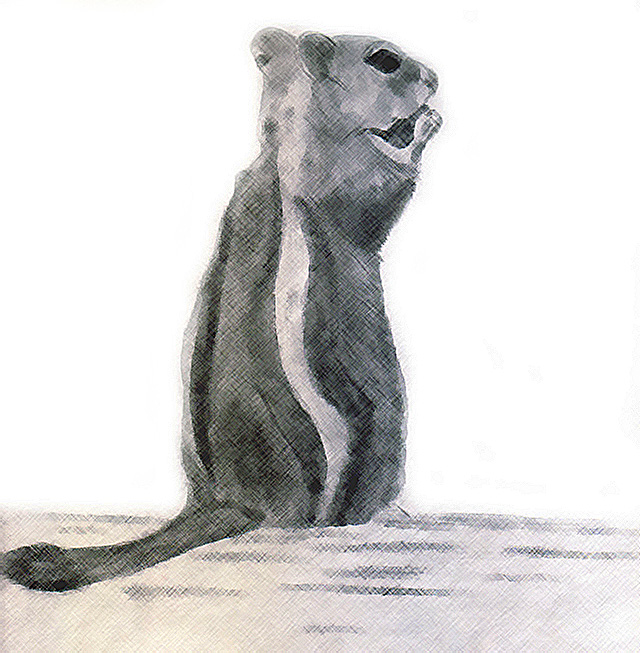
Instead it’s a drawing I made of a fake chipmunk I did while our art class was touring the provincial museum (now the Royal British Columbia Museum) in Victoria in October of 1979. The museum was absolutely wondrous to me. It had the usual exhibits, mainly focused on local native art, totem poles and such, but it also had life-size or nearly life-size dioramas depicting scenes both past and present from around the province. The highlight was probably the mining town that was modeled in loving detail, complete with a fishy-smelling cannery, a street filled with shops, a movie theater and a bakery that always had the aroma of cinnamon wafting from it.
The chipmunk was part of the one of the nature dioramas. I don’t remember the exact scene it was in but judging from its stance it was probably not about to be eaten by a moose.
It’s not a bad little drawing but there’s nothing especially remarkable about it, either. I think I’m most proud that I got the proportions right and didn’t give it some weird mega-head or something. Maybe I’ll go over the digital copy and see how I’d improve on it today with 30 more years of life experience and 0 more years of useful art talent. The teacher gave me a B for it. I can’t really argue with that.
Next: Something the teacher gave me an A for!
UPDATE:
Here’s what I would have done to the image if I’d had a PC with Photoshop in 1979 instead of an Atari 2600 with a Canyon Bomber cartridge:
(apply the crosshatch image effect and adjust the level to give it better contrast)
I did one more Big Walk® around Burnaby Lake before my first tentative steps back into running next weekend.
The weather was sunny after several days of monsoon-like weather thanks to the Pineapple Express. I took advantage and found it to be mild, with little wind and most of the big puddles already having dried up along the trail. Even the cyclists and dogs off-leash didn’t bug me. It was a nice hint that spring is on the way after The Rains.
My favorite “rules are not for me!” moment came when crossing north on Roberts Street, near the rowing pavilion. As you approach the resumption of the trail on the other side of the road there is an especially giant sign that states DOGS MUST BE LEASHED AT ALL TIMES. I watched a woman stop and remove the leash from her dog in front of this sign. I don’t know if she was going for bonus irony points or what. At least the dog was well-behaved.
I used the iPod pedometer to track my pace and came in with the following stats:
2:23:53 duration
17.6 km distance
898 calories burned
18,746 steps taken
I was walking fast enough that any faster would have been a light jog. Things seem to have held together nicely both during and after the walk. Next weekend I’m heading to the resplendent gold and blue Mercer Stadium Track to do a simple calibration run fort the new iPod. It will probably be 2-4 laps or 800-1600 meters, enough to get the calibration and see if my Achilles tendon will weep in protest or behave itself. From there I will be doing a few short runs per week, starting with some 2Ks, moving up to 5Ks and finally back to my usual 10-11.5K runs. I don’t have a set schedule in mind, I’ll just ramp things up based on my stamina and pain/discomfort after each run. If all goes well I’m going to aim to beat last year’s mark by running 1,000K. Since I’ve already missed two months, I’l need to hit at least 100K each month going forward. If I stay healthy I can do it. If not, I can always lie lie lie.
I’ve found it strangely soothing to lay in bed and tap out a post on the virtual keyboard of the iPad. I do so using the WordPress app rather than loading in this site directly, as the app smooths off the edges of working on a tablet’s smaller display.
Speaking of Macs, I now have a Macbook Air, my first laptop and also my first Mac. I’ve used Macs on and off for years and always resisted the siren call because of price, lack of good gaming choices and as of Windows 7, OS X is no longer a compelling reason to venture over to the Mac side of things.
Regarding the first point (price), ultrabooks (super-slim and light notebooks) and the Macbook Air are pretty much at price parity, with neither side holding a definite advantage on comparable specs. This will probably change over the next year as more Windows 8 ultrabooks come onto the market but for now the pricing and features are close enough to remove it as a deciding factor.
On the gaming front, things have improved in Mac land but it still sucks compared to the PC side, it just sucks less. And that’s why my main machine is still running Windows.
On the third point, OS X has its flaws and strengths much like Windows 8 (which I currently run), so that’s a wash, too.
I opted to get the Macbook Air because it’s especially light (less than three pounds), has excellent battery life and the keyboard is backlit, something I’m always a sucker for. Its primary function will be for writing when I am away from the home machine, so this sucker is ultimately meant to pay for itself. Or at least pay a little for itself. Really, I’d probably be happy if it just paid for the taxes.
Ironically, I made this post on the PC while the Macbook was updating.