The James Patterson word factory continues apace

I noticed kobo.com was highlighting something called James Patterson BOOKSHOTS. Before reading further I speculated on what these might be. Photos of James Patterson novels that have been shot at with guns in artful ways? James Patterson book covers re-imagined as placemats for your favorite home-cooked meals (I suppose a better name for those would be BOOKMATS)?

It turns out these are novellas that promise to be under 150 pages and under $5. That’s $5 Canadian, so almost free.

Right now two of these books are available, each for $3.99. “The revolution in reading” promises approximately 50,000 more titles in the next few months, with more to come beyond that. None of them appear to be written by James Patterson. They cover a variety of genres, ranging from thrillers using Patterson’s characters to romance and non-fiction.

Some (many? most?) of these books are banking on the mere presence of the Patterson name to sell them. Do I really want to read a book of quotes from Trump and Clinton? I might if I trust Patterson in a vague, general way and admire his work (“He wrote some kids book, he must be a nice guy”). And the publisher is so confident in this premise (“Patterson’s name alone will sell a book of quotes from Trump and Clinton”) that they are pushing ahead with the aforementioned five million or so books (er, BOOKSHOTS).

The whole thing is predictable–authors attaching their names to books they haven’t actually written is hardly a new thing or exclusive to Patterson–but also weird and a little depressing. I mean, if Stephen King lent his name to a series of cookbooks, I would find it interesting in an abstract sense, wondering if the recipes were all about how best to prepare vampire bat goulash (ghoulash?) or crunchy almond spiders, but if it was just King’s name slapped on each volume I’d be thinking “cash grab” and pass. Actually, I’d pass regardless, because I’m not particularly yearning to find out what sort of recipes Stephen King has to offer. The cash grab is the depressing part.

The weird part is attaching the name to all manner of genres. It’s as if Patterson’s brand is so strong it can be used to promote anything. Why stop at books? Why not James Patterson clothing, lunch boxes or toiletries?

On the positive side, this does give other writers an opportunity to get their work published, and with the Patterson brand behind the books, a greater chance to be noticed. The low price and low page count also pushes these into the impulse buy zone, further increasing the odds that some of them will be picked up.

Now I’m conflicted. I kind of want to hate James Patterson BOOKSHOTS because, come on, it’s a money grab. But if it helps writers, especially new writers…maybe it’s not as horrible as I’d like it to be.

I’m still not picking up Sacking the Quarterback, though.

The first unofficial Africa hot day of 2016: June 5th

It got up to 31º C today, nearly 10 degrees above the average. Even the breeze was hot. Given that this is still the first week of June you might think this would be an omen pointing toward a very hot summer. However, the forecast is calling for rain and below seasonal temperatures just days from now, so who knows.

One day we’ll have smart robots that will know exactly what weather is coming. And they will use it against us because robots don’t care if it rains.

The dirty corgi walk

I went for another long walk today and once more wore my Hokas. The weather was much warmer, edging past the mid 20s as one of those fancy high pressure ridges has formed over the area (Weather Underground has a post about “dangerous, extreme heat blanketing the west” this weekend).

After completing the 18+ km route (walking counter-clockwise around Burnaby Lake this time) I noted the following vs. the last big walk:

  • my overall pace was even faster, 8:38/km vs. 8:54/km
  • my right leg started to feel achy after only one km; once the endorphins kicked in it wasn’t too bad
  • the right ankle twinged briefly again at the 8 km mark. Very weird that it would be that predictable.
  • the right shoe was rubbing one of my toes, which didn’t happen last time. Maybe the socks made the difference? The toe was rubbed red but never got to where it started bleeding
  • I jogged a few times in brief bursts and felt okay while doing so

I actually felt a strong urge to jog several times, simply to get back sooner because the shoe rubbing on the toe was bugging me a lot. A strange and unpleasant incentive, but at least it gave me the opportunity for a few test runs (ho ho).

The heat didn’t bother me. It’s much more tolerable when walking vs. running.

Oh, and the dirty corgi? This was a little weird. I passed by a number of people, given the zippy pace I was keeping, and one couple had a dog with a docked tail. I think all dogs should have big tails that can effortlessly sweep items off a coffee table and it strikes me as a little cruel to dock tails simply because it’s tradition or whatever. Anyway, it made me start thinking about other dogs that usually get docked and the corgi immediately came to mind. A few minutes later I passed a couple with a corgi. How strangely coincidental! The corgi was unleashed (no surprise there) and was distracted by a small mud puddle that had lingered since the last rain, so I (seemingly) walked by unnoticed. After sating its curiosity, it ran up to me from behind and for reasons only it will know, jumped up to say hi. Being a corgi, it only made it as far as my left hand, which it covered in water and grit from the puddle it had waddled through. I was both amused and annoyed. I washed when I got home.

I don’t like dogs. Still.

The walk was a mixed bag. The pace means the soreness of the right leg wasn’t enough to slow me down and the little joggy bits seemed fine, but after three weeks without runs I’m still uncertain whether I should try a run now or wait a little longer.

Is it wrong to get excited about new appliances?

The washer broke a month or so ago, though it feels like five years. It would spin then shake then combine both until it felt like it was trying to reach escape velocity. We replaced the rubber ring (after waiting several weeks for the hard-to-find part to ship) that forms the seal when it’s washing (it’s a front loading machine) but after doing this the washer continued to made grindy noises and more disturbingly, smoke. We opted to replace it. Although the dryer still works, we further decided to replace them as a set and began looking for deals.

We found a matching set of Samsung machines at Coast Appliance and they have been delivered. We will install them soon™ and I expect it to be tremendous fun because they are stacking machines and weigh about as much as a pair of mated elephants. Despite that, I can safely say after dealing with a local laundromat for the past month, a place that features washers that leave your clothes with enough water in them to fill a bathtub, as well as staff who apparently hate customers and cleaning clothes, I am actually kind of excited about doing laundry at home again. As a side benefit, the purchase also made me clean the living room to make temporary storage space for the new machines (I don’t recommend replacing large household appliances as a means to encourage you to clean the house, as large household appliances are kind of expensive and you should probably clean anyway, because dust should never become so thick that you can carve into it.)

Book review: Trigger Warning

Trigger Warning: Short Fictions and DisturbancesTrigger Warning: Short Fictions and Disturbances by Neil Gaiman
My rating: 4 of 5 stars

If you ever talk to someone who’s read The Lord of the Rings books, it’s inevitable that you get to that question: Did you read the songs?

For me the answer was not a straightforward “no” because I did read some of them, then I read fewer as I worked my way through the story, then I just plain stopped. But I still had a great time reading The Lord of the Rings.

The same can be said of Neil Gaiman’s latest collection, Trigger Warning, which intersperses a few poems–the equivalent to Tolkien’s songs–in among the short stories. In his second collection, Fragile Things, he describes the poems as “bonuses for the kind of people who do not need to worry about sneaky and occasional poems lurking inside their short-story collections.”

I read some of the poems, then read fewer of them, the just plain stopped. But I still had a great time reading Trigger Warning.

This is a hodgepodge of stories, covering everything from modern horror to high fantasy, all of it presented with Gaiman’s usual dry wit and depiction of the world as a place both dark and beautiful.

I enjoyed all of the stories but being who I am, the ones I enjoyed most were the Twilight Zone-esque “The Thing About Cassandra” in which imagined loves are perhaps not so imaginary, “Orange,” which uses a question and answer format to show the transformation of a young, tanning-obsessed woman into something rather more cosmic and “The Man Who Forgot Ray Bradbury,” which paints a chilling portrait of a man who forgets words, with more impact than one might expect. Stories based on Dr. Who and Sherlock Holmes are well-executed and the final and original piece, “Black Dog” features Shadow from American Gods, in a story about murder, ghosts and the power of the mind to both protect and destroy.

This is an easy recommendation for anyone who enjoys Gaiman’s writing, but I feel there is enough variety here to entice those unfamiliar with his work.

View all my reviews

A strange walk

Today I woke up with an immense pressure headache.

I also went to bed the previous night the same way, though the pressure was not quite as immense then.

I’ve also been stuffed up the past few days so perhaps this is a renewed mega-allergy attack for an allergy that I have yet to identify but may be associated with pollen or other spring-related junk in the air. Whatever it is, it made me feel almost dizzy just to stand up. Bending down to tie my shoes was like diving in a submarine to the depths where The Great Old Ones await.

I opted to take the day off work then self-medicated with some Advil. After letting it kick in I decided to get outside, thinking that some fresh air might help and the exercise (probably) couldn’t hurt.

I tracked the walk, which took me to Burnaby Lake, around it and then back, a total of over 18 km. My pace over the first few km was in line with recent walks, starting around 9:30/km but then something strange happened (this is the first strange part of the walk). My pace picked up and continued to pick up. Save for the final km, when I finally started feeling weary, I stayed at or under 9:00/km for an overall average pace of 8:54/km. This is my best walk in months and rather unexpected. Even stranger (part 2) was that my right leg and foot (and my left foot, for that matter) felt fine throughout. I had a brief twinge in the right ankle around the 8 km mark but it lasted only a few moments and never returned. The leg continued to feel fine post-walk. It feels fine now.

What was so different about this walk compared to the others where the leg and foot have felt cranky and sore?

I wore my running shoes. The color migrating Hokas, to be precise. And I think that was enough. The Hokas may not retain their color well but they do provide a noticeable level of support. My normal walking shoes are Scarpa light trail hiking shoes. With my orthotics inserted in them they are eminently wearable but without them my left foot will start crying about me being a mean-spirited barbarian sometimes within mere minutes of walking out wearing them. Could the shoes really make that much difference? Possibly.

I’m going to wear my new Brooks Cascadia shoes for the rest of the week and see how they compare. Hopefully the results prove interesting, just not ancient Chinese curse interesting.

The third and final strange part of the walk came near the end. I had just exited the Brunette River trail onto North Road. There was a car in the curb lane on the bridge facing south with its hazard lights on. The rear bumper showed signs of damage, presumably from a rear-end collision. There appeared to be bits of the car on the road, under the bumper. None of this is strange because, as they say, accidents happen.

The strange part is there was no sign of the other presumed vehicle in this presumed accident. And no sign of the driver. Or any drivers. Or emergency vehicles. Or anything or anyone else that might be related to this looks-lik-an-accident. Just a slightly damaged car sitting in traffic by itself.

I got out of there quick, not just because the strangeness perturbed me, but because a car sitting on a busy road as rush hour commenced seems like a good way for more accidents to happen.

Bad design: Closing a Modern (Metro) app in Windows 8

Windows 8 is an easy target because so many of its design choices were sub-optimal for desktop computers and were even kind of iffy on tablets, which is what the Windows team was bizarrely designing the OS for back in 2012. It is telling that Windows 10 either undid all of Windows 8’s new features or reworked them, often dramatically.

Here’s one example: Closing a Modern app.

Modern (or as they are often referred to before Microsoft changed the name, Metro) apps are programs specific to the Windows Store, introduced with Windows 8. These apps could run on Windows 8 and Windows RT, the ill-fated version of Windows that ran on ARM processors. They were always full screen and as such felt very tablet-oriented. They lacked the usual minimize/maximize/close buttons in the top right corner so it was perhaps not surprising that some people didn’t know how to close these programs.

Microsoft wanted these to be treated like iOS apps in that you generally would never need to close them. Windows would manage memory and shift apps around as needed. But if an app misbehaved or you suddenly decided you really hated the weather app and wanted to kill it–how would you close it?

By moving the cursor to the top of the screen until it changes from a pointer to a grabby hand, then, while holding the left button down, using the hand to drag the app off the bottom of the screen.

If that sounds a bit awkward, it was even worse when you actually attempted the task, especially on large monitors with a lot of real estate to cover as you worked the app down to the bottom of the screen and the dark oblivion that awaited it. If you flinched and released the mouse button early you had to start over.

This is bad design.

Windows 8.1 modified this by having a title bar appear when you moved the mouse to the top of the screen. This title bar had the expected controls in the top right corner, including the coveted close button.

Windows 10 changes Modern apps more significantly, allowing them to run in regular windows that can be minimized, closed and moved around like any other window. If a Windows 10 device is running in tablet mode (new to Win10) Modern apps automatically  switch to full screen mode and behave as they do in 8.1. This is one of many examples of the Windows 10 team both correcting the flaws of Windows 8, while also coming up with new and better ways for the UI to behave.

A few posts short of a load

When the jogging updates dried up in the second half of the month my general writing inspiration also withered away and so here I am well short of my post-a-day ratio on the final day of May. There’s a little under two hours left in the month as I write this and I could bang out ten lame haikus, one per post, in order to meet the goal of 31 posts for the month but that would be dirty cheating.

Instead, I will admit defeat and resolve to do better in June. On the plus side there is one fewer day in June than May, so that’s already aces, as the kids say.

Here’s a writing haiku I should probably print out poster-size and slap on the wall above my monitor and everywhere else:

Writing is easy
All you do is start writing
Remember, don’t stop

Run update: Still no running, walking continues with occasional limping

This injury of the right leg is bizarre, puzzling and a tiny bit scary because it is bizarre and puzzling.

My last run was a little over two weeks ago, on May 15th. Since then I have continued my 5K walks during lunch (with one exception, on a rare soggy day) and have also walked about the same on the weekends. The pattern has typically been the same: a slower pace than before the leg was hurt, but varying from pretty close to normal to decidedly on the pokey side (though still a brisk pace for the average person).

The weird part is how the ankle is behaving. Sometimes in the morning or after sitting for an extended period, like in a meeting, it gets very stiff and sore, enough that I almost limp while walking on it. In the best case this will largely vanish after walking for just a few seconds at a normal pace. The worst case will see the pain/limping disappear after a few minutes, replaced by a general achiness.

The worst instance of the latter happened Friday at work after a one hour meeting. The ankle was astoundingly tender, I was hobbling about enough to draw concern from co-workers, then, while climbing the stairs to the second floor to check a lab, I found it hurting so much I had to stop walking and just hung on to the railing with both hands, afraid I might not be able to hold myself upright otherwise.

I checked the lab and by the time I came back down the stairs I was walking normally again, with no sign of a limp and no real pain. I even did a little jig to demonstrate to a co-worker how suddenly A-OK I was.

It is weird. I don’t understand it. But I know I don’t like it and each day it feels like I’m not getting any closer to a return to running. I may have to call in the experts. By which I mean go to the doctor.

Stupid leg.

Good design: Windows 10 taskbar icons

I figure it’s only fair to highlight good design as well as bad design, especially where the good design is an improvement over a previous iteration. Here’s my first entry.

When you launch a program in Windows 7 and 8 you get a combo 3D/glow effect on the taskbar icon to let you know the program is running. Multiple instances of the same program stack like cards (as seen by the Chrome and File Explorer icons below):

Windows 7 taskbar icons

The problem here is if you have a mix of running and non-running programs, it becomes difficult at a glance to see what is actually running, especially if you only have one instance going.

Windows 10 dispenses with this and instead uses a slim but easily identified white line under any program that is running, like so:

Windows 10 taskbar icons

The effect actually looks better than the screenshot depicts (the white line is slightly thicker and brighter) but you can still tell at a glance that File Explorer and iTunes are not running, that Firefox and mIRC are active and that OneNote is the program that currently has focus because of the shading behind its icon. The UI is further clarified by stripping away the 3D glow effect, which creates too much visual clutter. The overall effect is cleaner and more practical. Good job, Microsoft!

Bad design: The original iMac mouse (1998)

I’m going to start posting random thoughts on bad design I’ve encountered over the years. Most of these will be tech-oriented but I will occasionally give shout-outs to things like the incredibly heavy and awkward doors on my parents’ 1977 Ford Granada.

In 1998 a recently-returned-to-Apple Steve Jobs ushered in the iMac, a product line that continues successfully to this day. The original iMac was a daring and colorful all-in-one design that did away with a floppy drive (controversial at the time), made an optical drive standard and for the first time included USB ports, allowing Mac owners to use peripherals that worked with the broader PC market.

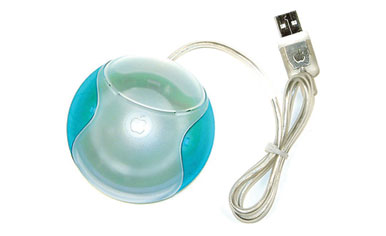
The iMac came with a keyboard and a mouse. This is the mouse (and I am far from the first to highlight its shortcomings):

original iMac mouse
Image courtesy of Macworld.com

It was often referred to as a “hockey puck” for obvious reasons. It is, perhaps, the only round mouse to ever go into mass production.

There is a reason for this.

Look at your hand. Is it round? To be certain, look at your other hand (apologies to any one-handed people reading this). You have probably noticed that your hands are not round. When you grip the original iMac mouse, it is an awkward grip, because its shape does not take into account the shape of the human hand. This is bad design.

Apple did learn its lesson, though it took two full years of people madly trying to keep the circular mouse oriented before it got replaced. Here’s the current (insipidly-named) Magic Mouse that ships with iMacs:

magic mouse

See how it approximates the shape of the human hand? Good work, Apple.

Spoiler: We’ll be revisiting Apple mice at some point in the future.

It’s still rock and roll (and jazz and pop and sort of punk) to me: Billy Joel albums ranked

This is an incomplete ranking as it doesn’t include any of Joel’s live albums nor does it feature his first three releases, Cold Spring Harbor (1971), Piano Man (1973) and Streetlife Serenade (1974) or his classical album, Fantasies and Delusions (2001). That still leaves nine studio albums, spanning the years 1977-1993.

I discovered Joel when a lot of people did, when he hit it big with The Stranger in 1977. The first album of his I owned (back when vinyl wasn’t cool, it was just the format every record store sold) was 1978’s 52nd Street, which went on to win a Grammy for Album of the Year. I loved what I heard and bought every album after until he retired from recording new music in 1993.

Billy Joel knows melody. He knows hooks. He knows how to write super-slick pop songs that can transcend that slickness to become something more. He also indulges himself regularly, a veritable Renaissance Man on some albums, shifting from Broadway-style show tunes to smoky ballads to jazzy riffs and effervescent pop. Sometimes it feels like he’s gleefully showing off and it works. Sometimes, less so. Here’s how I rank those nine albums, from best to worst.

First, let me say this is trickier than it seems because while I definitely think there are weaker albums in this mix, the better ones are fairly consistent, meaning the top five are almost interchangeable (while being quite different from each other, a nice trick).

  1. The Nylon Curtain (1982). After his divorce, Joel channels The Beatles and gets serious. He stretches out vocally and writes on weighty topics, covering the Vietnam war, the collapse of the industrial economy in the U.S. and more. It’s an album filled with anxiety and regret, of faint hopes and dashed dreams. It’s not exactly feel-good material. But at its best the music shimmers and soars and Joel moves from one style to another with purpose. The first half particularly stands out, with “Allentown”, “Pressure” and “Laura”–another one of Joel’s poison pen letters to a demanding, damaged and imaginary (I hope) lover.
  2. Glass Houses (1980). This is almost the literal opposite to The Nylon Curtain, a big arena-friendly album in which Joel tries to rock out. I say try because this is still pop, but it’s meatier than usual. There’s usually a little filler on every Joel album, but Glass Houses is incredibly tight, its scant 35 minute run time moving quickly from one song to the next. There are a few ballads here and they are lovely, but the album is driven by propulsive songs like “All for Leyna” and “Sometimes a Fantasy.”
  3. 52nd Street (1978). The first half is particularly strong, starting with the in-your-face “Big Shot” and ending with the jazzy tones of “Zanzibar.” The second half features some fine music, too, but the epic “Until the Night” is undercut by Joel’s lyrical weaknesses. His musings on women feel dated or old-fashioned if you’re feeling charitable.
  4. The Stranger (1977). In some ways this is a better album than 52nd Street but it’s hurt by having several weaker songs padding it out. Some might call it heresy but I have never liked the schmaltzy “Just the Way You Are” and the closer “Everybody Has a Dream” is probably the least memorable finale on Joel’s albums. On the plus side, the Broadway-style production of “Scenes from an Italian Restaurant” is great fun and “The Stranger” is a perfect blend of music and lyric, right down to the creepy whistle that opens and closes the song.
  5. An Innocent Man (1983). A love letter to his then girlfriend Christie Brinkley, this throwback to the sound of the late 50s and early 60s is Joel at his most joyful and relaxed. The songs are like a bowl of candy, sweet little confections, from the rousing “Uptown Girl” to the somewhat preachy yet undeniably catchy “Tell Her About It.” My favorite is probably the wistful title track.
  6. Turnstiles (1976). There are a number of good songs on this album and I happen to find the cynical tone of “Angry Young Man” amusing specifically because of Joel’s delivery (which I think was deliberate) but a number of the tracks are also featured on the live “Songs in the Attic (1981) and they are more vital in their live versions, notably “Say Goodbye to Hollywood,” which benefits from the string section being excised and “Miami 2017” (whose doomsday vision of the future only has one year to become reality).
  7. River of Dreams (1993). His last pop album of new material and coming 22 years after his first, River of Dreams finds Joel angry in “The Great Wall of China” and “No Man’s Land” then showing a tender side as father in “Lullabye.” There’s more filler than usual here but as a send-off, it’s not bad at all.
  8. Stormfront (1989). I rank this lower than River of Dreams simply because more of the songs are less memorable and it’s rather dated now. “We Didn’t Start the Fire” is catchy but superficial and “When in Rome” is one of my favorite Joel songs to skip. For some reason it just grates.
  9. The Bridge (1986). A number of songs here are quite catchy but the album is rife with affectations, mostly in Joel’s vocalizations. He performs a duet with Ray Charles and mimics Ray Charles. He adopts a falsetto in “Big Man on Mulberry Street” because he can and “Modern Woman” is a song I simply can’t stand. The whole album feels indulgent, further brought down by weaker tracks that surround the set pieces.