Every four years we get a bonus day at the end of February because our calendar sucks and this is the best we can do to make it work.
Since this has no real impact on anyone or anything other than serving as a reminder that there’s some kind of Olympics that year (the summer games in Rio this year, a place currently best known for the Zika virus and some of the world’s most polluted water–have fun, athletes!) it seems like a reasonable solution. And it lets people born on the 29th pretend to age in quasi-dog years. “I got my driver’s license when I was four years old, that’s right.”
I saw Deadpool last night. I knew just enough about the character and movie to properly calibrate my expectations (vulgar, gory over-the-top violence, irreverent) and was pleased to find the movie was, in its own vulgar, gory and irreverent way, quite charming and at times pretty funny. Ryan Reynolds obviously has affection for the character/material and had a great time making the film–and it shows. As a bonus, you get to see him nude. As a special bonus, you even get to see his naughty bits. As penance for this, you see them after he has been transformed into a hideously ugly mutant.
About a quarter of the way through the movie a pair of small white lights began flashing, one on either side of the movie screen. It seemed like an alarm of some kind. Presumably they don’t have real alarms (the kind that pierce ear drums) to prevent that whole “yelling fire’ in a theater effect. I ignored it for a bit and then Nic finally said we should check it out so we went to the lobby and immediately got word that it was a fire alarm, but a false one. We returned to our seats and the lights kept flashing, which was more annoying now that we knew there was no inferno imminent.
A few minutes later a pair of employees came in and one gamely tried talking over the movie’s audio (Deadpool is not a film that employs subtlety in its audio–or any other part) and we got the gist: an apology for the alarm and an offer for a full refund or free pass.
After they left the film suddenly froze. It’s a digital projector so I’m wondering if the hard drive crashed. Would we get to see the world’s largest BSOD? No, it turned out they were setting the movie back to just before the disruption. I actually caught a piece of dialogue I had missed the first time.
When the movie ended we filed past someone who did indeed give us a pair of free passes (good until December 31, 2017, so good for the release of Episode VIII). We’ll likely use them for Zootopia, one of those anthropomorphic Disney moves that looks way better in the previews than it has any right to.
Overall, the disruption was relatively minor, didn’t detract from the experience (Deadpool is pretty much the perfect movie to experience a false fire alarm in) and we got a free movie out of it. I rate the evening 6 out of 7 Ryan Reynold’s fourth wall-breaking comments.
Run 411 Average pace: 5:53/km
Location: Burnaby Lake CW
Distance: 5.35 km
Time: 31:30
Weather: Overcast
Temp: 11ºC
Wind: moderate with occasional strong gusts
BPM: 168
Stride: n/a
Weight: 169 pounds
Total distance to date: 3335
Device used: Apple Watch and iPhone 6
For my third weekly run I changed things up a little by running clockwise and running a wee bit farther, as the 5K marker is about 300 m further along the trail when approaching from this direction. The forecast threatened thundershowers but fortunately the rain held off entirely, though it was occasionally quite gusty. Despite being quite warmer than the last run, the wind was sharp enough to produce a chill on the walk to the lake.
The Speedgoats again bled color into my socks so grr on that. On the plus side, my left foot held up better. I tried to pace myself on the first km again and pretty much failed, with a pace of 5:21/km, much faster than the rest of my run. I’m not sure how much extra energy it would give me for the remaining four km, anyway.
I generally felt more energetic, which is nice with a lowly once-per-week pace and look forward to seeing even more rapid improvements when I resume running multiple times per week.
My pace was improved again, from 5:56/km to 5:53/km. Not much but I’ll take it.
A family of three were riding bikes, including the inevitable kid-wobbling-like-he’s-going-to-fall-over, one of my favorite things to encounter on the trail. Another guy was riding solo and he looked a bit sheepish when I shot him The Look as I jogged by. Here’s a good way to avoid feeling sheepish: DON’T RIDE YOUR BIKES AT THE LAKE.
The trail was a bit puddle-filled in places but only required a bit of minor dodging and the next sign of spring (after the early budding of trees) was in the air. And the air stunk. Specifically, the skunk cabbage is beginning its annual bloom and this earliest stage is among the stinkiest. Fortunately the stink was confined to a stretch adjacent to one of the boardwalks.
Overall, a satisfactory effort. I’m still undecided on wearing the TomTom but may do so next time.
I’ve finally added a few more posts to the little “Posts I Like” thing over to the right (or at the bottom if you’re on a mobile device). These are posts that I find amusing/terrifying or somehow worth noting. Of note is the brief, tragic “Learning to Swim” saga.
Another of my “on sale, looks interesting” reads, Talking to Crazy focuses on dealing with irrational (“crazy”) people, running a range from annoying co-workers to potential mass murderers. Yes, there is a chapter on dealing with people who may be thinking of getting a gun and doing some people huntin’.
Talking to Crazy is not a book for people who like lots of data, studies and stats to back up the claims and advice on offer. Goulston has many years of experience as a psychiatrist and draws on anecdotes from that experience to illustrate the strategies he lays out. He also admits that mental health can be at times a lot trickier to diagnose and treat than physical ailments and frequently cautions that some of his advise should be used with caution or not used at all without the assistance of a mental health professional.
Most of the strategies revolve around empathy–listening to the irrational person, letting them know you understand they are upset, not judging, not offering solutions (at least not immediately). Much of this is common sense but Goulston provides detailed steps and often explicit phrases or wordings to use.
The book turns increasingly darker as it moves from dealing with people you may not need to interact with (his advice on those is: don’t) to co-workers and then family. He covers how to handle those with genuine mental disorders like schizophrenia (mostly by sensibly letting mental health care workers do the heavy lifting) and ends with strategies on handling people who may be thinking of suicide (yikes) or those who may be primed to follow in the steps of the many mass murderers of late. Here he chillingly warns parents of potential killers that if they are worried about saying something lest they become a target that they are already targets before they say a single word.
It’s hard to refute the advice given, as so much of it is both common sense and comes from a solid core of providing empathy and withholding judgment. In essence, Goulston is saying that the best way to deal with irrational people is to keep yourself in check, so you don’t join in on the accusations, fear and anger. He emphasizes this by spending a section of the book with a series of exercises that force the reader to reflect and self-assess, to look for their own weaknesses and learn to manage or overcome them.
Much of the advice will be difficult for people to act on. Goulston comes across as outgoing and forthright. The timid will find it challenging to say most of the things he thinks is necessary to defuse irrational people and begin the process of turning their behavior toward the positive. But just rehearsing the steps alone may help bolster someone’s confidence and push them that much closer to trying.
Talking to Crazy is written in a highly accessible style and the heavy use of anecdotes gives the book the feel of a conversation, rather than a checklist of things to do. I fortunately don’t have to deal with anyone I’d flat-out call irrational, so I’m unlikely to use the advice anytime soon. The advice is solid and presented well, though. I would have preferred more data to back up the strategies but this is a more of a nitpick. Talking to Crazy is not a data-driven book and the advice remains useful and at times thought-provoking all the same.
Write 10 sentences using a different cliché in each. Now, rewrite the sentence to eliminate the cliché and find a more clever and creative way to convey its meaning.
The early bird gets the worm.
Being proactive and planning ahead will yield fruitful results and worms.
A bird in the hand is worth two in the bush.
Don’t be greedy, just be happy with that damn bird you already have.
A stitch in time saves nine.
Being able to sew efficiently will leave you with more time to ponder inscrutable sayings.
Early to bed and early to rise makes a man healthy, wealthy and wise.
Elimination of a social life will reduce the likelihood of indulging in unhealthy habits, promote sleep regularity and leave you more sharp-witted and lonely.
A rose by any other name would smell as sweet.
Referring to a rose as a “prickly green and red stink stick” will not change its alluring aroma and will also cause people to give you a wide berth.
All’s fair in love and war.
Killing is good.
You can lead a horse to water but you can’t make it drink.
Maybe your horse has a water allergy.
Slow and steady wins the race.
The answer your boss gives when you ask for a promotion.
Do unto others as you would have others do unto you.
Make sure your list of kinky habits lines up with your dating site matches before replying.
A watched pot never boils.
You’re never having that cup of coffee.
What’s going down?
I am curious as to the current status of the Canadian dollar.
When in Rome, do as the Romans do.
Wear a toga and have slaves.
It occurs to me that I am not only suggesting sarcastic writing prompts, I am now writing them, too. In my defense I am doing this exercise on lunch, am pressed for time and tapping into sarcasm is like opening the floodgate of a dam, behind which is a massive lake of sarcasm.
In 2015 I read 36 books and one short story. Actually, I read a lot of short stories but only one that was purchased standalone (“In the Tall Grass”).
I once again saved a tree by reading 100% digitally, primarily via a Kobo H20 ereader, an iPad mini (which unceremoniously died midway through the year) and my iPad Air (which did not unceremoniously die but is used primarily for reading in bed, as it’s a bit too big for me to enjoy carrying around for book reading). The iPad reading was done via the Marvin ereader app. Kobo and Amazon’s Kindle apps are both seriously lacking in features vs. their ereader counterparts, possibly to drive sales of said ereaders.
I reviewed the majority of books on Goodreads and the reviews break down as follows on their one to four star scale (Goodreads does not allow half stars):
Five stars: 1
Four stars: 15
Three stars: 8
Two stars: 2
One star: 1
For the most part I enjoyed the books I read last year, with 23 of 27 reviewed netting at least three stars. Even the pair of two-star novels (Swan Song and The Gate at Lake Drive) both had their strengths and I don’t regret reading them.
The five-star was a re-read, Stephen King’s On Writing. As I wrote in my review, it’s the seamless fusion of writing primer and memoir that lifts this book from being very good to great.
The one-star review is for The Store, Bentley Little’s semi-satirical take on a Walmart-like store chain that takes over small towns for nefarious and profitable purposes. I’d never read Little before and have no idea how representative The Store is of his style, but it left me unwilling to investigate any of his numerous other The _____ books. The utter banality and formulaic writing made this the most eye-rolling read of 2015 (Swan Song would be the runner-up, see my review for a few examples).
I’ve settled into a bit of a pattern with my book-reading over the past few years, with my selections falling into these groups:
a couple of Stephen King novels, typically a mix of a current title and an older one or two I haven’t read. I read five this year, so I went a bit King-crazy. I have no regrets. I say that even having read Dreamcatcher.
a couple of science fiction, fantasy or horror classics dating back to the 19th or early-to-mid 20th centuries. Only two this year: Lord of the Flies and Alice Through the Looking Glass.
a smattering of current novels or books spanning my usual interests: science fiction, horror, weird stuff (UFOs, etc.). This was the bulk of my reading.
books by established authors that were on sale. These are usually old or lesser-known titles, like Arthur C. Clarke’s (excellent) The City and the Stars, an outrageously ambitious first novel.
a handful of books by new authors (or at least new to me) that were on sale, typically published by small presses or self-published. I’m always hoping that I’ll find a new author to follow but usually end up either disappointed or ambivalent. The best of these was probably Sarah Lotz’s The Three.
a few re-reads. I re-read Dirk Gently’s Holistic Detective Agency again and did not regret it.
And now here are a few of my 2015 Reading Awards:
Favorite book of 2015: Station Eleven (Emily St. John Mandel) Favorite re-read of 2015: On Writing (Stephen King) Most depressing book of 2015: Idiot America (Charles P. Pierce) Best Stephen King book I read in 2015 (not counting On Writing): From a Buick 8 (yes, you heard me–the story is simple but is strangely charming) Most disappointing classic: Swan Song (Robert McCammon). I don’t understand why this book is rated so highly. It’s not bad, it’s just very average. I would say I’m a picky reader but I love enough junk to know that’s not true. The “Well, that was…interesting” Award: Given the Circumstances (Brad Vance). I figured it was time to read a gay romance. For the first half of the book the two main characters dance around each other (they are massive/studly NFL and MLB players, of course) then when they finally have sex it’s rendered in enough detail to qualify as a medical dissertation. It felt weird (that’s what he said). It was essentially story story story EXPLICIT HARDCORE SEX story story EXPLICIT HARDCORE SEX story story EXPLICIT HARDCORE SEX story fin. Maybe all romances are written this way and I never knew because I’d never read any. Now I know and well, it was interesting.
As happens from time to time, I was thinking. In this instance I was thinking about how I used to have a bicycle and in a small way I yearn to have one again.
On the plus side, a bike lets you get exercise without beating up your shins and feet like running does.
On the negative side, bikes require a lot more maintenance than running shoes and despite being a lot larger, are more prone to being stolen (as my last bike–and several before it–was).
On the plus side again, you can cover a lot more ground on a bike, zipping and gliding along.
Negatively, you can crash at high speed or get hit by a bus. I hardly ever crash when jogging. It’s really only happened once (stupid dog).
On a bike you ought to wear a helmet and no one ever describes helmets as “hugely sexy-looking and comfortable.” I wear a jaunty cap when I run and it adds a dash of flair, unless it rains, then it looks like some limp white blob died on my head.
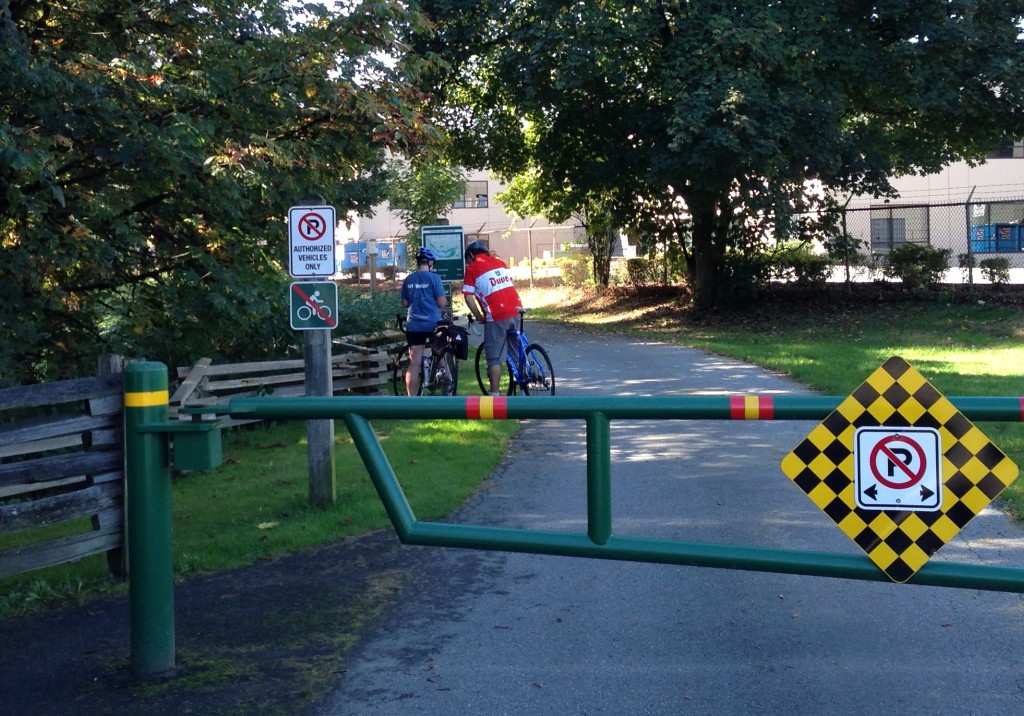
Mainly, though, if I got a bicycle, I’d become one of them–the people I loathe at Burnaby Lake. Which people? These people:
Free writing is a prewriting technique in which a person writes continuously for a set period of time without regard to spelling, grammar, or topic. It produces raw, often unusable material, but helps writers overcome blocks of apathy and self-criticism.
I’ve never been entirely sold on this technique, though I appreciate its goal to stimulate any sort of writing, which is presumably better than not writing when your goal is to write. I don’t mind having unusable material. I’ve certainly written plenty of stuff that was either cut or buried out round back. It’s not like you can do it wrong. Kittens have never been killed due to free writing, not to my knowledge, anyway. Where’s the harm in giving it a whirl?
And so here’s five minutes of free writing.
Fred always wondered what happened when you died. He figured it couldn’t be good because no one ever came back to say stuff like, “This Heaven place is awesome!” On the other hand, maybe post-living was so awesome that everyone who died was having too much fun to come back and rub it in the face of the living. Or maybe you evolved to a higher plane and ended up with a superiority complex and couldn’t be bothered to speak to lowly organic forms of life.
“Oh, yes, I knew them when I was mere flesh and blood, but there’s no way I could ever communicate with them again. We exist at profoundly different levels. I see the ever-expanding cosmos, they see Walmart flyers and what a great deal ketchup is this week. We have no common frame of reference.”
Fred thought some more. His Uncle Joe died at age 62. A bit young–shy of retirement age–but he couldn’t really picture Joe as evolving to a higher form. The guy could barely dress himself without putting his pants on backward. How could he become one with the cosmic firmament? He wouldn’t even know what cosmic firmament was. “Sounds candy ass to me,” he’d say.
And what if you killed yourself? Would you just snuff out in a ball of negative energy? Would you evolve sideways into something not-quite-cosmic? Fred couldn’t get past the idea that killing yourself was cowardly.
And stop. There it is, five minutes and 241 words of Fred contemplating death, raw and unpolished, just like Fred himself, whoever he is.
(I fixed the typos because typos bug me. Actually, it’s not the typos so much as the angry red squiggly lines underneath them.)
I just checked the CBC site. So far no word of kitten deaths as a result of this exercise. I consider this a win. Now I shall absorb the fruits of my labor to write something magical and exciting.
Pong was the first popular video game. I first played it in a darkened pizza restaurant in 1974, the video screen casting an eerie blue glow on those gathered around it. I was nine years old.
And hooked.
In 1976 we got the home version of Pong. It had two control knobs built into the console. My brother used his advanced high school electronics wizardry to pry the knobs out and then attach them to longer wiring, allowing us to sit back and play while reclining on those giant weird pillows that were so popular in the 70s. It was great.
Through the mid-70s and early 80s, my love of video gaming saw me spending many an hour in video game arcades–my first full-time job was handing out quarters at an arcade. The job was about as exciting as it sounds, but it was still cool to be surrounded by the light and noise of forty arcade cabinets. My manager was less impressed when a group of teenage boys gathered around a machine one night, managed to jimmy it open, and then empty all the quarters from it. Hey, I just thought they were really into Sub-Roc 3D.
Looking back, some of my memories and recollections of arcade games include:
the Williams games were technically dazzling and impossible for me to play competently. These included Defender, Stargate (no relation to the movie or TV series) and Robotron 2084. I loved these games but my roll of quarters would vanish all too quickly attempting to play them. I’m pretty sure I lost a ship just pressing the one player button in Defender.
while I enjoyed Time Pilot, there was something almost transcendental about its sequel, the space-oriented Time Pilot 84, that really hooked me. I actually got pretty good at this one. A local laundromat in Vancouver had it and I probably spent more money on it than others did doing their laundry.
I never quite mastered Dragon’s Lair but could play through (the superior) Space Ace with a single quarter. It was pretty much watching a cartoon with a joystick. That sounds wrong and in a way it was.
A friend and I played Super Mario Bros as player vs. player since you could push or otherwise manipulate the other player into the crabs, turtles and mean ice cubes. You didn’t get points by indirectly offing the other player but in a way that made it even better.
I remember thinking laser disc games were not the future. I was right (fortunately). Williams had one called Star Rider that was decent, cleverly using the laser-y part as a fairly seamless background to a respectable racing game (there’s even a YouTube video).
The cocktail table version of Ms. Pacman was awesome. Suddenly, standing in an arcade was obsolete (several arcades started providing stools).
The Movieland Arcade in Vancouver was one of my regular haunts and had a row of Sega’s Daytona USA machines near the front. Racing against friends was great fun. The arcade and those Daytona USA machines are still there more than twenty years later, but the arcade always looks forlorn and empty. The sign in the window also still advertises “girlie movies” in the back. I never watched the girlie movies.
by the mid-80s, we reached a kind of golden age of arcades. Most games were still 25 cents, with new games sometimes being 50 cents. Graphics had improved dramatically so titles like Toobin’ still look pretty good today. Home consoles were in the pre-Playstation era, so arcades still had a place with a technically superior presentation. That would fade by the early 90s. Coincidentally I was edging toward 30 and my own interests began pulling me away.
a friend and I played Cyberball against the Deluise brothers. I don’t remember why they were in Vancouver at the time.
another friend and I would drive from Duncan to Victoria to play games like Star Rider and Crystal Castles at Xanacade. Yes, we drove nearly an hour just to play video games. Both ways, in the snow!
Video arcades still exist, mostly on the appeal of massive novelty machines that cost a lot more than a mere quarter, but like many things you adore in your youth (hello, Mad magazine), the magic has faded. Alas and such.
Here are some writing prompts related to school, education, learning, or the lack thereof.
As always, I provide the caveat that these prompts are deliberately terrible and are not meant to be used. If you use one and create something decent from it, consider it an accident gone gloriously and strangely right.
In an effort to make the paperless office a reality, all faculty are given tablets. The tablets are made of stone and each comes with a chisel. Describe the reaction of the faculty.
A student has a grand, sweeping vision on how her university can be better-managed in this highly competitive, technologically-challenging time we live in. It involves logrolling and lawn darts. Write the speech the student gives to the board assembled to hear this vision.
The Department of Psychology runs an experiment in conjunction with the IT Department to determine how many superfluous confirmation prompts someone has to click through when trying to print a document before totally losing it. Write about the exciting results of the experiment.
Rather than trying to fight students constantly checking Facebook in class, teachers instead embrace this by having a hologram of Mark Zuckerberg appear in classrooms. Write about Mark teaching students what’s really important. Share and like if you agree.
It turns out that modeling a school on Lord of the Flies is actually a bad idea. Explain why in 500 words.
Run 410 Average pace: 5:56/km
Location: Burnaby Lake CCW
Distance: 5.13 km
Time: 30:32
Weather: Overcast
Temp: 6ºC
Wind: light
BPM: 166
Stride: n/a
Weight: 168.6 pounds
Total distance to date: 3330
Device used: Apple Watch and iPhone 6
I replicated last week’s run, doing the same route, with one change: I used the orthotic insoles in my Speedgoats. While my left foot did hurt, it started to hurt much later and minimally enough that I didn’t consider it a serious issue during the run.
Despite a few sprinkles en route to Burnaby Lake, it remained dry for the entire five km and the trail was in much better shape, with the need to dexterously dodge and weave and sometimes plunge straight through puddles being unnecessary.
The Speedgoats proved to be a mixed success again. They passed the shoelace test but as I was nearing the dam on my walk back the lace on the right shoe was on the verge of coming undone. Had I still been running, I’m sure it would have, so I consider this a technical fail. Worse, the color leeching happened again. This time the only moisture in the shoes came from my feet sweating but this was enough to leave prominent blue stains on both socks. I’ll probably be taking them back to Kintec for a refund or exchange (likely an exchange, as I have to believe this is some sort of flaw in a specific production run).
I tried to pace myself a little better at the start of the run but mostly failed there. My first km was 5:24/km, fell to 6:10 for the second km and stayed in that general vicinity for the remainder of the run. The pace was a five second improvement, which was nice. My heart rate was also lower, which is also good. I expect to be sore again but not quite as sore.
I may wear the Tom Tom watch the next time just to compare (it also syncs to my Nike+ account).
Overall, I was hoping for small improvements and got them, so I’m pleased. Now I just need to finish runs without ruining more socks.