Movie review: Star Wars: The Force Awakens

Hey, there’s a new Star Wars movie out. You may have heard about it, possibly.

Released twelve days ago, Star Wars: The Force Awakens has already made over $600 million domestically. Even taking into account ticket price inflation, that’s an impressive figure. Ten years after Lucas wrapped up his prequel trilogy with Episode III: Revenge of the Sith, there’s apparently quite an appetite for more Star Wars movies.

I’m not going to ramble on since the Internet is already stuffed to the gills with reviews of the movie, but I will offer a few of my own thoughts.

I saw the original Star Wars when I was 12 years old. It was magical and awesome. I’d never seen a movie like it before. When Return of the Jedi came out in 1983 I paid to see it four times, something I’d never done before and have never done again since. I loved Star Wars and its flaws and imperfections didn’t bother me in the slightest, even as I acknowledged them.

When Lucas decided to make Episodes I-III I was excited. I’d have preferred Episodes VII-IX since we already knew Anakin Skywalker became Darth Vader, but still, new Star Wars!

As it turned out, whatever Lucas captured for the original three movies largely eluded him for the prequels, which were flat, poorly-directed, bloated with overly busy effects, featured embarrassing fan service and had one of the worst movie romances ever.

The biggest criticism I might level at The Force Awakens is that it largely uses the template of the first movie, swapping in new characters for the same general roles. But this is a minor nit, because it is done well and serves as a way to relaunch the movie series, not just for people who didn’t grow up with the original trilogy, but especially for those who did.

I suspected J.J. Abrams would be a better fit for Star Wars than Star Trek and he is. Reining in his excesses, he ably directs a cast that is diverse, smart and appealing. The script is rather sharp for a Star Wars film. The whole thing moves relentlessly, but finds the right places to breathe before picking up the action again. The fan service is tolerable–in stark contrast to what Abrams did in Star Trek–and Harrison Ford, who plays a surprisingly large part in the film, perfectly recaptures the character of Han Solo. And BB-8 is adorable.

Really, the major achievement here–apart from the stellar work done by the young cast that will carry the series forward–is that this feels like a Star Wars film in a way the prequels never really did. It’s ironic that it took people other than Lucas to rediscover and recapture what made the original trilogy work so well.

Now I just have to wait impatiently for Episode VIII.

Book review: The Illustrated Complete Works of H.P. Lovecraft

The Illustrated Complete Works of H.P. LovecraftThe Illustrated Complete Works of H.P. Lovecraft by H.P. Lovecraft
My rating: 4 of 5 stars

I read most of Lovecraft’s fiction back when I was a teen, initially drawn to his work not by his reputation or fame but by the lurid Michael Whelan cover art found on the 1981 paperback editions published by Del Rey. The art is fantastically creepy, even if it doesn’t particularly relate to Lovecraft’s stories. You can see the two pieces (chopped up to span seven paperbacks) at Whelan’s site here and here.

I picked up this particular collection because it assembles all of Lovecraft’s stories in chronological order, allowing the reader to experience both the growing skill of Lovecraft as a writer and the expansion and iteration of his favorite themes, settings and tentacles. The included illustrations are merely serviceable but given the price of the volume, that’s a non-issue.

I read the collection over the course of many months, usually taking in a story or two between novels. Not to get all up in the puns, but this is probably the sanest way to read his work. Lovecraft wrote some frightful horror but most of it is delivered in the form of dense, baroque prose that feels as antiquarian as the tombs and ruins his narrators stumble upon. His characters are also strangely mute, with little in the way of spoken dialogue–but this turns out to be a good thing, because as elaborate as Lovecraft’s phrasing could get, he had an undeniable style and facility with language that was completely absent when he presented characters talking to each other. No actual person would ever speak the way a Lovecraft character does. It’s like watching an early rehearsal of a high school play in 1915. A bad high school play.

But if you tackle his body of work with some restraint there are some great stories in here, and any horror buff would be remiss in not sampling at least the better-known works, ranging from the mythos-establishing “The Call of Cthulhu” to the short novel “At the Mountains of Madness,” which eschews most of Lovecraft’s excessive flourishes and in turn stands as one of his most chilling stories, as an expedition explores and uncovers the horrors found in ancient cyclopean ruins deep in the Antarctic.

Lovecraft is at his best when he paints surreal landscapes, often literal dream worlds that his protagonists wander through, sometimes emerging mad, sometimes not emerging at all. Conversely, he is at his worst when his racism and classism comes through, with villains typically described as “swarthy,” “thick-lipped” or otherwise not white and more specifically, not English. You could argue that he lived in a less-enlightened time but that’s really no excuse.

And don’t ask about the cat*.

Still, his influence and unique voice make him one of the essential horror authors and this collection allows one to experience his growth, if not as a person, then as a storyteller.

* the cat in his 1924 story “The Rats in the Walls” is named Nigger Man, after a cat Lovecraft himself owned

View all my reviews

That whole iPad tablet thing

There have been a few famous tablets over the years. Moses brought a few down from Mt. Sinai you may have heard of, for example. I’d like to talk about one that is a little more current–specifically the iPad, introduced by Apple in 2010.

At the time one of the most amazing things about the iPad was not its relatively svelte design, power or display but its price–$500 was seen as a veritable bargain for a piece of Apple hardware. People were impressed, the iPad sold millions, the improved iPad 2 sold millions and everyone was happy ever after.

Until Apple’s 3rd quarter (Apr-Jun) of 2013, when year over year sales of the iPad declined for the first time. Sales remained flat for awhile but starting in the 2nd quarter (Jan-Mar) of 2014, sales of the iPad have declined year over year for every quarter–seven quarters in a row so far.

Reasons for the declines have been attributed to various factors but the main ones people cite are:

  1. Cheaper alternatives, mainly in the Android tablet market and in the forked version Amazon uses for their tablets
  2. Longer upgrade cycles; people upgrade phones every two years, tablets get upgraded more like computers, so some may hang onto their iPads for 3-4 years before feeling a need to update
  3. The rise of larger smartphones has eaten away some of the tablet market
  4. The rise of smaller, lighter ultrabook laptops has likewise eaten into the tablet market
  5. Hybrid devices like Microsoft’s Surface Pro 4 have lured away some people who wanted something more powerful than an iPad
  6. The iPad hasn’t changed fundamentally since its introduction over five years ago. Compare the original iPhone and its capabilities to the current iPhone 6s and the difference is fairly dramatic

The reason I decided to write this is because I think Apple’s iPad strategy is muddled right now and what they are doing is unlikely to reverse the declining sales (it should be noted that in Q4 2015 Apple sold 9.88 million iPads–the lowest number since Q3 2011–but that’s still an awful lot of iPads, so it’s not going away anytime soon, regardless).

Let’s see how Apple is addressing the above factors.

  1. Cheaper alternatives. Apple is never going to produce a bargain-priced tablet. Apple doesn’t do bargain-priced anything and that’s okay, no one expects them to. But they had to do something to bring pricing down and their solution has been to retain a selection of previous generation models at lower price points. Hence you can get the current iPad Air 2 for $499 or the previous generation iPad Air for $399. This is probably the best Apple can do here. They are never going to compete against Amazon’s $50 tablet-soon-to-be-in-a-cereal-box approach.
  2. Longer upgrade cycles. This is something Apple has no real control over. It affects all tablets, so it’s not a problem specific to Apple. Would dramatically different iPads spur people to upgrade sooner? It’s possible but it’s just as likely it could push people into keeping what they have if the new version deviates too much from what they expect an iPad to do.
  3. Larger smartphones. Apple has chosen to go the route of cannibalization here by introducing the iPhone 6 and 6 Plus in 2014 with larger 4.7″ and 5.5″ displays. While they’d prefer people buying an iPad and an iPhone, having them buy a larger iPhone is better than having someone eliminating both and getting a big screen Android phone instead.
  4. Smaller, lighter laptops. Apple is again going with cannibalization by introducing the MacBook, a 12″ laptop that weighs less than two pounds, comes with a single USB-C port and is available in three different colors–just like an iPad! Price-wise it’s in an entirely different market but design-wise it’s definitely the first step by Apple toward making a laptop that is as light and portable as a tablet.
  5. Hybrid devices. Apple executives like to make fun of products until they decide to do their own take on a particular device a few years later. Such is the case with the iPad Pro and its optional keyboard and stylus. Apple’s take on a Surface Pro-style device is more iPad and less laptop than the Surface but it’s clear Apple is trying to pull away sales from Microsoft’s hybrid while also attempting to expand the iPad’s reach.
  6. The 2015 iPads all do the same things the original did in 2010, they just do it faster while weighing less and looking better. This is one area where Apple does not appear to have a plan–or has yet to reveal it.

Looking over the list, Apple is clearly doing some things to address problems with declining iPad sales, even if some of those–like the introduction of larger iPhones–help the company more than they do the iPad itself. The reason I stated that Apple’s iPad strategy seems muddled is tied directly to its current iPad lineup and how it’s evolved over the last year.

In 2013 Apple introduced the iPad Air. The next year they brought out the iPad Air 2, a faster, thinner, lighter model. This year Apple did not update the Air–the primary iPad model–at all. They refreshed the iPad mini by replacing last year’s embarrassing iPad 3, which only added Touch ID–something Apple apparently thought people would be happy to shell out an extra $100 for–with the iPad mini 4. They also introduced the iPad Pro, the really big iPad. They retained the iPad Air and iPad mini 2 as “budget” alternatives.

The mini sells well but it doesn’t sell as well as the 9.7″ model. One could argue that its sales may decline even more as larger phones encroach on its space–a 5.5″ display is closer to a 7.9″ display than 9.7″, after all (Apple doesn’t break out sales per iPad model but industry fancypants generally agree the 9.7″ model is the main seller). The iPad Pro, while still fundamentally an iPad, is so much larger and more expensive that it is likely to draw people looking for its unique qualities rather than as a general tablet. Someone who just wants a good, solid iPad still has the iPad Air 2 and despite it being a year old, it is still a fine tablet. But by not updating its main model, Apple seems to be saying it doesn’t know what to do with it. They can probably make it faster, maybe a little thinner (they are hitting limits in this area) but is that enough to woo people to upgrade? It doesn’t look like it, but at the same time no update at all makes the iPad Air 2 feel a bit forgotten and again, it’s their primary iPad.

Will the improved mini 4 turn sales around? It’s unlikely, though the improvements are welcome.

The iPad Pro is still a bit if a mystery in how it will play out but I think its high price will keep it from breaking out and becoming a huge seller. And people considering a Surface Pro are probably still more likely to get a Surface Pro, if only to overcome the limits of iOS that the iPad Pro still has to contend with (some would argue–as I would–that Windows 10 is a better operating system for productivity than iOS 9).

Rumors are circulating that Apple will reveal its next revision of the Apple Watch at a March 2016 event–about three months away as I write this– and the event may also reveal the follow-up to the iPad Air 2. If this turns out to be accurate, it will be interesting to see what the next iPad will look like and if the delay in updating it is due to product drift and uncertainty or because Apple is poised to bring some truly new features to the iPad.

Having an iPad Air myself, I admit I wouldn’t mind the lighter Air 2 but given the differences between the two models, I can’t justify the expense of upgrading. I’m curious to see if Apple can talk me into parting with my money in 2016.

GlutenQuest complete

And on the second day there was gluten.

The possible gluten repository of Galloway’s, a local bulk/specialty food store, yielded a veritable treasure of trove of gluten and other bread-making ingredients, so my partner bought the place out and made bread.

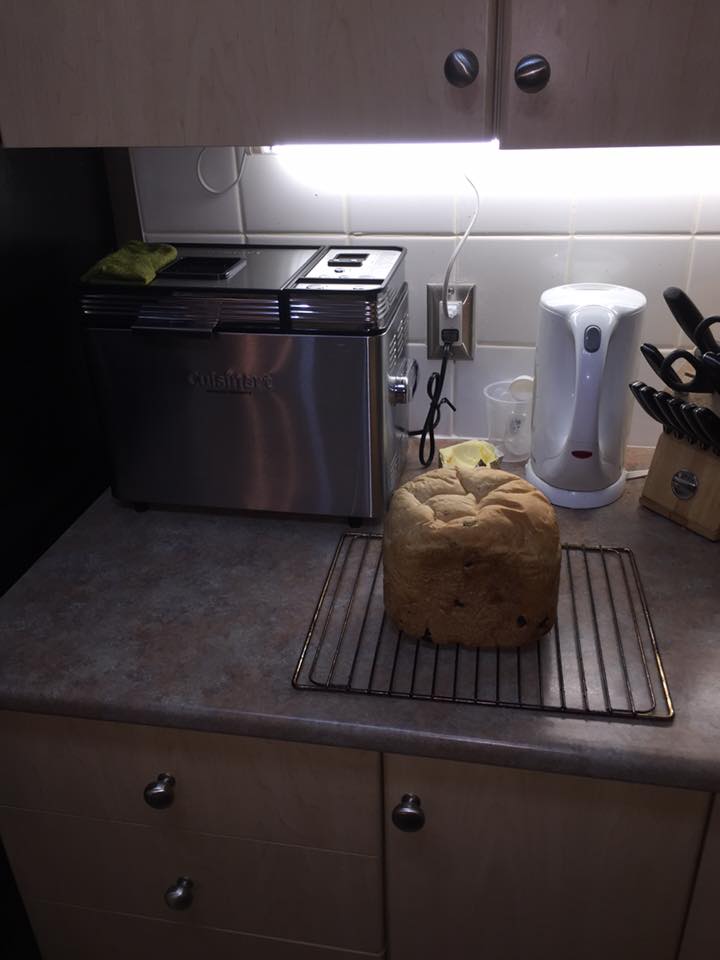
The first loaf was whole wheat bread made pre-gluten discovery and it was fine, if a little dense. The next loaf was raisin bread, which rose to monstrous proportions (even though the image makes it look kind of stubby and short) and was very yummy to boot. Jeff’s picture of the loaf, the bread maker and some of our kitchen counter is below. The bread’s integrity did not survive long:

rasin' bread
Raisin bread, ready to fulfill its purpose in life of being eaten.

I suspect we will be up to our eyeballs over the next few weeks in a variety of breads, rolls and anything else that can be made in a bread maker, but that’s okay. I’ve started running again and I’m reasonably confident I can outrun the calories of the many delicious things this diabolical device can create.

Reasonably certain.

Boxing Day and the lack of gluten

I was at the mall today (Lougheed Town Centre, to be precise) and it wasn’t as insane as I had feared, given it was Boxing Day.

I remember way back in olden times when the local news would run a story every year about people camping overnight outside A&B Sound to get Boxing Day deals on electronics. Now A&B is gone, vinyl records which used to be cheap are overpriced and bought by hipsters, and enough stuff is bought online that the crowds are not as madding as they once were. Overall I’d have to say things have improved, though I kind of miss checking out the New Releases section at A&B, since I often had no idea what was actually new until I did this.

My partner wanted to spend some of his Christmas money on a bread maker. It would take precious space on the kitchen counter but his eyes sparkled and I could not in good conscience deny him. Tonight we have a bread maker. It’s still in its box on the living room floor. Why?

Gluten.

Gluten is apparently as difficult to find as precious metals. Maybe moreso. Most bread recipes call for gluten and while there are workarounds, we had flour that was not enriched and gluten would be needed. I did a search for gluten in Vancouver and this produced about a billion results–all for gluten-free anything you could think of. Gluten-free bread, gluten-free cereal, gluten-free bathroom mats. But actual gluten? It’s like a unicorn. People talk about it, you hear of it, but you never see it and start to wonder if it really exists.

Tomorrow we’ll be checking some specialty food stores with the goal of buying a ten year supply of gluten should any of them have stock on hand. Maybe a 50 year supply. I can make that a bucket list item–bake bread with REAL GLUTEN when I’m a hundred years old.

Book review: Hell House

Hell HouseHell House by Richard Matheson
My rating: 4 of 5 stars

Although Hell House may take its inspiration from Shirley Jackson’s The Haunting of Hill House, mainly in the broad premise of a group of people investigating a haunted house, it departs from the relatively mild chills of Jackson’s tale and goes straight for the throat–and every other body part. The ghosts in Hell House are nasty things that mean to injure and even kill those daring to solve the home’s decades-old mysteries.

Matheson, perhaps best-known for his contributions to the original Twilight Zone TV series (“Nightmare at 20,000 Feet” among others) has written a ghost story that leaves the reader wondering who is right–Florence Tanner, a medium brought to the house with three others to help uncover and perhaps banish whatever malefic force dwells within–or Lionel Barrett, a physicist who theorizes that ghostly doings are nothing more than residual energy that can be neutralized by a “reversor,” a large contraption covered with dials, buttons, switches and filled with vacuum tubes. You know, like a typical computer from 1970 (when the story takes place).

Tanner and Barret are joined by Barrett’s wife, Edith, and another medium, Ben Fischer, who as a teenager had been part of a disastrous attempt to clean the house in 1940, an attempt that left everyone but Fischer dead.

Promised loads of money by the house’s current owner if they can wrap up their investigation of life after death in a week, the foursome quickly discovers that the house is primed for a party in which everyone is invited…to die! Exploiting personal weaknesses of the four, the house’s spirits move quickly and violently to divide and conquer.

Matheson does a terrific job balancing tensions both between the four and between the sides of spiritualism and science. Also to his credit, there are no eyeball-rolling moments where characters do stupid things in order to advance the plot. There is a battle here between the living and the not-so-living and Matheson lets it play out in as believable a manner as you are likely to get in a story about a haunted house.

For a novel published in 1971, Hell House is surprisingly timeless. Apart from the above-mentioned “reversor” it could be updated to the present day without any substantial change, a testament to Matheson’s straightforward, character-driven approach. If you want a ghost story that is more than people wandering around the dark and hearing a few odd noises (ie. every limp ghost-hunting show ever), Hell House’s bricked-over windows, profane chapel and steam(ed to death) room will serve you well.

View all my reviews

My five favorite things about Christmas

It is Christmas Eve and as I enjoy some tea on this cool, crisp evening, here are my five favorite things about Christmas, in no particular order:

  • Eggnog. It’s actually kind of gross, like imbibing sickly sweet cream, but drinking it feels exactly like it is–a rich indulgence perfect for partaking of once a year
  • Presents. I don’t really care about getting presents but it would seem wrong to oppose them, unless they were mean reverse-presents like boxes of poop or something
  • Snow (provisional). I like snow on Christmas but only on two conditions: 1) I am not traveling 2) it doesn’t rain immediately (or not-so-immediately) afterward, turning the slow into slush
  • We’ve already passed the shortest day of the year, automatically making Christmas and every day up to the next winter solstice better
  • A Charlie Brown Christmas. It rails against the commercialism of the holiday, has a terrific jazzy score, uses actual children for the voices of children and delivers its message without feeling heavy-handed. It’s also a little weird in a way that’s hard to describe.

Bonus favorite thing: peace on Earth, if it ever actually happened.

Never start a post with weather

Or so Elmore Leonard might advise if he was talking about blogs instead of books. Because weather is generally boring. Observe:

Today it rained a lot and was cold. We didn’t experience catastrophic flooding and it didn’t actually drop below freezing, but things got wet and the buses were crowded, damp and unpleasant.

Was that interesting? No, it was not. This is a little better:

Today a series of mega-tornadoes swept through the city, blowing apart skyscrapers, flattening dozens of blocks and leaving behind nothing but smoking ruins. It also rained a lot and was cold.

Although this is more exciting it also has the small issue of being untrue in regards to the mega-tornadoes. Astute readers are likely to know that mega-tornadoes hardly ever sweep through Metro Vancouver, putting them in a negative and non-receptive state of mind for the rest of your post. They may even decide to not read further at all, knowing full well that millions of amusing cat images are just a few clicks away in another tab.

So I’m not going to talk about the weather. Instead I’m going to talk about the seasons. Most people associate seasons with weather but technically you can talk about one without discussing the other. As I am about to do in the next paragraph.

The winter solstice was yesterday, December 22, and as such this means the shortest day of the year has passed and now the days will get longer and before you know it the glory of summer will have returned. Hooray summer!

That is all.

P.S. It better not snow before then. Damn snow.

I’m dreaming of a partly cloudy Christmas

With three days to go, Weather Underground is forecasting partly cloudy conditions, a 0% chance precipitation and a chilly high of 2ºC for Christmas Day.

Good: no rain
Good: no snow
Meh: 2ºC isn’t exactly summer weather but it’s still above freezing

I can live with–nay, embrace–this yuletide forecast. A crisp, cold day is roughly a billion times better than a torrent of rain or a bunch of snow that turns to rain and creates rivers of slush and when you come back from a walk you find your pants are somehow soaked all the way to your waist.

So here’s hoping.

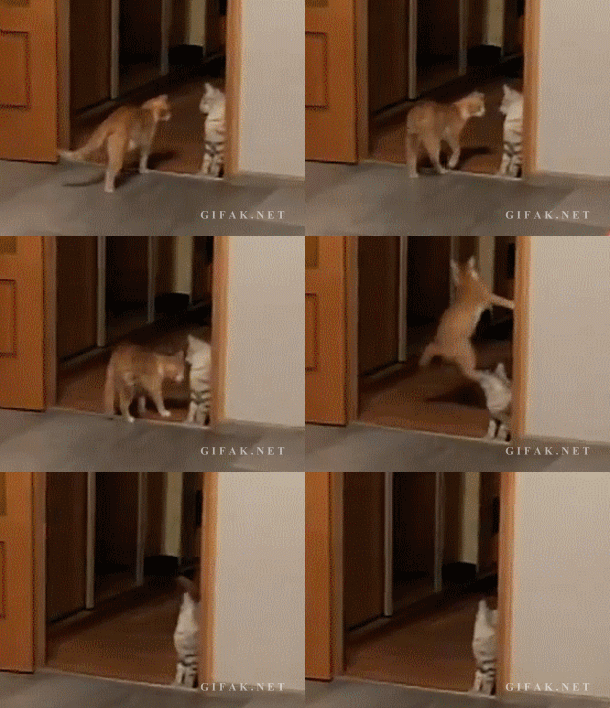
Also, I am still sore from my run on Sunday. This is not weather-related but didn’t seem worthy of its own post (I write after devoting yet another post to a cat gif).

Day 20 of the New Fat: Sudden weird weight loss

I was down an even two pounds today, dropping from 167.3 to 165.3. Even though I had no real snacks yesterday, this still surprised me. But it is encouraging.

Today I was bad and ate an apple strudel but was sufficiently guilty afterward to go out and do my first 5K in over four months, so it kind of worked out in the end. Not snacking is not easy but I’ve compensated for the strudel incident, behaved since returning from my run, and am fairly sure I’ll make it to bed without eating an entire cake.

Weight: 165.3 pounds -2.0
Body fat: 19.5%

Run 408: The unexpected run with bonus Watch and nippy dog

UPDATE, August 21, 2022: Updated tags for better searching and to note this was the first run using an Apple Watch (Series 0).

Run 408
Average pace: 5:42/km
Location: Brunette River trail
Distance: 5.0 km
Time: 28:35
Weather: Overcast
Temp: 7ºC
Wind: light
BPM: 172
Stride: n/a
Weight: 165.3 pounds
Total distance to date: 3320
Device used: Apple Watch (debut, Series 0) and iPhone 6

Here it is a mere four and a half months later and I’ve completed my next run, which I was totally not expecting.

Dedicated spambots scraping this blog for running articles may recall that my last run was on August 3rd, the first official day of my vacation. The run ended with my right hip (not actually my hip, as it later turned out) being hurt sufficiently that I knew I would be out for the rest of the summer or, as it turned out, almost the rest of the entire year.

Once I had sufficiently mended we were past summer and into fall and the days grew short and it was difficult to run after work. Running on the weekend also proved difficult because I just plain lost my mojo.

Today I had a Clif Bar for lunch (usual as I quest toward my target weight of 150) but a short while later I caved and had an apple strudel. It was loaded not only with sugar but also guilt. I had made a vow to stop snacking, and this was a clear violation. I soaked in the tub and contemplated how this, along with a planned pasta dinner, would contribute to The Fattening. I felt bad.

I decided to run.

I got changed and because this wouldn’t be an “official” run, I chose to not wear the TomTom watch. Instead I thought I’d give my fancy new Apple Watch and iPhone a workout (ho ho), using the Watch’s Activity app.

Setup was simple. I chose Outdoor Run, it advised me as this was my first run that I should run for at least 20 minutes to let the watch suss out my average pace. I planned 5K so this would not be an issue as I have not recently had bionic legs surgically attached.

I decided to walk the length of the Brunette River trail first, then start the run at the opposite end. This would get me heading in the right direction on the home stretch. I wore my usual gear, though the t-shirt was swapped for the long-sleeved version. This was not an unwise choice as it was 7ºC, not exactly tanning weather.

Upon arrival at the river trail I noted the bear sign was still up. It’s December 20th, I’m pretty sure the bears have gone south or started hibernating or whatever it is they do in the winter.

Using the watch, I selected my running music (from 1987, see previous post), chose the Outdoor Run activity and set the distance at 5 km. I tapped the Start button and three seconds later I began my first run in a good long time.

I kept the pace deliberate and actually had no trouble completing the full 5 km. A stitch threatened early on but never fully materialized and the only discomfort I felt was the usual “this is what it feels like to use certain muscles again after not using them for 18 weeks.” The left foot started to hurt but stayed tolerable. I stuffed toilet paper into the shoe to help provide extra cushioning but toilet paper squashes easily, something I forgot since I’m not in the habit of squashing it.

My pace seemed about right, given the layoff: 5:42/km. I broke the five-minute mark on the first km, slowed over the next three and picked up on the final. Again, this is all more or less normal. The BPM came in at 172, much higher than the 160 of my last run back in August. I’m not sure if this is accurate and thus worrisome, or inaccurate and no big deal.

While everything worked well enough with the Activity app, it is too self-contained and lacks some stats to really prove useful in the long term. I may try the Strava app on my next practice run, as it’s supposed to be spiffy.

Three other things of note on the run:

  • There were a lot of fishers out there and more people in general than I expected
  • As I looped back to the entrance of the trail, a Metro Vancouver worker was removing the bear sign, as if he had read my mind; for reasons unknown (conspiring with bears?) the other sign at the western end of the trail was left up
  • Some dope with a dog let his dog off-leash and while he was bent over tying his shoe on the other side of the trail, the dog came running after me, nipping and barking at my heels. It wasn’t scary so much as annoying. I shot the guy a dirty look as he called Cujo back, then observed, with no surprise, as they headed off, the dog was still unleashed. I pondered what it would take to get him to decide it was a good idea to put the leash back on (he had a leash with him). I decided nothing would because he was a stupid, selfish jerkface.

I now wait to see how my body feels tomorrow (I’m thinking a little sore but not bad). I could potentially run again in three days, but may wait until next weekend. The important thing is I ran, I survived, I worked off that strudel, and I’m curious to go out and do it again.