I’d kind of forgotten how I used OneNote for a few years as my note-taking app1Skip to the last paragraph to find out why I am randomly discussing OneNote. It’s multiplatform–basically everything but Linux2Unless you use the web version–and while the UI is a bit odd, it makes sense once you realize it apes real world use: a series of notebooks (sections), each with their own pages (sets of notes).
Unlike something like Obsidian (which I use currently) it’s all in a proprietary format and your notes are saved to a folder somewhere on OneDrive, so exporting your notes to another program is not exactly a straightforward task (I only see an option to export pages as PDFs). Which also explains why none of my OneNote notes are in Obsidian.
On the plus side, this is a full WYSIWYG app, so you can easily add audio, video, images and other files, mess around with different fonts and styles and basically go crazy doing things that are impossible in a plain text file. That has definite appeal to a visually-minded dope like me.
I’m…somewhat tempted to try it again. I shouldn’t. Having text-only notes keeps me focused or sane or something. I don’t need to be able to dictate my notes using a microphone.
Do I3No, I do not. Yet I want to do so now. Badly. I am bad and should feel bad.?
Look, I’m sticking to Obsidian and there’s nothing I can do to convince me otherwise. Probably almost for sure.
I woke up fat and unrested. Is unrested a word? Apparently not. I will add it to Nedlish!
Day 10 my remaining symptoms are the same, but milder in all cases. The nose is a bit stuffy, the chest feels a bit congested (though no coughing unless I contort into a cough-friendly position) and the ears are just a touch plugged, depending on which way I turn my head.
Despite feeling better in all regards, I had an allegedly poor sleep last night and also managed to gain 1.2 pounds, like secret night gnomes were directly injecting fat into my body as I (poorly) slept.
It’s 2023 and that means the big thing is AI (that’s Artificial Intelligence, not some guy named Al). If you are reading this in some other year, you may be wondering what the fuss is all about from your tiny, climate-ravaged hovel. Or you may be wondering the same as a gleaming machine built on AI yourself! Who can say what the future holds?
As for the present, it started in 2022 when AI-generated art became a thing. That’s still ongoing (see the controversy over Marvel using AI-generated art for its opening credits to Secret Invasion), but things kicked into high gear right near the end of the year when OpenAI unveiled its ChatGPT website to the public, allowing you to query an AI built on all kinds of data scraped from the internet through 2021. You could ask for recipes, have it write haikus, or generate code, or just write your crappy books and list them on Amazon for you. There are concerns, as you might imagine.
Given the recent implosion over at Twitter over what Elon “Galaxy Brain” Musk has called “extreme levels of data scraping”, I wondered, might my own humble blog be subjected to the same? It is, after all, a treasure trove of my collected thoughts and wisdom, stretching back 18 years! In internet time, that’s like going back to the dinosaurs. Or at least mastodons (not to be confused with the social media platform). What can I do to protect my sacred words from evil, exploiting AI? How could I stop some young lad from going down the wrong path by using text from creolened.com to, in some small way, help write his homework, leaving him bereft of critical thinking and writing skills, and therefore destined to a life of petty crime and indolence?
I have the answer.
I’ll fill every post with words I’ve made up. Eventually, Nedlish will become the universal language Esperanto could only ever dream of becoming. This is a perfect plan. Let’s get started.
narnar
flembock
poddle
wistern
lugpuppy
droofus
edumatainmentification
yubbo
More to come. Get to work, AI, on the glorious Nedlish future!
It’s the end of June, I’ve lost weight, it’s been sunny, and I got sick.
So, a mixed bag.
And now ten words that rhyme with June:
Spoon
Moon
Prune
Loon
Tune
Rune
Boon
Croon
Zune1According to Microsoft, this is totally a real word
Dune
Now, take these ten words and use them in a story! Surprise writing prompt!
I sat by the window, listening to a tune on the radio, staring out and up at the fat moon. I used a spoon to shovel up ice cream from a bowl, directing it to my mouth. The night was silent, save for the plaintive cry of a loon. I did not want to listen to it croon its sorrowful song, so shut the window.

I picked up my Zune, which still worked all these years later, quite the boon. I played a song at random and did not like it. Why had I bought it? I would need to prune my playlist. I laid back on the bed and closed my eyes, seeing before me in the dark an image of endless sand, one giant rolling dune after another. Had I been here before, or only in a dream? I opened my eyes and reached over to the nightstand, picking up a small wooden talisman I had been given by a stranger, a burnished, dark rune, whose etchings defied explanation. I held it up before my face and turned it over.

"Soon," I whispered. "Soon."2Bonus rhyming word for extra credit
NOTE: I normally have a link to my Goodreads review, but the site is down as I post this. I'll remove this note once it's back up and the links can be put in.
My rating: 3 of 5 stars
I’ll be honest, I read this book for two reasons: because it’s short, and I was curious what a more nuts and bolts approach to novel writing would look like (I got it with a big book bundle that I was looking through after finishing my last read). I have read many books about writing novels, so by this point it takes something with a little extra to make my socks really roll up and down.
Structuring Your Novel doesn’t really have that, but it is a perfectly cromulent introduction to novel structure for a new author. The book is divided broadly into three parts:
Breaking down the classic three act structure
Breaking down scene structure, specifically the scene/sequel duo
A final section, curiously, on sentence structure
Initially I found the book overly restrictive in how it demands a novel must be written, but for new writers, this is probably a good thing–learn the rules before setting a blowtorch to them. Weiland even notes that some well-known authors don’t use the three-act structure–but actually do! They just do it without realizing it, because it’s the natural way people tell stories: a beginning, a middle, an end. This seems entirely logical.
The scene/sequel thing is also very fundamental: stuff happens, then the characters react, or more broadly, ACTION and then THOUGHT. Logical!
Really, everything in the first two-thirds of the book is fine, if not revelatory for anyone who has been writing for a while. But I question the necessity of the section at the end on how to write sentences. None of the advice is bad or wrong, but it feels out of place in a book about structuring your novel, as if Weiland cribbed from a book on grammar to make this book a little heftier. It’s easily skipped, and I’d suggest any writer who struggles with grammar might want to read an entire book on the subject before trying to crank out a novel. Rewiring is hard enough without having to correct a bunch of grammatical errors as well.
Overall, this is a perfectly fine book for new writers.
UPDATE, June 1, 2023: Here's a link to the original post on Mastodon by Matt Birchler that started this. If you can't follow the link, he's updated his original post to confirm from a member of the Ulysses team that this was indeed a joke and is riffing off a previous newsletter in which Fehn had raised the ire of Musk fans by criticizing Musk:

Me just opening my newsletter for updates from my writing app:

Editing for visibility: I’m choosing to assume this is a joke that didn’t land. The Ulysses newsletter has gone off the rails recently though, so it’s all just weird.

Edit 2: got confirmation this is a joke. Apparently the Elon trolls came for Marcus recently, and this was a sarcastic response to them. Sounds like many readers didn’t have that context, and this read like a normal Elon Stan letting their freak flag fly ?

This is why you don't try to be funny in a company newsletter!
I begrudgingly use Ulysses. It’s a fine app–in some ways even a great app–but I was not pleased when it went to a subscription model and mused at the time that they would have trouble adding genuinely useful features to “justify” the sub. And I think that happened.
But this post isn’t about the subscription model Ulysses uses. It’s their choice to charge a sub, just as it’s my choice to pay for it. I grumble, but for now, I pay, as I’ve yet to find another program that does everything that Ulysses does in a way I like. What this post is about is the Ulysses newsletter the company sends out periodically to its customers. More specifically, it’s about the current newsletter May 2023), which I think is attempting some ill-advised humour that may result in them actually losing customers.
I think it’s safe to say that most people don’t love email, they tolerate it. And when it comes to newsletters, I’d also reckon a lot of people may sign up for one (no harm, no foul), but then unsubscribe when they realize the newsletter isn’t providing enough value. I have culled a lot of newsletters in the past year for this very reason!
The current newsletter, which was sent out today, is written by Ulysses GmbH & Co. founder and creative director, Marcus Fehn. He is German. Is this important? Maybe, if you think some of what I’m about to highlight can be explained by differences in language, culture and things getting lost in translation.
Hello, fabulous subscriber of our newsletter,
This is Marcus from Ulysses, and I’m about to tell you something newsworthy. But first I need to make a statement:
**I love Elon Musk**. Elon is one of my favorite people on Earth, on the Moon, and of course on Mars. He’s a great innovator, probably a fantastic lover and an overall nice guy. I wish I was as smart as him. Or just 1% as smart as him. I also love Twitter and what he has done with it. Twitter was great before Elon, and it’s much better now. It’s a haven for free speech, a civilized marketplace of ideas, and it should be the blueprint for all social media apps going forward. I also applaud it for teaching kids how to behave in public.
Marcus Fehn, Ulysses founder and creative director
There is some debate on Mastodon on whether the above is:
Very obviously a joke and meant to be funny (the haha kind of funny)
Meant to be sincere praise of Musk and Twitter
There is no debate, however, on this being a baffling and just plain odd way to start out a newsletter to customers of a subscription-based markdown writing app. If it’s a joke (and I think it is), it’s executed just clumsily enough to make people think it might be legit. You could argue that just makes it more like satire, which is like funny jokes for sophisticates. Or grumps. (I like satire.) But even as satire, this is a completely tone-deaf way to start a newsletter. As a Ulysses user, I don’t care what Fehn thinks about Musk or Twitter, unless it somehow impacts Ulysses. I get that Fehn may have opinions or just likes writing things, but starting a company-based newsletter with this is bad form all around. This is why blogs exist, Marcus!
The rest of the newsletter continues in a jokey manner, with Fehn talking about 20 years of Ulysses and “20 years of hate mail, but that’s a different story” and that he’s visiting San Francisco and will be “the one in the bullet-proof vest, just in case.” I think he’s just trying hard (too hard?) to be funny, and a lot of it comes off flat or weird. The newsletter does exude with his personality, but that again is debatable on whether it’s a plus or minus.
For me, the whole thing is weird and off-putting, and it’s made me once again start looking for alternatives to Ulysses, preferably something that works on both Windows and Macs. And isn’t Scrivener. 😛
I have recently begun digging through my old creative stuff–sketches and stories from back in the olden days when I had hair and dreams. Now I just dream of having had hair.
One of the things I’ve noticed about some of the old short stories, dating back to the early 90s or even earlier–so some 30+ years ago, written when I was in my mid-20s or so, is how vulgar they are. Everyone curses, the guys are all leering monsters you wouldn’t let within 20 metres of a woman, or perhaps any other human. Everyone drinks or is drunk. I’d say I was repressed and letting it all hang out in my fiction, except:
I never drank other than an occasional beer, and never wanted more
I rarely swear in the flesh, feeling I can draw on more colourful metaphors to express myself than common cuss words
I have never leered at a woman, nor have wanted to
Also, a lot of stories revolve around death, which is also weird, because ruminations on mortality usually start when you’re, well, older. But I apparently had it on my mind a lot when I was 24 or 25 (this might partly be explained by my father dying when I was only 27, but that goes beyond the time when most of the referenced stories were written).
Anyway, no grand point here, just one of those things I noticed. That, and a lot of the writing is very first draft. I “finished” a lot of short stories that were never really done.
I have two computers (technically three, but the third is sitting unplugged with a possibly dead SSD and has not been used in four years): a Mac and a PC. They both work about the same and I find general performance pretty much equal, with a few quirks here and there.
The PC is much better for gaming because Mac gaming remains in a state of LOL. Apple is as good at building a gaming culture on Macs as it is at regularly releasing Mac Pro computers and keeping them updated1In the last 10 years Apple has released a Mac Pro in 2013 and 2019. Neither has seen any substantive updates since release.
For coding, either works. My coding is bad enough that I can’t really see a difference between platforms.
For graphics, there are plenty of options on either side. I have been using Pixelmator Pro more often lately, which is Mac-exclusive. But for just viewing images/photos, I prefer using the Photos app in Windows.
The weather app on Windows 11 is better than the one on the Mac.
For writing, there are, again, oodles of options on both computers. Annoyingly, some of the best options are platform-exclusive and/or have that pesky subscription model attached to them.
The main point of this digression is this: I regularly switch between the Mac and PC based on the specific task I’m doing. For general purposes–browsing, chatting with interweb pals, writing in my super-secret diary and so on, they are functionally interchangeable. So if I am, say, working on the Mac, I’ll keep doing so until there’s something I prefer or need to do on Windows, then I’ll switch over–and vice-versa.
And here the digression ends, as this post is about writing.
A renewal of interest in things I’ve written
I’ve recently re-read or am in the process of re-reading some of my older stuff, and the distance afforded by not having looked at some of these stories for years has given me a chance to appraise them with fresh eyes. I’m pleased to discover the writing holds up. This has sparked renewed interest in my long form (novel) writing. Maybe I should try to finish one of these lonely, abandoned National Novel Writing Month would-be epics!
So, the reality is, I could write a novel with a pencil and a couple of lined exercise books–and I did just that when I was 19! But something being possible doesn’t necessarily mean it is optimal. When I write, I do it using a fancy computer like the Mac or PC I have. But then I need to choose the software, and this is where the rabbit hole begins.
The rabbit hole
AI-generated rabbit hole. Thanks, AI!
When I was last writing regularly, I used Ulysses. I have railed against its subscription model before, though they have interestingly reduced the yearly cost by $10–which suggests it is not working well for them. They have also entered what I call the bloat stage, where they add new stuff that doesn’t enhance the writing experience at all, it just provides bullet points on “this is what your subscription is paying for.” That said, the core of the program is fine, the sub cost per year is bearable, but…it’s Mac-only. Remember how I switch between my Mac and PC a lot?
All I really want is a writing app similar to Ulysses that works on both platforms and is not web-based.
I look over the usual suspects:
Scrivener. Still unwieldy, with an ugly UI (yes, it matters to me!) and works terribly on cloud drives (the exact opposite of Ulysses in that regard).
FocusWriter. It’s fine, but a little too spartan. It’s barely better than Notepad in terms of features, though you can pretty up the UI. I feel like it’s great for writing short stories, but would fall flat on novels.
yWriter. This seems to have so much of what I want–and more, taking a real kitchen sink approach to novel writing (somewhat reminiscent of Scrivener), but it’s such a weird design, with windows for everything. It looks and feels cluttered, kind of the opposite of what I want when I’m just writing.
Microsoft Word. I mean, I have it, but it really falls down on editing long documents, which novels tend to be. Also, fighting its formatting could be an Olympic sport.
SmartEdit Writer (formally the way cooler-sounding Atomic Scribbler. This feels like a hybrid of Scrivener and yWriter, and also openly discourages saving to the cloud. It’s not as cluttered-looking as yWriter, but I am still not a fan of its UI.
Probably a few others I’ve forgotten.
So it seems I mostly want a few things:
A clean UI. What a lot of people (and marketing types) now call “distraction-free.”
The ability to handle long form (novel) writing. This means being able to break down writing into scenes/chapters that can be easily edited and organized individually.
Works with cloud saves, for better portability. This is no longer as critical, and I can save files to my NAS to achieve a pseudo-cloud functionality. Something like Scrivener turns your writing into a messy collection of files, increasing the risk that something will go wrong, and making cloud-based saving a pit of vipers. Who wants their writing to be a pit of vipers? Other than vipers, that is.
Works on both Mac and PC. So I don’t need to switch when the muse (or discipline) strikes.
Conclusion
I don’t have one! I’ll probably keep using Ulysses on the Mac for now, because there’s less friction there. I’d otherwise have to start exporting the stuff I want to work on and spend more time fiddling instead of writing.
Tonight, I thought I’d take a gander at my unfinished NaNoWriMo novel The Mean Mind, just read the first few chapters or something.
This isn’t a humblebrag, but upon re-reading the story, it actually pulled me in. There’s no huge backstory, no build-up, no endless “world building.” It quickly establishes weird stuff is happening and starts piling on the mysteries, totally encouraging the reader (me) to keep turning the virtual pages to see what happens next (spoiler: I already know).
The reasons this is trouble is because I’m now excited about the story again and it makes me want to resume working on it. But it’s unfinished for a reason, and I know if I keep reading I will reacquaint myself with that reason. And then I’ll feel sad.
But I’m going to keep reading, anyway. Maybe after having not laid eyes on the story for so long, I’ll think of some new way forward. The notes section on it literally ends mid-word, like I was suddenly distracted by a shiny object and never came back to it.
I’ll update this post once I’m done the read-through.
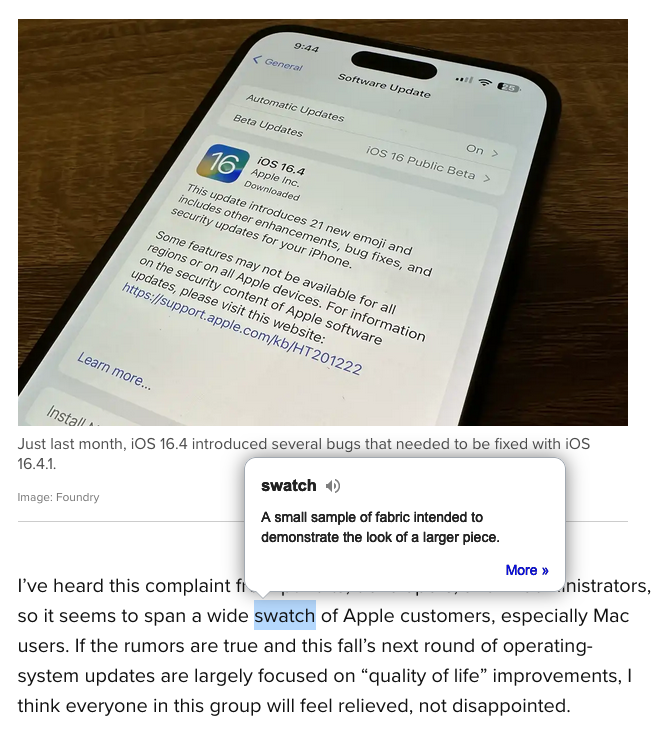
NOTE: I have no idea if Jason Snell’s pieces on Macworld are looked at by an editor or not, but I needed a title for this post.
Jason Snell wrote:
Now, I’m not really bagging on Snell, he’s a fine writer (he’s been writing about Apple stuff for a hundred years or so and was editor of Macworld himself for a decade), and this is a common mistake. But as someone who didn’t write the article, it jumped out at me immediately, and I’d like to think the same would happen with an actual editor eyeballing it. In lieu of an actual editor, would a grammar checker flag this? Let’s find out by pasting in the quote and letting the checker I use in Firefox, LanguageTool, give it a look:
Quote:
I’ve heard this complaint from pundits, developers, and IT administrators, so it seems to span a wide swatch of Apple customers, especially Mac users. If the rumors are true and this fall’s next round of operating-system updates are largely focused on “quality of life” improvements, I think everyone in this group will feel relieved, not disappointed.
– Dan Moren, Macworld
And lo, LanguageTool only flagged “rumors” because it’s the American version.
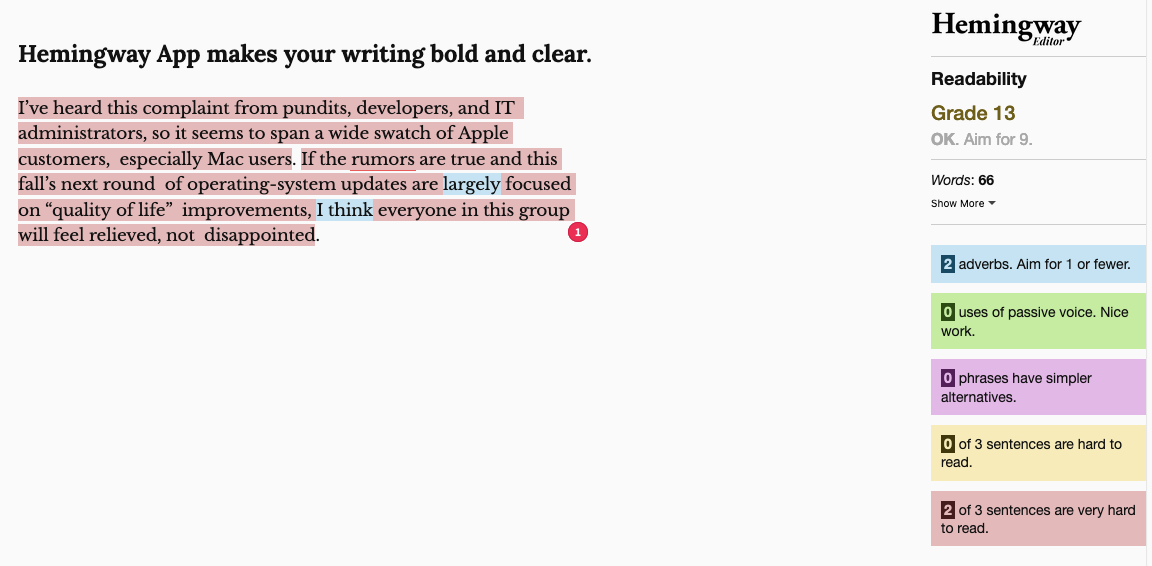
The Hemingway editor also did not catch it (to be fair, this is kind of above Hemingway’s pay grade):
(Click to embiggen)
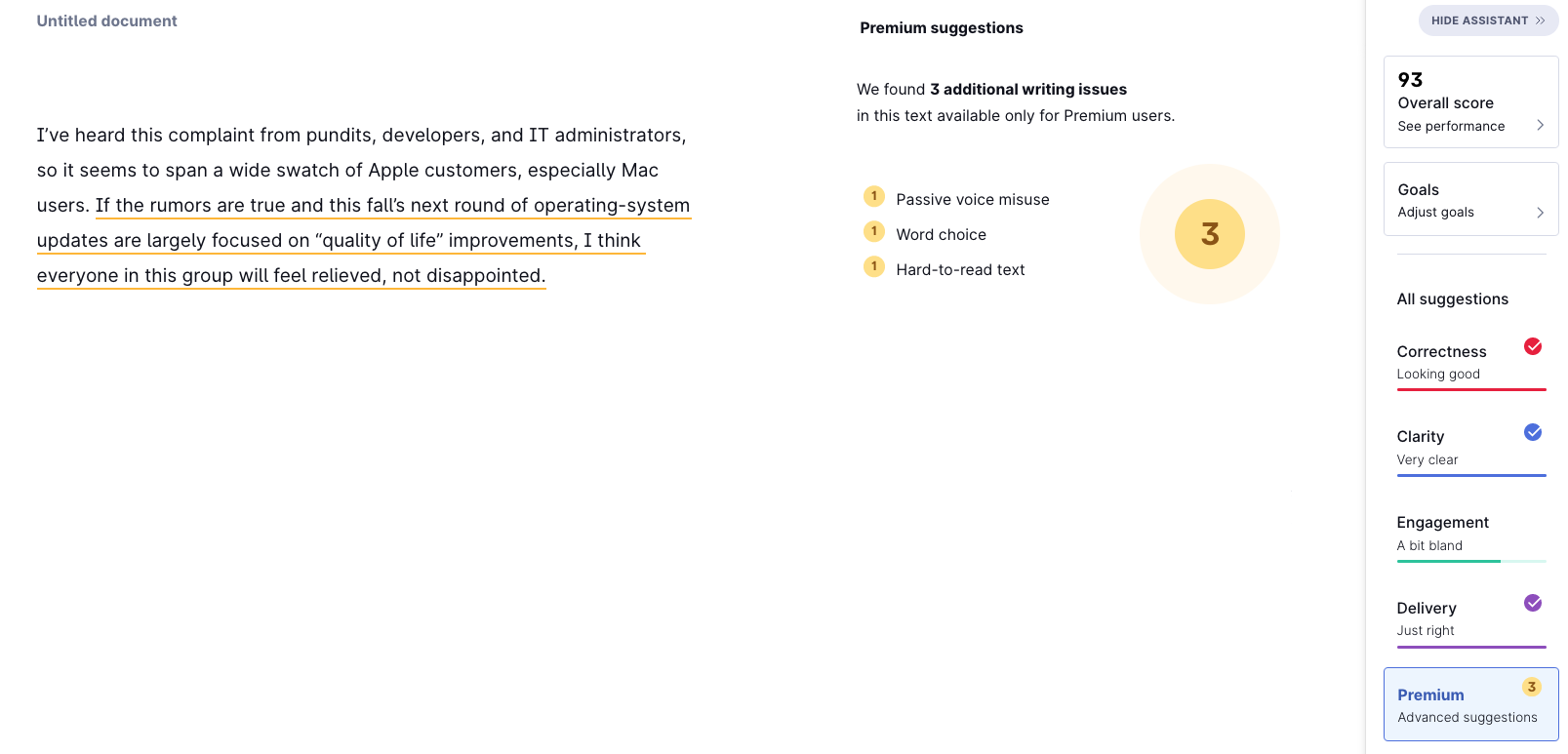
Grammarly also gives it a pass, but seems more impressed with the writing than Hemingway. There’s no pleasing that guy.
(Click to embiggen)
I’m starting to wonder if swatch is now considered an appropriate replacement for swath. My world is turned upside-down!
It’s late and I need to get to bed, but wanted to post something, so, being 2023, I asked AI to do it for me!
Here’s ChatGPT’s three-line bedtime story:
Once upon a time, in a far-off land,
Lived a tiny snail with a shell so grand,
Every night, she would dream of being a butterfly, soaring over the sand.
It’s more a poem than a story, but what does it know? Thanks, AI!
Actually, it’s probably more than I can’t focus long enough to sit down and write something. In any case, I intend to start cranking up the old writing machine in the next few days, seeing if I can hit a goal of an average of two posts per day for the month (62 total). As of right now, I am 10 posts behind. That’s a lot of McTopics. I need to get cracking.
Here’s a haiku to start. I even wrote it myself instead of outsourcing it to ChatGPT!
Time to Write

Time to get writing
Put fingers on the keyboard
Magic gushes out