Hydrant in the grass.


Hydrant in the grass.
A strange thing happened in August.
My weight neither went up nor down.
Technically if I go from August 1 to August 31 I was up 0.5 pounds, but my stats for the first and last day of the month are exactly the same as they were for the first and last days in July. On July 31 I weighed 162.8 pounds and on August 31 I weighed…162.8 pounds.
Kind of weird.
I dipped below 161 a few times, hitting a low of 160.4 pounds once, but never quite got to my stated goal of under 160, alas.
It now becomes my September goal.
However, I did run more in August and the nil weight loss may be a result of a little muscle gain. My body fat actually dropped decently over the month and is now at 27.8 pounds, down 2.4 pounds on the year.
And I’ve remained donut-free.
In all, I take these things as signs of a positive trend. Onward and downward! (weight-wise)
August 1: 162.2 pounds
August 31: 162.8 pounds (up 0.6 pounds for the month)
Year to date: From 162.3 to 162.8 pounds (up 0.5 pounds–unchanged from July)
And the body fat:
January 1: 18.5% (30.2 pounds of fat)
August 31: 17.9% (27.8 pounds of fat (down 2.4 pounds)
 Confessions of an Alien Hunter: A Scientist’s Search for Extraterrestrial Intelligence by Seth Shostak
My rating: 4 of 5 stars
This is a fun read and my biggest complaint is that it came out in 2009 (just as the Kepler space observatory launched) and hasn’t been updated, so there’s a lot of near-future discussion about systems that have since come online.
Conversely, we still haven’t detected extraterrestrial intelligence since then, either. 😛
Some might be put off by Seth Shostak’s breezy writing style, peppered with puns and humor, but I felt he always pulled back just in time to let the hard science and sober speculation take over. And if you’ve seen Shostak on TV–having more than a casual interest in astronomy, aliens or some combination thereof makes it likely, as he’s not just SETI’s senior astronomer, he’s also their main go-to for interacting with the media–then the light tone is not surprising. He is passionate about his work, but he is a wonderfully droll person. I suppose that may help when you’re willing to offer straightforward commentary on episodes of Ancient Aliens.
Despite being nearly a decade old at the time of this review, the book remains a thorough examination of SETI’s history, its goals, and its then-current operations. Shostak brackets the nuts and bolts of SETI with his own background leading up to joining the group, and offers tidbits from his work as an advisor on films like Contact and the remake of The Day the Earth Stood Still (he helped them make the scientists sound more like real people and less like jargonbots).
A lot of the book centers around the inevitable questions arising from SETI–what would SETI do if a signal was confirmed? How might the public react? What would aliens look like? How long will it take to scan the visible galaxy? Is it all just a goofy waste of time?
People who favor the “waste of time” side may not be moved by Shostak’s arguments, but most others are likely to come away with an appreciation of SETI’s work, and perhaps even a sense of hope in the continuing search for signs of intelligent life somewhere out in space.
Recommended. (But an updated version would be spiffy.)
Flowers outside the Langara College library.

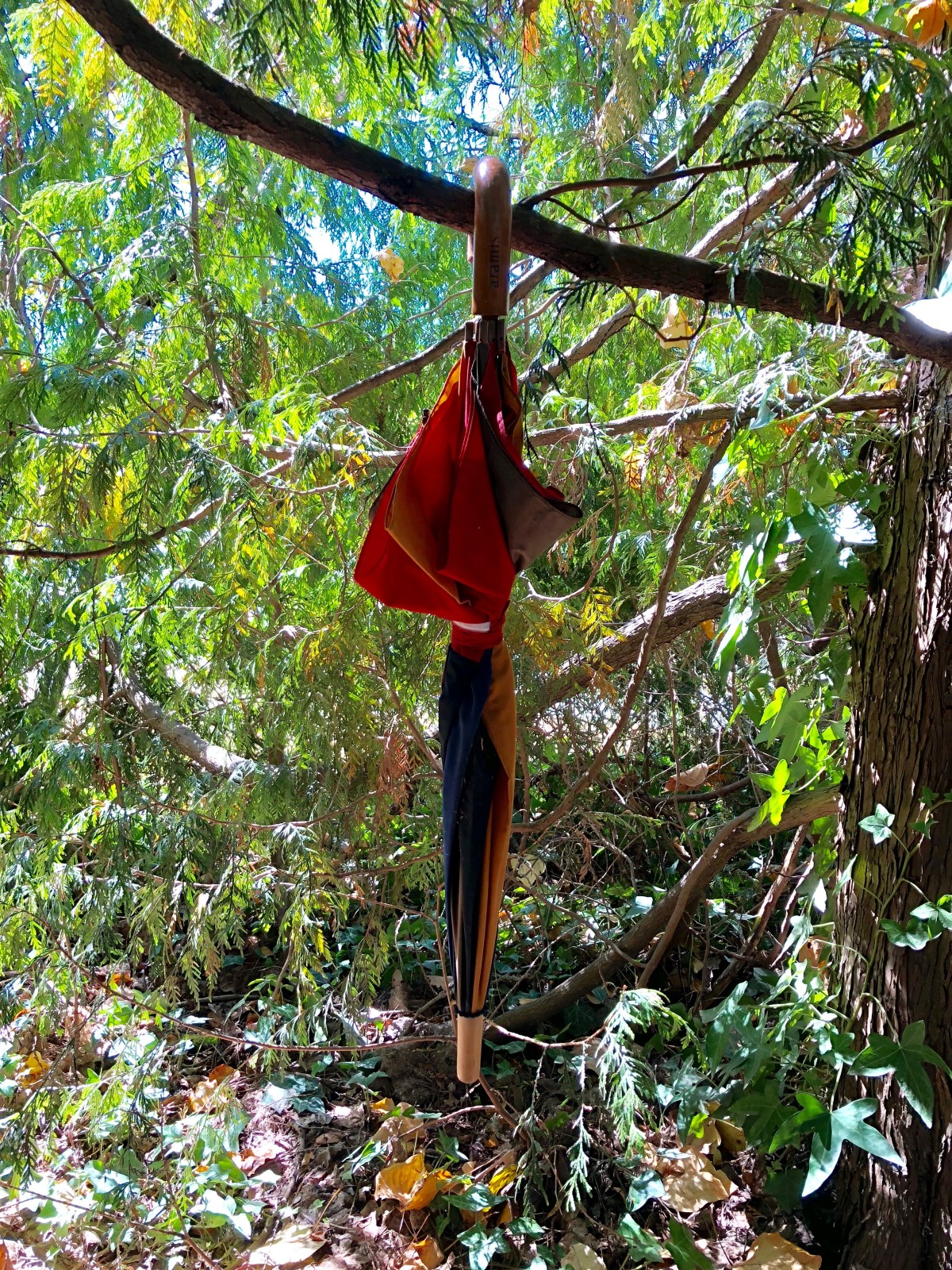
Umbrella in tree, Langara Golf Course.
Berries on Cambie Street.

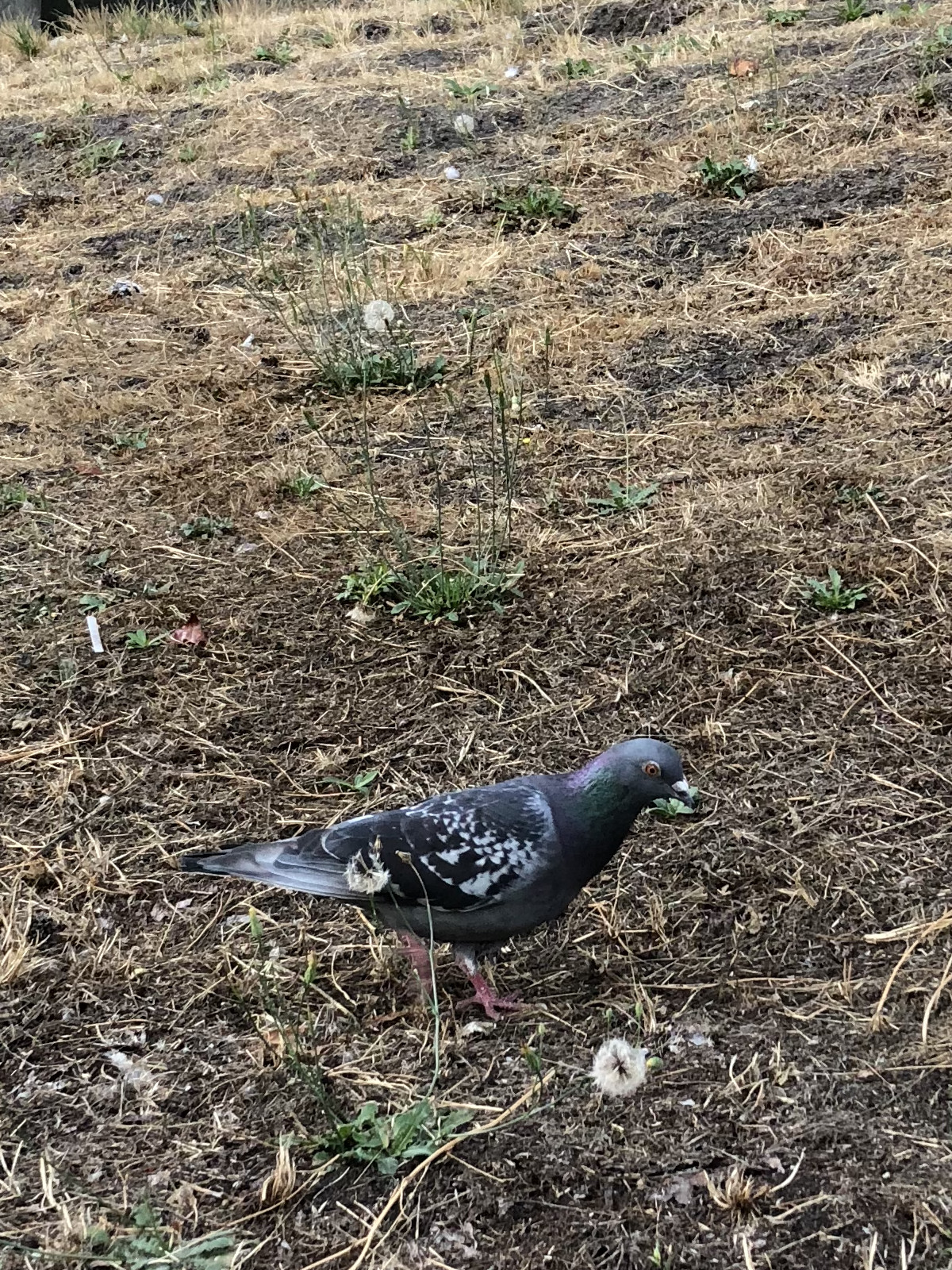
Pigeon patrolling near Lougheed Town Centre Station.
I was on Day 7 of my renewed Complaint Free 21-day challenge when I opened my mouth this morning to a co-worker and…complained about the weather, of all things. And not even the current weather, the weather last week. Old weather.
This is sort of the equivalent of telling yourself over and over not to do something and then doing it, anyway. As soon as the complaint left my lips I knew what I’d done and the bracelet was snapped onto the left wrist.
Tomorrow I begin Day 1 again, a little wiser and hopefully a little more content about the weather. 😛
(It was sunny and pleasant today, adding a pinch of irony to the whole thing.)
Immovable dachshund on Fader Street.

It rained today, the first rain we’ve had this month during daylight hours (we had one other brief shower overnight). It took 25 days to arrive, which is impressive, but in a somewhat depressing way, less impressive than it once was because dry summers are no longer uncommon.
The rain is good because it helps reduce the likelihood of the tinder-dry forests instantly going up in flames, it helps to douse the smoke drifting down from all the current forest fires already raging due to the tinder-dry aforementioned, and it may slightly revive the very very brown grass seen everywhere.
As I am the lucky recipient of a return of the cold I had a few weeks ago, I probably wouldn’t have run, anyway, but even that turned out to be okay–I enjoyed the indulgence of a true day off, where I shrugged off not completing my activity rings, enjoyed some comfort food, and bought a couple of Frisbees. Er, flying discs.
The weather appear much the same tomorrow, but if I’m up to it, I may try a short, soggy run. And like it!
Today it is cloudy, cooler and there’s a chance of showers.
This is actually good, because it’s finally, if temporarily, cleared the infernal smoke haze from the area.
In celebration I present a cat reclining in a pose not unlike mine two nights ago when I canceled my usual Tuesday evening run due to the smoke and 32ºC temperature.

 2k to 10k: Writing Faster, Writing Better, and Writing More of What You Love by Rachel Aaron
My rating: 4 of 5 stars
This is the second book I’ve read recently about how to greatly increase the volume of your writing. I note with some irony that both books have been very slim.
I was surprised that 2K to 10K had so little overlap with 5,000 Words Per Hour, so in a way the two books complement each other nicely.
Rachel Aaron offers some very specific advice that can be distilled down to two words: plan everything. And two more bonus words: track everything. She strongly advocates outlining a novel before diving in as the key to being more productive in your writing and boosting your daily word count. Unlike Chris Fox’s book, Aaron draws repeatedly from her own work to illustrate her tips, and it works to good effect, while also adding a more personal touch to the advice.
Like Fox, she is clearly enamored of her methods and the success they have brought her, and that enthusiasm is just as infectious here as it is in 5,000 Words Per Hour. You want to immediately dive in and follow the approach she advocates.
The second half of the book is a bit more of a traditional how-to, covering (and endorsing) the classic three-act structure, going over techniques on editing–here I find it interesting that she doesn’t let her beta readers look at her story until she is done with it, arguing that it’s not fair to have them offer feedback on what is still a work-in-progress.
There are no exercises here, unlike 5,000 Words, so the expectation is to take the advice and run with it.
Overall, a quick read and well worth it for both new writers or those who find themselves struggling with the process of simply getting words down in a regular, consistent manner.